Gender History MSc/PgDip

Dynamite mixing, Ardrossan, 1897. Photo from the University of Glasgow Library Special Collections.
The Masters in Gender History is a unique programme which provides specialist instruction in the skills and approaches required to conduct a gendered analysis of the past. The leading course of its kind in Britain and with an international outlook in terms of curriculum, teaching staff and students, it draws on the expertise of world-leading scholars from the Centre for Gender History to provide tuition on topics including feminism, patriarchy, sexuality, masculinity, intersectionality and LGBTQ+ history and their application to a wide range of historical and cultural contexts.
- Academic contact: sam.rutherford@glasgow.ac.uk
- Teaching start: September
- Glasgow: Gilmorehill campus
- MSc: 12 months full-time; 24 months part‑time
- PgDip: 9 months full-time; 18 months part‑time
Why this programme
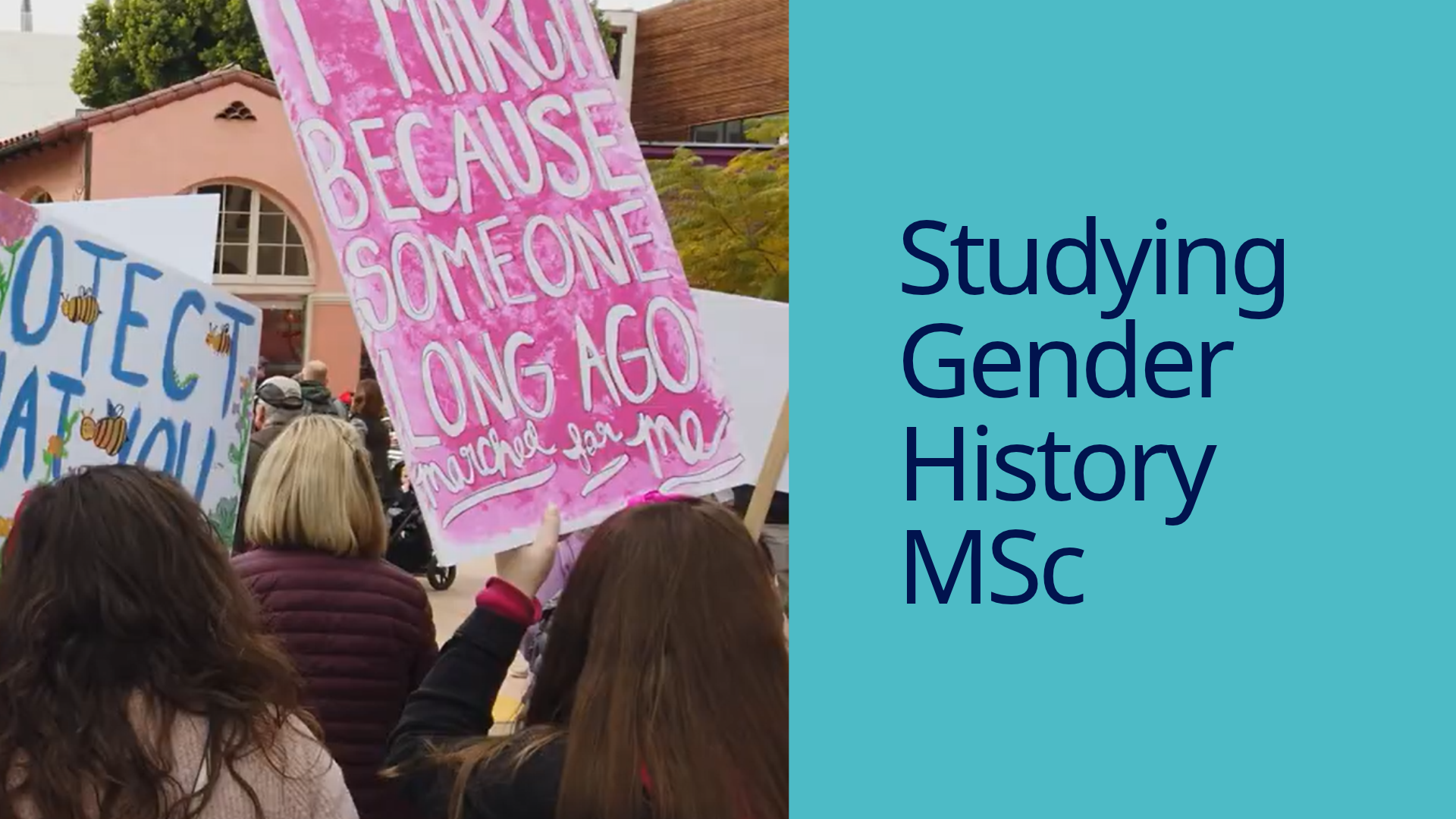 https://www.youtube.com/watch?v=kQX0UwYr1wA
- The Masters in Gender History is the only course of its kind in Britain, offering specialised tuition in the gendered analysis of the past.
- It is run by the Centre for Gender History, which is home to the largest concentration of gender historians in Britain and offers an unparalleled environment for study and research in this field.
- On this programme you will receive expert tuition in the theoretical and methodological approaches to gender history and their application to a wide range of historical and cultural contexts. The course is taught by world-leading scholars in gender history, committed to developing and deepening your own research interests.
- As a student within the Centre for Gender History, you will become a member of a vibrant and unique research centre, with a thriving postgraduate community and a programme of tailored workshops, research seminars, and knowledge exchange events.
- Activities run annually by the Centre include a postgraduate gender history reading group, a high-profile research seminar series, and a public lecture in Global Gender History. The Centre also regularly hosts visiting international scholars.
- The Centre for Gender History fosters close ties with Glasgow’s world-class museums, galleries and libraries, including Glasgow Women’s Library, the only accredited museum in the UK dedicated to women’s lives, histories and achievements.
- Our FutureLearn MOOC, A Global History of Sex and Gender, is an excellent introduction to some of the programme's key themes and methodologies. We recommend you take this 4-week course before starting your postgraduate degree with us.
- Looking to deepen their understanding and level of critical engagement with gender as a category of historical analysis
- Interested in pursuing independent research in gender history
- Who would like to build transferable skills for careers in fields such as heritage, policy, data analysis, writing, creative industries, and more
- Theoretical approaches to the history of gender and sexuality such as global and decolonial histories, LGBTQ+ histories, histories of childhood and youth, histories of science and medicine, histories of free and unfree labour
- How to work with source material, including physical and digital archival sources, material culture, and oral histories
- Formulating research questions and designing independent research projects
- A wide array of optional courses that allow you to focus on specific themes, times, and places
- The ability to apply academic approaches to the study of gender
- Engaging critically with historians' arguments and existing academic scholarship
- Research in physical and digital archives
- Analysing different types of sources and data
- Advanced analytic writing
- Formulating independent research questions
- Project design and management
- Presentation and oral communication skills
Key Facts
This degree is ideal for anyone:
Key topics include:
Skills you will develop
What our students say
You really get a flavour of all of the different specialisms on offer. I've really benefited from that and I've been able to really hone in on my own interests while also experiencing the breadth that's on offer here as well. Having so much more freedom than I remember from undergrad, of being able to just do what interests you. The encouragement to just follow your own interests is something that really jumped out at me.
It's a very, very friendly city. People kind of just chat to you and it's a really friendly atmosphere. Adam, MSc student
Meet more of our students
MSc Gender History student Pratika Dewi takes us through her experience of studying as a University of Glasgow Arts & Humanities student, visiting the Mary Queen of Scots exhibition, and what she has planned for the future.
Panel Discussion and Q&A
Watch a recording of our recent panel discussion and Q&A with students and staff from this degree.
Global Gender History (Online Distance Learning)
We also offer a Masters in Global Gender History by online distance learning.
Programme structure
You will take:
- Three core courses
- Three optional courses
You will also produce a dissertation.
The core courses are designed to give you a thorough grounding in the methodological and theoretical approaches of gender history, as well as introduce you to a wide variety of gendered ‘texts’, including written, audio-visual, and material sources.
You will also be trained in the research skills necessary to conduct your own, independent research project.
Optional courses can be selected from History programmes in the College of Arts & Humanities and the College of Social Sciences. However, there is also an opportunity to work in an interdisciplinary capacity, by taking courses in other subjects, including American Studies, War Studies, Classics and many others, subject to permission.
Teaching is mainly seminar-based, in small classes. Independent and self-reflective critical work is fostered through written assignments and seminar presentations, culminating in the dissertation.
Semester 1: September to December
- Gender, Politics And Power (core course)
- Doing History: Sources and Skills for Historians (core course)
- One optional course
Semester 2: January to March
- Gender, Culture and Text (core course)
- Two optional courses
Optional courses
You can choose courses in History programmes in the College of Arts & Humanities and the College of Social Sciences.
With permission, you can also take courses from other subjects in the College of Arts & Humanities and in other colleges, including American Studies, War Studies, Classics and many others.
Summer: April to September
Programme alteration or discontinuation
The University of Glasgow endeavours
to run all programmes as advertised. In exceptional circumstances, however, the University may withdraw
or alter a programme. More information: Student contract.
Career prospects
The research skills and methods you’ll gain on this programme give you the transferable skills you need for positions in the public and private sectors, including heritage policy and projects, media and teaching. The programme is also an excellent foundation for a PhD.
Fees & funding
Tuition fees for 2027-28
MSc
Home & RUK
- Full-time fee: £11,481
- Part-time fee: £1,276 per 20 credits
International & EU
- Full-time fee: £27,390
PgDip
Home & RUK
- Full-time fee: £7,654
- Part-time fee: £1,276 per 20 credits
International & EU
- Full-time fee: £18,260
Fee status
Deposits
International and EU applicants are required to pay a deposit of £2000 to secure a place on this programme.
Deposits: terms & conditions
The following guidelines will apply in determining whether a deposit will be refunded. Where the deposit is refunded, a 25% administration fee will be deducted unless otherwise stated.
a: Deposits WILL be refunded to applicants under the following circumstances:
- Where the University is unable to offer you a place on the programme as specified on the offer. A full refund will be issued in this case.
- Death of a close family member (parent/guardian, grandparent, sibling, spouse, child/dependent). Official evidence (signed and stamped) must be provided.
- SERIOUS ill health of the applicant or a close family member (parent/guardian, grandparent, sibling, spouse, child/dependent). Official evidence (signed and stamped) must be provided.
- Applicant does not meet conditions of offer. This may be academic or language test requirements. Satisfactory evidence must be uploaded to the student’s applicant self-service to prove that they have not met the conditions of their offer (note that applicants who do not meet the language condition of their offer must show reasonable attempt to meet this, i.e. they must provide at least two language tests which were taken after the date the deposit was paid).
- Visa / ATAS refusal: we will only consider a refund if the visa / ATAS refusal was based on matters outside of the applicant’s control.
- If a refund request is received within 14 days of the deposit being received a full refund will be issued under the Consumer Protection Regulations.
b: Deposits WILL NOT be refunded to applicants under the following circumstances:
- An applicant decides not to attend the University for any reason not outlined above.
- Personal financial constraints / unsuccessful scholarship application.
- Applicant has decided to defer – in this situation the University will retain the deposit and hold it against the applicant’s account to secure their place for the following year of entry. You may defer twice. After the second deferral standard conditions will apply.
- There is still time to meet the English language test requirement before the final upload date. Please see section a) 4.
- Visa / ATAS was applied for too late. Please see section a) 5.
- Any documents used for admission are proven to be fraudulent. We work in partnership with Qualification Check to check academic qualifications. English language qualifications are verified with the provider.
- The refund request is received more than 30 days after the official course start date as outlined in your offer email.
Timeframe for requesting a refund
Refund requests must be received no later than 30 days after the official course start date as outlined in your offer email. As per section b)7 above the request will be denied.
Receiving a refund
- To comply with Money Laundering Regulations, the University will pay all refunds to the original payer using the source payment details. This is known as a “return to source” payment.
- All appropriate documentation and evidence relating to the original payment must be provided, when requested.
- All payments and refunds are in GBP currency - the University is not responsible for any exchange rate fluctuations or beneficiary bank charges associated with the refund.
- Where University approved payment methods have not been used, this may cause significant delays or prevent payment altogether.
- We will aim to issue the deposit refund within 8 weeks of receipt of information per point 2 above. At peak times this may be longer.
How to request a deposit refund
Please go to our enquiry form and select 'Fees and Deposit' as the enquiry reason and then 'Can I have a deposit refund?'.
Please upload all supporting documentation to your applicant self-service portal before submitting the above request.
Additional fees
- Fee for re-assessment of a dissertation (PGT programme): £370
- Submission of thesis after deadline lapsed: £350
- Registration/exam only fee: £170
Funding opportunities
The scholarships shown are relevant to this programme. For more funding opportunities search the scholarships database
Entry requirements
2.1 Hons (or non-UK equivalent) in any subject.
A 2.2 Honours degree may be considered.
Substantial, directly relevant experience may be considered in place of formal qualifications. If you are applying based on relevant experience, please include a personal statement evidencing this with your application.
International students with academic qualifications below those required should contact our partner institution, Glasgow International College, who offer a range of pre-Masters courses.
English language requirements
For further information about English language requirements, please contact the Recruitment and International Office using our enquiry form
For applicants from non-majority English speaking countries, as defined by the UK Government, the University sets a minimum English Language proficiency level.
Accepted English Language Tests
We accept a wide range of English language tests for entry to this programme. Tests must have been taken within 2 years 5 months of programme start date, and requirements must be met using a single test.
IELTS Academic/IELTS Academic for UKVI/ IELTS Academic online
- 6.5 overall with no subtest less than 6.0
- IELTS One Skill Retake Accepted
- We do not accept General Training
TOEFL iBT (including MyBest and Home Edition)
Test taken up to 20 January 2026
- 90 overall with no subtest less than Reading 20; Listening 19; Speaking 19; Writing 21
Tests taken from 21 January 2026
- 92 overall with no subtest less than 4.5
PTE Academic (test centre only)
- 65 overall with no subtest less than Reading 60; Listening 60; Speaking 65; Writing 60
- We do not accept the online PTE Academic
Cambridge C1 Advanced and C2 Proficiency
- 176 overall with no subtest less than 169
Oxford ELLT
- 7 overall with no subtest less than 6
LanguageCert Academic/Academic SELT/ Academic Online
- 70 overall with no subtest less than 65
Password Skills Plus
- 6.5 overall with no subtest less than 6.0
Trinity College Integrated Skills in English II
- 96 overall with no subtest less than 90
Kaplan Test of English
- Any two subtests at 480 or higher, and any two subtests at 450 or higher
PSI Skills for English
- B2 Pass with Merit
Duolingo English Test
- 120 overall with writing at 120 and no subtest less than 110
Oxford Test of English Advanced
- 140 Overall with any two subtests at 126 or higher, and any two subtests at 136 or higher
Alternatives to English Language test
Degree from majority-English speaking country (as defined by the UKVI including Canada if taught in English)
- students must have studied for a minimum of their final year at Undergraduate level, or 9 months at Master's level, and must have completed their degree in that majority-English speaking country within 6 years of programme start.
TNE degree from UK university taught at a campus outside of the UK
- students must be awarded the degree by the UK university and must have completed the degree within 6 years of programme start.
Pre-sessional courses
The University of Glasgow accepts evidence of the required language level from the English for Academic Study Unit Pre-sessional courses. We would strongly encourage you to consider the pre-sessional courses at the University of Glasgow's English for Academic Study (EAS) Unit. Our Pre-sessional courses are the best way to bring your English up to entry level for University study and remain valid for 2 years following date of successful completion.
Our courses give you:
- direct entry to your University programme for successful students (no need to take IELTS);
- essential academic skills to help you study effectively at University;
- flexible entry dates so you can join the right course for your level.
For more detail on our pre-sessional courses please see: https://www.gla.ac.uk/schools/mlc/eas/pre-sessionalcourses/
We can also consider the pre-sessional courses accredited by the below BALEAP approved institutions to meet the language requirements for admission to our postgraduate taught degrees:
- Heriot Watt
- Kingston Upon Thames
- Middlesex University
- Manchester University
- Reading University
- Edinburgh University
- St Andrews University
- UCL
- Durham
International students
We are proud of our diverse University community that includes students and staff from more than 140 different countries.
How to apply
To apply for a postgraduate taught degree you must apply online. We cannot accept applications any other way.
Please check you meet the Entry requirements for this programme before you begin your application.
Documents
As part of your online application, you also need to submit the following supporting documents:
- A copy (or copies) of your official degree certificate(s) (if you have already completed your degree)
- A copy (or copies) of your official academic transcript(s), showing full details of subjects studied and grades/marks obtained
- Official English translations of the certificate(s) and transcript(s)
- Evidence of your English language ability (if your first language is not English)
- Any additional documents required for this programme (see Entry requirements for this programme)
- A copy of the photo page of your passport
We may also request additional documents such as a personal statement, portfolio, references or a sample of academic writing to support your application.
If we request a reference, this should typically be an academic reference. However, where this is not possible, a reference from a current employer may be accepted. If you already have a copy of your reference on letterheaded paper, you can upload this with your application. Otherwise, you may provide your referee’s name and contact details on the online application, and we will contact them directly.
You have 42 days to submit your application once you begin the process.
You may save and return to your application as many times as you wish to update information, complete sections or upload supporting documents such as your final transcript or your language test.
For more information about submitting documents or other topics related to applying to a postgraduate taught programme, see how to apply for a postgraduate taught degree
Guidance notes for using the online application
These notes are intended to help you complete the online application form accurately; they are also available within the help section of the online application form.
If you experience any difficulties accessing the online application, see Application System Help.
- Name and Date of birth: must appear exactly as they do on your passport. Please take time to check the spelling and lay-out.
- Contact Details: Correspondence address. All contact relevant to your application will be sent to this address including the offer letter(s). If your address changes, please contact us as soon as possible.
- Choice of course: Please select carefully the course you want to study. As your application will be sent to the admissions committee for each course you select it is important to consider at this stage why you are interested in the course and that it is reflected in your application.
- Proposed date of entry: Please state your preferred start date including the month and the year. Taught masters degrees tend to begin in September. Research degrees may start in any month.
- Education and Qualifications: Please complete this section as fully as possible indicating any relevant Higher Education qualifications starting with the most recent. Complete the name of the Institution (s) as it appears on the degree certificate or transcript.
- English Language Proficiency: Please state the date of any English language test taken (or to be taken) and the award date (or expected award date if known).
- Employment and Experience: Please complete this section as fully as possible with all employments relevant to your course. Additional details may be attached in your personal statement/proposal where appropriate.
Application deadlines
For entry in September 2027
International & EU applicants
+++
International application rounds
Applications are considered on a rolling basis within each round, and the decision date shown for each round is the latest date by which you will receive an outcome on your application.
Round 1: 1 October 2026 to 5 November 2026
You will receive our decision on your application by 18 December 2026.
Round 2: 6 November 2026 to 17 December 2026
You will receive our decision on your application by 3 March 2027.
Round 3: 18 December 2026 to 4 February 2027
You will receive our decision on your application by 8 April 2027.
Round 4: 5 February 2027 to 25 March 2027
You will receive our decision on your application by 6 May 2027.
Round 5: 26 March 2027 to 13 May 2027
You will receive our decision on your application by 10 June 2027.
Round 6: 14 May 2027 to 8 July 2027
You will receive our decision on your application by 29 July 2027.
As we receive a high volume of applications, prospective students are only allowed to apply to each programme once per year.
---
UK applicants
- 24 August 2027

Postgraduate events