

Real-Time CFD in the simulation of Aerial Firefighting
Project Overview
Wildfires present a growing challenge for emergency response agencies, with aerial firefighting playing an important role in the suppression operations. This project aims to develop a simulation framework capable of modelling the interaction between a firefighting aircraft, the surrounding atmosphere, and an active wildfire.
The simulation environment combines the aircraft flight dynamics, atmospheric modelling, empirical wildfire simulation, and water physics within a single system. The objective is to investigate aircraft performance, pilot workload, and firefighting effectiveness under various operational conditions.
Research Objectives
- Develop a high fidelity coupled aircraft-fire-water-atmosphere simulation environment.
- Investigate the effects of the fire-induced disturbances on the aircraft/system performance during firefighting operations
- Evaluate the effectiveness of various aircraft platforms and water delivery systems under different operating conditions.
Methodology
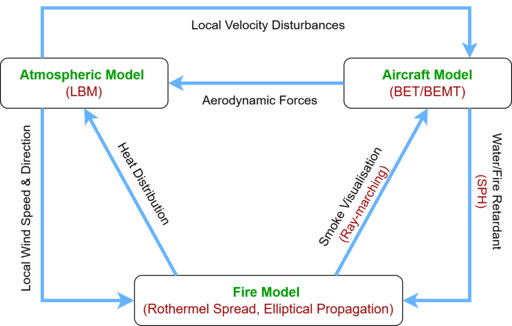
The simulation framework combines high fidelity models of the aircraft demonstrators [S-70i, Bell 412, and the CL-215/415 water bomber], empirical fire spread model with an elliptical propagation algorithm, a smoothed particle hydrodynamics based model of the water/ fire-retardant, and a Lattice Boltzmann Method (LBM) solver for the atmospheric model. The simulation structure, with the interactions between the components, is shown below
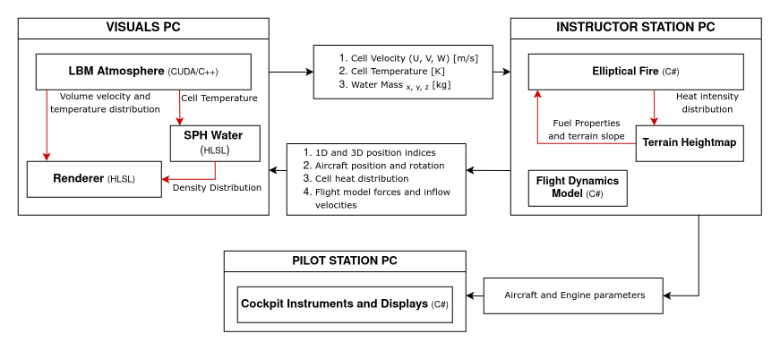
This project employs a distributed computing system to avoid pooling high workloads on a single device. An overview of the system, showing the compute nodes, the included simulation components in each node and the communication data path between them, is shown below
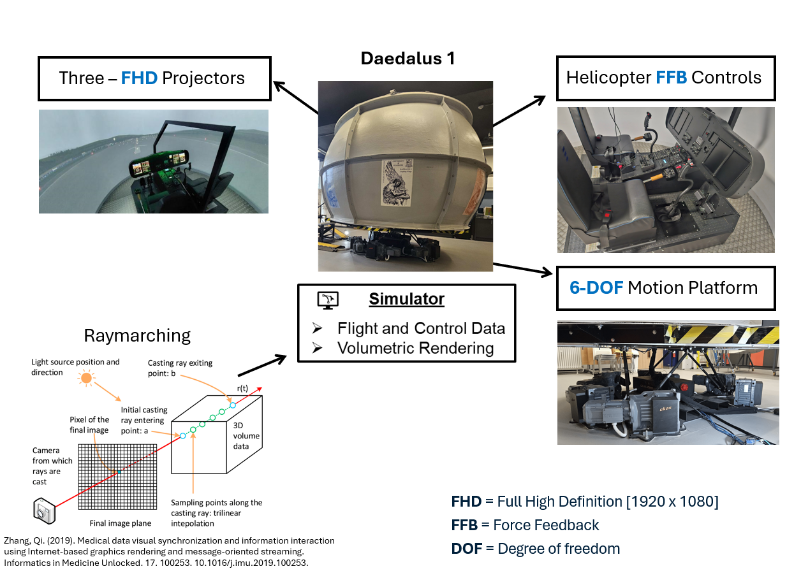
Physical testing and evaluation of the simulation system will be done with the Daedalus 1 flight simulator. An overview of the major simulator components is shown below
Current Results and Development
Development has focused on implementing and integrating the major simulation components. Current capabilities include helicopter flight dynamics, wildfire simulation, atmospheric modelling, and water-drop representation within a common simulation environment. Demonstrations of the coupled simulation in action are shown below.
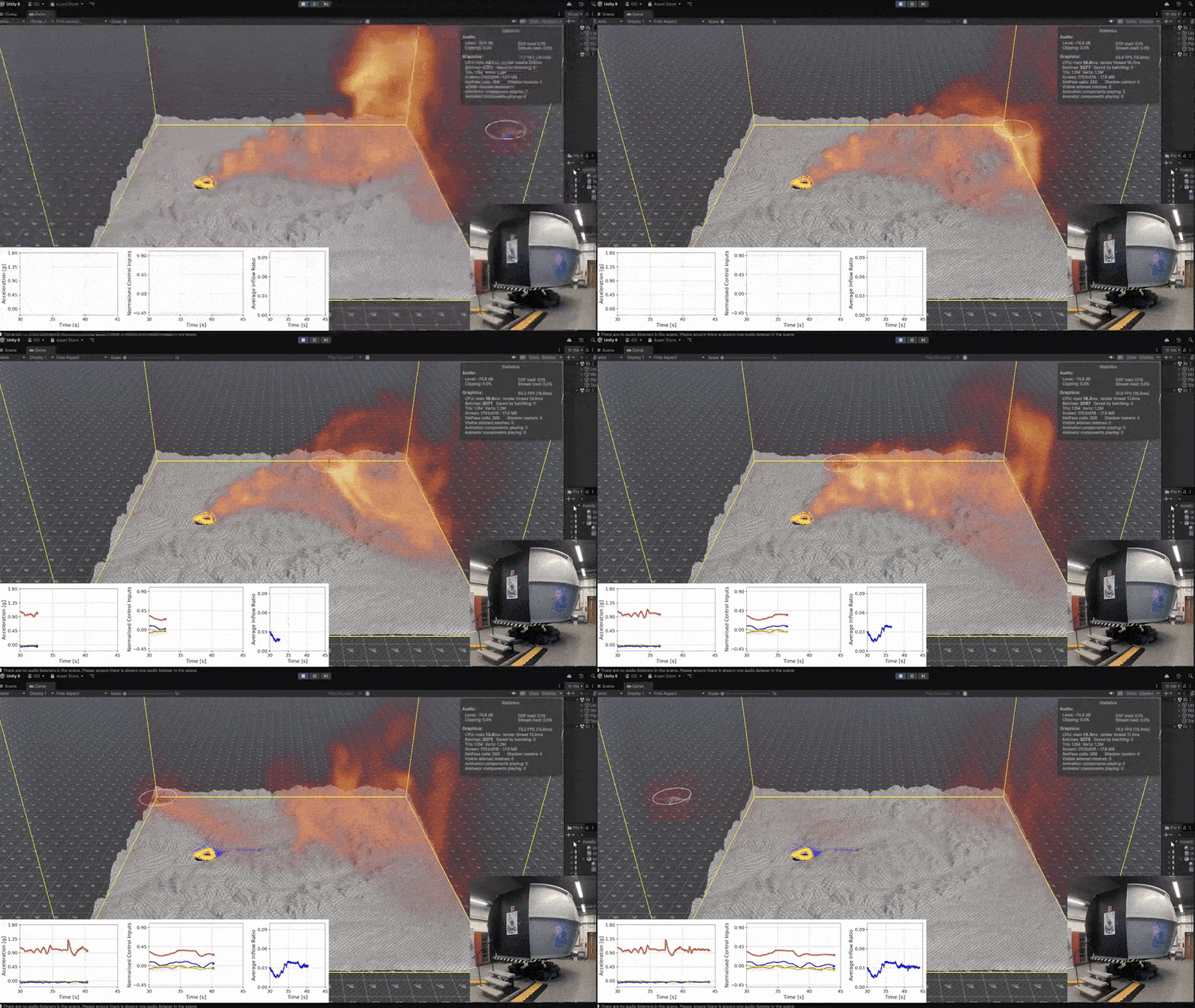
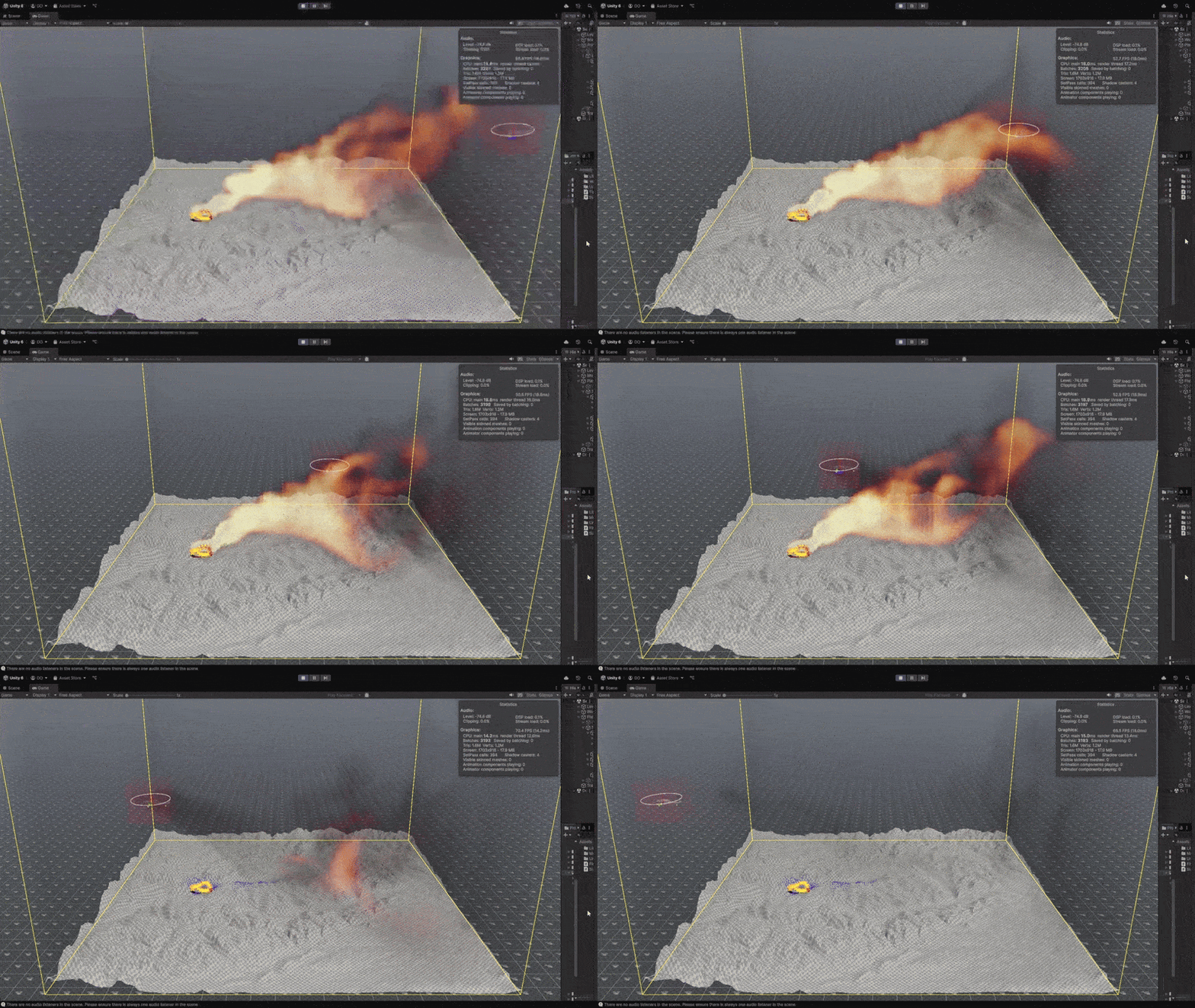
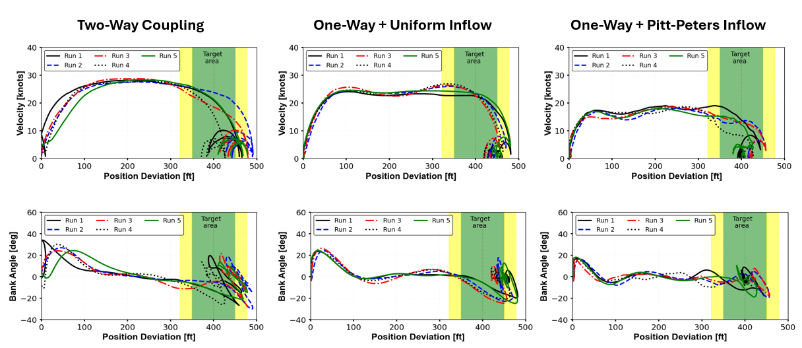
Initial analysis results have shown that the inclusion of the rotor aerodynamics within the coupled atmosphere-aircraft system leads to a reduction in the overall impact of the fire on the aircraft performance. This is because the velocity sampled at the rotor disk is now a resultant of the velocity due to the fire plume and the helicopter main rotor wake which leads to a lower amplitude in the velocity variations.
This is shown in the results from the lateral repositioning test shown below wherein the two-way coupled configuration produced the most consistent flight trajectory across the test cases.
Performance
Current work is focused on expanding the range of operational scenarios, improving model fidelity, and conducting pilot-in-the-loop evaluations.
Publications
• Dada, O., and Barakos, G., “Real-Time CFD in the simulation of Aerial Firefighting,” Aerospace Science and Technology, Vol. 168, 2026, pp. 110980. DOI: https://doi.org/10.1016/j.ast.2025.110980.
• Dada, O., Barakos, G., Zhang, T., and Luo, Y. “A framework for Aerial Firefighting Simulation,” CEAS Aeronautical Journal, 51st ERF 2025 - Advances in Research, Development, Simulation, Design, Manufacturing, Testing and Operation of Rotorcraft (Accepted)
• Dada, O., Barakos, G., and Zhang, T., "Coupled Rotorcraft–Atmosphere Simulation for Firefighting Applications" 82nd Vertical Flight Society Forum, West Palm Beach, FL, USA, 05-07 May 2026. (Accepted
• Dada, O., and Barakos, G., "Real-Time CFD in the simulation of Aerial Firefighting" 51st European Rotorcraft Forum, Venice, Italy, 09-12 September 2025. (Published)
Publicity and Outreach
https://www.linkedin.com/pulse/simulation-breakthrough-could-spark-aerial-htd7e
https://techxplore.com/news/2026-05-simulation-breakthrough-aerial-firefighter-revolution.html

Contacts
George Barakos - Professor, George.Barakos@glasgow.ac.uk
Oyedoyin Samuel Dada - PGR, 2832340D@student.gla.ac.uk