


Parallel visions: BBC Television at 90 and the early years of GUST
In the year that marks a century since alumnus John Logie Baird first demonstrated television, we look at the remarkable parallels between the early years of student TV at the University and those of the BBC.
By Dr Donald F McLean, FIET, FRHistS
For many years, Glasgow University Student Television (GUST) has proudly claimed its founding in 1964. Recent research at the University's Archives has provided a richer story, revealing the University’s pioneering history of educational television following Harold Wilson’s October 1963 call for a ‘University of the Air’.
1964 marked the creation of the University Television Service. Student television took several more years to emerge. GUST eventually became a pioneering, student-run service that gave generations of Glasgow students the chance to craft television programmes using professional equipment.
Striking parallels to the early years of GUST can be found in the story of the BBC, which had launched the world's first regular public television service from Alexandra Palace in London in 1936.
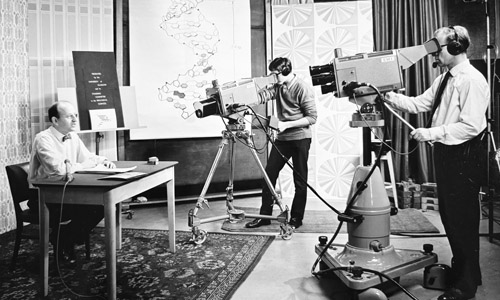
The University Television Service, before the formation of GUST, making an educational programme for biology students. Image: Archives & Special Collections
Following in the BBC's footsteps
The design of the BBC’s studio in 1936 shaped the way television programmes were made for almost 50 years. Working in a purely analogue medium, students at Glasgow in the early 1970s found themselves using techniques that would have been familiar to BBC programme-makers nearly 40 years earlier.
In the University's television studio in Southpark House, students operated monochrome cameras, edited 16mm movie film by hand and produced programmes as a series of programme segments performed and recorded live in a ‘Gallery’ overlooking the studio floor. In many ways, the process closely resembled television production at the BBC in 1936. Students even adopted BBC jargon, referring to headphones as ‘cans’ and pre-recorded audio as ‘grams’.
GUST did, however, have one important advantage over pre-war BBC: access to videotape recorders. These allowed the live segments to be assembled, one by one, into the weekly programme. The recorders, however, lacked the ability for any post-production changes, rendering an end result similar to a live broadcast.
Establishing the University Television Service
The studio facilities existed because Glasgow’s universities had been at the forefront of recognising television's potential as a major tool for education. In early 1964, the Senate and Court approved the creation of a television service to support teaching across every faculty. Just two years later, the University became the first in the country to own a mobile television studio. By 1968, electronics giant EMI had installed a professional television studio in the basement of Southpark House. At the same time, a new cable network extended television coverage across the campus to link up teaching hospitals and schools across Glasgow.
This pioneering work of the city’s universities attracted national attention. Brian Jackson, one of the founders of the Open University, described Glasgow in 1966 as "the most advanced in Western Europe in the field of university and school television".
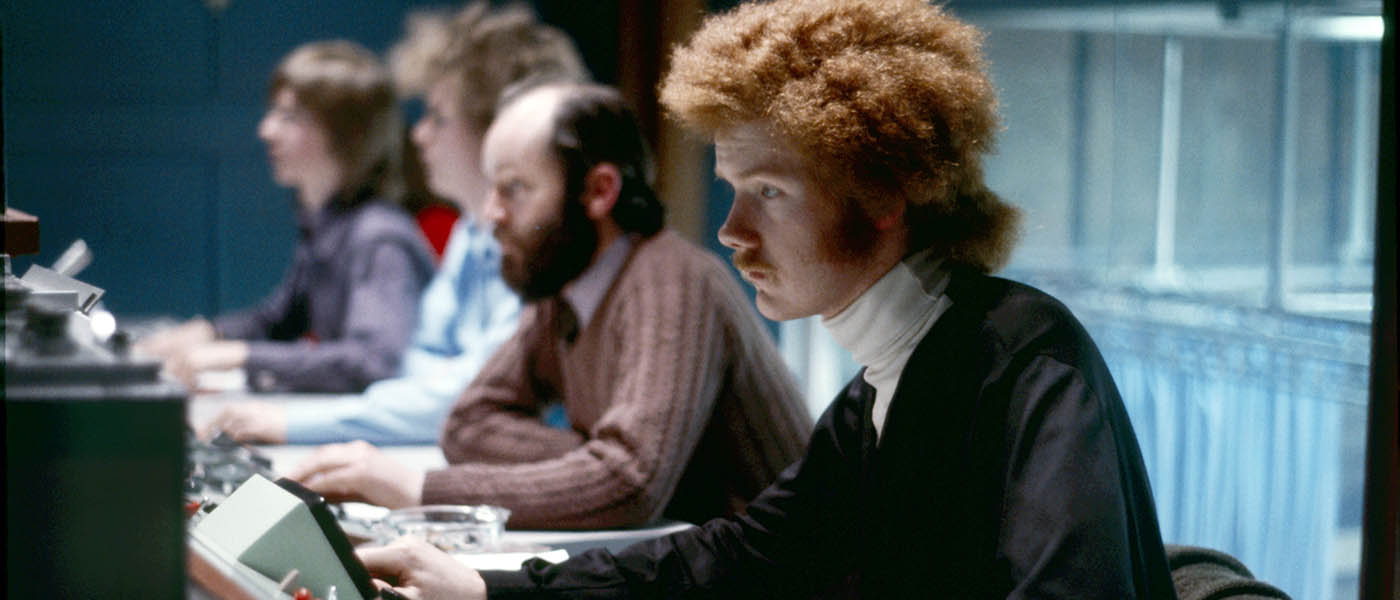
The author, Donald McLean, working at GUST with Television Service Engineer George Nicholson. Image: Parlan McFarlan
However, none of these developments included an entertainment service for students. Whilst reporting on student television elsewhere in 1967, the 'Glasgow University Guardian' lamented the total lack of such a service at the University. As if in answer, the Director of the University Television Service, Roderick MacLean, openly invited students interested in exploring the medium with a view to producing their own programmes. Recognising television as a powerful new way to connect with students, the Students' Representative Council (SRC) began discussions to establish a regular service.
The University's television service was described in 1966 as "the most advanced in Western Europe in the field of university and school television".
A faltering start
Launched on 31 January 1969, the first attempt at a service struggled to gain momentum. The programmes were poorly advertised, attracted only a small audience and relied heavily on professional television staff to operate the studio. Contemporary reports suggest that there were only a handful of students sourcing and presenting content and that those students struggled to maintain a regular schedule of programmes.
A turning point came later that year when three SRC officers – one of them future broadcaster Andrew Neil – interviewed the University's new Rector, Lord MacLeod, for student television. Although few people watched it, the interview demonstrated television's potential as a medium for student journalism.
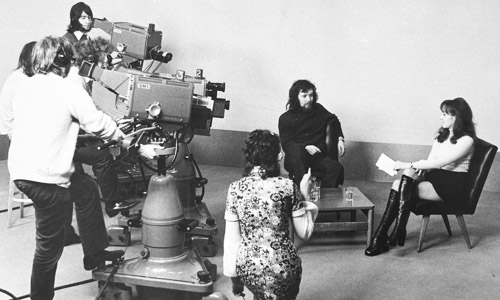
The Second Editor of GUST, Chic Boyd, shown as interviewing the Third Editor, Irene Mallis, around 1972. Image: Archives & Special Collections
Over the next two years, the SRC increased its commitment to student television, amending its constitution to reshape the service to be a student-led media counterpart to the 'Glasgow University Guardian'. In December 1971, the name 'GUST' appeared in print for the first time, along with an appeal for students to become camera operators, vision mixers and production crew.
By giving students access to every aspect of television production within a professional, BBC-style environment, the SRC and the University Television Service had created an incubator for collaborative artistic creativity, technical discovery and leadership development.
The following month, the first fully student-run GUST programme was shown at lunchtime on Friday 28 January 1972, named unimaginatively ‘Lunchtime Friday’. In the first few years, each programme opened to the sound of Jimi Hendrix playing the opening guitar solo of his 1968 hit single, ‘Voodoo Chile’.
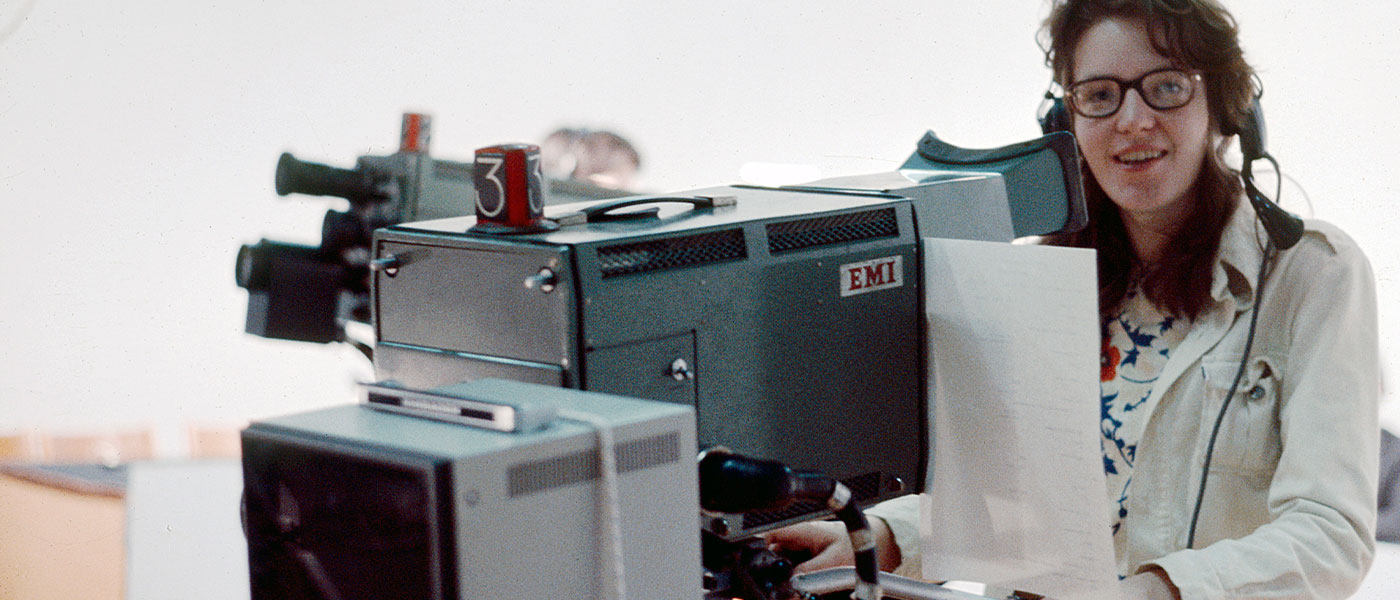
Camera operator Alison Stevenson in the 1970s. Image: Parlan McFarlan
What made GUST special
The late 1960s had seen the gradual growth of student television services across the UK. Some began with equipment acquired by students themselves, whilst others made use of their university’s facilities. Their origins varied widely, making claims of being ‘first’ less important than how long the services lasted.
"Since the late 1960s, GUST has won awards, launched careers, and given students the chance to experience the excitement of making television.
Some of the earliest services – Strathclyde in 1965 and York in 1967 – made innovative use of their university’s audio-visual equipment. By contrast, the University Television Service in the late 1960s provided student television with professional-grade facilities that were comparable to those in BBC regional news studios.
Similarities between early GUST and pre-war BBC
When GUST interviewed celebrities or covered events away from the studio in the early 1970s, it relied on manually edited professional audiotape and 35mm photographs. Before those pictures could be used on television, the film had to be developed and enlarged, with the resultant prints mounted on black display cards. Titles and captions were prepared using dry-transfer white lettering mounted on similar cards.
On the evening set aside to record the week’s programme, the edited soundtrack was played back while studio cameras sequenced through the captions and photographs, with all actions coordinated by those in the Gallery.
Not all programmes took place in the studio. Like the BBC’s earliest pre-war ‘Outside Broadcasts’, Southpark’s studio cameras could be operated outside the front of the building using special extension cables.
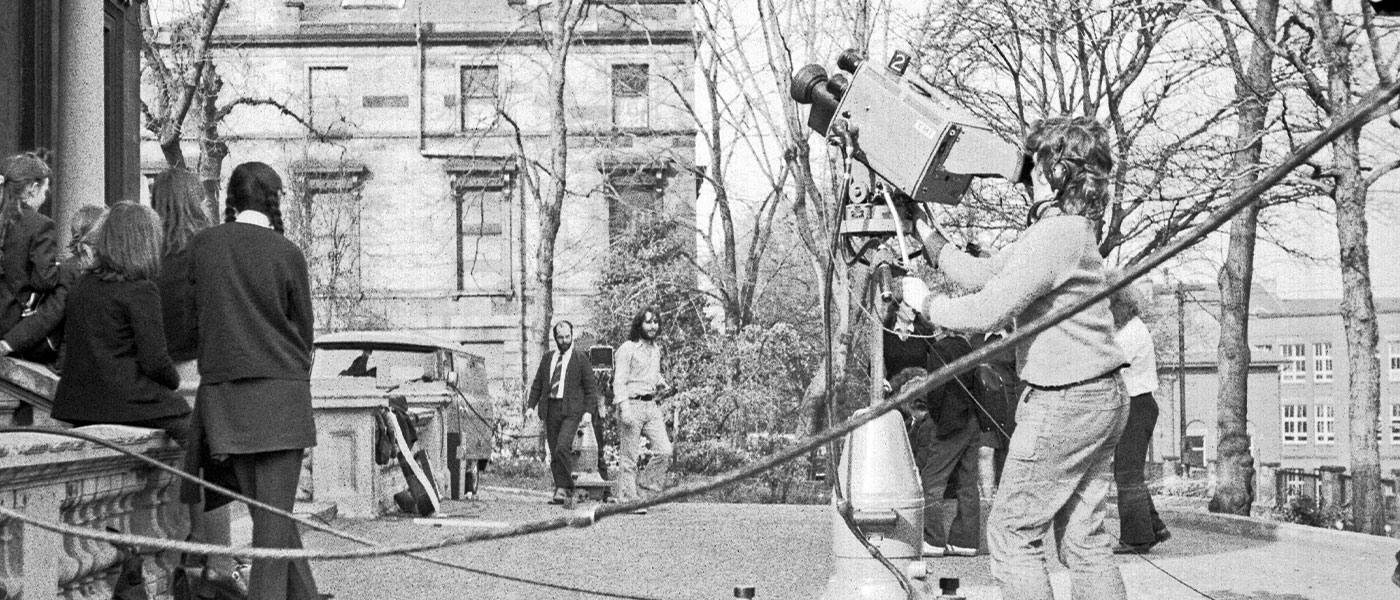 A GUST outside broadcast in 1974, filming a student folk band miming to an audiotape. Image: copyright DF McLean
Although the University used its mobile television unit extensively to record medical procedures in teaching hospitals, it also made the unit available to GUST for concerts and special events.
The high cost of filming and editing 16mm film restricted GUST’s use of movie camera and lighting equipment to special occasions, such as an interview with the Corries, who became known for Scotland’s unofficial national anthem, ‘Flower of Scotland’.
By arrangement with the staff, additional studio time at Southpark House was on occasion set aside to record local bands. Their performances provided a source of material for future programmes.
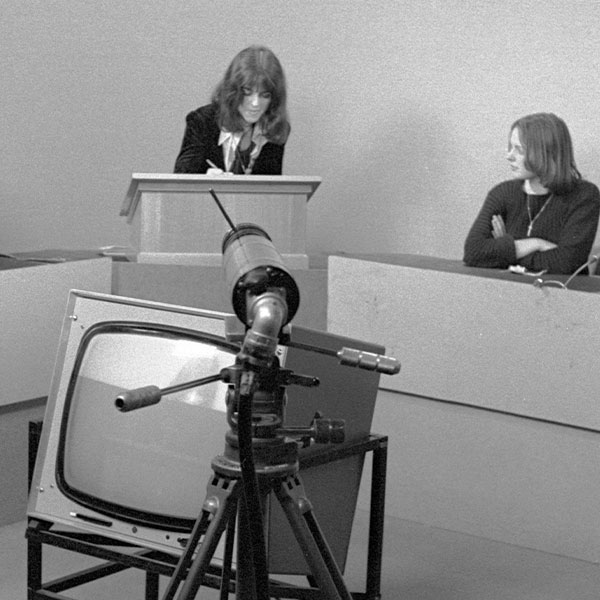
The programmes that came closest to being fully live productions in the studio were the ever-popular quiz shows. Modelled on the format of 1960s ‘University Challenge’, these productions placed considerable demands on both the GUST team and the studio staff.
Throughout the academic year, students in 1970s GUST worked together as an integrated team: photographers, caption makers, sound recordists, camera operators, floor managers, producers, vision-mixers, all played their part crafting the weekly magazine programme. Everyone in GUST was free to take on any available role – whether changing captions or directing their own programme. Unlike the BBC, GUST in the 1970s had no rigid hierarchy, supported by the generous supervision and guidance of the University Television Service staff.
By students, for students
More than 50 years later, technology has transformed almost every aspect of television production. Today's GUST members can shoot, edit content using laptops and smartphones, and publish to a global audience instantly, via the internet – activities their predecessors could hardly have imagined.
What has not changed is the enthusiasm of successive generations of students. Continually renewing itself as members graduate and new recruits arrive, GUST has become one of the University's longest-running student organisations. Like a ‘Ship of Theseus’ in human form, it has endured through massive change while still retaining its identity.
Its origins may lie later than once believed, but that does not diminish its enduring legacy as one of the nation’s leading student television organisations or its place in the University’s rich history of student achievements.
A timeline of TV at UofG
• 1964: Approval is given to establish a University Television Service, with the aim of supporting the delivery of education services to students.
• 1968: The University commissions its television studio in Southpark House and establishes a campus-wide cable network for student viewing around the University.
• 1969: A version of student television commences, but falters over the following year due to a lack of support.
• 1971: Student television is first referred to as GUST during preparation for the launch in January '72, with Dave Stewart as its first SRC Editor.
• 1974: GUST Editor is elected President of the National Student Television Association (NaSTA) for 1974–75.
• 1996–2001: GUST wins Best Broadcaster at the NaSTA Awards six years in a row and dominates the field.
• 2020–2021: GUST weathers the storm of COVID to keep providing continuous term-time operation, unbroken since 1972.
• 2005: The station purchases the www.gust.tv domain and begins posting more and more videos online.
• 2011: GUST updates its technology and buys its first high-definition digital camera.
• 2026: GUST wins Silver Broadcaster of the Year at the NaSTA Awards.
Image: GUST quiz in the 1970s, based on the 'University Challenge' format. Copyright DF McLean
GUST today
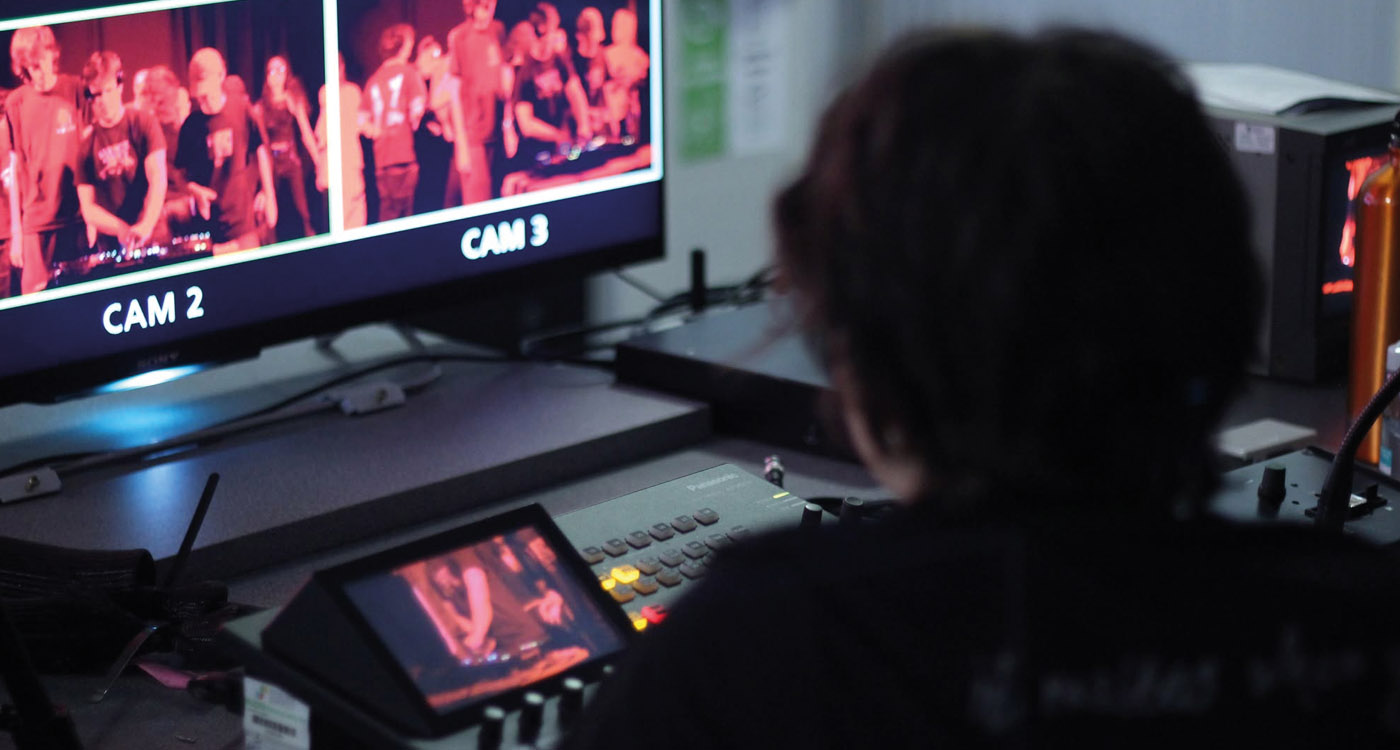
Today’s GUST is made up of around 20 members from a diverse range of academic fields that represent all four colleges, helping the society produce programming that covers a wide range of academic fields and other subjects. Florence Griffiths (Fourth year, Film & Television Studies, below) is GUST Controller for 2026–27: “I found GUST in my first year at UofG and it has given me skills which I will carry into my life and future career,” she says. “As Controller, I get to watch the ‘Gusties’ as their hard work moulds GUST for future generations and leaves an important legacy within the development of student television.
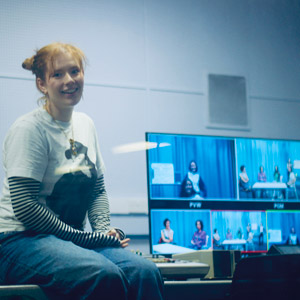 "The best part is collaborating on a piece of work that creates long-lasting bonds surviving beyond the University experience. Creatively working together to learn new skills and developing work that we are proud of creates a deeper connection between peers.”
This feature was first published in October 2026.