

Section Members
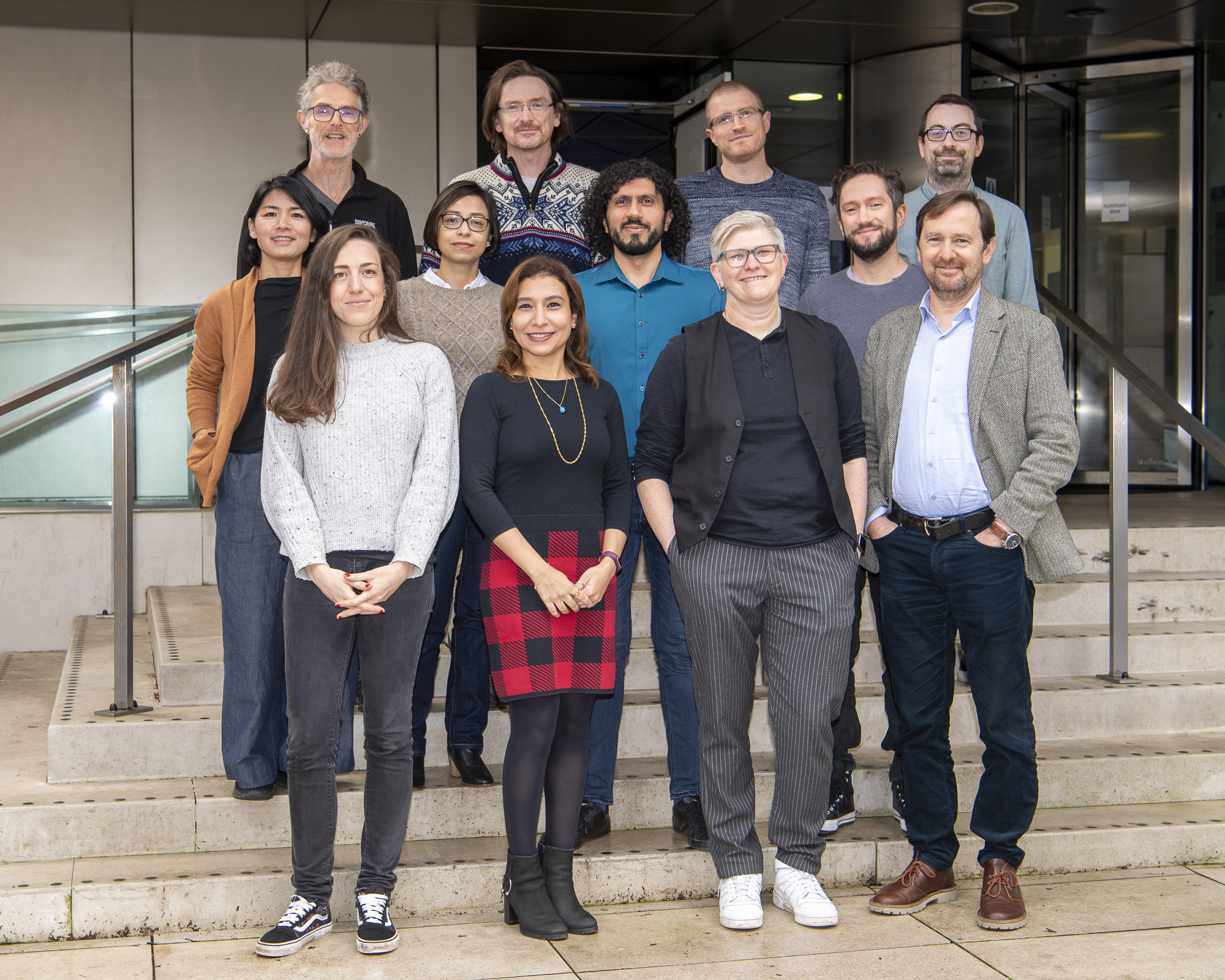
Academic Staff
- Simone Stumpf - (Section Leader)
- Stephen A Brewster
- Matthew J Chalmers
- Fahim Kawsar
- Alessandro Vinciarelli
- Mohamed Khamis
- Xianghua (Sharon) Ding
- Mary Ellen Foster
- Tanaya Guha
- Mark McGill
- Julie Williamson
- Mathieu Chollet
- Euan Freeman
- Ilyena Hirskyj-Douglas
- Stephen Lindsay
- Marwa Mahmoud Anis
- Florian Weidner
Affiliate Staff
Research Staff
- Andres Ramirez-Duque
- Desponia Sampatakou
- Evangelia Fringi
- Evdoxia Taka
- Graham Wilson
- Joseph O'Hagan
- Patrizia Di Campli San Vito
- Ross Johnstone
- Shaun Macdonald
- Thomas Goodge
Postgraduate Research Students
- Abraham Melvin
Everyday Privacy: Exploring Data Access and Control Methods to Support Informed Privacy Decisions for Everyday Augmented Reality - Al Baiaty Suarez David
Grasping Reality: Towards Embodied Haptic Interactions that Enhance Sense of Agency in Mixed Reality - AL Balushi Maha Shamis Hamed
Automatic detection of cry and laughter in children for mental health applications - Al Dossary Alia Ahmed A
Automatic analysis of verbal and nonverbal communication during lectures and public speaking - Alareef Nesreen Farraj S
Social Perception of Speech in Virtual Environments - Alfaar Munirah Abdulmohsen M
Designing and Evaluating Human-Centred Explanations in AI: A Multimodal Study of Explainability for Child Attachment Classification in the SAM-XAI Framework - Alharbi Bashayer Jurayyad F
A hybrid approach to Detect Nonverbal Cues In multi-Part Conversations - Alipour Delnia
How do I feel? Explaining health data analysis through an artificial agent - Almalki Ohud
Improving the usability of authentication in immersive virtual reality - Altalhi Sahar
An Analysis of Oral Presentations in View of an Analysis of Public Speaking - Alutaibi Sara
VR Safety: Investigating and Reducing Physical and Psychological Risks in Real-World Environments - Ashkenazi Shaul
Deploying Social Robots for Multilingual Accessibility: Supporting Newcomers and Staff in Public Service Spaces - Aziz Maryam
Designing a stress management chatbot to improve effective user engagement in young adults - Babalola Omodolapo Victor
Robust Privacy-Preserving Federated Learning for securing IoT - Bei Le
AI-Assisted Learning for Computer Science Teachers: A Comparative Study of China and Scotland - Bhattacharyya Jake
Sonic and Acoustic Links Between Real and Virtual Worlds in Audio Augmented Reality - Bian Tongfei
Vision-based social understanding and prediction - Blair Andrew
Embracing Industry 5.0: Participatory Design and Integration of Social Public-Space Robots - Cherp Ninelle
Enhancing Mobile Interactions: Integrating Gaze-Based Inputs with Multimodal Techniques - Childs Katharine
Promoting Interest and Broadening Participation in Computing among Middle School Pupils through Physical Computing Projects using Grounded Cognition Theory - Dimitri Serena
Understanding Human-Avatar Interaction and design: Insights from Neuroscience and human perception. - Djurhuus Jógvan Heindrikur
Evaluating Explainability: Developing Standards for Human-Centred Assessment of AI Explanations in Facial Expression Recognition and Mental Health Prediction - Drago Diego
Design and Development of Multi-Sensory Interactions in the Metaverse - Duta Monica
Thoughtful gestures: Designing a formal framework to code and decode hand-over-face gestures - Elfleet Morad
Designing AI Companions for Everyday XR Interactions - Feng Zejian
Multimodal GNN-based framework of automatic human behaviour analysis for mental health application - Fiani Cristina
Safeguarding Children from Harassment in Social VR: Integrating Child, Parent and Expert Perspectives into the Design of Automated Embodied Moderators - Gerosa Barboza Anaclara
Learning and cognition in the computing science classroom: a study on conceptual understanding for young learners. - Ghosh Bishal
Adapting Nonverbal Communication Dynamics to Human-Robot Social Interaction - Glorioso Sofia Marilina
Optimisation of Neural Networks Based on Multimodal Data Fusion on Edge Devices - Guo Jingjing
Multimodal Mimicry Modelling in Human Interaction and Its Applications - Gutierrez Serafin Benjamin
Designing Mindful Intervention with Therapeutic Music on Earables to Manage Occupational Fatigue - Huang Jinling
Designing ICTs for Chronic Disease Self-Management Support - Imanzade Ulkar
Importance of Equipping Computer Science Teachers and Curriculum in the Age of Artificial Intelligence in Education in Azerbaijani and Scottish Elementary and Secondary Schools - Li Junle
Reader at the University of Glasgow, leading the SIRIUS Lab in the GIST section, specializes in Human-Computer Interaction. Our research interests strongly align, and he has agreed to supervise my research. - Li Xinyu
Concept-Based Interpretable Framework for Affective Computing Applications - Luo Lin
Interactive machine learning fairness and explanations - Minucci Elena
Sustainable Me: A persuasive social AI for adopting sustainable lifestyles - Moers Lukas Gabriel
N/A - Moghanloo Yasaman
Modeling the Heart–Lung Axis through Multimodal Learning for Health Monitoring - Namnakani Omar Mohammed A
Exploring Gaze Input Techniques for Target Acquisition in Mobile Settings - Perrone Francesco
Synthetic Presence as Moral Perturbation: A Field-Theoretic Model for Evaluating Moral Behaviour in Human–Robot Interaction - Retallick Hanna
Developing effective mobile app interventions to support transitions towards healthier, more plant-based diets - Ross James
Technology-Enhanced Skateboarding - Skovfoged Milo Marsfeldt
Utilizing behavioural change theory for designing conversational agents to improve stroke survivors adherence to patient-reported outcomes - Smith Emily
On speechdancing: automatic inference of social and psychological phenomena from verbal and nonverbal behaviour in conversations - Sule Sadiq Atumeyi
'Empowering Parents through Parental Intervention to Broaden Participation of Women in Computing: A Multifaceted Examination in Nigeria - Sumayli Waleed Mohammed A
Physicians and nurses confidence in utilising Artificial Intelligence for prescribing and administering medication in Saudi Arabia - Sun Wei
AI-POWERED NARRATIVE SUPPORT FOR WELLBEING IN CANCER CARE - Surrall Alistair
Developing Large Language Model based pedagogies & tools that support GCSE students learning to program Python in a mixed ability setting - Thompson Jesse
Multispecies Sound Design for Animal-Computer Interaction - Voges Amelie
You Never get a Second Chance to Make a First Impression - Establishing how best to align human expectations about a robot’s performance based on the robot’s appearance and behaviour - Wang Jiaqi
Develop technology that can act as a mediator between humans and non-human primates to create meaningful interactions: Designing a multi-modal device for Lemurs - Wang Tai
The effects of interaction with an augmented reality head-up display on driver emotions - Wang Weiyun
Smart Everyday Objects for Proactive Health Living - Wang Xueyang
Developing Bystander Privacy Protection Mechanisms for Smart Glasses - Waugh Kieran
Designing Efficient Interaction Techniques for Mid-Air Gesture Interfaces - Wijaya Antonius Bima Murti
Toursits detection and analysis from video to support sustainable and smart tourism - Yan Jianhui
A Design Space for the Ad-Hoc Interaction with Everyday Objects in Augmented Reality - Yang Hongxiang
Avatars and Identity: Identity Construction Mechanisms for Social VR - Yang Junhan
Advancing Co-Speech Gesture Generation and Evaluation: Explore Semantic-Integrated Diffusion Models Generation - Yu Wanshu
Designing, implementing, and evaluating an intelligent conversational agent for facilitating peer support - Zhang Shuhao
Human-Computer Interactions (Computing Science) - Zhang Yusen
Facial Express Recognition for Mental Well-being Assessment and User Experience - Zhao Qianyan
Research on AR Natural Interaction Mechanisms in Multi-scenario Mobility Chains - Zreik Srour Rawan
Partnering older drivers with new driving technology