

Digital Cultural Heritage
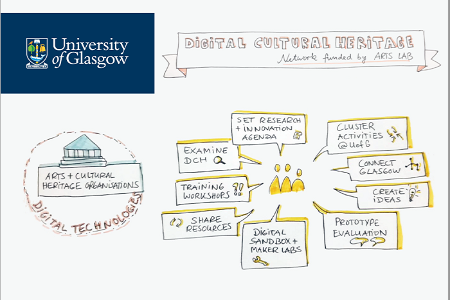
We are an interdisciplinary lab for anybody interested in the use of digital technologies to support cultural activities or
interpret the past.
Our members include researchers and practitioners from a wide range of disciplines and industries. We support a broad spectrum of activities including mentoring, hacking/making events and seminars.
Directors
Prof Maria Economou
Dr Gareth Beale
Dr Lynn Verschuren
Events
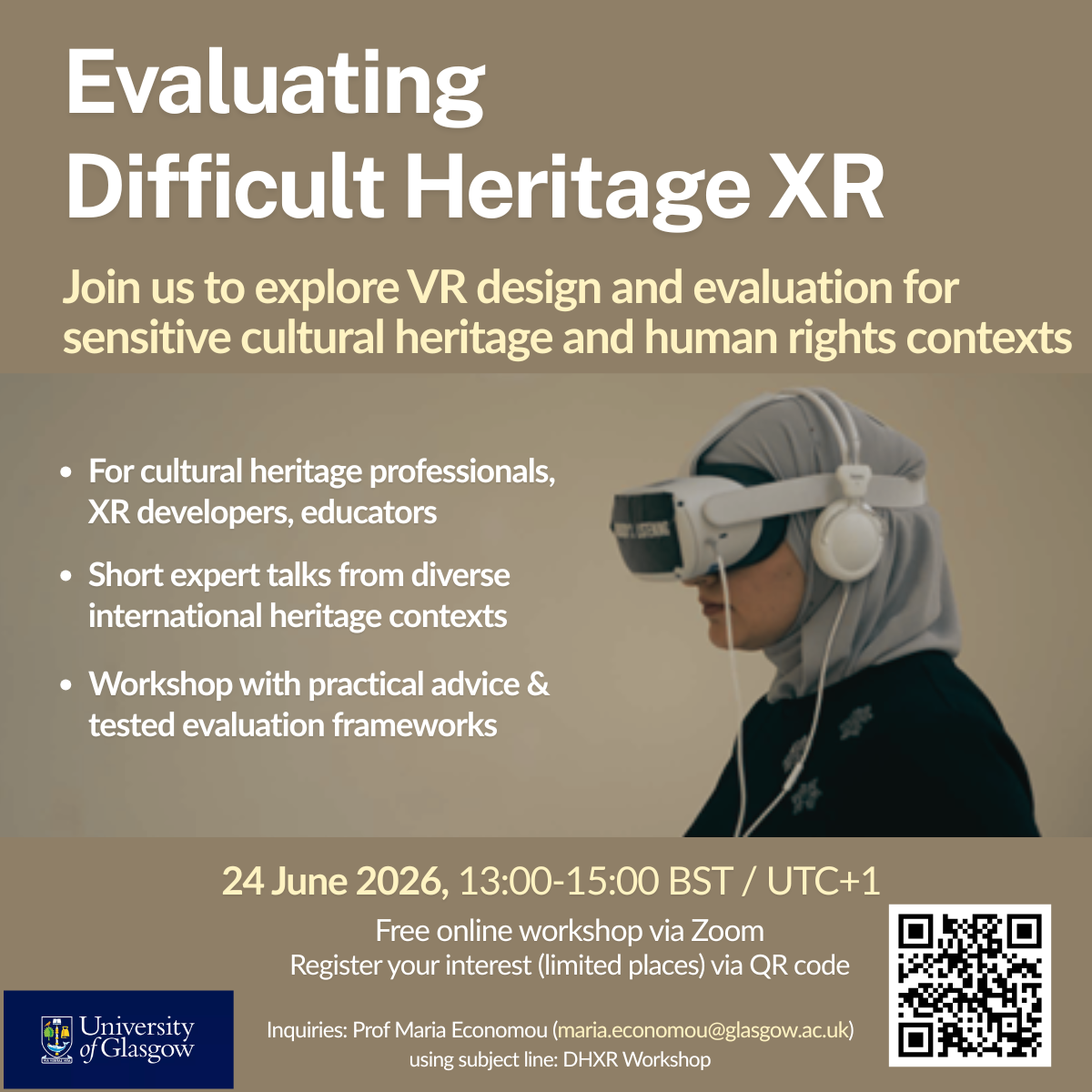 Online Workshop
Evaluating Difficult Heritage XR
24 June 2026, 1-3 pm BST
PROGRAMME
13:00-13:05 MARIA ECONOMOU Welcome
13:05-13:15 MARIA ECONOMOU Evaluating Emotional Engagement: Adapting the EMOTIVE Framework for Difficult Heritage XR
13:15-13:25 ROZHEN MOHAMMED-AMIN & KAVI ALI
Evaluating Nobody’s Listening on the Ground: Adapting EMOTIVE for Difficult Heritage VR in Iraq
13:25-13:33 ALBERT SIERRA
Stepping into an Uncomfortable Past: Using VR Immersive Experiences to Uncover Difficult Stories to Visitors and Schools in Catalonia
13:33-13:41 AGIATIS BENARDOU (& GEORGE PAPAIOANNOU)
Beyond Memory: Immersive Encounters with Greek Difficult Past
13:41-13:49 GEORGE PAPAIOANNOU
Beyond the Prison Walls: Experiencing Corfu Prisons (Greece) through Virtual Reality.
13:49-13:57 DIMITRIS CHARITOS & MARTIN GORDON
IMPULSE VR platform: Co-creating Virtual Experiences with Difficult Heritage from WWII Poland
14:02-14:10 ERIK CHAMPION
Flipping Difficult Heritage Questions With XR. Lessons learned from Australian case studies
14:10-14:18 GEORGE ARTOPOULOS
Staging the co-production of knowledge about difficult heritage in the museum: the case of Nicosia Airport, Cyprus
14:18-14:55 PEER CONSULTATION ROUNDTABLE: Bringing Your Challenges and Contexts
- What evaluation challenges are you facing with difficult heritage XR?
- How could you adapt these frameworks in your context?
- What support do you need to implement evaluation?
14:55-15:00 WORKSHOP WRAP-UP & RESOURCES
Speaker Biographies and Abstracts
Maria Economou is Professor of Digital Cultural Heritage at the University of Glasgow, where she holds a joint appointment shared between Information Studies at the School of Humanities and The Hunterian, the university’s museum and gallery service. She held a British Academy/Wolfson Research Professorship (2022-2026) on 'Emotional engagement with museum collections through digital storytelling and participatory approaches'. (Maria Economou’s UofG profile page)
Title: Evaluating Emotional Engagement: Adapting the EMOTIVE Framework for Difficult Heritage XR
Abstract: This talk presents the EMOTIVE evaluation framework for emotionally engaging heritage experiences developed through the H2020 EMOTIVE project (2016-19). It describes testing it initially at the Hunterian Museum with Roman Scotland Antonine Wall prototypes, then its adaptation for the Yazidi genocide Nobody’s Listening VR in Iraqi Kurdistan. Drawing on research in analogical recognition and historical empathy, it demonstrates how evaluation frameworks can adapt sensitively across temporal periods, geographies, and cultures.
Rozhen K. Mohammed-Amin is an Associate Professor at the Kurdistan Institution for Strategic Studies & Scientific Research (KISSR) and Co-founder of the Cultural Heritage Organization (CHO) in the Kurdistan Region of Iraq. Her work focuses on digital heritage and immersive storytelling for cultural memory and human rights.
Kavi Ali is a cognitive scientist with a BA in Cognitive Science (neuropsychology focus) and Spanish from Pitzer College, USA. She works as a research assistant and communications coordinator at the Cultural Heritage Organization (CHO), and as research assistant at the American University of Iraq, Sulaimani.
Title: Evaluating Nobody’s Listening on the Ground: Adapting EMOTIVE for Difficult Heritage VR in Iraq.
Abstract: This talk reflects on the evaluation of Nobody’s Listening, an immersive VR experience on the Yazidi genocide. It discusses how the EMOTIVE evaluation framework was adapted for fieldwork in Iraq, highlighting methodological, ethical, and practical lessons for assessing emotional engagement, historical empathy, and human rights awareness in difficult heritage VR.
Albert Sierra Reguera is the Innovation Manager of the Catalan Cultural Heritage Agency, and is currently focused primarily on 3D and VR projects.
Title: Stepping into an Uncomfortable Past: Using VR Immersive Experiences to Uncover Difficult Stories to Visitors and Schools in Catalonia
Abstract: The Ulls de la Història (Eyes of History) project is currently renewing the stories told across six cultural heritage sites in Catalonia. Moving beyond the usual protagonists and highlighting more diverse social groups, we are addressing difficult aspects of Catalan history through immersive VR experiences, both on-site and in Catalan schools.
Agiatis Benardou is President of the Board of Directors at DARIAH-ERIC.
Title: Beyond Memory: Immersive Encounters with Greek Difficult Past.
Abstract: This talk explores how VR and immersive storytelling reshape the ways we engage with difficult heritage in Europe. Drawing on the Block 15 project (of the Haidari, Athens Nazi concentration camp), it examines how immersion enables new forms of access and interpretation. It reflects on the methodological and ethical challenges of translating traumatic and contested histories into immersive experiences, and the role of VR in mediating collective memory.
Georgios Papaioannou, Ionian University (Corfu, Greece) & Institute of Mathematics & Informatics, Bulgarian Academy of Science (Sofia, Bulgaria).
Title: Beyond the Prison Walls: Experiencing Corfu Prisons (Greece) through Virtual Reality.
Abstract: The project developed an immersive Virtual Reality tour of the historic Corfu Prisons, a still-functioning correctional institution with highly restricted public access. Using digital documentation, 3D recording, and VR technologies, the project enables remote exploration and interpretation of an important yet largely inaccessible component of Corfu’s cultural heritage.
Dimitris Charitos is Professor at the Department of Communication and Media Studies and the Department of Digital Arts and Cinema of the National and Kapodistrian University of Athens. He holds a PhD in virtual environment design, has participated in more than 15 European Research projects and is a practicing audiovisual and interactive artist. URL: spatialmedia.ntlab.gr
Martin Gordon is responsible for international cooperation in new and emerging media, immersive technologies and cultural heritage for the Film University Babelsberg KONRAD WOLF. He also supports and represents the Film University in the European Institute of Innovation and Technology (EIT).
Title: IMPULSE VR platform: Co-creating Virtual Experiences with Difficult Heritage from WWII Poland
Abstract: This presentation explores the digital reconstruction of two Holocaust-related heritage sites with German and Polish partners and using the IMPULSE VR platform. It examines how immersive experiences enable new forms of interpretation and addresses practical challenges for heritage practitioners implementing VR in difficult heritage contexts.
Erik Champion is Professor of Virtual Heritage and Interactive History at Adelaide University and directs the Playful Cultures Lab, part of the Australian Research Centre for Interactive and Virtual Environments (IVE). He is Emeritus Professor at Curtin University and Honorary Professor of Games, Immersive Media & Extended Reality, at the University of Salford, UK.
Title: Flipping Difficult Heritage Questions With XR: Examples from Australia
Abstract: This short talk briefly recounts a move from a focus on ‘photorealism’ in virtual heritage projects towards providing platforms for discourse and interpretation. These raise new opportunities and challenges for evaluation. Can we bring evaluation back into the user experience of virtual heritage?
Georgios Artopoulos, MPhil (Cantab.), PhD (Cantab.), is an Associate Professor at the Cyprus Institute and Chair of the Joint Research Centre, DARIAH EU.
Title: Staging the co-production of knowledge about difficult heritage in the museum: the case of Nicosia Airport, Cyprus.
Abstract: This presentation draws on research at the intersection of immersive technologies, architectural history, digital humanities, and participatory heritage, to discuss the conditions under which new approaches to representing difficult heritage, such as the inaccessible modernist heritage of Nicosia Airport, Cyprus, can enhance museum visitors' engagement in spatial interpretation and knowledge co-production.
AI in Cultural Heritage Workshop: Lessons Learned and Ways Forward
The Digital Cultural Heritage Lab, in collaboration with the CREATe Digital Technologies and Humanism theme, are organising an AI in Cultural Heritage Workshop: Lessons Learned and Ways Forward on Friday, 31 May 2024, 2.00pm to 4.00pm. The workshop will be held at the Adam Smith Business School, The Hothouse (Room 282) with the first part only (i.e., the Lightning Talks) streamed also online.
This dynamic workshop will bring together a range of cultural heritage professionals, researchers, and artists to examine the opportunities and challenges that AI is providing for managing and interpreting collections and communicating with different audiences. What have we learned from those who have been working with AI in the cultural sector? How do we start exploring this technology? What are the ethical and other concerns we need to be aware of?
The workshop will include, in the first part, a small number of hybrid lightning talks (a combination of online and face-to-face at the UofG main campus, which will be streamed online), followed (for those attending onsite) in the second part by group work and discussion involving onsite participants, and finishing with an informal reception and chance to network.
Whether you're a seasoned professional/researcher in the use of AI or just starting out, or want to find out more about it, this workshop will offer valuable insights and practical knowledge to enhance your understanding of AI in the context of cultural heritage. You will get the chance to hear from industry experts, participate in hands-on activities, and network with others interested in this topic.
Presenters include:
Marion Carré, CEO and co-Founder of Ask Mona, Paris, the cutting-edge company
Amy Adams, Collections Information and Access Manager, National Museum of the Royal Navy
Paul Gooding, Professor of Library Studies and Digital Scholarship, Information Studies, UofG
Sarah Ames, Digital Scholarship Librarian, National Library of Scotland
Sarah Cook, Professor of Museum Studies, Information Studies, UofG
Cassandra Kist, Chancellor’s Fellow, Department of Computer and Information Sciences, University of Strathclyde
Interested in joining us? Participation in the workshop is free, but you need to register on Eventbrite
The Games and Gaming and Digital Cultural Heritage ArtsLab Labs, in collaboration with colleagues in Information Studies and Education Evolved Ltd, warmly invite you to an 'AI in Arts (& Humanities) Research' event on Monday 23 October 2023, 2pm-4pm.
The aim is to bring together colleagues in the College of Arts & Humanities, including those who are already using AI in their research, those interested in finding out more about it, and complete beginners who would like to explore new possibilities.
The event will be interactive with discussions about the potential and challenges for AI in research, incubating future collaborations/initiatives in this area.
There will be short presentations at the start by a few colleagues working in AI in the Arts & Humanities, followed by breakout group discussion, providing opportunities to connect, to experiment, and to share ideas.
Please sign up for either in-person (capacity-limited) or online attendance at these separate links.
We also encourage you to respond to the optional 2-question form here, included to aid us in understanding participants' diverse existing research related to AI, and to help to create collaborations going forward.
We hope you are able to join us.
Digitally Exhibiting Textual Heritage: Workshop 1 - January 28th, 2022, 11am-1pm
This first of three workshops sees presentations from Daryl Green (University of Edinburgh Library), Suzanne Paul (Cambridge University Library), Julie Gardham (Glasgow University Library) and Prof. Maria Economou (Information Studies and The Hunterian Museum) to discuss the landscape of written heritage exhibitions, both physical and digital, and consider what we might learn from the use of digital interactives within the museum sector.
Considering the topic from both pre- and post-pandemic perspectives, and defining "exhibition spaces" very broadly to include various points of access, this workshop series brings together librarians and archivists, museum curators, artists, and researchers to discuss the challenges of physical and digital exhibition, and the possibilities of emerging digital technologies for connecting audiences with the written past.
11:00: Welcome and Introduction, Dr Johanna Green, Information Studies, University of Glasgow
11:15: Daryl Green, University of Edinburgh Library - 'Book Exhibitions in a Digital World: Past and Present'
11.30: Julie Gardham, Glasgow University Library - '"Front runner or also ran?" A Gallop through the Performance of Archives and Special Collections at the University of Glasgow in the Virtual Exhibitions Race'
11:45: Suzanne Paul, Cambridge University Library - 'All the Books: Reflections on Making a Digital Library'
12:00: Prof. Maria Economou, Information Studies/The Hunterian Museum, University of Glasgow - 'Digital Storytelling and Immersive Technologies in Exhibitions for Engaging Emotionally with Collections'
12:15-close: Q&A
Virtual Teaching with University Collections: Lessons learnt & ways forward
When: Friday 22 October 2021, 14:00 – 15:30
Where: online. Registration and full programme at the Eventbrite link
This event, co-sponsored by University of Glasgow Collections Lab, Digital Cultural Heritage Lab & the LTDF Archives Unlocked project, will look back at the last year of technology-assisted virtual collections teaching, asking the questions: What worked? What failed? What lessons have been learnt? And what next?
Attendees will get the opportunity to see virtual collections teaching technology in action with demonstrations from Archives & Special Collections and The Hunterian. Virtual collections teachers & learners will share their experiences and thoughts through a series of lightning talks. And the event will conclude with a Roundtable Q&A asking: what's next?
Immersive Technologies in Cultural Heritage Research and Practice
When: Tue 20th Apr 2021 10:00am - 4:00pm
Where: Online
Event for PhD students in in arts and humanities disciplines across Scottish HEIs co-organised with the SGSAH Cultural and Museum studies Discipline+ Catalyst and the UofG Arts Lab on Immersive Experiences.
Information Studies PGR seminar on “Impact of Covid-19 on postgraduate research methodologies”
When: 3 Dec 2020
Where: Online
We are delighted to announce that we are holding a special event zoom Information Studies seminar on the 3rd December (15-16:30 followed by an informal online get-together) to celebrate our PGR community. The PGRs in Information Studies have chosen the theme of the impact of Covid-19 on postgraduate research methodologies and this is a topic that will no doubt be of interest to many here in the College of Arts and indeed beyond. Seven of our PGR candidates will be presenting their own work under this topic and will be sharing reflections on the effects of the previous few months on their research.
We hope that all of you will be able to join the event and the discussion at the end (as well as the less formal part after the seminar, to get together within the Subject and celebrate all our work this hard semester - feel free to bring your favourite drink, of course optional).
Zoom URL: https://uofglasgow.zoom.us/j/98518961453
Speakers:
- Cassie Kist: “Difficult heritage during Covid19”
- Franzi Mucha: “Lost in zoom – networking and conferencing during a pandemic”
- Joe Nockels: ‘Crossing wires: interdisciplinary research in the time of Covid-19’
- Erin Walter: “Losing the Plot: From Face-to-Face to the Digital Void in Practice-as-Research Methodologies”
- Lynn Verschuren: “Conducting Visitor Evaluation in a Pandemic: Challenges & Lessons Learned”
- Aimee Fletcher: “Digital data collection: potential for greater accessibility. Can the impact of COVID positively impact study accessibility for disabled participants?”
- Rachel Thain-Gray: “Feminist epistemological future-building as a source of energy during pandemic times”
Digital Cultural Heritage Staff Research Showcase
When: 25 Nov 2020
Where: University of Glasgow Archaeology Seminar Series
Speakers: Prof. Maria Economou, Dr Paul Gooding and Dr Johanna Green in Conversation with Dr Gareth Beale (University of Glasgow)
Smithsonian event: Glasgow Digital Cultural Heritage Showcase
When: 10.00-12.00, Tuesday 8 October 2019
Where: Hunterian Museum, Main Building University of Glasgow
Description: The event will include working demonstrations and prototypes from a number of major research projects including new immersive experiences, digital storytelling, on-site in-gallery and online exploration of museum collections (using for one of the case studies the Hunterian’s Antonine Wall Scottish Roman display from the Unesco World Heritage site). Free event but registration required.
Information Studies PhD showcase
When: 4.00-5.30, Wednesday 9 October 2019
Where: Boyd Orr Building, Lecture Theatre D
Description: Jointly organised with Archaeology. Speakers: Sarah Gambell (“The tactical value of digitisation for the preservation of cultural heritage in conflict”); Cassy Kist (“Social Media and Socially Engaged Museum Practices”); Franziska Mucha (“Crowds, Community and Co-Creativity”)
H2020 EMOTIVE demo: Immersive Technologies and Storytelling for Cultural Heritage
When: 13.30-18:00, Wednesday 30 October 2019
Where: Hunterian Museum, Main Building University of Glasgow
Description: EMOTIVE is a European Union-funded Horizon 2020 project which seeks to develop emotionally-resonant digital experiences for visitors at cultural heritage sites, with a particular focus on the unique - but curatorially very challenging - UNESCO World Heritage sites of the Roman Frontier display on the Antonine Wall at the Hunterian Museum in Scotland and the Neolithic site of Çatalhöyük in Turkey. Free but registration required.
Digital Cultural Heritage Staff research
When: 4.00-5.30, Wed 4 Dec 2019
Where: Boyd Orr Building, Lecture Theatre D
Description: Collaborative research with the Cultural Heritage Sector, organised by Information Studies and Archaeology. Speakers: Maria Economou, Hilary Young & Emilia Sosnowska; Paul Gooding; Johanna Green.
