

Research Stories
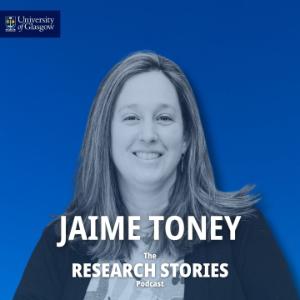
Jaime Toney: How can a city become sustainable?
Professor Jaime Toney discusses systems thinking, climate adaptation and the partnerships behind Glasgow's efforts to become a thriving, resilient city.
Listen on Apple Podcasts | Listen on Spotify
This episode is for researchers, PhD students, research assistants, established academics, research professionals, prospective postgraduate researchers, and anyone with an interest in sustainability and climate resilience.
In this episode:
- Working with Glasgow City Council to address complex sustainability challenges.
- The GALLANT project and Glasgow as a living lab.
- The Thriving Glasgow Portrait and Doughnut Economics.
- The role of dialogue, curiosity and shared understanding in decision-making.
- Climate adaptation and vulnerability-led approaches to policy.
- Working across government, academia, charities, and community organisations.
- Lessons for researchers seeking to create real-world impact through partnerships.
- The University’s civic role in shaping the future of Glasgow.
Guest Bio
Professor Jaime Toney is Director of the Centre for Sustainable Solutions at the University of Glasgow and Sustainable Futures Lead for Glasgow Changing Futures. Originally trained as an environmental and climate scientist, her work now focuses on systems transformation, sustainability, climate adaptation, and partnership-led approaches to addressing societal challenges. She leads major collaborative initiatives including GALLANT and works closely with governments, local authorities, charities, communities, and businesses to develop evidence-based pathways towards more sustainable and equitable futures.
Partnership Ecosystem
- University of Glasgow
- Glasgow City CouncilGALLANT
- Climate Ready Clyde
- C40 Cities
- Sustainable Glasgow Partnership
- Welsh Government
- Scottish Government
- UK Government
- Community organisations across Glasgow
- Verture
- MACC Hub
Key Projects & Programmes
- GALLANT Project
- Thriving Glasgow Portrait
- MACC Hub (Maximising UK Adaptation to Climate Change Hub)
- Climate Ready Clyde
- Glasgow Changing Futures
Collaborators & Partners
Hosted and produced by Nick Bruce, with questions, recording, editing, mixing, artwork and original music by Nick.
Production assistants: Temiloluwa Ajayi & Conor Molloy
Links and resources from this episode
Transcript
NB: So, you started in environmental and climate science, working with molecules and sediments. Tell me about your transition into more people-based work. Has it changed your outlook on anything through the work that you're doing now?
JT: Through the work that we’re doing now, we're really engaged in a lot of partnerships, and I think, for the changes that we need to see in order for us to move towards a sustainable future and better outcomes for future generations, we as researchers can't just work on our own in an isolated way. We need to take the challenges that we're addressing from people who are actually experiencing them in the real world. So, a lot of the work in engaging with people helps us understand a lot better what those challenges are and where they sit across different levels of society or different levels of the system. So, within the GALLANT research project, as an example, we have over 65 researchers across lots of different disciplines who are coming together: one to address the key environmental challenges that have come from Glasgow City Council, but in doing that, we've engaged stakeholders from communities, from the council itself, from elected government officials, from public and private sector. And one of the things that we keep hearing in those discussions is when we talk to communities, they always end up saying, “well, if only the council would”. And when we speak to people who work in the council, they'll say, “well, if only the elected officials would”. And you can probably tell where I'm going with this… When we speak to elected officials, they say, “if only Scottish Government would”. And so, a lot of what we've been doing, in terms of research, is more around that systems transformation and those systems processes. And a lot of that involves the relationships between people, the networks, and the partnerships where we need to better drive change and better connect up those systems.
NB: And you mentioned Glasgow City Council there, who you work collaboratively with. Can you tell me a little bit about how that relationship works and what does that involve?
JT: In the Centre for Sustainable Solutions, when we first set up around 2020, we were really interested in what we could do from a higher education institute’s point of view around research, education, and partnership. And the partnership that really did develop was that partnership with Glasgow City Council, and it was largely because our colleagues who were focused on public policy research, in their interactions with the council - at that point, I didn't really know anybody in the council - but they were saying, “you know, everything we talk to them about, it doesn't matter whether we're talking directly with the sustainability team, with the folks who are working in economic development, with the folks who are working in community partnership, sustainability keeps coming up as an issue.” And so, they made initial introductions. And then I think for us, we had a really key opportunity with a number of things coming together. One, unfortunately, it was COVID times and we were trying to, as a city, recover from COVID. And the City Council was looking at what that trajectory looked like. They also knew that, within a year's time or so, they were going to be hosting COP26, which is a big international climate conference. And so, we developed with partners across Glasgow City Council to unpick the complexity. And so, we had a roundtable with senior leaders from across the city: both from public sector and private sector. It was hosted by the leader of the Council, Susan Aitken, and our principal, Anton Muscatelli, at the time, and it was really a great opportunity to learn about the complexity and really think of what a future and a vision moving forward looks like. One of the other things that came together was even though Glasgow isn't a mega city, so it's not big enough to actually be one of the C40 cities, C40, as an organization which brings together all of those mega cities and lots of different fora, was really interested in Glasgow being involved with them, and, in particular, an initiative called the "Thriving Cities Initiative”. And so, for us, the University and the Council were involved in those discussions from day 1 in order to be part of that initiative. The city would have to create what's called a “city portrait”, which we now refer to as the “Thriving Glasgow Portrait”. And the city itself didn't necessarily have the resources at the time to pull that together, because it requires a lot of stakeholder engagement and workshopping and various other things. And so, the University took on the management of developing that Thriving Glasgow Portrait. But that's what has become the foundation of our kind of systems transformation work within the GALLANT project. And all of this understanding of engaging with partners and stakeholders across the city is what led to us defining what the research questions and the research challenges were that we wanted to take forward within the GALLANT project.
NB: And before I ask you about the GALLANT project, what are the outputs from these discussions? Do they influence research? What happens with this information that you gather?
JT: So, one, the fact that you have practitioners, Researchers and decision makers all in the room trying to understand the challenge and the problem. You end up with people in the room who have never spoken to each other before, but are all working on that same challenge in some way, sometimes in parallel, but just haven't met and things like that. And so, I think one of the outputs is actually the relationships that develop within those processes, whether there is a funding opportunity in mind from the outset or not. So, the dialogues that we ran in 2021 didn't have a specific funding opportunity that we were going to. We wanted to uncover some of those barriers and enablers for making change. And those outputs fed into the round table that we held with the senior leaders. And so, in some ways, it's it was a big kind of knowledge sharing event. But I guess the other thing in terms of that dialogue process is you're inviting people into the room, and you're conducting those dialogues in a slightly different way than you would have ordinary boardroom conversations and things like that. You set the ground rules that people are coming in for curiosity-driven inquiry around the topics and the challenges that we're discussing, and you end up creating an environment where people are happy to openly question share concerns. And I think ultimately, what you get out of those is something quite different from when people come into the room and expect to be advocating for a particular position. It creates much more collective understanding and collective inquiry that's really productive.
NB: And you mentioned GALLANT, which positions Glasgow as a “living lab”. What does that mean and what does it look like day to day when you're working with an organisation like Glasgow City Council?
JT: I think one of one of the things about being a “living lab” is you're setting out from the beginning, the expectation that you're working with something that's going to change through time. And so, unlike other projects that I've worked on or been involved with, we knew from the outset, one that the funding that we had applied to was five years of funding, rather than the typical kind of short term three years of funding. And so, from the outset, we knew that we had, for example, in the community collaboration space, we had about designed in, we had about 18 months of just building those trusted relationships with communities, um, creating important assets for them around what they saw as valuable and important in terms of sustainability. The systems transformation piece that we're working on is very much about understanding from stakeholders across the city, using doughnut economics, what would Glasgow look like if it were thriving. So, thriving for people and thriving, in terms of the environment and nature. And those are how we frame all of our conversations. And then as we move forward as a living lab, we're continually taking into our research the points of view of stakeholders: understanding what works, understanding what doesn't work. And so, I guess as the PI, I kind of have a very high-level helicopter view of what's happening across the project. But that living lab component means that every aspect of everything that we do is working with partners and stakeholders across the city. In terms of what's emerged from that, working with Glasgow City Council, initially we were very much tied in with working with the sustainability team, who we still do work very closely with, but we've also expanded out. We're working quite closely with the planning team. We work quite closely with the business intelligence team. We work quite closely now with the economic development team. And so, we've actually provided some of those, I guess you would call them, kind of temporary bridging structures across the council - in some cases where those interactions and those bridges didn't exist before.
NB: Okay, how would you define the meaning of a sustainable future and an equitable future?
JT : Well, I think sustainability and equity need to go hand in hand. So, I don't see those necessarily as separate futures. I think when we talk about futures, I tend to talk about them in a plural sense. A lot of what we've been doing, I guess at the city scale, is placemaking. We've been doing that at the community level, but then we've been trying to connect up the community visions with the overall city and decision-maker vision. And so, we've kind of defined from that original snapshot of the Thriving Glasgow Portrait, what Glasgow would look like to be thriving, which, to me, is a statement and a vision of where we want to get to. But, you know, we have a current reality, a current set of circumstances. And so, I think developing the future, or futures, and what those look like will be different for every place that you go to and, different set of people that you engage with. I'm confident that we've engaged with such a large number of people across Glasgow, that it is a fairly comprehensive future vision that we've put together within that Thriving Glasgow Portrait. And the council is now bringing that in through what they're doing in terms of their economic development framework, and we're working closely with them now to put indicators and data behind that so that they can actually understand whether things are moving in the right direction.
NB: And do you think we're heading in the right direction in terms of a thriving Glasgow and, by extension, a thriving world? Do you feel optimistic about where we're heading?
JT: So, I'm not sure if “optimistic” is the right word. I would say hopeful. Within Glasgow, I think we are very privileged to be working with a council that is very progressive. And for me, I think every individual who wants to take some sort of climate action needs to take a look at where they have control, where they have influence, where they're best placed to, kind of, make change. If I go back to the point where COP26 was happening, and there were a huge number of opportunities to get involved with different things. I was kind of having those reflections myself, you know. Where can I be most useful and make the most change? For me, I don't think I can have any influence on those high-level international discussions that are going on. And so, for me, I saw sort of the momentum and the energy around. And then the scalability of something like that, in terms of making a bigger change, would be that you're connecting with other regions and other cities who are trying to do the same thing, and that you're actually learning from each other in terms of what works and what doesn't work, and how you change and adapt different methods of what you're doing based on, you know, the place that you're in. And I've been involved in other research projects now as well. Well, it's actually not a research project. It's a knowledge exchange project called “Maximizing UK Adaptation to Climate Change Hub”. So, we call it the MACC hub, for short. But that's working across now the four nations of the UK. So, I co-lead the Scotland spoke, with a charity called Verture. And that's very much about taking a vulnerability-- led approach to climate adaptation.
NB: What's a “vulnerability-led” approach?
JT: So, it means that when you're acting and coming up with solutions for the impacts of climate change, those solutions are starting down at the ground level and making sure that we're addressing things that are the social determinants of health and wellbeing. So really, from the beginning of developments that are coming through, thinking about those who are most vulnerable to the changes that we're going to be facing. And I think, however you frame whatever kind of work that you're doing or policies that you're creating, if climate adaptation is completely framed around technology and innovation and kind of “hard infrastructure”, you'll have a very different outcome in terms of where we are twenty, fifty or one hundred years from now, than if you start by framing the work that you're doing around caring about those who are most vulnerable in society. And so, this knowledge exchange partnership across the four nations is looking at how do we take an approach that starts from understanding how we do things that are right by those who are most vulnerable. And we've been in discussions with UK government, with Wales, Northern Ireland and Scotland. And I mean, I guess this comes back to you asking whether I was optimistic and I said hopeful. But, in all of those conversations that we have with various departments within the UK government and the devolved governments, there is a real sense that that sort of approach is needed. And within this project, in terms of knowledge exchange, we're really trying to show what works. And the onus is on us to demonstrate that that vulnerability-led approach actually does work, so that future approaches aren't just about technology and innovation but can have longer term outcomes.
NB: Mhm, I'm surprised to hear that these are the types of conversations that are happening in these rooms, because when I look at the world around me, it doesn't feel like these are the type of attitudes that are around in the air. And it's quite easy, when you're reading the news and the media of the day, to become quite pessimistic. So, I guess that's more of an observation, but do you feel like there's a disconnect between the discussions that you're having in these spaces and what the collective, uh, attitudes of the public at large are?
JT: I mean, I think the place where this is most evident is we've recently gotten through running a masterclass, that we've engaged with the Welsh Government on, where they have a Future Generations Act. They have a Shaping Places agenda and policy where they're really bringing systems thinking and wellbeing to the heart of everything, they do. So, their approach is very much aligned with what we're trying to do within the MACC hub. And even though that's the approach their government's taking, I think if you went across Wales, not all of the population of Wales is necessarily bought into that. And, you know, you still see developments going forward that are still driven by economics and economic growth. So, I think both of these things are happening in society and across all four of the nations.
NB: Do you have any ideas or any sense of, um, how a person who's not in academia, isn't present in these spaces, but is engaged and wants to make a difference and wants to contribute meaningfully to these discussions and to this problem - how can they meaningfully engage with these issues? How can they get involved? What positive contributions can they make?
JT: Yeah, I mean, I, I think if we look at some of the examples across Glasgow, it's been amazing to learn about what more and more people are doing, whether that's people who are involved in community organizations in Govanhill with them really holding on to the heritage and reclaiming the Govanhill Baths there, and actually creating the Deep End, which has basically a recyclable and reuse centre where they're collecting plastics from the community and turning them into benches and furniture and usable items. They have woodworking shops where they teach people different skills and things like that. I think everybody needs to find, you know, what it is their interests align with and what they can tangibly take forward. There's the organization South Seeds. They run a tool library and so you can rent them out and things like that. So, there's all different levels.
NB: So, looking ahead for you, how would you like the University's relationship with the city of Glasgow to evolve over the next five or ten years? And what role can centres like the Centre for Sustainable Solutions play in that?
JT: I think there's a lot of places where we still could come together in terms of how we engage and interact with the city. You know, the University has a civic mission, and a lot of researchers are doing work in research across the city. I think finding a way where we are able to articulate and include our values around sustainability, particularly around the legacy that we're leaving for future generations. And as part of that, a healthy and natural environment, finding a way to bring that in across all of the different areas that we're working on. We have really strong partnerships, particularly around climate adaptation with Climate Ready Clyde and other sorts of partnerships, including the Sustainable Glasgow Partnership. But those seem sometimes to sit aside from or apart from some of the other decisions that we’re making. And I'm not being critical or judgmental here, but they sit aside from some of the more innovation discussions we're having around what's happening in terms of development along the Clyde and other parts of the city and really thinking, you know, if we were going to bring those Thriving Glasgow values that the stakeholders across the city have said that they would like to see, how do we start using those a bit more, not only in the city's decision making, but within those partnerships that exist across the city that the University is involved in as well?
NB: So, if any researchers listening want to work at the boundary between research and real-world change, what's one thing you wish you'd understood earlier?
JT: I guess it's how important those external partnerships and trusted relationships are. I think some disciplines are probably more aligned to doing that already. But coming from the climate science side of things, for the work that I was doing to be impactful, my data would be included in, you know, global climate models that are projecting what future scenarios and circumstances are going to look like, and/ or that data would be taken up by something like the IPCC reports that synthesize kind of the state of the physical science evidence base that then gets summarized and put before policymakers. And I guess for me, that's kind of a passive role to be playing. And you don't have a direct connection into the change that needs to happen on the ground. I think more and more, to really understand the challenge and the complexity of challenges where we're seeing climate change come together with health impacts and and various other things, the scope of what you do is not only interdisciplinary, but moves into that transdisciplinary space, which is that connection with the outside world. I don't think we can claim to be solving societal challenges without having that direct engagement with society in some way.