Global Gender History MSc/PgDip/PgCert: Online distance learning

The Masters in Global Gender History (online distance learning) offers online, vocationally-orientated tuition in gendered analyses of the global past. Expert instruction is provided by world-leading scholars from the Centre for Gender History, working in partnership with heritage, media and third sector professionals. Together, they will provide you with the skills necessary to evaluate and propose initiatives to gender, queer and decolonise historical narratives. A key strength of the programme is its flexibility. It can be taken full or part-time from September or January, its accessible digital learning environment allowing you to fit your studies around your life.
- Online distance learning
- Academic contact: sam.rutherford@glasgow.ac.uk
- Teaching start: January or September
- Online
- MSc: 12 months full-time; 24 months part‑time
- PgDip: 9 months full-time; 18 months part‑time
- PgCert: 9 months full-time; 18 months part‑time
Why this programme
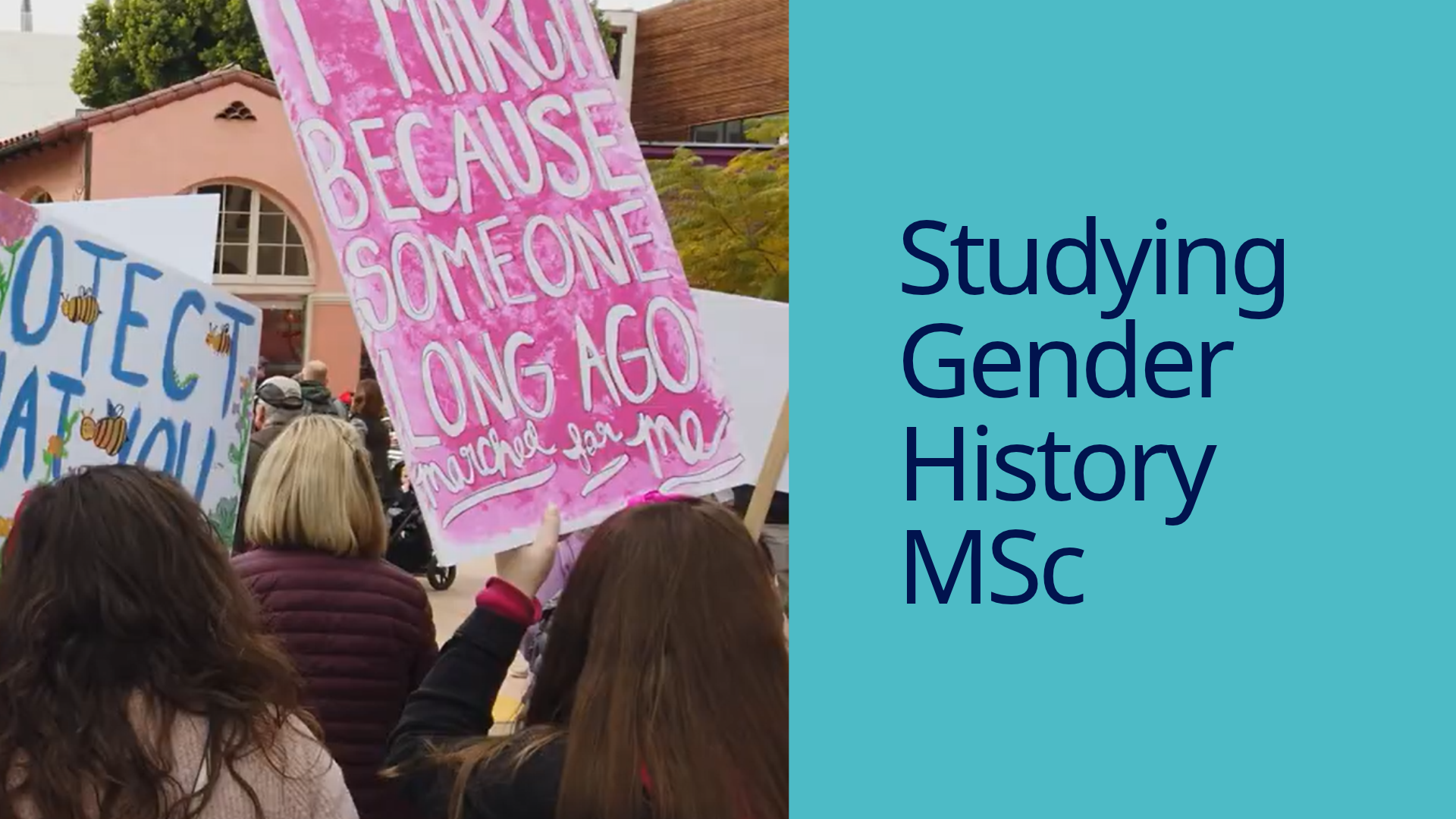 https://www.youtube.com/watch?v=kQX0UwYr1wA
- The Masters in Global Gender History (Distance Learning) is a flexible, online programme, offering vocationally-orientated tuition in gendered analyses of the global past.
- It is run by the Centre for Gender History, which is home to the largest concentration of gender historians in Britain and offers an unparalleled environment for study and research in this field.
- On this programme you will receive expert tuition in the theoretical and methodological approaches to global gender history and their application to a wide range of historical and cultural contexts. The course is taught by world-leading scholars in gender history, committed to developing and deepening your own research interests.
- Teaching collaborations with partners including the Smithsonian, Glasgow Women’s Library, and the Burrell Collection, will enable you to assess and propose initiatives to gender, queer and decolonise the presentation of historical narratives and evidence, for public and academic audiences.
- A key strength of the programme is its flexibility. It can be taken full or part-time, with September or January entry points. Two core courses are supplemented by a range of optional modules, the programme ending with a dissertation or an applied dissertation by (digital) placement (where available). An engaging and accessible online learning environment ensures you can fit your studies around work and caring responsibilities.
- As a student within the Centre for Gender History, you will become a member of a vibrant and unique research centre, with a thriving postgraduate community and a busy programme of hybrid and online events, including research seminars, knowledge-exchange workshops and lectures.
- Our FutureLearn MOOC, A Global History of Sex and Gender, is an excellent introduction to some of the programme's key themes and methodologies. We recommend you take this 4-week course before starting your postgraduate degree with us.
- Looking to deepen their understanding and level of critical engagement with gender as a category of historical analysis
- Interested in pursuing independent research in gender history
- Who would like to build transferable skills for careers in fields such as heritage, policy, data analysis, writing, creative industries, and more
- Who would like to build transferable skills for careers in fields such as heritage, policy, data analysis, writing, creative industries, and more
- Who wishes to study flexibly by distance learning
- Theoretical approaches to the history of gender and sexuality such as global and decolonial histories, LGBTQ+ histories, histories of childhood and youth, histories of science and medicine, histories of free and unfree labour
- How to work with source material, including physical and digital archival sources, material culture, and oral histories
- Formulating research questions and designing independent research projects
- A wide array of optional courses that allow you to focus on specific themes, times, and places
- The ability to apply academic approaches to the study of gender
- Engaging critically with historians' arguments and existing academic scholarship
- Research in physical and digital archives
- Analysing different types of sources and data
- Advanced analytic writing
- Formulating independent research questions
- Project design and management
- Presentation and oral communication skills
Key Facts
This degree is ideal for anyone:
Key topics include:
Skills you will develop
Introducing Global Gender History (video)
Global Gender History Introduction Video
What our students say
The flexible option for online learning as well as part-time and full-time meant that I could still get the master's degree that I was wanting. It was really nice when we have our seminars, a lot of the time it's hybrid. It's been really good to have that kind of live back-and-forth rapport. It's just like: 'We've got some people calling in and they'll be participating as well'. Chloe, MSc student
Meet more of our students
MSc Gender History student Pratika Dewi takes us through her experience of studying as a University of Glasgow Arts & Humanities student, visiting the Mary Queen of Scots exhibition, and what she has planned for the future.
Panel Discussion and Q&A
Watch a recording of our recent panel discussion and Q&A with students and staff from this degree.
Find out more
Gender History (On Campus)
We also offer a Masters in Gender History programme on campus
Programme structure
This is a distance learning, full or part-time programme with entry points in September and January.
You will take:
- Two core courses (Gender, Politics and Power; Gender History Applied)
- Four optional courses from a selection offered by the Centre for Gender History
- A Dissertation OR an Applied Dissertation by (Digital) Placement (where available).
Learning takes place online using an engaging and accessible digital learning environment, specially designed to be intuitive to use. Teaching resources include live seminars, pre-recorded lectures, case-studies, curated reading lists, and closely moderated discussion forums. In-depth critical interrogation and continual self-reflection are fostered through a wide range of assignments, including essays, presentations, blog posts, project proposals, public talks and exhibition work. The programme culminates in a dissertation, with, where available, an option to take an applied dissertation by (digital) placement.
Core Courses
Semester 1
Semester 2
Dissertation
- Dissertation/ Applied Dissertation by Digital Placement
Optional Courses
Typical optional choices include:
- Approaches to Queer and Trans Histories
- Making a Living: Work, Gender and Society 1700-1850
- A 'New Form of Slavery'?: Indentured Labour in Post-Slavery Caribbean Societies, c. 1836-1917
- Qualitative Approaches to the Study of Political Violence
- Reparations Now (Part One)
- Reproductive rights and justice: Historical perspectives
- Women and Power in Renaissance Italy
The availability of a particular course may depend on student numbers and staff availability. Not all courses may be available every year.
Students have flexibility in the configuration of their courses, as long as they take both their core courses in Year 1 and end the programme with the Dissertation.
Programme alteration or discontinuation
The University of Glasgow endeavours
to run all programmes as advertised. In exceptional circumstances, however, the University may withdraw
or alter a programme. More information: Student contract.
Career prospects
The research skills and methods you’ll gain on this programme give you the transferable skills you need for positions in the public and private sectors, including heritage policy and projects, media and teaching. The programme is also an excellent foundation for a PhD.
Fees & funding
Tuition fees for 2027-28
MSc
Home & RUK
- Full-time fee: £11,481
- Part-time fee: £1,276 per 20 credits
International & EU
- Full-time fee: £27,390
International students will receive a 20% tuition fee discount.
PgDip
Home & RUK
- Full-time fee: £7,654
- Part-time fee: £1,276 per 20 credits
International & EU
- Full-time fee: £18,260
International students will receive a 20% tuition fee discount.
PgCert
Home & RUK
- Full-time fee: £3,827
- Part-time fee: £1,276 per 20 credits
International & EU
- Full-time fee: £9,130
International students will receive a 20% tuition fee discount.
Tuition fees for January 2027 start
MSc
Home & RUK
- Full-time fee: £11,367
- Part-time fee: £1,263 per 20 credits
International & EU
- Full-time fee: £26,460
International students will receive a 20% tuition fee discount.
PgDip
Home & RUK
- Full-time fee: £7,578
- Part-time fee: £1,263 per 20 credits
International & EU
- Full-time fee: £17,640
International students will receive a 20% tuition fee discount.
PgCert
Home & RUK
- Full-time fee: £3,789
- Part-time fee: £1,263 per 20 credits
International & EU
- Full-time fee: £8,820
International students will receive a 20% tuition fee discount.
Fee status
Additional fees
- Fee for re-assessment of a dissertation (PGT programme): £370
- Submission of thesis after deadline lapsed: £350
- Registration/exam only fee: £170
Entry requirements
2.1 Hons (or non-UK equivalent) in any subject.
A 2.2 Honours degree may be considered.
Substantial, directly relevant experience may be considered in place of formal qualifications. If you are applying based on relevant experience, please include a personal statement evidencing this with your application.
English language requirements
For further information about English language requirements, please contact the Recruitment and International Office using our enquiry form
How to apply
To apply for a postgraduate taught degree you must apply online. We cannot accept applications any other way.
Please check you meet the Entry requirements for this programme before you begin your application.
Documents
As part of your online application, you also need to submit the following supporting documents:
- A copy (or copies) of your official degree certificate(s) (if you have already completed your degree)
- A copy (or copies) of your official academic transcript(s), showing full details of subjects studied and grades/marks obtained
- Official English translations of the certificate(s) and transcript(s)
- Evidence of your English language ability (if your first language is not English)
- Any additional documents required for this programme (see Entry requirements for this programme)
- A copy of the photo page of your passport
We may also request additional documents such as a personal statement, portfolio, references or a sample of academic writing to support your application.
If we request a reference, this should typically be an academic reference. However, where this is not possible, a reference from a current employer may be accepted. If you already have a copy of your reference on letterheaded paper, you can upload this with your application. Otherwise, you may provide your referee’s name and contact details on the online application, and we will contact them directly.
You have 42 days to submit your application once you begin the process.
You may save and return to your application as many times as you wish to update information, complete sections or upload supporting documents such as your final transcript or your language test.
For more information about submitting documents or other topics related to applying to a postgraduate taught programme, see how to apply for a postgraduate taught degree
Guidance notes for using the online application
These notes are intended to help you complete the online application form accurately; they are also available within the help section of the online application form.
If you experience any difficulties accessing the online application, see Application System Help.
- Name and Date of birth: must appear exactly as they do on your passport. Please take time to check the spelling and lay-out.
- Contact Details: Correspondence address. All contact relevant to your application will be sent to this address including the offer letter(s). If your address changes, please contact us as soon as possible.
- Choice of course: Please select carefully the course you want to study. As your application will be sent to the admissions committee for each course you select it is important to consider at this stage why you are interested in the course and that it is reflected in your application.
- Proposed date of entry: Please state your preferred start date including the month and the year. Taught masters degrees tend to begin in September. Research degrees may start in any month.
- Education and Qualifications: Please complete this section as fully as possible indicating any relevant Higher Education qualifications starting with the most recent. Complete the name of the Institution (s) as it appears on the degree certificate or transcript.
- English Language Proficiency: Please state the date of any English language test taken (or to be taken) and the award date (or expected award date if known).
- Employment and Experience: Please complete this section as fully as possible with all employments relevant to your course. Additional details may be attached in your personal statement/proposal where appropriate.
Application deadlines
January 2026
Applications for this online programme will be accepted up to course start.
September 2026
Applications for this online programme will be accepted up to course start.
- Applications for this online programme will be accepted up until it starts.

Related programmes
Online postgraduate

Postgraduate events