

Licencing and Copyright
Creative Commons Licences
Many funders require articles to be shared with a liberal creative commons attribution licence (CC-BY). CC -BY is a liberal licence that allows the widest re-use of the publication whilst ensuring the authors are attributed. It allows users to copy, redistribute, remix, transform, and build upon the work for any purpose, including commercial use, without needing to ask for permission, provided that they credit the original author in the manner specified by the creator.
REF open access requirements for articles and conference proceedings published from 1 January 2026 to 31 December 2028 must have an open access licence (Creative Commons or equivalent) to be eligible, with a strong preference for CC-BY.
A CC-BY licence can be achieved in two ways.
The published version (version of record)
Before publication publishers usually ask authors to sign and return a licence agreement, sometimes called an author publishing agreement.
If the University agrees to pay the open access fee for an article or conference proceeding, authors must choose a licence of type 'CC-BY'. Other licence types such as CC-BY-NC or other extensions are generally unacceptable to funders if we are using their funds to pay for open access for articles or conference proceedings. More information on license requirements for funders can be found at Funds for Open Access.
The author accepted manuscript (AAM)
The University's Research Publications and Copyright Policy requires each staff member who authors (or co-authors) an in-scope work to grant the University a non-exclusive licence to share the Author Accepted Manuscript (AAM) of the relevant in-scope work publicly available under the terms of a Creative Commons Attribution (CC-BY) licence, or a more permissive licence.
Books
Sometimes funders will accept other licences for books. They may require an exception. Check their terms or ask research-openaccess@glasgow.ac.uk if we can help check for you.
Intellectual Property
If you have concerns about intellectual property being lost then you have probably already excluded this detail from the paper and/or have consulted the Intellectual Property service.
Copyright Statements
The copyright usually belongs to the creator unless they sign it away via a copyright transfer agreement.
If authors are asked to provide a copyright line for the article the format is:
Copyright symbol, year, author name, standard copyright statement
For example:
© 2026 Initial. Surname. This is an open-access article distributed under the terms of the Creative Commons Attribution License, which permits unrestricted use, distribution, and reproduction in any medium, provided the original author and source are credited.
If there is more than 1 author add 'et. al.' after the surname.
Understanding Creative Commons Licences
There are 4 different licence terms available under Creative Commons:
| License Term | Explanation |
|---|---|
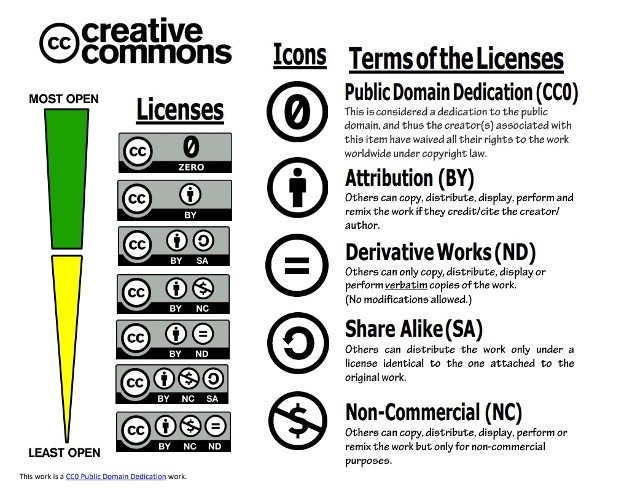
| Attribution (BY) | A user can copy, adapt, remix, display, perform, and distribute the work so long as they credit the name as requested by the creator. |
| No Derivative Works (ND) | the work is free to copy, distribute, display, or perform as it is, verbatim with no modifications or adaptations. |
| Share Alike (SA) | A user can only disseminate the work under the same license chosen by the original creator for the work. |
| Non-Commercial (NC) | A user may copy, distribute, display, perform, or remix the work but only for non-commercial purposes. |
Here is an interesting article that explains why a no-derivatives licence might not be what users who are considering applying it need https://creativecommons.org/2020/04/21/academic-publications-under-no-derivatives-licenses-is-misguided/
The official infographic below shows the Creative Commons licences from most open to least open:
Creative Commons offers a CC Chooser tool that asks a series of questions that can help you identify the right license for your work.
More information is available from the Library website on Creative Commons and copyright guidance for University of Glasgow staff, students and researchers.
Other Resources for Copyright and Licensing
Rights retention enables authors to exercise the rights they have on their manuscripts to deposit a copy of the Author Accepted Manuscript (AAM) in a repository on publication and provide open access to it.
cOAlition S have created an explainer video and an author's rights quiz to help authors acknowledge and assert their rights.
Authors who have included a rights retention statement with their submission in order to comply with the will need to read any licence agreements carefully to ensure that it is compatible with any open access wishes or requirements. If you receive any objection or unusual feedback from the publisher contact research-openaccess@glasgow.ac.uk.
Need advice on completing an author publishing agreement? Contact the Enlighten team at research-enlighten@glasgow.ac.uk.
You may also be interested in: