

Field station marks 80 years of environmental research at Loch Lomond
Published: 28 October 2026
Eight decades of scientific research will be celebrated as the University of Glasgow marks the 80th anniversary of its field station on the shores of Loch Lomond
Eight decades of scientific research will be celebrated as the University of Glasgow marks the 80th anniversary of its field station on the shores of Loch Lomond.
The anniversary celebrates the work of the Scottish Centre for Ecology and the Natural Environment (SCENE), which has played a key role in ecological research and field-based teaching since its foundation in 1946.
Originally constructed and equipped using surplus materials from the War Department, the field station has evolved over the past 80 years into an important centre for environmental science, supporting research, and training the next generation of environmental scientists.

Throughout the years, students from the University’s undergraduate and postgraduate degree programmes have used the site to investigate freshwater ecosystems, develop field research skills and deepen their understanding of the natural environment.
SCENE researchers have made many influential discoveries, including revealing the hidden challenges faced by Atlantic salmon during their migration to sea, showing that more than 40% of all juvenile salmon were lost during their passage through Loch Lomond. Other research, focused on local bird life, demonstrated that blue tits breeding in urban environments produce fewer and less successful offspring than their woodland counterparts.
To celebrate its 80th milestone, researchers, students and partners will come together for a multidisciplinary symposium which will explore Loch Lomond’s rich scientific history, the discoveries made over the past 80 years and the environmental challenges shaping its future.
The event – organised by UofG, the University of Stirling and the Loch Lomond and The Trossachs National Park – will explore how research in and around Loch Lomond has advanced understanding of the area and its underlying biological, chemical and geological processes.
The anniversary also comes at a time when establishing a comprehensive understanding of Loch Lomond’s ecological condition is increasingly important.
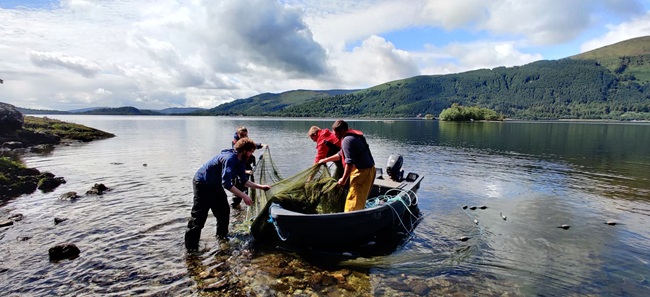
Although it is the largest lake by surface area in Great Britain, there is still no comprehensive contemporary assessment of its ecological health. The University of Glasgow has launched a fundraising initiative to support the State of the Loch project, which aims to combine SCENE’s long-term environmental records with emerging technologies, including environmental DNA (eDNA) and remotely operated underwater vehicles.
The project aims to establish a contemporary baseline of the loch’s ecological condition against which future environmental change can be measured, helping researchers better understand the ecosystem and inform its long-term management.
The symposium will also focus on a wide range of topics, including glacial history, historical land use, biogeochemistry, physicochemistry, ecology and environmental management. Together, these perspectives will provide an up-to-date understanding of the loch, its surrounding landscapes and the challenges it faces in a changing world.
Professor Chris Harrod, Director of SCENE, said: “Eighty years ago, the University of Glasgow had the foresight to found a field station on the shores of Loch Lomond. Since then, generations of researchers, students and staff have built a tradition of excellence in ecological and environmental research and teaching. Their work transformed our understanding of the loch and its surroundings and made a mark on science worldwide. That work continues today at SCENE with a new generation of students and staff.
“This important symposium brings together researchers, environmental practitioners and key stakeholders with new data and fresh ideas. New technologies, powerful ways of analysing data and talented young scientists make this a very exciting time. We want to start the conversations that will spark future collaborations and help understand and protect Loch Lomond and its catchment in a time of rapid change.”
Dr Dominic McCafferty, Deputy Director of SCENE, said: “Field stations such as SCENE on Loch Lomond are as much needed today as they were 80 years ago, allowing students to develop their knowledge of the natural world.
“At the field station students have a unique opportunity to live and study within Loch Lomond and the Trossachs National Park, learning how to identify and record the rich biodiversity living in Loch Lomond and other surrounding habitats. This fieldwork experience using the latest scientific techniques equips students with a wide range of essential skills for their future careers in environmental science across the world.”
Loch Lomond Symposium: Advances in research in the Loch Lomond Catchment, will take place October 27 and 28.
Enquiries: ali.howard@glasgow.ac.uk or elizabeth.mcmeekin@glasgow.ac.uk
First published: 28 October 2026
<< MVLS News