

Dr Justine Rudkin receives Academy of Medical Sciences Springboard Award
Published: 15 April 2026
Dr Justine Rudkin, a Lecturer in Bacteriology at the School of Infection & Immunity, has been awarded a prestigious Academy of Medical Sciences Springboard Award for her work on the common bacteria Staphylococcus aureus
Dr Justine Rudkin, a Lecturer in Bacteriology at the School of Infection & Immunity, has been awarded a prestigious Academy of Medical Sciences Springboard Award for her work on the common bacteria Staphylococcus aureus.
This year the Academy of Medical Sciences has awarded £6.7 million, shared between 55 early career researchers at 38 institutions across the UK, backing new research that can transform our understanding of pressing health challenges.
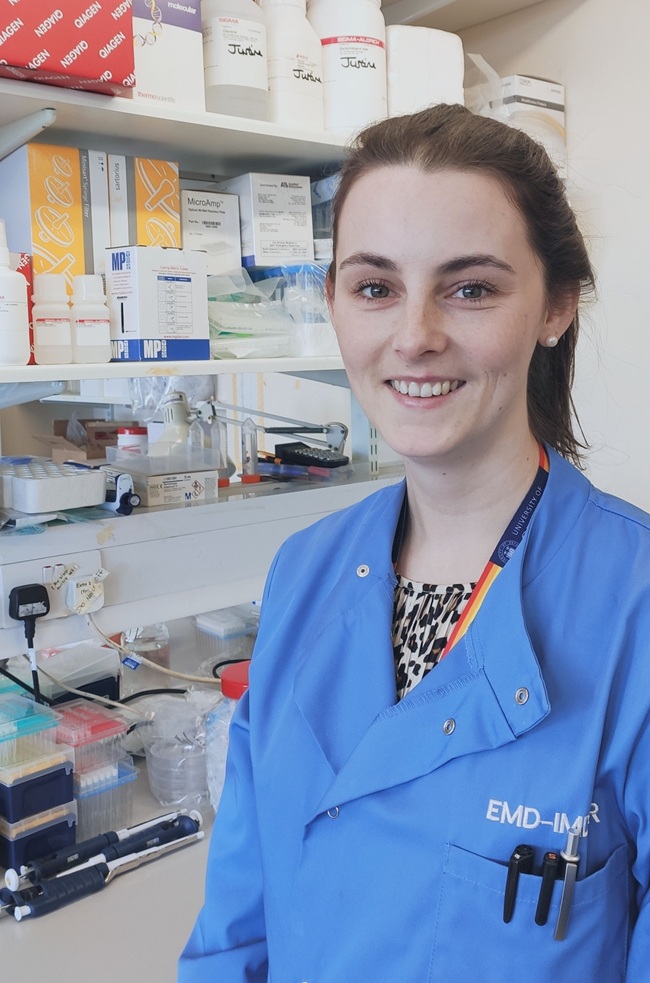
Delivered through the Academy’s flagship Springboard programme, the grants support curiosity-driven, discovery-stage research – the foundational science that underpins future treatments and interventions. The awards support researchers to take their first steps as independent group leaders, testing bold ideas with the potential to improve lives, reduce health inequalities and strengthen the UK’s long-term research base.
Now in its 11th year, the Springboard programme supports researchers at a critical point in their careers, when many are establishing laboratories for the first time and need the freedom to explore ambitious questions.
Dr Rudkin’s work focuses on nasal colonisation by the prolific pathogen Staphylococcus aureus, which colonises the nasal passages of up to 50% of the population. Having this bacterium living in your nose is a major risk factor for developing S. aureus infections such as pneumonia and sepsis.
Alongside her team, Dr Rudkin is working to understand how this bacterium anchors itself within the nasal niche. The new AMS Springboard funding will be used to investigate the interaction between S. aureus and the protective mucus layer covering nasal epithelial cells.
Dr Rudkin said: “I am very proud to be awarded AMS Springboard funding, which will be transformative for both my research group and my own development. In addition to supporting research costs and enabling the recruitment of a new team member, I am thrilled to have funds to attend a residential training course that has been on my bucket list for a while now.”
Having recently marked a decade of impact, the programme has now supported 471 early career researchers at 68 UK higher education institutions, expanding institutional and regional reach with researchers at the University of Lincoln and the University of Greenwich funded for the first time this year, and more than £50.5 million invested since it’s creation in 2015.
With support from the UK Government’s Department for Science, Innovation and Technology, Wellcome and the British Heart Foundation, this year’s awards span the full breadth of biomedical and health research. Together, these projects aim to help people to live healthier lives, reduce health inequalities and strengthen the UK’s ability to prevent and respond to future health emergencies.
UK Science Minister Lord Vallance FMedSci said: "To tackle cruel diseases like Alzheimer’s, Parkinson’s and chronic pain, and ultimately save lives, we must help researchers to take their ambitious discovery-stage work to the next level. This support is backing researchers at a stage where attracting commercial investment can be a challenge and builds on the Government’s record investment in research – unlocking more discoveries that benefit people across the UK and beyond."
Professor James Leiper, Director of Research at the British Heart Foundation, said: “Tomorrow’s medical breakthroughs start with today’s innovative ideas. Programmes like Springboard give early career researchers the backing and belief to take risks, follow their curiosity and ask questions that can change lives. We’re proud to support this work which has the potential to unlock new insights into heart and circulatory diseases, and open doors to better prevention and treatments, strengthening the UK’s research talent for years to come.”
Ben Murton, Head of Early Careers and Career Development Researchers at Wellcome, said: "Early career researchers need time and resource to establish their research identity, benefitting from larger and longer grants, which we’re committed to providing through our Discovery Research programme at Wellcome. Springboard provides an opportunity to launch into a research career and establish a research group, encouraging researchers to ask the big questions and pursue the bold ideas that lead to cutting-edge, curiosity-driven discoveries. The diversity of areas and approaches supported through Springboard is essential for a healthy pipeline of future research leaders.”
Enquiries: ali.howard@glasgow.ac.uk or elizabeth.mcmeekin@glasgow.ac.uk
First published: 15 April 2026
<< MVLS News