

Mathematical Modelling of the Human Eye
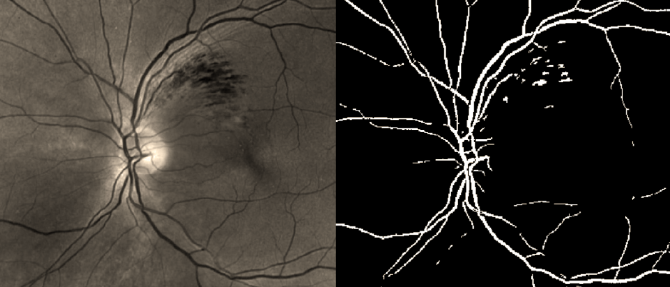
The light sensitive portion (the retina) requires large amounts of nutrient to accommodate metabolic demand, and as such requires two dedicated vascular systems. These systems are both fed from outside the eye, and form an interesting point of coupling between the eye and the external environment. Mathematical modelling of these vasculatures is possible using sophisticated image extraction technique to form an interconnected vascular network. Analysis of these models has been used to quantify fluid pressure changes within the eye, particularly in the aftermath of a traumatic brain injury.
Researchers
Publications
- A model of the mechanisms underpinning unconventional aqueous humor outflow. Investigative Ophthalmology & Visual Science, 66(4), (2025).
- Rapid amplification of cerebrospinal fluid pressure as a possible mechanism for optic nerve sheath bleeding in infants with nonaccidental head injury. Investigative Ophthalmology & Visual Science, 65(12), (2024).
- A discrete-to-continuum model for the human cornea with application to keratoconus. Royal Society open science, 11(7), (2024).
Grants
- EPSRC First Grant - Elastic Jumps on Networks
- SofTMech with MIT and POLIMI (SofTMechMP): EP/S030875/1
- SofTMech^SET: EP/T017899/1