

Sii colleagues win national teaching innovation award
Published: 17 February 2026
A cross-Life Sciences team including School of Infection & Immunity pair Dr Laura McCaughey and Dr Claire Donald has been recognised with a LearnSci Teaching Innovation Award for pioneering the use of Smart Worksheets to transform how R/RStudio and statistical analysis are taught to Year 2 students.
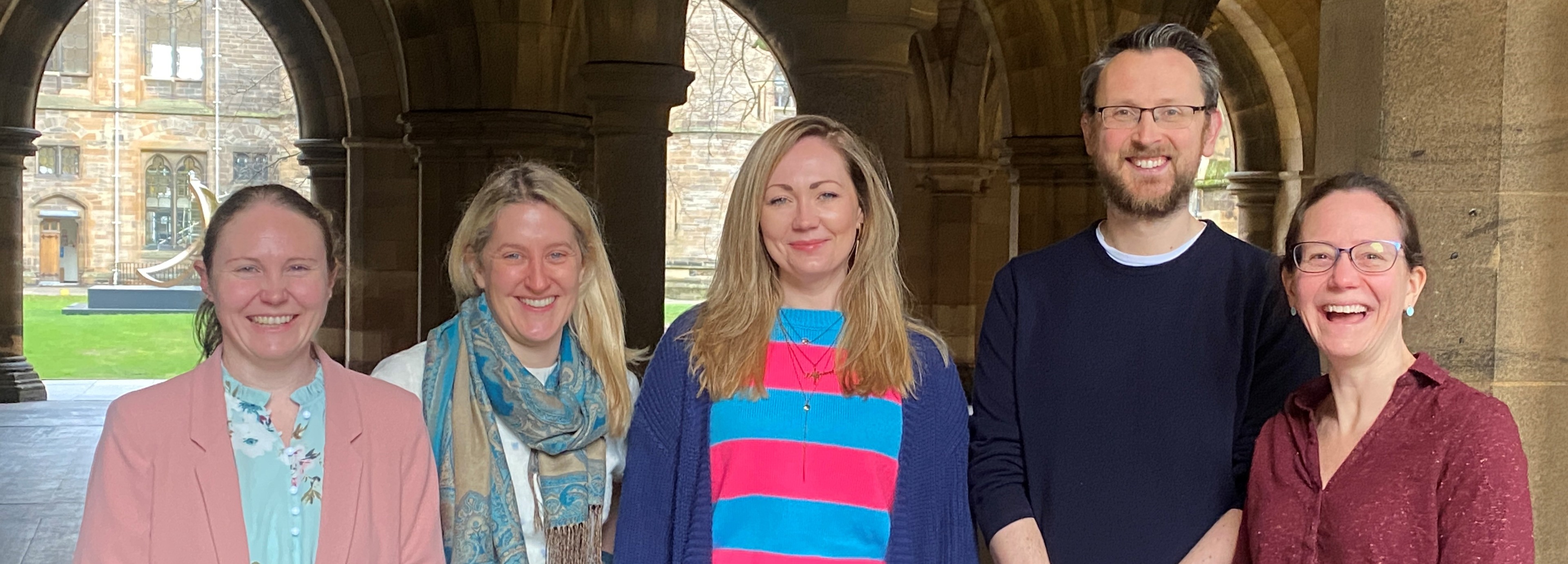
A cross-Life Sciences team involving two School of Infection & Immunity colleagues has been recognised with a LearnSci Teaching Innovation Award for pioneering the use of Smart Worksheets.
Sii pair Dr Laura McCaughey and Dr Claire Donald, Dr Anna McGregor, Dr Denise Hough, and Dr Donald Reid (School of Biodiversity, One Health & Veterinary Medicine), and Dr Pam Scott (School of Molecular Biosciences) received the award for developing the first LearnSci Smart Worksheets specifically designed to support statistical programming in R.
R and statistical analysis are core skills for life sciences graduates, underpinning data interpretation, reproducible research and evidence-based conclusions.
At UofG, R/RStudio is taught to around 2,200 students across Years 1–5. However, for early-year students, programming and statistical theory are often entirely new, and large cohorts (200–700 students) can limit opportunities for individual feedback.
The team’s solution was to create customised Smart Worksheets that provide real-time feedback on coding errors and on the accuracy of commands, statistical tests and figures.
The aim: build confidence, deepen understanding and make high-quality support scalable across large classes.
The Smart Worksheets were rolled out in three Year 2 courses:
BIOL2044 (Microbiology & Immunology, 320 students): Used summatively with unique datasets, enabling students to complete and receive feedback on the data analysis section (worth 30 per cent) before writing the rest of their lab report. This helped separate complex data analysis from interpretation and narrative writing, improving overall report quality.
BIOL2039 (Fundamental Biology, 650 students) and BIOL2041 (Animal Biology, 210 students): Used formatively, providing structured, interactive support in large lab settings where staff-to-student ratios limit individual feedback.
Feedback from 249 students demonstrated clear impact, with 82 per cent rating 8–10/10 when asked if they would recommend Smart Worksheets (mean 8.6/10).
Confidence increased in: General data/statistical analysis (+0.54 on a 1–4 scale) and Using R (+0.65 on a 1–4 scale), with 89 per cent agreeing or strongly agreeing that the worksheets supported a deeper understanding of R.
Students highlighted the value of real-time feedback, step-by-step structure and a focus on interpreting outputs rather than memorising code.
One respondent said: “[It] allowed me to think for myself more, instead of just being told what to do. It extended my knowledge of what the data actually tells me.”
Another stated: “It really upped my confidence in knowing that I was moving forward correctly, both in continuing to code and in writing my lab report.”
The team also observed reduced demand for R drop-in sessions and more efficient marking processes.
Unexpectedly, the worksheets also supported students with social anxiety by reducing the need to seek help publicly during labs.
One student summed up the experience as: “Probably the most helpful thing I’ve had at uni so far.”
The LearnSci judging panel, meanwhile, praised the project as ‘exceptional’ and ‘a fantastic team effort’.
The team is now expanding Smart Worksheets into Year 1 and additional Year 2 courses, extending the benefits across the Life Sciences portfolio.
Congratulations to Laura, Claire, Anna, Denise, Donald, and Pam on this well-deserved recognition!
First published: 17 February 2026