

Our Research
We live in an era of great, and often interlinked, environmental and societal challenges, including biodiversity loss, food security, climate crisis and disease emergence. Our School is uniquely positioned to address many of these challenges in novel and impactful ways by combining world-leading and complementary expertise in biology, veterinary science, comparative health, mathematical modelling, and social science. To do this, we endeavour to bring new interdisciplinary approaches and technologies to the fore to drive research innovation and to span all levels of biological organisation from cellular, whole animal and
population, to the (eco)system scale. Our vision is to deliver research that combines discovery-led science with targeted interventions and applications, aimed at making real-life progress to our understanding and management of biological systems.
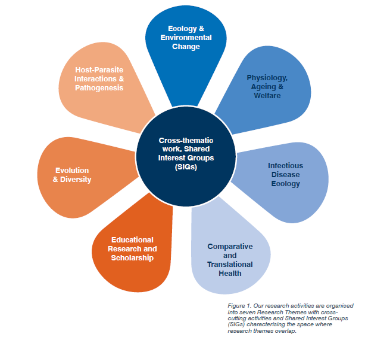
Structurally, our staff reside within seven research themes (Figure 1). The purpose of these themes is to provide focal points for the organisation of research activities and events (including cross-cutting Shared Interest Groups) and give staff and students a platform to interact and collaborate.
Strategic Aims
 Building on existing areas of strength and responding to topical research challenges in One Health, our strategic focus covers four main areas:
• Disease Ecology (vector-borne diseases, zoonoses, anti-microbial resistance, parasitology)
• Environmental Change/Biodiversity (evolution, eco-physiology, conservation science)
• Sustainable Animal Health and Production (emerging technologies in animal/animal health research, comparative genomics, animal physiology/nutrition/welfare, aquatic biology/aquaculture, land use, green economy, nature markets and companion animal health)
• Quantitative Modelling and One Health Solutions (mathematical and statistical models and inference, machine learning/artificial intelligence, model-guided interventions, evaluation)
To advance these focal areas, we aim to:
(1) Strategically invest in individuals who amplify our current distinctive strengths in challenge-led One Health research and discovery science whilst having the foresight to recognise, invest and build capacity in emerging new areas that enable us to be at the leading edge internationally.
(2) Promote our research strengths particularly to Government and external bodies to ensure our School is front and centre when people think of One Health at a University, national and international level.
(3) Prime external collaborations and strategic partnerships nationally and internationally to enhance our ability to obtain larger funds for multidisciplinary research. Solidifying a critical mass of partners will enhance future success in what we know will be a more competitive, unpredictable, and austere economic and external funding environment.
(4) Support our research leaders as critical and influential nodes within the School that are empowered to enhance our ability to influence research policy, create impact, network, build international reputation and enable agile cross-disciplinary working leading to the generation of externally funded Centres of Excellence and doctoral training programmes.
(5) Support fundamental discovery science research with particular emphasis on enhancing our biological understanding using access to top-level equipment and curiosity-driven research to drive discovery-led innovation.
(6) Effectively utilise leadership and mentorship programmes to support the full potential, ambition and development of our staff and students towards key leadership positions in research areas of high strategic value to the School.
(7) Integrate our clinical expertise and hospital infrastructure with the rest of the College community to drive new avenues for translational research
(8) Expand our vibrant PGR community in parallel to securing career opportunities for Fellows recognising that these early career scientists are our future.
(9) Develop PGT courses and programmes which will help stimulate cross-disciplinary activity and help build Glasgow’s identity in planetary health.
EXAMPLES OF RECENT PROGRESS AND SUCCESS
Aquaculture is a major part of the Scottish economy that exemplifies both the promise and challenge of offering sustainable, home-grown solutions to food security. We have supported new innovative research approaches that respond to industry needs by providing portable experimental field study systems for aquatic production in an environmental context. This has resulted in over £3M of funding across four awards from the Biotechnology and Biological Sciences Research Council (BBSRC) and other sources.
With a focus on sustainable aquaculture – the farming and harvesting of fish, shellfish and aquatic plants – the research team will focus on farmed salmon and seaweed across the four projects. A future post in veterinary fish health will complement our current expertise in fish biology and physiology and unlock new funding and industry collaborations in this area.
Taking a One Health approach that extends into economics and social science, we are also investigating aquatic food production systems and sustainability in an international context. This includes new funding from BBSRC (£1.1M) to examine important links between aquaculture and managing antimicrobial resistance in Southeast Asia (see ‘International Partnerships).’
Finding new ways to promote Biodiversity, Green Economy, and Net Zero, and to reap co-benefits by looking at these issues holistically, are high priorities for the UK and Scottish governments. Our prior strategy of cross-School appointments in Environmental and One Health Economics has led to involvement in an impressive series of recent funding, including multiple large UKRI awards, including

RESPECT - £3.8M, COAST-R Network - £2.0M and RACC - £2.9M). SBOHVM scientists also led a major strategic initiative (‘Nature Markets’) around incentivising land use change that maximises benefits to society with respect to climate change, biodiversity and public health. It is exceptionally well aligned with MVLS 2033 and UofG’s strategic ambitions, which include Glasgow Changing Futures, the Centre for Sustainable Solutions and Planetary Health. This work has paved the way for a successful bid for a NERC Doctoral Focal Award (‘NetGAIN’, total value: £2.6M + 100% matched value from industry and 9 PhD studentships to UofG).
How animal populations respond and adapt to changing environmental conditions, from changes in climate to urbanisation, is another major strand of our work, with new research projects supported by Leverhulme and other funders (£0.65M in total).
Recent advances in Artificial Intelligence (AI) and Data Science offer unprecedented opportunities to leverage new insights from large biological data sets. In partnership with colleagues in the School of Mathematics and Statistics, SBOHVM researchers managed to secure a Leverhulme Doctoral Training Programme to apply analytical approaches and AI to ecological data. The award will bring £2.2M and fund 3 MSc scholarships and 18 PhD studentships at UofG over the next eight years. The appointment of Farrell, a new lecturer applying machine learning to understand animal and pathogen macroecology, further strengthens our technical expertise in this critical area, which is bound to have important repercussions for the future of biological and veterinary science.

Our School is globally recognised for its research excellence in Vector Biology. Notable newly-funded projects that cover international as well as UK-based work are supported by The Bill & Melinda Gates Foundation (£3.8M) and UKRI (£1.25M) and involve a large number of our staff bringing complementary expertise and strategic partners, including the MRC-University of Glasgow Centre for Virus Research, UKHSA, UKCEH and Ifakara Health Institute. A key component in our strategy for growing our profile in vector biology was the recruitment of Professor Fredros Okumu, a world leader in the study of malaria vectors and their control, in 2023. This has been instrumental in broadening our research network and securing recent awards from the European Union (VectorGrid-Africa - €6.1M) and Wellcome (£5.0M).
As the School leads in the College theme of Planetary Health, we build on our well-recognised expertise and strengths to develop new interdisciplinary research and teaching to address the health of the Earth’s natural systems, and all forms of life that depend on them. Methodologies in complex intervention research have been widely applied in public health, for example, through the NIHR and MRC framework for complex intervention research. However, these approaches have the potential for broader application to other ecological, environmental or economic interventions relevant to Planetary Health.
Within SBOHVM, we already have a strong track record in intervention research, for example, through large-scale process evaluations of rabies control interventions in the Philippines, the management of antimicrobial resistance in Tanzania, the control of schistosomiasis in Uganda (including a recent £8.1M Wellcome award), and planned interventions in marine mammal entanglement programs. We will develop this capacity further, creating a distinctive identity for Glasgow as a centre of expertise in Planetary Health interventions. A key objective of the Planetary Health theme is to identify opportunities for supporting areas and carrying out new research that might not fall neatly into existing disciplinary boundaries and intervention strategies. An illustrative example for this approach is a recent $3.4M award from the Coalition for Epidemic Preparedness Innovations to tackle the threat of Rift Valley Fever virus emergence.