

Biennial Report 2023-2025
Head of School Welcome
 Dear Colleagues,
It has been a great privilege to have served as the Head of School for two years. In that relatively short time, we have concluded the merger of two separate communities to form the School of Biodiversity, One Health and Veterinary Medicine (SBOHVM) and made considerable progress in restructuring the School.
We are now moving into a phase of strategic delivery. Our School is large and diverse in every respect, whether in regard to the number of students and staff, or our infrastructure that extends from Loch Lomond to Lanark. With that size comes great opportunity and breadth of expertise to improve animal health, produce societal benefit, and acquire a greater understanding of the natural world.
I have been overwhelmed by the dedication and team spirit here in the School and I look forward to realising our ambitions over the coming years. It is important that we celebrate the enormous success we have achieved thus far and so it is with great pride that I share with you this report to highlight our achievements and
communicate our future strategic direction.
Professor Christopher Loughrey
BVMS PhD FRCVS FRSB FHEA
“I have been overwhelmed by the dedication and team spirit here in the School and I look forward to realising our ambitions over the coming years.”
A New Vision
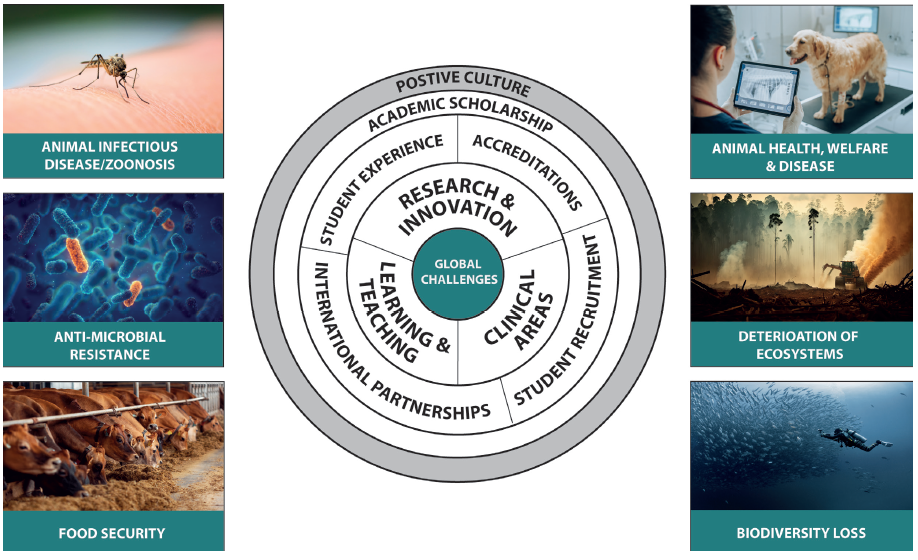
 Our society faces enormous critical global challenges including animal infectious disease/zoonoses; animal health, welfare and disease; antimicrobial resistance; deterioration of ecosystems; food security; and biodiversity loss. These are amplified by environmental change and affect health inequalities, human health and socioeconomics. The SBOHVM’s world-leading expertise in understanding the interactions between humans, animals and ecosystems (One Health) and well-practised modes of collaborative working make us a cornerstone in the University of Glasgow’s mission to address these global challenges and change the world.
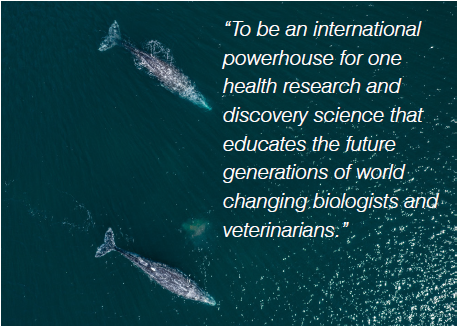
Our vision is to be an international powerhouse for one health research and discovery science that educates future generations of world-changing biologists and veterinarians. The vision underpins a desire to embrace bold transformational change while preserving our culture of collaboration and community. Our mission is to centralise the importance of global challenges and use them to shape our research, educational and clinical strategies. This will enhance our student experience (in particular, how we prepare our students to address future challenges), influence how we recruit students, feed into our accreditation processes and dictate the types of national and international partnerships we form. A focus on academic scholarship is key to achieving this mission as is the importance of ensuring a positive culture for our students and staff that is inclusive, supportive and upholds the University values of equality and diversity. These values must permeate all our activity.
A Revised Leadership Structure
Planning, strategy and optimisation of resources form the core ethos of our leadership structure. Some decisions require an agile and reactive response, balanced with future planning. To that end, we have formed a successful Head of School group that meets weekly to address topical issues relating to HR and finance. In parallel, we also have a School Executive group, which meets monthly to address strategic decisions.
The group includes the key leaders of the School who have line management of over 550 staff and Directors who take strategic responsibility for our future direction and leadership of their functional areas. The future is often unpredictable, but the philosophy of these two leadership groups is that we take control of what we can control and take charge of where we can to move forward strategically.
School Executive
Head of School’s Group
Director of Education (Life
Sciences)
Director of Education (Vet)
Director of Innovation
Director of PGT
Director of Commercial
Operations
Head of Farm Animal Clinical
Sciences
Head of Path, Public Health &
Disease Inv.
Head of Veterinary Teaching
Team
Head of Equine and Small
Animal Health
Head of School's Group
Head of School
Three Deputy Heads of
School
(Research, Learning and
Teaching, and Clinical)
Head of Professional
Services (PS)
Deputy Head of PS
Professional Services
Manager
HR
Finance
Director of EDI
Research Theme Leads
Infectious Disease Ecology
Physiology, Ageing and Welfare
Evolution and Diversity
Host Pathogen Interactions
Ecology and Environmental
Change
Educational Research and
Scholarship
Comparative and Translational
Health
NEW INVESTMENT AND STAFF APPOINTMENTS
Between August 2023 and August 2025, we made appointments to new academic and professional services posts, including:
• Animal Nutrition
• Antimicrobial Resistance
• Aquatic Ecology/Director of Scottish
Centre for Ecology and the Natural
Environment (SCENE)
• Lecturer in Infectious Disease Ecology
• Lecturer in Artificial Intelligence
• Research Fellow in One Health
Interventions
• Small Animal Surgery
• Accreditations Officer
• Pathology
• Clinical Skills
• Equine Medicine
• Clinical Pathology
• Anaesthesia
• Out-of-hours clinicians
• Head of the Equine Practice
• Head of Pet Practice
• Clinicians in the Pet Practice
• Diagnostic imaging
College and University Alignment
We are a central and critical node in the delivery of the ambitions of the College and University. As a result, we have fostered important links across the wider University community with two main areas of focus. The first is with the College Futures themes of Planetary Health, Health Inequalities, Advanced Therapeutics and Diagnostics, and Fundamentals of Life. As a School, we have embraced leadership of the Planetary Health theme and we continue to work towards alignment with the remaining three themes. The second area relates to the University’s Glasgow Changing Futures strategy, which focuses on Sustainability and Health Inequalities.




Our strategic focus strongly aligns with both of these themes. We have also created strong links with other Colleges and aim to strengthen these with a wider variety of exemplars. This includes the Centre for Sustainable Solutions, Water and Environment, Geography and Earth Sciences, Urban Studies, International Relations, Anthropological Research, Sociology, School of Education, Systems, Power and Energy, Smart infrastructure, Chemistry, Engineering and Computing, particularly around modelling and AI.