

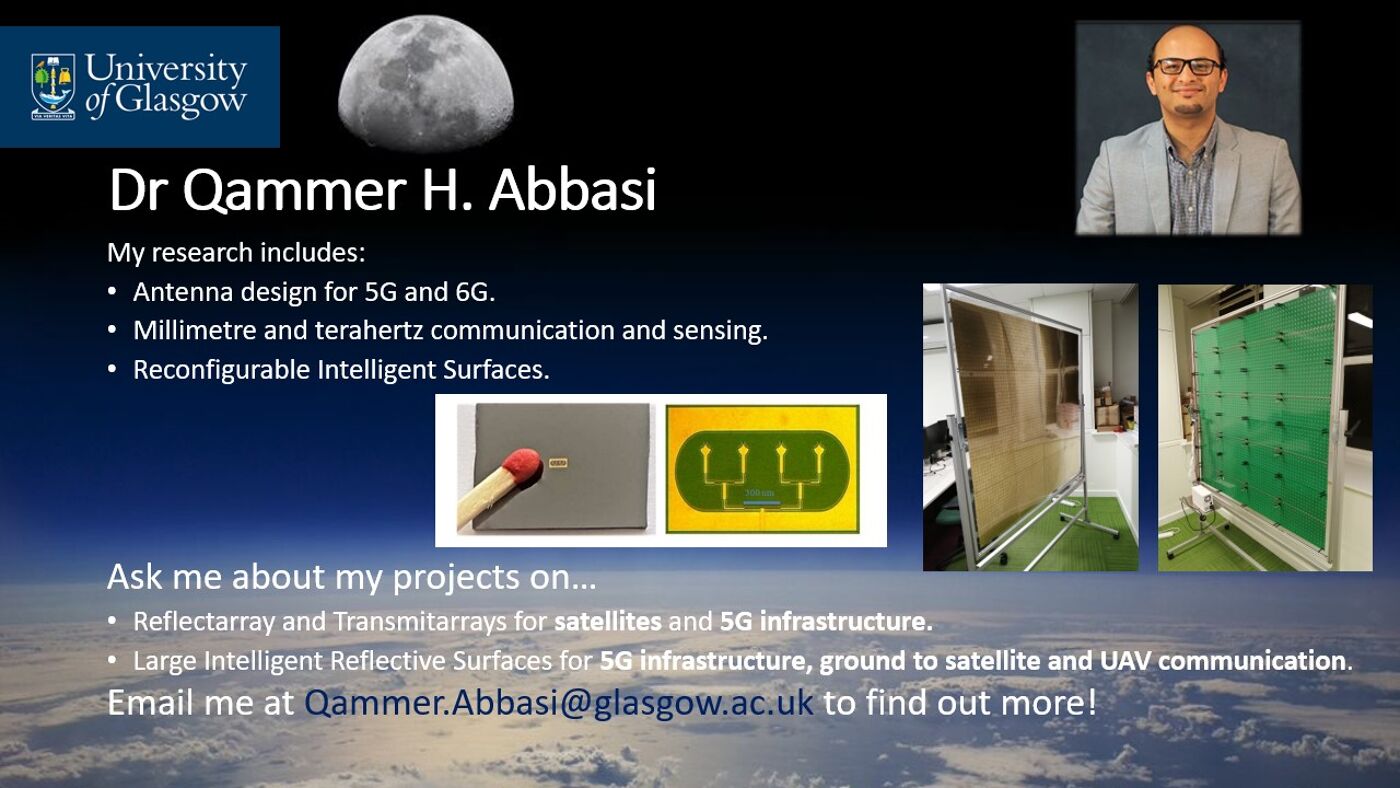
Professor Qammer H. Abbasi
My research includes:
- Antenna design for Satcom, 5G and 6G
- Millimetre and terahertz communication and sensing
- NTN
- Reconfigurable intelligent surfaces
- Integrated sensing, computing and communication
Projects
- Reflectarray and transmitarrays for satellites and 5G infrastructure
- Large intelligent reflective surfaces for 5G infrastructure, ground to satellite and UAV communication
- Heating effect in SATCOM
Dr Matteo Ceriotti
I develop trajectory design and optimization techniques for space missions. I exploit unconventional propulsion techniques (such as solar sailing) and natural perturbations (such as multi-body gravitational environments) to devise and enable new mission concepts.
I also use machine learning to replace conventional global optimisation techniques, reducing the computational time when the problem size is extremely vast, for example for multi-target space missions. Applications range from debris removal for sustainable use of near-Earth space to missions to asteroids for planetary science.
Professor Lee Cronin
We have no idea what biochemistry is possible beyond Earth. However, only living systems can produce complex molecules in abundance, so we have developed a theory and experimental measure of molecular complexity which we can use for detecting life. We are collaborating with NASA towards building a flight instrument for mapping the molecular complexity in extra-terrestrial samples. As part of our digitization of chemistry and Chemputer project we are also collaborating with satellite companies such as SpacePharma to develop automated chemical synthesis in microgravity environments.

Dr Luke Daly
I co-lead the UK Fireball Network that images fireballs and track meteorites to find out which asteroids they come from and where they land. We recently helped recover the Winchcombe meteorite in 2021.
I use correlative microanalysis to analyse changes that occur in materials in response to Space Weathering.
By studying water-rich meteorites, Martian Meteorites and asteroid sample return mission materials we are uncovering new reservoirs of water in our Solar System and inferring how they evolve and interact on rocky bodies, to help answer the question where did Earth’s oceans come from?
Projects
- Imaging the night sky. The UK Fireball Network takes pictures of the night sky every 30 seconds from six different locations capturing fireballs and also weather, stars, satellites etc.
- Correlative microanalysis. Our analytical pipeline can be readily applied to uncover micro-nano-scale structural features of any material from rocks to satellite components.
Professor Patrick Harkness
Projects

Professor Muhammad Imran
- Future wireless technologies (5G, 6G)
- UAV Communication
- Terrestrial/Non-Terrestrial communication
- Reconfigurable Intelligent Surface
Projects
- Satellites and 5G infrastructure.
- 5G infrastructure, ground to satellited and UAV communication.
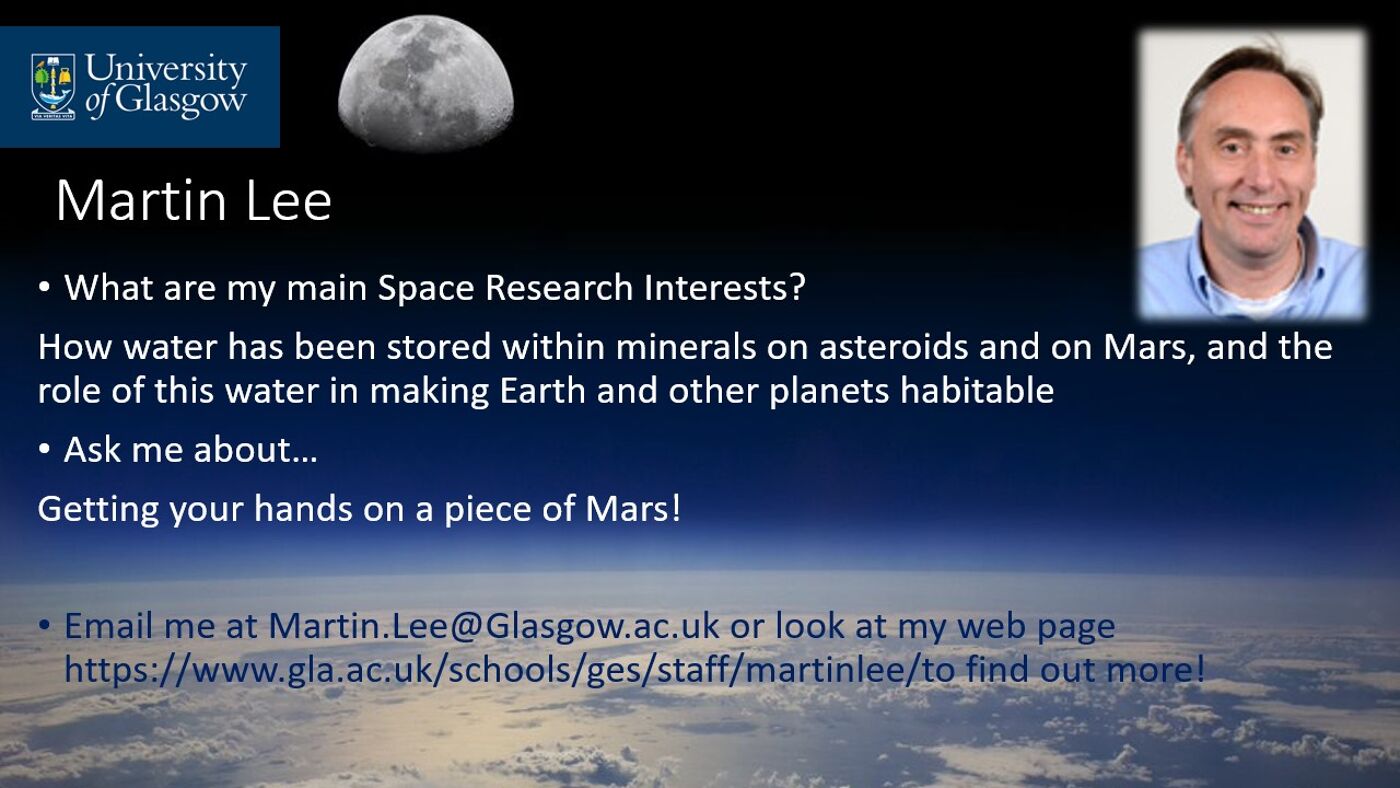
Professor Martin Lee
How water has been stored within minerals on asteroids and on Mars, and the role of this water in making Earth and other planets habitable
Ask me about…Getting your hands on a piece of Mars!
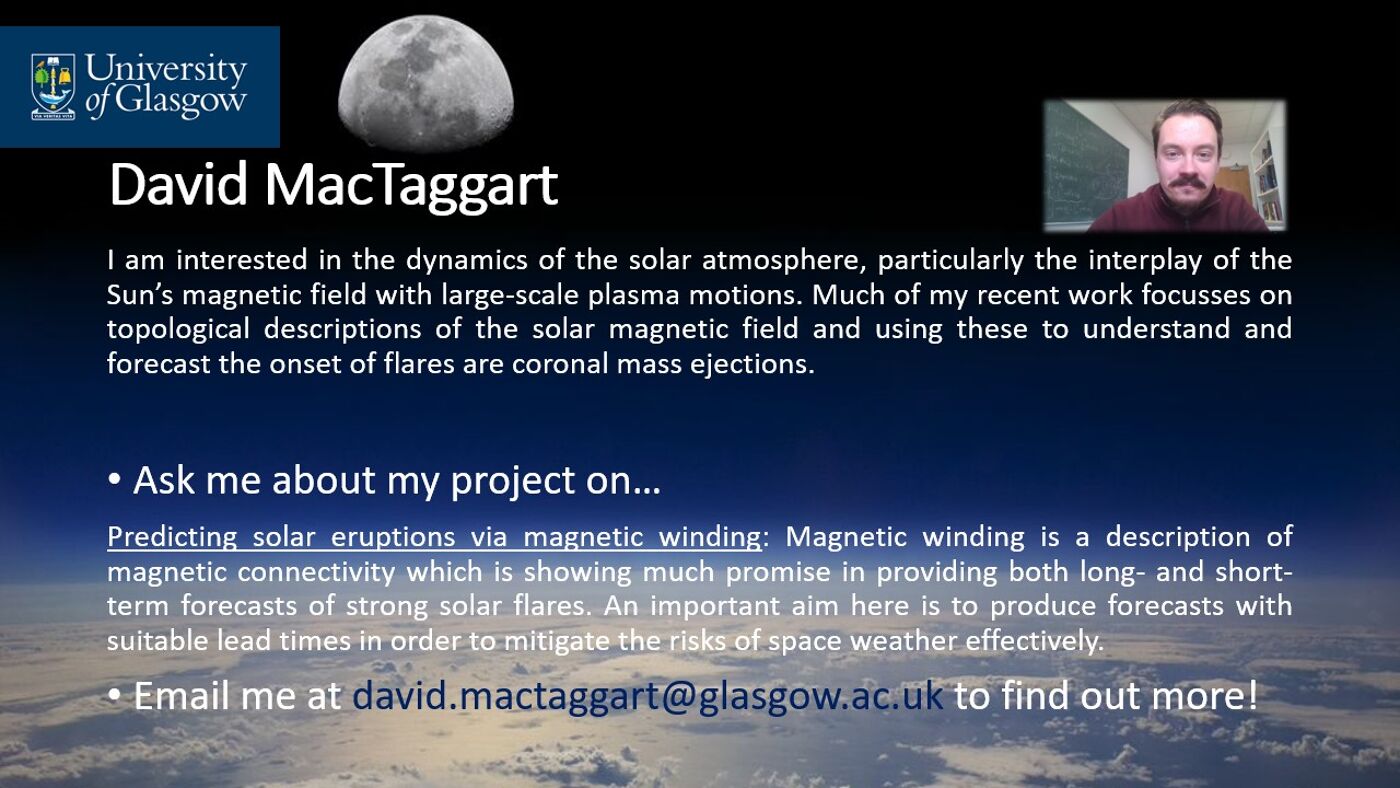
Dr David MacTaggart
I am interested in the dynamics of the solar atmosphere, particularly the interplay of the Sun’s magnetic field with large-scale plasma motions. Much of my recent work focusses on topological descriptions of the solar magnetic field and using these to understand and forecast the onset of flares are coronal mass ejections.
Predicting solar eruptions via magnetic winding
Magnetic winding is a description of magnetic connectivity which is showing much promise in providing both long- and short-term forecasts of strong solar flares. An important aim here is to produce forecasts with suitable lead times in order to mitigate the risks of space weather effectively.
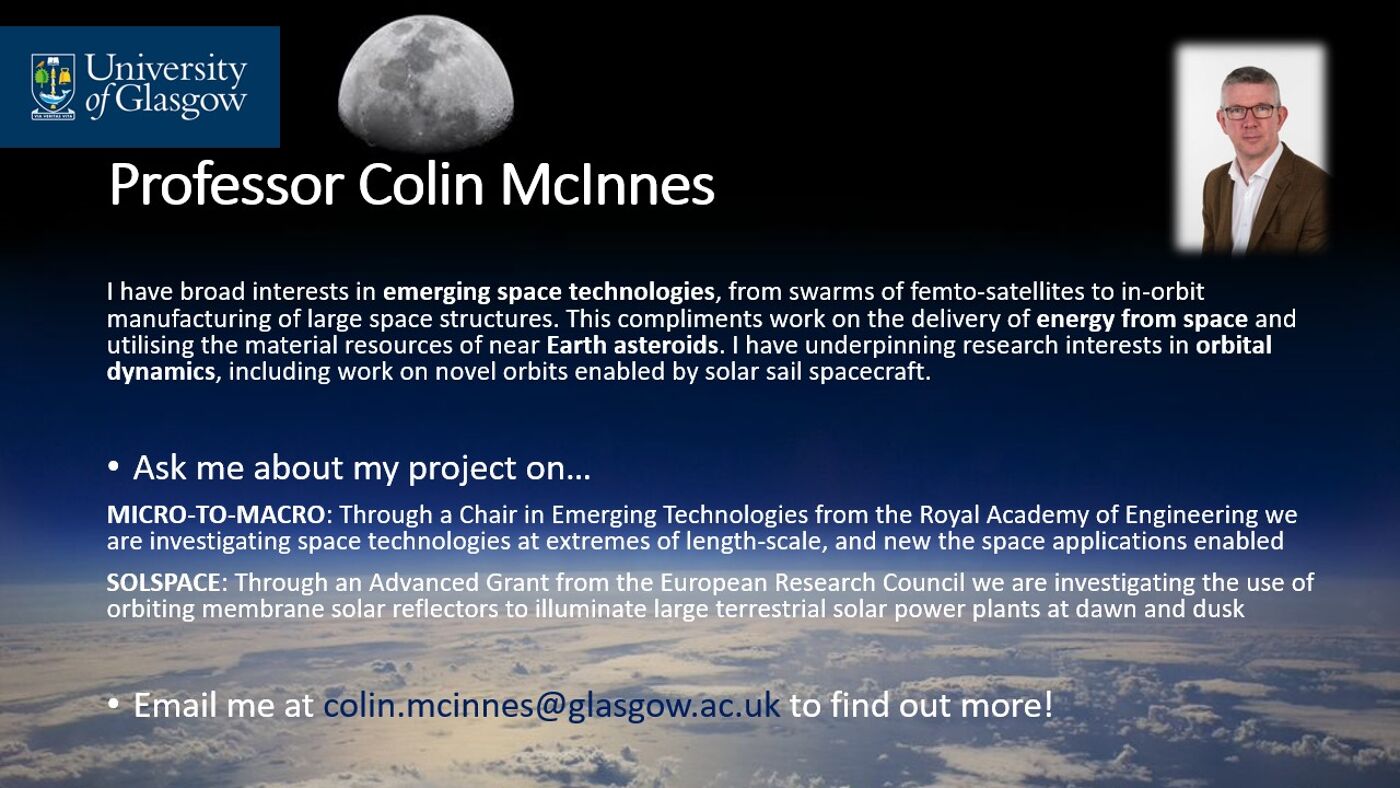
Professor Colin McInnes
I have broad interests in emerging space technologies, from swarms of femto-satellites to in-orbit manufacturing of large space structures. This compliments work on the delivery of energy from space and utilising the material resources of near Earth asteroids. I have underpinning research interests in orbital dynamics, including work on novel orbits enabled by solar sail spacecraft.
Projects
MICRO-TO-MACRO: Through a Chair in Emerging Technologies from the Royal Academy of Engineering we are investigating space technologies at extremes of length-scale, and new the space applications enabled
SOLSPACE: Through an Advanced Grant from the European Research Council we are investigating the use of orbiting membrane solar reflectors to illuminate large terrestrial solar power plants at dawn and dusk
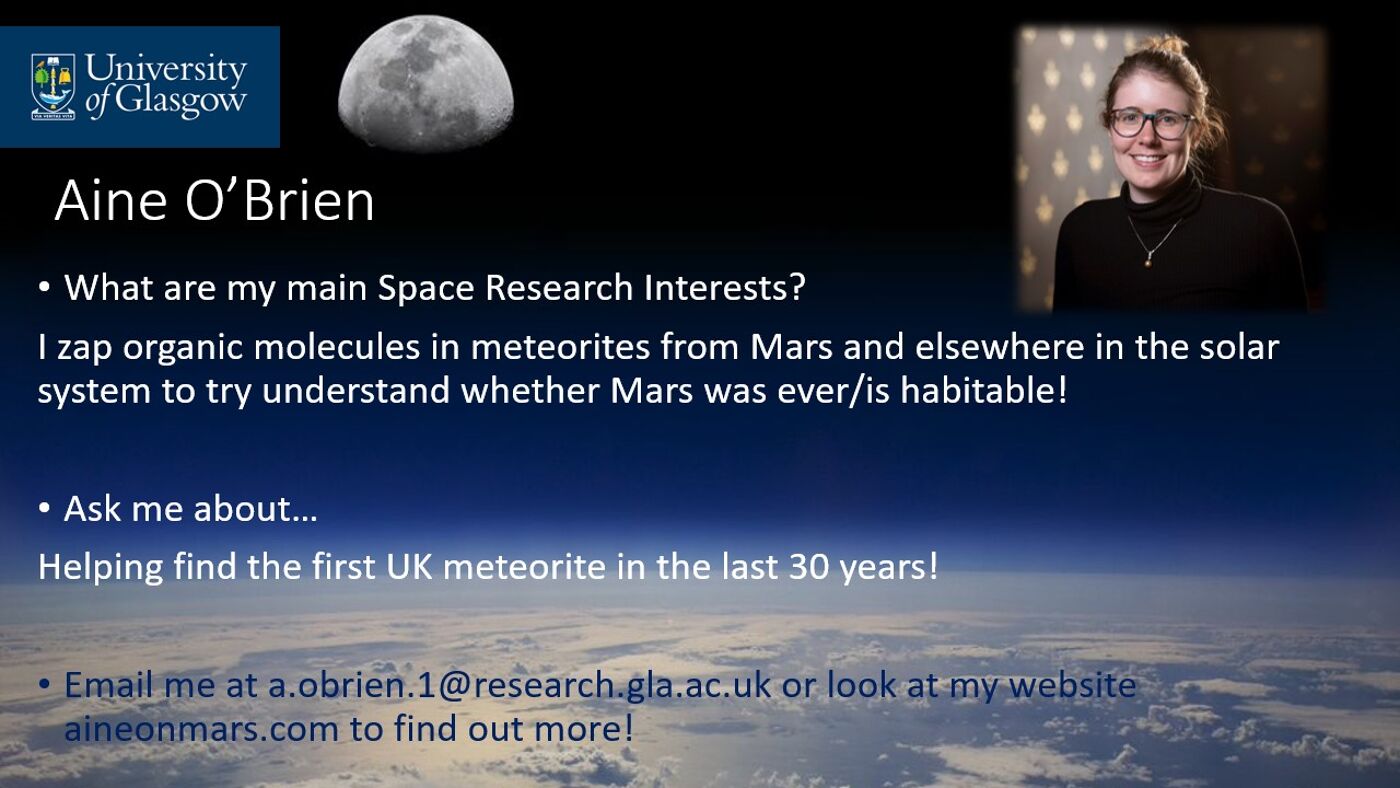
Dr Áine O’Brien
Dr Imran Shafique Ansari
I investigate wireless channel models for spectrally efficient and secure beyond 5G (B5G) satellite communications.
I am also exploring efficient energy harvesting solutions for wireless communications B5G in LEO / MEO via utilising free-space optical technology.
Projects
- System performance over a decode-and-forward relay experiencing k-u shadowed fading.
- Demystifying future satellite networks from security perspective.

Professor Fin Stuart
I measure the trace quantities of gases trapped in primitive meteorites to determine when they were ejected from their parent body and to identify if they preserve remnants of material that pre-dates the formation of the Solar System.
Ask me about new ways to determine how the lunar surface has evolved. We have developed a method using Neon Isotopes produced by Galactic Cosmic Rays to determine how efficiently the upper few metres of lunar soil is gardened by meteroid impacts and electrostatic levitation.
Dr Mark Symes
Applications of electrochemistry in space. For example, oxygen and hydrogen production from water under low gravity and extreme conditions, electrolysis of regoliths for oxygen and metal extraction and development of electrochemical systems for closed chemical cycles (e.g. for life support and resource recycling to support human space exploration).