

Inside Dr Koutmeridis’s “Democracy Lab”: A Classroom Where Every Voice Counts
Published: 29 April 2026
Commentary
The Democracy Lab, led by Dr Theodore Koutmeridis at the University of Glasgow, is an innovative teaching approach where students engage in open, real-world debates to develop critical thinking, global awareness, and a sense of democratic participation alongside their academic studies.
Walk into Dr Theodore Koutmeridis’s lecture at the University of Glasgow Adam Smith Business School and something unusual is already happening before the teaching begins. Students from Pakistan, Armenia, Mexico, China, Northern Ireland, Scotland and elsewhere, are debating something that happened in the world this week. They disagree. They listen. They have things to say.
This is the Democracy Lab: roughly 20 minutes at the start of each lecture devoted to open debate on a real-world topic, chosen jointly by students and their lecturer. No formal assessment, no preparation required. Everyone in the room is treated not just as a student, but as a citizen and importantly as a future leader. It has been running for four years, and everything started the morning Russian troops crossed into Ukraine. That day Dr Koutmeridis found he could not just start teaching as he originally planned. So instead, he asked students to debate on the war, and through the debate he covered the lecture material of his Development and Behavioural Economics courses.
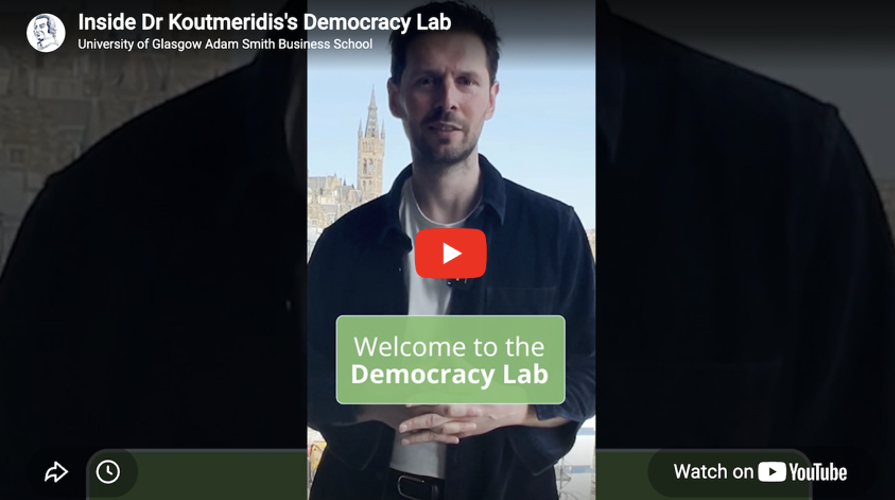
What students say about the Democracy Lab debates
Connor from Northern Ireland on the world they are entering: “After the industrial revolution and the attack on unskilled labour, now we are seeing AI and the attack on skilled labour. The way we can stand up to innovation, is through standing with each other. The Democracy Labs for standing for one another were the best way to achieve that.” He adds: “In other classes the person sitting next to me might have an entirely different opinion but I would never know.”
Paulina from Mexico on trust and democratic participation: “People are living in countries which have democratic institutions but they don’t trust them. Because their democracy is failing them… The Democracy Lab gives us a chance to have a say in our education. The students learn about the past, the present, so we can understand what we can do in the future.”
Aasiya from Pakistan on theory meeting reality: “One of the topics we covered was the five reasons for war and through the war between Iran and Israel, I was able to link that the commitment problems was one of the issues there… When I was coming to the University of Glasgow, I always wanted an environment where I can learn from the textbooks and implement in the field. From the Democracy Labs I have understood that you can still implement what you have learned remaining in the class.”
Alfie from Scotland on what universities are for: “The University is supposed to be for people that are thinking, and we are losing a bit of what it is all about… Let’s make universities again what they were for, great institutions for thinking.”
Mane from Armenia on sharing different perspectives: “Each one of us has an individual perspective and the fact that we all come from different countries adds context to your view. The ability to share your thoughts, discuss how different countries experience differently the same issues, was one of the most valuable discussions.”
Aurora from China on being encouraged rather than just assessed: “Encouraged us to share our opinions, maybe there are mistakes but always encouraged us. And I also learned that to share, respect and accept others’ opinions, is also important.”
Matt from South Africa with the clearest definition of what the Lab is for: “Democracy isn't just about majority. It’s about everyone having a voice.”
Other comments on the overall democracy lab teaching approach:
“It encouraged me to engage so much more with the class and the content.”
“It made the course worth attending. It was one of my key moments as a postgraduate student.”
“I am a cynical person but this has made me a bit more hopeful for the future.”
“It allowed me to feel less like a number and more like a person. I am really sad it is over. I guess time flies when you’re having fun.”
Beyond the classroom
The Lab has not stayed inside the lecture theatre. Inspired by the debates, students and Dr Koutmeridis have fundraised together for breast cancer research, malaria nets, and children’s clinics in Africa. He has run three marathons, in Athens, Thessaloniki, and Edinburgh, fundraising for these campaigns. Sometimes with students running alongside him. None of it was planned. It grew from the culture the debates created.
What Glasgow offers
The Democracy Lab is one example of what studying at Glasgow can look like: a safe space where students are treated as citizens, thinkers and future leaders, where the gap between the world and the curriculum is taken seriously, where students have a say on what they are taught and where difference of background, nationality, and opinion, is treated as a resource. As Ethan from China puts it: “The origin of democracy for each country is different. We simply have a different culture.” Concluding that the debates have a dual effect, acting both as: “A Platform for Diverse Perspectives” and “An Opportunity for Self-Expression.”
As Dr Koutmeridis notes: “Teaching is like playing music. In the Democracy Lab we transform the class from a classical concert where the educator/ conductor reads the slides/ music sheets, into a jazz jam session where students and educators share the stage, express themselves and become something like democratic improvisers.”
If you are considering to study, this is the kind of conversation you would be joining at the University of Glasgow.
First published: 29 April 2026