

Television turns 100: Glasgow’s export to the world
By Dr Donald McLean
Exactly a century ago, the world experienced the first public demonstration of the then-astonishing medium of television by John Logie Baird, who had studied at UofG. Dr Donald McLean, Honorary Lecturer in our School of Culture & Creative Arts, brings the event to life.
On a mild Tuesday evening in London’s West End on 26 January 1926, something remarkable took place that heralded the rise of television as the dominant medium of the 20th century.
Around 40 members of London’s Royal Institution visited John Logie Baird’s rented rooms in 22 Frith Street, Soho. They had been invited by Baird to witness something not seen before: a work-in-progress television system that could show recognisable facial expressions. Whereas Charles Francis Jenkins in Washington DC had shown televised silhouettes in the summer of 1925, Baird chose the more difficult path of televising faces lit photographically. Much was at stake; Baird was utterly reliant on success to secure his future.
It had been almost a year since the public had first seen Baird's televised moving images. The detail then had been barely enough for an emoji-like face. However, it caught the imagination of many of the shoppers crowded into London's Selfridges department store, all waiting to catch a glimpse of this promise for the future.
Throughout 1925, despite financial constraints, Baird designed and built an improved machine. This provided the detail necessary to recognise facial expressions. By early October, he knew he was on the right path.
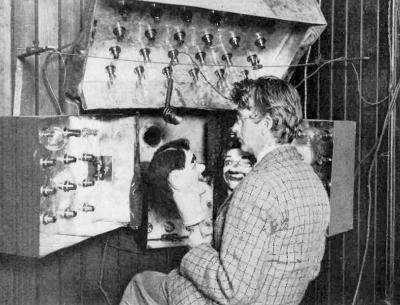
Baird in 1925 with the dummies that appeared in some of the first televised broadcasts, along with the panels of bright lights needed to produce a bright enough image at the receiver. (Image: Public domain, via Wikimedia Commons)
On that late January evening of 1926, the distinguished guests from the Royal Institution were admitted in small groups to Baird's upper-floor makeshift laboratory. As each group left, their comments revealed that very few of the guests had been impressed with or realised the significance of what they had seen.
Two days later, 'The Times' newspaper recognised Baird's achievement, identifying him as the first person to show recognisable facial expressions by television. It was, however, still early days; the article expressed uncertainty about the extent of the further development needed to make television available for everyone.
Born in Helensburgh in 1888, Baird had gained a diploma in mechanical engineering over eight years at Glasgow's Technical College. To convert his diploma to a degree, he began but did not complete a six-month course at the University of Glasgow. Rather than pursue an academic career, Baird chose to create, manage and promote his own business, despite lifelong poor health.
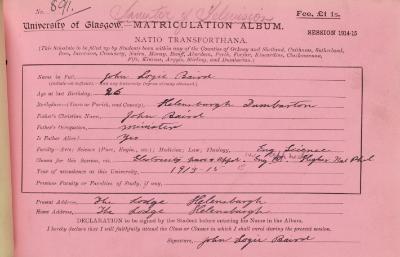
John Logie Baird’s matriculation slip enrolling him for study at UofG in the 1914–15 academic year. (Image: Courtesy of Archives & Special Collections)
Inspired by pioneering work in the early 1920s, Baird had focused down on making long-forgotten 19th-century ideas for television work. The public demonstrations at Selfridges in 1925 and Frith Street in 1926 led to further costly development with no signs of profit. Baird was the first to show television’s possibilities, thereby securing his backers' continued financial support.
Baird’s vision signal could be handled just like audio, allowing him to achieve a few impressive stunts by phone and by amateur radio that would cement his public reputation.
In 1927, Professor Taylor of the University’s Physics department talked by phone with Baird in London while watching the live image of Baird’s face on a transportable display in Glasgow’s Central Hotel. An even more notable event took place in early 1928, where guests in New York could see the televised image of a face transmitted live from London.
Items from that historic event, including the world’s earliest surviving recording of a television signal from Baird’s unsuccessful videodisc player, are held in the University’s Archives and Special Collections.
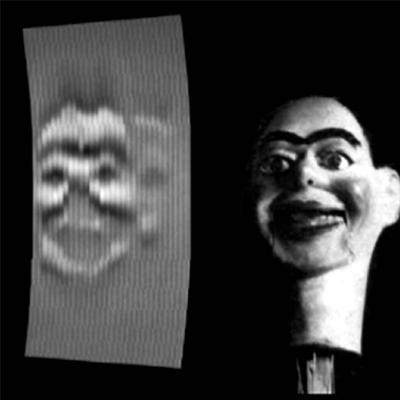
John Logie Baird’s 'Stookie Bill' ventriloquist’s dummy head used for television tests from September 1926. The image on the left was recovered by the author from the earliest surviving recording of television, held at UofG's Archives & Special Collections. (Image: Copyright DF McLean.)
While major established companies could afford to invest in long-term television development, Baird’s short-term need to make a profit out of television encouraged his most significant achievement. In 1929, he funded and operated a low-cost experimental television service with regular scheduled programmes having 30 lines per picture. These were broadcast nationally using the BBC’s existing medium-wave radio transmitters.
The BBC took over full operations for the Baird service from 1932 until 1935, after which it began the London regional television service in 1936 with 405 lines per picture. Marconi-EMI’s all-electronic and all-British engineering served as the template for all future analogue television systems. Though London and the Home Counties benefitted from the new service, viewers in Scotland would have to wait 20 years before they would again be able to see broadcast television.
From his modest beginnings in Glasgow, Baird had become by 1936 the main influencer in making Britain the world leader in pre-war broadcast television. He remains today not just the person who first showed television to the public but an example to us all of what a penniless Scotsman with passion and unwavering commitment can achieve.
This article was first published in January 2026.
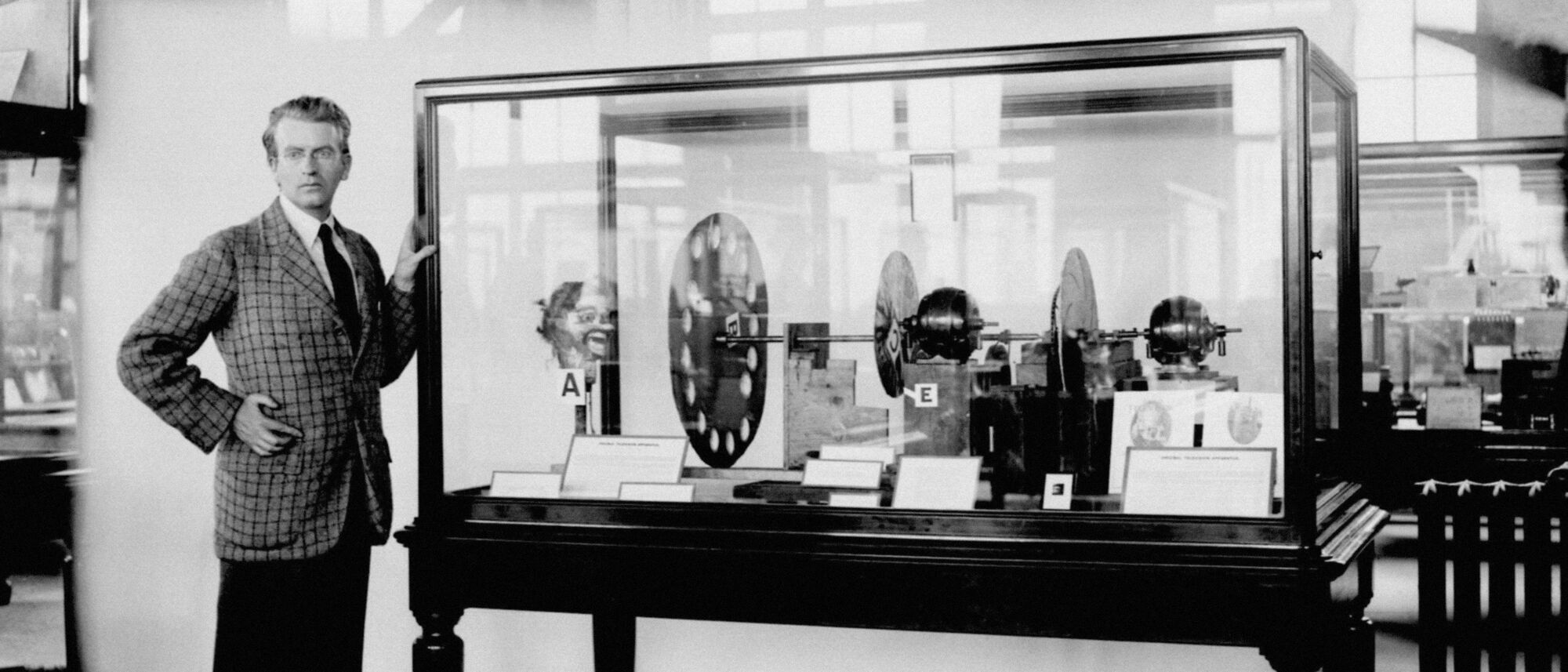
Main image: John Logie Baird later in 1926 presenting the TV apparatus he used in the January demonstration to the Science Museum in London. Image: Alamy
Image below and image left of Baird with dummies: Public domain, via Wikimedia Commons
IN HIS OWN WORDS – BAIRD ON THE HISTORIC EVENTS OF 1926