

Scientists discover the Spiderman of our cells, which traps viral genomes in its web
Published: 19 March 2026
In the same way Spiderman shoots his web to ensnarl his enemies, scientists have discovered a way in which our cells defend our bodies from the early stages of viral infection by synthesising a sticky ‘web’ to trap viral genomes.
In the same way Spiderman shoots his web to ensnarl his enemies, scientists have discovered a way in which our cells defend our bodies from the early stages of viral infection by synthesising a sticky ‘web’ to trap viral genomes.
The disciplinary spanning research – jointly led by two UKRI Medical Research Council (MRC) units, the MRC-University of Glasgow Centre for Virus Research (CVR), and the University of Dundee MRC Protein Phosphorylation and Ubiquitylation Unit (PPU) – shows a novel way in which our cells deploy this superhero technique to counter the processes that begin within minutes of a virus infecting a cell.
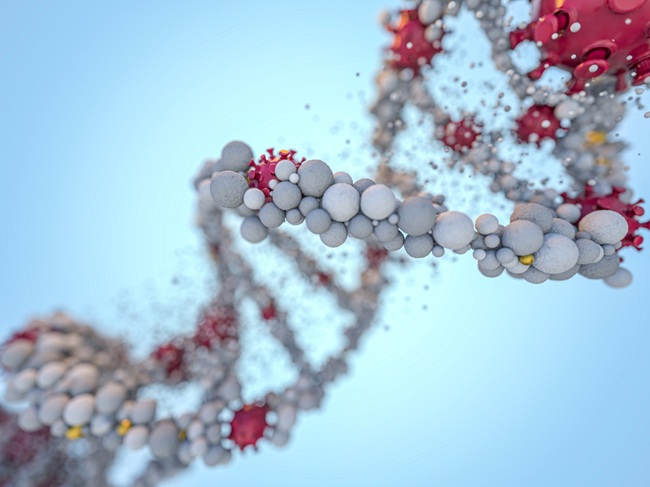
By trapping the villainous virus, the cell aims to control the early stages of viral infection to prevent replication and spread.
The researchers found that the immune system achieves this via a protein called ZNFX1, which is synthesised when a cell is alerted to the presence of a virus within a nearby cell.
When a virus first enters our bodies, it attempts to establish a niche by hiding its genome from detection. In addition, the virus manipulates essential cellular processes to enable replication, to synthesise new viral proteins, and to build new viral particles. These new virus particles then leave the cell to transmit to other cells or hosts.
However, our cells produce ‘sensor’ proteins that scrutinise molecules on entry – akin to how passport control screens the identities of those entering a new country. ZNFX1 is just such a sensor, which ‘scans’ long molecules called nucleic acids. Nucleic acids – DNA or RNA – make up the genomes of all life forms, including viruses. Somehow, by scanning RNA, ZNFX1 can discriminate what is a virus and what is from our cells.
In this research, published in Molecular Cell, the team discovered that ZNFX1 has another, secret function – an ability to deploy a spiderman-like sticky ‘web' using a molecule called ubiquitin. The web is made of chains of ubiquitin that entrap the viral genome. This ubiquitin web somehow prevents the proper, intricate function of the viral genome, slowing viral replication.
Importantly, mutations in the gene than encodes ZNFX1 can cause severe autoimmune and neurological disease – with extremely high mortality for many such affected children. The team found that some of these deleterious mutations impair ZNFX1 web formation, implying that this 'spider-like’ property of the innate immune system plays a crucial role in how our cells ordinarily defend themselves.
Ongoing work by the researchers is seeking to understand how ZNFX1 couples viral genome detection with spider-web formation. So far, the webs only appear to last for a few hours, after which they collapse, and the virus continues to replicate. Understanding why this is could provide a route to making the webs last longer – slowing replication further or inhibiting it all together.
Dr Adam Fletcher, UKRI Future Leadership Senior Fellow at the CVR, who co-led the study, said: “This is yet another elaborate way that the cell defends itself from viruses. By temporarily entrapping viral genomes, ZNFX1 seems to act like a ‘speed bump’ for the virus. Understanding how these antiviral webs form and why they dissolve would help us figure out whether they can be harnessed as antiviral medicines in the future.”
Prof Satpal Virdee, Professor of Chemical Biology at the PPU, who also co-led the study, said: “Our cells are surprisingly adept at countering viral infections using highly sophisticated mechanisms, yet the battle is often lost. Understanding how these “built-in” defences operate at the molecular level is crucial, as it can inform how they might be therapeutically modulated to treat infectious disease.”
The work was a product of close collaboration between two MRC-funded units, highlighting the impact that arises from UK government funding of multi-disciplinary, basic research.
The paper, ‘ZNFX1 uses two-component ubiquitin circuitry to quarantine viral RNA,’ is published in Molecular Cell. The first authors are Dr Daniel Squair and PhD student Eilidh Rivers. The work was jointly funded by a UKRI Future Leaders Fellowship, the Wellcome Trust and the Medical Research Council.
Enquiries: ali.howard@glasgow.ac.uk or elizabeth.mcmeekin@glasgow.ac.uk
First published: 19 March 2026
<< MVLS News