

Sii professor brings ‘Leishmaniacs’ to Blairmore to explore parasitologist’s legacy
Published: 1 September 2026
More than 50 researchers from Sii and the international parasitology community visited Blairmore to explore the legacy of Sir William Leishman in a trip organised by Sii Co-Deputy Director Professor Mike Barrett following the British Society for Parasitology’s annual meeting in Glasgow.
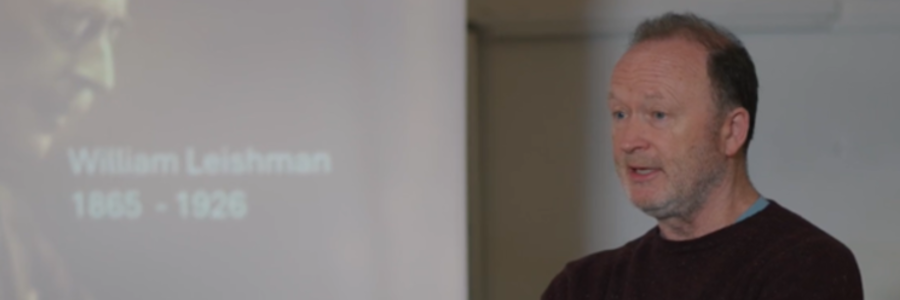
Researchers from the School of Infection & Immunity and the international parasitology community have visited Blairmore to explore the legacy of Sir William Leishman and its connection to research being carried out today.
The visit, organised by Sii Co-Deputy Director Professor Mike Barrett, took place on Friday 10 April, the day after the British Society for Parasitology’s annual meeting in Glasgow.
It brought more than 50 researchers to the Argyll village where Leishman once lived to reflect on the history of research into Leishmania parasites and the disease they cause, leishmaniasis.
The group included researchers from India, Australia, Peru, Colombia, France, Switzerland, Brazil, Germany, Spain, the USA, Belgium, the Czech Republic and Mexico, reflecting the international effort to tackle a disease that remains prevalent across tropical and subtropical regions.
Leishman, who studied medicine at the University of Glasgow, was an important figure in the development of tropical medicine. His work in the late 19th and early 20th centuries helped identify the parasite that now bears his name.
With 2026 marking the centenary of his death, the visit provided a particularly timely opportunity for researchers investigating leishmaniasis today to learn more about the person after whom the disease was named.
More than a century later, Leishmania remains the focus of research at the University of Glasgow and institutions around the world.
An estimated 700,000 to one million new cases of leishmaniasis occur annually, and scientists continue to work towards a better understanding of the parasite and improved approaches to tackling the disease.
Professor Barrett said: “With 2026 marking the centenary of Sir William Leishman’s death, and the British Society for Parasitology holding its annual meeting in Glasgow, we had an opportunity to introduce an international group of researchers to the history of the man after whom their chosen field of study was named.
“We enjoyed a beautiful spring day, with the journey along Loch Lomond, across the Rest and Be Thankful and down Loch Long, showcasing some of the most striking parts of Scotland.
“The group received a wonderful welcome in Blairmore, followed by lunch and talks exploring Loch Long, the village and Sir William’s life and work.
“I have always felt that learning about the history of a disease and the people involved in its study can offer new ways of appreciating parasitology.
“Hopefully, this visit will help inspire a new generation to learn about leishmaniasis and contribute to its elimination.”
Professor Barrett explained that the field has progressed from establishing the parasite’s fundamental biology towards answering questions with direct implications for treatment.
Researchers are now investigating areas including how existing drugs kill the parasite without harming human cells, the biochemical pathways involved, potential new drug targets and the use of genomics to monitor Leishmania.
The visit also provided an opportunity to consider the wider history of parasitology and the scientists whose contributions have shaped the field.
A new video produced during the visit explores Leishman's legacy, the development of Leishmania research and the challenges that remain for researchers working on the disease.
Watch the embedded video to discover more about the visit and the continuing story of Leishmania research.
First published: 1 September 2026