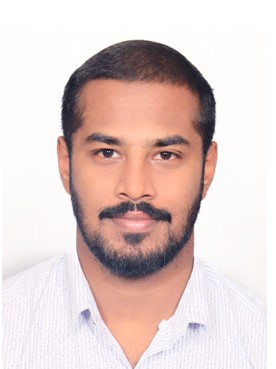
Dr Sathish Kumar Marimuthu
- Research Associate (Biomedical Engineering)
email:
SathishKumar.Marimuthu@glasgow.ac.uk
pronouns:
He/him/his
Level 3, Pearce Lodge, University Avenue, University of Glasgow, Glasgow City, Scotland, United Kingdom, G12 8QQ
Biography
Personal Website: https://sathishkumarmarimuthu.github.io/
I am a Postdoctoral Research Associate (2025–2029) at the University of Glasgow, working under the guidance of Dr Sean McGinty in the James Watt School of Engineering and Professor Nicholas Hill in the School of Mathematics & Statistics. My research focuses on developing computational modelling approaches to support cardiovascular and neurosurgical planning, predict immediate and long-term outcomes following intervention, and improve implant design to enhance patient outcomes and quality of life. I am particularly interested in the mathematical and computational modelling of surgery-induced deformation, vascular adaptation, and growth and remodelling, as well as the mechanical response of biological tissues such as blood vessels and the brain.
My long-term research goal is to develop next-generation surgical planning and navigation systems by integrating patient-specific mechanical modelling with augmented and virtual reality technologies for the treatment of cardiovascular and neurological diseases.
Previously, I was an industry-sponsored PhD researcher (2020–2024) at the SofTMech Centre, University of Glasgow, jointly funded by the EPSRC and Terumo Aortic Ltd, UK. My PhD research, conducted in collaboration with Terumo Aortic, focused on developing computational tools for patient-specific pre-surgical planning of endovascular aortic repair, with particular emphasis on modelling stent-graft deployment and device–vessel interaction. As part of this work, I also collaborated closely with Professor Francesco Migliavacca and Dr Giulia Luraghi at Politecnico di Milano, Italy.
Building on this research, I secured funding through the Glasgow Knowledge Exchange Fund (GKEF) in collaboration with Terumo Aortic to validate and transfer a computational framework for modelling vascular adaptation following stent-graft deployment in abdominal aortic aneurysms. The project aims to translate the framework towards industrial R&D applications and, in the longer term, patient-specific pre-surgical planning. Our group had previously secured an EPSRC Impact Acceleration Account (IAA) award with Terumo Aortic to further develop findings from my PhD into a validated framework for understanding stent deployment and device–vessel interaction. To broaden my experience in cardiovascular biomechanics, I subsequently joined the EPSRC Centre for Future PCI Planning as a Postdoctoral Research Associate in the James Watt School of Engineering, while continuing to contribute to the aortic modelling and knowledge-exchange activities.
My earlier research at IIT Madras focused on computational biomechanics and immersive technologies for surgical planning. My master’s thesis, supervised by Professor R. Krishnakumar, involved investigating fluid–structure interaction during craniotomy and developing a virtual reality-based platform for pre-surgical planning and post-operative assessment in cardiothoracic surgery. This work was carried out in collaboration with Dr Komarakshi Balakrishnan, a cardiothoracic surgeon, with the aim of supporting the planning and assessment of left ventricular assist device (LVAD) implantation.
The resulting virtual reality platform was used by surgeons to support the pre-operative planning of LVAD implantation in paediatric patients with cardiomyopathy and to assess post-operative outcomes by evaluating LVAD inflow cannula orientation using segmented geometries reconstructed from follow-up imaging. The work received national recognition following the successful treatment of a paediatric patient whose case had previously been considered extremely challenging by multiple international centres. India’s former Education Minister recognised the work publicly.
Research interests
My current research focuses on modelling in-stent restenosis following percutaneous coronary intervention (PCI). I am investigating how the mechanical environment created by stent deployment influences subsequent vascular adaptation and neo-intimal growth. This work combines growth and remodelling (G&R) theories, including volumetric/kinematic growth models and homogenised constrained mixture theory (CMT), with fluid–structure interaction (FSI) and damage mechanics. I am also interested in incorporating drug-eluting stents into these models to investigate the relationship between local drug delivery, vascular mechanics and the extent of neo-intimal growth.
My PhD research focused on the computational modelling and optimisation of stent-grafts for the treatment of aortic aneurysms and dissections, with particular emphasis on device–vessel interaction, tear propagation and long-term vascular adaptation following endovascular repair. I developed computational approaches to investigate and optimise stent-graft designs with the aim of reducing post-operative complications. This work involved advanced techniques in nonlinear continuum mechanics, finite element modelling and the extended finite element method (XFEM). I also developed user-defined material subroutines for anisotropic hyperelastic constitutive models used in soft-tissue mechanics.
Building on my PhD research, I am currently using longitudinal pre- and post-operative CT imaging from abdominal aortic aneurysm patients to develop and validate multiscale growth and remodelling models of vascular adaptation following stent-graft implantation. The aim is to understand how the interaction between the implanted device and the arterial wall drives long-term changes in vessel geometry and, ultimately, to support improved device design and patient-specific treatment planning.
Alongside computational biomechanics, I have a strong interest in the use of Mixed Reality, including Virtual and Augmented Reality (VR/AR), for surgical training, pre-surgical planning and intra-operative navigation. My longer-term goal is to integrate patient-specific biomechanical models with immersive technologies to develop more predictive and interactive tools for cardiovascular and neurological interventions.
Publications
2026
Macaulay, Callum, Husmeier, Dirk  ORCID: https://orcid.org/0000-0003-1673-7413, Davies, Vinny ORCID: https://orcid.org/0000-0003-1896-8936, Marimuthu, Sathish Kumar and Colebank, Mitchel
(2026)
Deep Gaussian processes and multivariate Bayesian spline-based methods for emulating nonlinear cardiovascular systems.
Journal of Machine Intelligence and Data Science, 7,
09-21.
(doi: 10.11159/jmids.2026.002)
ORCID: https://orcid.org/0000-0003-1673-7413, Davies, Vinny ORCID: https://orcid.org/0000-0003-1896-8936, Marimuthu, Sathish Kumar and Colebank, Mitchel
(2026)
Deep Gaussian processes and multivariate Bayesian spline-based methods for emulating nonlinear cardiovascular systems.
Journal of Machine Intelligence and Data Science, 7,
09-21.
(doi: 10.11159/jmids.2026.002)
2025
Marimuthu, Sathish Kumar, Luraghi, Giulia, Maclean, Craig, Brodie, Robbie, Migliavacca, Francesco, McGinty, Sean ORCID: https://orcid.org/0000-0002-2428-2669 and Hill, Nicholas A. ORCID: https://orcid.org/0000-0003-3079-828X
(2025)
A three-dimensional computational study of critical pressures of dissection propagation in the aorta.
Biomechanics and Modeling in Mechanobiology, 24(5),
pp. 1767-1780.
(doi: 10.1007/s10237-025-01991-2)
(PMID:40742501)
(PMCID:PMC12454525)
2021
Ramaswamy, Rajesh Kumar, Marimuthu, Sathish Kumar, Ramarathnam, Krishna Kumar, Vijayasekharan, Srinath, Rao, Kemundel Genny Suresh and Balakrishnan, Komarakshi R. (2021) Virtual reality‑guided left ventricular assist device implantation in pediatric patient: valuable presurgical tool. Annals of Pediatric Cardiology, 14(3), pp. 388-392. (doi: 10.4103/apc.apc_81_21) (PMID:34667413) (PMCID:PMC8457285)
Articles
Macaulay, Callum, Husmeier, Dirk ORCID: https://orcid.org/0000-0003-1673-7413, Davies, Vinny ORCID: https://orcid.org/0000-0003-1896-8936, Marimuthu, Sathish Kumar and Colebank, Mitchel
(2026)
Deep Gaussian processes and multivariate Bayesian spline-based methods for emulating nonlinear cardiovascular systems.
Journal of Machine Intelligence and Data Science, 7,
09-21.
(doi: 10.11159/jmids.2026.002)
Marimuthu, Sathish Kumar, Luraghi, Giulia, Maclean, Craig, Brodie, Robbie, Migliavacca, Francesco, McGinty, Sean ORCID: https://orcid.org/0000-0002-2428-2669 and Hill, Nicholas A. ORCID: https://orcid.org/0000-0003-3079-828X
(2025)
A three-dimensional computational study of critical pressures of dissection propagation in the aorta.
Biomechanics and Modeling in Mechanobiology, 24(5),
pp. 1767-1780.
(doi: 10.1007/s10237-025-01991-2)
(PMID:40742501)
(PMCID:PMC12454525)
Ramaswamy, Rajesh Kumar, Marimuthu, Sathish Kumar, Ramarathnam, Krishna Kumar, Vijayasekharan, Srinath, Rao, Kemundel Genny Suresh and Balakrishnan, Komarakshi R. (2021) Virtual reality‑guided left ventricular assist device implantation in pediatric patient: valuable presurgical tool. Annals of Pediatric Cardiology, 14(3), pp. 388-392. (doi: 10.4103/apc.apc_81_21) (PMID:34667413) (PMCID:PMC8457285)
Grants
• Glasgow Knowledge Exchange Fund (GKEF) and Terumo Aortic (2026–2027): £50,000 (Principal Investigator)
• EPSRC Vacation Internship (July 2026 - September 2026): Paid UG Summer Internship Project (Project Supervisor)
• EPSRC (2025-2026), Impact Acceleration Accounts (IAA) & TerumoAortic Grant: £71,939 (Co-Investigator)
• EPSRC (2020-2024), SofTMech and Terumo Aortic PhD Studentship. EPSRC Grant EP/S030875/1. (Doctoral Researcher)
• Half-Time Research Assistant Fellowship (HTRA), IIT Madras (2017-2020)
Supervision
• EPSRC Vacation Internship (July 2026 - September 2026) - Emma Fraser (BSc (Hons) Physics)
Teaching
University of Glasgow, UK
Teaching Contribution (Lectures), James Watt School of Engineering, Nov 2025
- Engineering Mathematics 1 ENG1063
Delivered lectures to 1st-year undergraduate cohort, covering core topics in Matrix Algebra, Sequences, Series and Limit.
Teaching Assistant, James Watt School of Engineering, May 2022 - Aug 2024
- Mechanics of Solids 3
- Mechanics of Solids 4 (ABAQUS lab)
- Finite Element Analysis lab - (ABAQUS lab)
- Design and Manufacture 2 lab
Taught solid mechanics problems to UG, MEng and MS students. Helped them in simulating elastic and plastic behaviour in ABAQUS. Assisted them in simulating a plate with a hole problem and 3D analysis of a bearing bracket design in ABAQUS.
Demonstrator, James Watt School of Engineering, May 2022 - Aug 2024
Helped students perform tensile tests, impact tests, and heat treatment processes to understand the effect of the annealing process of ferrous alloys and understand carbon’s effect on steel’s mechanical properties. Also assisted them in conducting tests on copper and polymers.
- Engineering Skills 1 (Mechanical) lab - Projects
Assisted students in building miniature trebuchet machines using laser-cut materials.
Marker, School of Mathematics and Statistics & James Watt School of Engineering, May 2022 - Aug 2024
- Mathematics1C: Introduction to Calculus, Mathematics 2B: Linear Algebra, Mathematics 2E: Mechanics, Engineering Mathematics 1, Finite Element Analysis and Mechanics of Solids 3
- Computational Methods in Design course
- The Design of Implantable Devices course
Indian Institute of Technology, Madras, India
Teaching Assistant, Department of Engineering Design, 2017 - 2020
Additional information
Visiting Researcher | 2025–2028
- Department of Clinical Medicine, Aarhus University Hospital, Aarhus, Denmark
- PolitoBIOMed Lab, Department of Mechanical and Aerospace Engineering (DIMEAS), Politecnico di Torino, Italy
Conference Presentations
- Marimuthu, S.K.; Geelkerken, R.; Brodie, R.; Maclean, C.; McGinty, S.; Hill, N.A. (2026). Modelling stent-induced remodelling in aneurysmal aortas using homogenized constrained mixture theory. 9th International Conference on the Virtual Physiological Human (VPH 2026), Milan, Italy, 1–4 September 2026.
- Marimuthu, S.K.; McGinty, S.; Hill, N.A. (2025). Finite element modelling and validation of stent-induced growth and remodelling in aneurysmal and dissected aortas. Biomedical Engineering Conference (BioMedEng25), Glasgow, UK, 4–5 September 2025.
- Marimuthu, S.K.; McGinty, S.; Hill, N.A. (2022). Effect of tapered stent-graft on maximum stress concentration and the reduction in the risk of distal stent-induced new entry (d-SINE) tears. 9th World Congress of Biomechanics (WCB 2022), Taipei, Taiwan, 13 July 2022.
- Marimuthu, S.K.; McGinty, S.; Hill, N.A. (2022). Numerical simulation of dissection propagation in three-dimensional patient-specific aortas. 9th World Congress of Biomechanics (WCB 2022), Taipei, Taiwan, 12 July 2022.
- McGinty, S.; Marimuthu, S.K.; Hill, N.A. (2022). A methodology to investigate aortic dissection propagation in a three-dimensional aorta. 11th European Solid Mechanics Conference (ESMC 2022), Galway, Ireland, 5 July 2022.
- Marimuthu, S.K.; McGinty, S.; Hill, N.A. (2021). Understanding the stent-induced stresses in patient-specific aortas modelled with an anisotropic hyperelastic constitutive model. Joint British Mathematical Colloquium and British Applied Mathematics Colloquium (BMC-BAMC 2021), Glasgow, UK, 8 April 2021. Poster presentation, online conference.
- Sathishkumar, M.; Krishnakumar, R.; Balakrishnan, K. (2020). Use of Virtual Reality as a Presurgical Planning Tool in LVAD Implantation. 66th ASAIO Annual Meeting, June 2020. Published in ASAIO Journal, 66(Supplement 2), p. 31, CAR11.
Invited Talks & Seminars
- Invited talk, IAA-INI-HIMR Workshop, University of Strathclyde, Glasgow, UK, 2–3 March 2026.
- Invited seminar, Continuum Mechanics & Industrial Mathematics Group, Department of Mathematics and Statistics, University of Strathclyde, Glasgow, UK, 26 November 2025.
- Invited talk, 2nd Terumo Aortic Academic Collaboration Conference, University of Strathclyde, Glasgow, UK, 18 September 2025. Simulation framework for modelling stent deployment and post-surgical vascular remodelling in aortic dissection and aneurysm.
- Invited talk, 1st Terumo Aortic Academic Collaboration Conference, University of Strathclyde, Glasgow, UK, 6 June 2023. Optimisation of stent-graft designs to reduce post-surgery complications in aortic dissection treatment.
Workshops & Awards
- Third Prize, Poster Presentation, Soft Tissue Modelling Workshop, 8 June 2023. Design of patient-specific stent-grafts to treat aortic diseases.
- DST-INSPIRE Internship for Young Scientists, Department of Science and Technology, Government of India, Bharathiar University, Coimbatore, India, 3–8 January 2011.
Summer Schools
Summer school on Biomechanics of Soft Tissues: From the Heart to the Cardiovascular System to the Brain (Jointly organised by Prof Ray Ogden and Prof Gerhard Holzapfel)
Technical University of Graz, Graz, Austria, 11 – 15 September 2023
- The course included lectures on essential ingredients of continuum mechanics, especially nonlinear elasticity with applications in cardiac biomechanical modelling, whole-organ models, assimilation of image-based data for patient-specific modelling, vascular adaptation during disease and treatments. Also, measurements of strain fields using imaging techniques and digital image correlation in soft tissues and the important area of parameter identification were covered.
- Another focus was on brain mechanics, including the unusual response of brain tissues and axons under loads, the shaping of the brain and skull during development, and the study of brain trauma and diseases.
Summer School on Computational Tissue Biomechanics: From in-vitro experiment to damage and failure analysis
KTH Royal Institute of Technology, Stockholm, Sweden, 5 – 9 September 2023
- The course introduced state-of-the-art tools in the continuum mechanical analysis of biological tissues, integrating theoretical, numerical and experimental concepts towards the description and analysis of a number of biological tissues.
- Conducted bi-axial tensile test experiments on porcine aorta tissues for material parameter estimation and curve fitting.