

Veterinary Biosciences (BSc/MSci)
1st in the UK for Animal Science in The Times & Sunday Times Good University Guide
Veterinary biosciences is a biological sciences programme designed to provide you with a strong understanding of the key elements that underpin all modern biological sciences, with a major focus on the biology of health and disease in animals.
The Veterinary Biosciences programme offers residential national and international field courses and non-residential field trips. There is a variety of field work, summer research projects and volunteering possibilities available within and beyond the University and many vibrant student societies available on campus.
Why study Veterinary Biosciences?
Discover the science behind animal health and disease through our Veterinary Biosciences degree.
Veterinary Biosciences explores the biology that underpins modern veterinary medicine, giving you a comprehensive understanding of the scientific principles that improve the health and welfare of domestic animals, companion animals and wildlife. Throughout the programme, you'll study a diverse range of subjects including comparative anatomy and physiology, animal management, infection and immunity, oncology, endocrinology, animal behaviour, welfare and conservation.
You'll gain a strong foundation in the biological sciences while developing the practical skills needed to tackle real-world challenges in animal health. Through laboratory classes and hands-on practical sessions, you'll build expertise in scientific techniques, experimental design, data analysis and statistical interpretation. In your final year, you'll undertake an independent research project, working alongside leading academics to investigate a topic that reflects your interests and career ambitions.
Alongside your scientific knowledge, you'll develop highly sought-after transferable skills including communication, collaboration, critical thinking and problem-solving, preparing you for careers across veterinary science, biomedical research, biotechnology, pharmaceuticals, animal nutrition, conservation and many other sectors.
Teaching is centred at our Garscube Campus, one of Europe's leading hubs for veterinary education and research. Here, you'll benefit from access to our working farm, providing opportunities to develop practical animal handling skills with both large and small animals, as well as our internationally recognised Small Animal Hospital and Equine Hospital. Studying in this unique environment means you'll learn alongside veterinary students, researchers and clinicians, gaining insight into the science that shapes animal health while being part of a vibrant and supportive community.
Whether your ambition is to pursue research, work within the animal health industry, contribute to wildlife conservation or continue into postgraduate study, Veterinary Biosciences provides the scientific knowledge, practical experience and professional skills to help you achieve your goals.
4 Year BSc - Programme Key Information
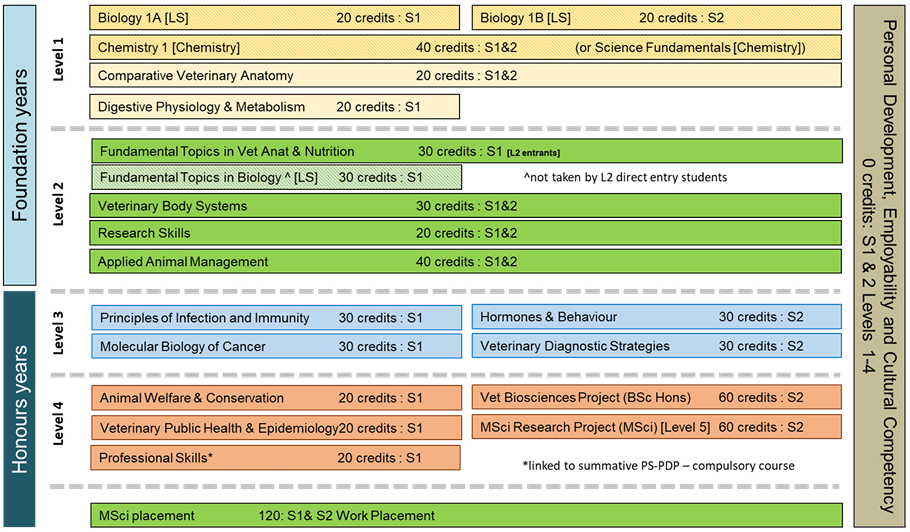
*This is an example of the course structure for academic year 26/27
Year 1
In year 1 you will study a range of subjects including animal anatomy & physiology, chemistry and biology.
Year 2
You will study the principles of animal management, physiology and molecular sciences and receive training in basic research skills.
Year 3
You will study aspects of the physiology of behaviour and the pathogenesis, diagnosis and management of disease and develop an appreciation of current challenges in these fields. You will also acquire skills in research and diagnostic technologies.
Year 4
In the final year of the programme you will develop advanced professional and quantitative skills and study population medicine, epidemiology and animal welfare & conservation.
The second semester features a full-time 12-week research project at the School of Biodiversity, One Health & Veterinary Medicine or another approved institution within the UK or overseas.
5 Year MSci - Programme Key Information
In addition to completing the four-year BSc programme, you may be eligible to undertake the MSci in Veterinary Biosciences. This programme includes an additional placement year between Year 3 and the final year of the degree, during which students typically undertake a research placement in industry or at a research institute in the UK or overseas.
Entry Requirements
For entry in 2027
Scottish Higher Entry Requirements
- ABBB at S5 will be considered. Typically S6 entrants will have AAAAA Higher or AAAA Higher + B Advanced Higher
- Additional requirements: Higher Biology or Chemistry.
Scottish Higher Adjusted Entry Requirements* (by end of S6)
- MD20: BBBB (also other target groups*)
- MD40: AABB (ABB S5 minimum for consideration)*
- Additional requirements: Higher Biology or Chemistry. Successful completion of Top-Up or one of our Summer Schools.
* See Access Glasgow for eligibility.
A-level Standard Entry Requirements
- AAB – BBB
- Additional requirements: A-level Chemistry or Biology.
IB Standard Entry Requirements
- 34 (6,5,5 HL)
- Additional requirements: HL Chemistry or Biology.
Advanced Entry into Level 2
- Advanced Higher AA, A-levels A*AA
- Additional requirements: Chemistry and Biology at A.
- Biology based HNC/HND or other institutional study considered on a case by case basis.
Admissions guidance
Application Key Information / Accreditations
Career Prospects
A degree in Veterinary Biosciences equips graduates with the scientific knowledge, practical laboratory skills, and analytical expertise to pursue a wide range of careers across the animal health and life sciences sectors. Graduates are well prepared for roles in pharmaceutical and biotechnology companies, veterinary diagnostic laboratories, contract research organisations, government agencies, and animal health charities.
Career opportunities include:
- research scientist
- laboratory scientist
- biomedical scientist (subject to additional professional requirements where applicable)
- clinical trials associate
- regulatory affairs specialist
- quality assurance scientist
- scientific or technical sales representative.
Many graduates also continue to postgraduate study, including master's and PhD programmes, leading to careers in academic research and higher education. The programme provides an excellent foundation for contributing to advances in animal health, welfare, disease prevention, and One Health initiatives that recognise the interconnected health of people, animals, and the environment.
Quick Links to University Policies
My First Year in Veterinary Biosciences
Meet Katie, as she discusses the exciting opportunities the course offers, the wide range of topics students explore, and the strong sense of community on campus.
My Final Year in Veterinary Biosciences
Meet Shona, as she shares what inspired her to choose Veterinary Biosciences, her experience of student life at Glasgow, and her aspirations for the future.