Guidance for Investigating Manager
Introduction
This guide outlines best practice for colleagues undertaking the role of Investigation Manager in accordance with the University’s Disciplinary policy.
This guide provides clear direction to ensure that all investigations, are conducted fairly, transparently, and in line with policy, safeguarding the rights and responsibilities of all parties involved.
What does the role entail?
The Investigation Manager is responsible for gathering evidence, establishing the facts and assessing whether there is a is a disciplinary case to answer. The role involves leading an impartial and thorough investigation and compiling a report for the Commissioning Manager, who will determine next steps based on the evidence and recommendations.
It is important to note that Investigation Managers do not proceed to hear any disciplinary case (or make decisions about sanctions) at a Disciplinary Hearing.
Background/Overview
Disciplinary investigations normally arise from allegations of misconduct that may involve potential breaches of one or more University of Glasgow policies (which are linked below).
The purpose of an investigation is to establish the allegations objectively (set by the Commissioning Manager) and consider if there is any basis for further action, if so, recommendations will be made related to next steps. Key responsibilities involve:
- Treat all parties fairly and respectfully.
- Gathering and assess relevant evidence, from all relevant parties as appropriate.
- Determine if there is a case to answer.
- Recommend the next steps without deciding a disciplinary sanction.
An investigation is normally instructed by a Commissioning Manager, typically an appropriate senior member of the University – typically the Head of Unit/School or Service. Before accepting the role of Investigation Manager, it is important to consider the following:
- Availability over the coming weeks/months.
- Expected timescales for completion.
- Declare any potential conflicts of interest (including any prior involvement in the incident/case)
When undertaking a disciplinary investigation, it is important that you:
- Prioritise the investigation as far as possible, seeking help with workload reallocation if needed.
- Keep an open mind regarding the outcome.
- Ensure impartiality, fairness and confidentiality throughout the process.
- Stay focused on investigating the specific allegations of misconduct related to the case.
Preparing for the Investigation
Familiarisation and Planning
- Read relevant University policies and procedures.
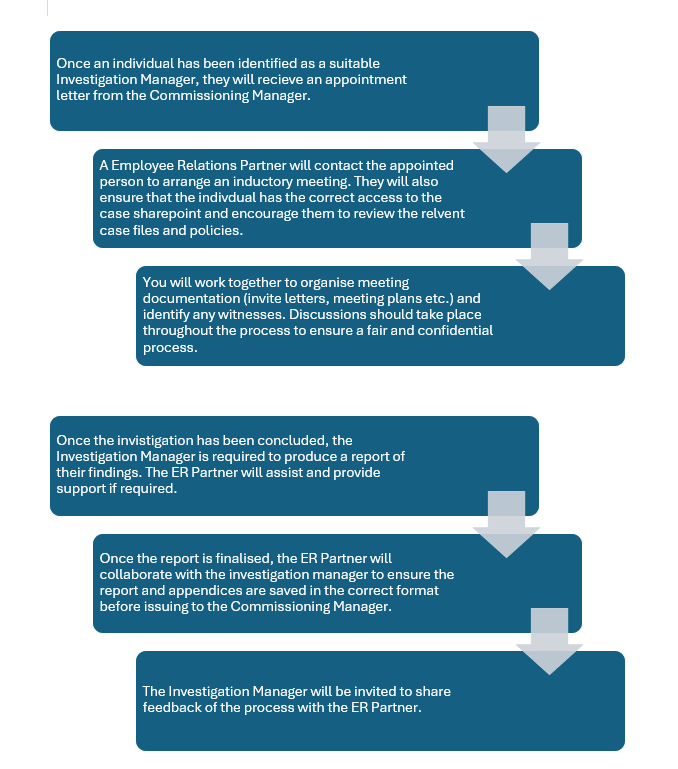
- Meet with your assigned Employee Relations (ER) Partner. Review and ensure you have access to case files on SharePoint.
- Agree on timescales for completion of the investigation and communicate any delays with the Commissioning Manager if you go beyond what was agreed in your appointment letter.
Investigation Planning
- Identify the evidence and relevant witnesses required to establish the facts.
- Liaise with the ER Partner to plan interviews accordingly and arrange invitation letters for all parties. Where evidence is likely to be time-sensitive or perishable this should be gathered as a priority.
- Prepare and consider questions to ask all individuals being interviewed and determine the order in which to meet with them. The assigned ER Partner will provide a template meeting plan with helpful information to assist you in planning accordingly.
Interview planning
- Block out time in your diary for scheduling interviews (including pre-meet and post-interview de-brief) and organise/book rooms where interviews will be held (private room to ensure confidentiality).
- Allocate a significant amount of time for pre-reading in preparation for upcoming interviews. (e.g., relevant emails and documents will be listed in the case timeline within the case folder). Use the case timeline and supporting documents to plan questions.
- Ahead of each interview, and with support from the ER Partner the Investigation Manager will produce a meeting plan (sometimes referred to as a “script”) which will set out the structure and format of the meeting, prepare a list of detailed questions relevant to the allegations and ensure all necessary information is available ahead of the meeting. It is important to understand this is a fluid plan and it may need to adapt during the meeting.
- Where significant delays in concluding the investigation are anticipated this should be notified to the Commissioning Manager and where possible a timescale for completion given.
- In the event of delay in concluding the investigation, it will be appropriate for the Investigating Manager to provide any update to employee(s) accordingly.
Conducting investigation interviews
The Investigating Manager will chair the investigation meetings, and lead interviews with a structured but flexible meeting plan. Additional questions may arise and should be asked as needed. The ER Partner may also ask follow-up questions, to ensure all relevant matters have been appropriately investigated and any points clarified. A short pre-meeting with the ER Partner is recommended to help finalise the plan and agree any adjustments.
Triangulating the evidence
The Investigation Manager is responsible for validating and cross-checking statements, information and evidence gathered during an investigation, especially where contradictions exist. If new evidence conflicts with previous statements, the Investigation Manager should revisit and follow-up with individuals as required. This process must be both timely and thorough, which may require reinterviewing individuals when necessary.
In the circumstances of contradictory evidence, the Investigation Manager will need to assess the evidence based on the balance of probabilities, whether the incident is more than likely to have occurred than not. They should be able to clearly explain the reasoning behind one version of events over another and confirm their conclusions.
Key roles in the process
Commissioning Manager
The Commissioning Manager is responsible for appointing an appropriate manager to support each stage of the disciplinary process and issue the formal letter to confirm the appointment and associated details. They will work closely with the relevant local People & OD Business Partner to monitor and support the wellbeing of all parties involved as appropriate.
Upon receiving the investigation report, the Commissioning Manager will review the findings and decide whether to accept or reject the recommendations. They are also responsible for issuing the investigation outcome letter to the colleague and ensuring that any recommendations are actioned. This may include reflective learning, training and/or progression to a formal disciplinary hearing.
Local POD Team/P&OD Business Partner
The local People & OD Business Partner is typically a first point of contact for managers engaging with the disciplinary process. They collaborate at the outset with the Commissioning Manager, providing guidance and support on identifying the Investigating Manager, and supporting the framing of allegations where required.
Once initial setup is complete, the case is handed over to the Case Management Hub, who then provide support, initially overseeing the issue of the Investigating Manager appointment letter. The local P&OD Business Partner maintains communication with the line manager and the Employee Relations Partner to provide ongoing case updates and support
Line Manager
The line manager (or suitable alternative if the line manager is directly involved in the case) plays a vital role in safeguarding the wellbeing of the colleague under investigation. They will remain in regular contact with their local People &OD Team at various stages throughout the process to offer practical and wellbeing support throughout the process and beyond.
Employee Relations Partner
The Employee Relations Partner (or Employee Relations Advisor), operating through the Case Management Hub, provides expert guidance and support throughout the disciplinary process. They advise Investigating Managers, Disciplinary Hearing Managers and Appeal Managers to ensure outcomes are fair, robust, and procedurally sound.
They support the Investigating Manager by offering guidance at each stage, including the development of meeting plans, correspondence and the investigation report. They also liaise with the Commissioning Manager, and relevant local People & OD Business Partner to keep all stakeholders informed and updated.
Note taker
A designated note taker attends the investigation meetings to accurately record discussions. They are responsible for producing clear and timely summaries during each meeting.
Witnesses
Witnesses are individuals who provide factual, relevant information and/or evidence about the case, typically through direct observation or knowledge of the situation or event in question. When engaging witnesses, the Investigation Manager must respect confidentiality and share only information pertinent to their involvement. Full details of the allegations should only be disclosed when necessary.
Witnesses should only be questioned on matters directly relevant to their experience, such as incidents they have observed. While they are not usually accompanied during investigatory interviews, it is considered good practice to allow this if requested. Participation is voluntary; and efforts should be made to address any concerns and encourage cooperation. Witnesses may also provide their accounts in writing as a ‘witness statement.’
The Investigating Manager is responsible for identify and inviting appropriate witnesses. Colleagues involved in the investigation must not approach or influence witnesses or seek character references. All witnesses are expected to always maintain confidentiality.
The Investigation Report
The Employee Relations Partner/Advisor will provide the Investigation Manager with an investigation report template and offer guidance on the content and structure of the report. This ensures that the investigation is documented in a fair, balanced, and evidence-based manner, leading to appropriate conclusions and recommendations. The report should present:
- A factual and impartial summary of the investigation.
- A clear outline of the facts established and those that remain unconclusive.
- Relevant evidence, referenced throughout and appended where appropriate.
- A conclusion, accompanied by one or more of the following recommendations:
- No further action is required.
- Informal action is appropriate (e.g. coaching, or support)
- Sufficient evidence supports the allegations and warrants a formal proceeding to a disciplinary hearing.
Investigating Managers must not recommend what level of sanction maybe warranted – such determinations are the responsibility of the Disciplinary Hearing Manager, should the matter proceed to a hearing.
All supporting evidence gathered during the course of the investigation should be attached as appendices and referenced appropriately within the main body of the report.
Concluding the Investigation
Once the report is completed and signed off, the Investigation Manager must submit the finalised report to the Commissioning Manager. It is the Commissioning Manager’s responsibility to review the report and formally communicate the outcome of the investigation to the Colleague.
Following the conclusion of the investigation process, the Investigating Manager will be asked to provide feedback on their experience. This reflective feedback will be shared with the Employee Relations Partner/Advisor to support continuous improvement of the investigation process and guidance provided.
Addressing issues that may arise during an investigation
It is recognised that during an investigation, unforeseen or complex issues may emerge. These situations require careful handling to ensure fairness, consistency and procedural integrity. In such instances, advice and support can be sought from local People & OD colleagues. The following section below outlines potential scenarios and guidance on how to manage them:
Requests for anonymity
In some cases, witnesses may request anonymity when providing information or evidence. Whilst such request may be made in good faith, anonymity can present challenges in terms of the credibility, weight, and transparency of the evidence, as well as in ensuring a fair process for all parties involved. Where a request for anonymity is received, the Investigation Manager should:
- Seek advice from the Employee Relations Partner/Advisor or other relevant local People & OD colleagues.
- Consider the rationale for anonymity, potential risks, and the implications for procedural fairness,
- Ensure that any use of anonymous evidence is supported by corroborating information where possible and is treated with appropriate caution.
Counter Allegations
If the colleague who is subject of the investigation raises counter-allegations, it is important that these are assessed objectively and without prejudice.
The Investigation Manager, in consultation with the Employee Relations Partner/Advisor must determine:
- Whether the counter-allegations are directly related to the original investigation and can be considered within the current investigation.
- If the counter-allegations are unrelated to the original investigation or involve individuals who are not part of the existing investigation, whether a separate investigation and distinct process should be initiated to address them.
This decision must be clearly documented to ensure procedural fairness whilst ensuring all concerns raised are properly considered.
Confidentiality
At each interview, the Investigating Manager is responsible for clearly advising all individuals involved about the confidential nature of the investigation. They must explain how any information shared during the process will be used.
When handling and sharing files during a disciplinary process, Investigation Managers must adhere to best practices to protect confidentiality and ensure data security. This includes:
- Using approved, secure file-sharing platforms for document exchange.
- Sharing files via secure links rather than attachments to maintain control over access.
- Setting appropriate access permissions (e.g., view only unless editing is necessary)
- Avoiding download permissions unless essential to the process.
- Verifying recipient email addressed carefully to prevent unauthorised disclosure
- Maintaining an audit trail that records who accessed that information and when.
The following University’s IT Policy and Data Protection Guidance provides further information to ensure compliance and safeguard of personal data.
Participation
All relevant parties (e.g reporting party, the responding party, witnesses) involved in an investigation are strongly encouraged to participate to support a thorough robust, fair and balanced process. Full participation is particularly important for the individual against whom the allegation(s) have been made against, as a refusal to engage may result in decisions being taken based solely on the available, and potentially incomplete information.
If a witness declines to participate or expresses a desire to remain anonymous, it is important to explore and understand the reasons for their decision. While witnesses are not obligated to participate, efforts should be made to engage them in the process. A meeting can be arranged by the local People & OD Team to explain the investigation process, address any concerns, and outline the support available to them throughout.
Cases which involve students
There are separate policies and procedures for handling student complaints; however, situations may arise where a complaint is raised by a student and names a University employee – such as a PhD Supervisor, Lecturer, or member of the Learning and Teaching team. In such cases, an initial case conference is usually held with relevant colleagues from Legal & Governance to assess the nature of the concern and determine the most appropriate route for investigation. This may involve handling the matter under the Student Complaints Procedure or, where appropriate, under the University’s employee disciplinary policy.
Where the student involved also holds an employment role within the University – such as a Demonstrator- this dual status must be taken into account and discussed with Legal & Governance. Throughout the process, it is essential to maintain ongoing dialogue with the Complaints Resolution Office to ensure that the approach taken is proportionate, consistent and in line with University policy.
Students who require more information about how to submit a complaint or wish to understand the process involved can access the Complaints Handling webpages for guidance.
Where the matter is to be addressed under the Disciplinary Policy for employees, the Commissioning Manager should consider appointing a dedicated point of contact for the student to ensure they are appropriately supported throughout the process.
Sickness absence during an investigation
Depending on the length/reason for absence, the investigating manager may need to postpone interviews until the colleague is back at work. In the case of long-term absence, depending on the specific circumstances, it may be best practice to encourage the colleague to participate in the procedure especially if the absence is due to stress relating to the disciplinary. Occupational Health can give guidance to understand fitness to attend meetings.
Police investigations
When a Police investigation is ongoing, guidance is required to determine whether the internal University investigation should proceed or wait until the criminal proceedings are concluded. In some cases, the Police may request that the internal investigation be paused until the criminal investigation is complete. The P&OD Business Partner and Employee Relations Partner/Advisor will provide advice in such situations.
Common pitfalls to avoid
- Delay in starting or concluding investigations.
- Incomplete or inconsistent documentation.
- Overstepping into disciplinary decision-making.
- Failing to treat individuals consistently.
Other Related Policies
- Disciplinary Policy
- Dignity at Work and Study Policy
- Code of Professional Conduct
- Expected Behaviour Policy
- Social Media Guidance webpages
- IT Services Code of Conduct – Regulations for the use of University ICT systems and facilities
- Glasgow Professional Behavioural Framework
- Personal Relationships Policy
- The University's Financial Regulations
- Research Ethics
- Research Misconduct Policy
- Grievance Policy & Procedure
- Probation Policy
- Policy for Managing Stress in the Workplace
Health and Wellbeing Resources
Information and guidance and wellbeing support for colleagues is available via:
- The University’s Health and Wellbeing Hub – Manager Zone
- The University’s Health and Wellbeing Hub
- Discussing Adjustments & Support
- Employee Assistance Programme (EAP) – provides confidential support to University employees and their family members, 24 hours a day, 365 days a year, 0800 882 4102.
- Champion Health app – provides online personalised wellbeing content, tools, trackers and includes a resources library. When registering enter access code: uog1451
- Able Futures –a mental health support service provided by Access to Work. There is no cost to using this confidential service and no waiting list. Support is available over the phone, video call and through email. Colleagues can call Able Futures on 0800 321 3137 or visit able-future.co.uk to sign up online.
- The University’s Mental Health First Aid Network – provide initial assistance and direct help for those wanting to talk about their mental health concerns.
Process Map