

Rachel Sandison, Deputy Vice Chancellor (External Engagement) reflects on the U21 summit
In April, the University of Glasgow was honoured to host the Universitas 21 (U21) Annual Network Meeting and the inaugural Leadership Summit, welcoming more than 150 senior leaders, policymakers, and global partners from across six continents to our Gilmorehill Campus.
Taking place during our 575th anniversary year, the Summit represented far more than a convening of international delegates and expertise. It was a moment to reflect on our history and achievements to date, while looking ahead to the future of higher education, and recognising the vital role that collaboration, partnership, and shared purpose will play in shaping our sector. 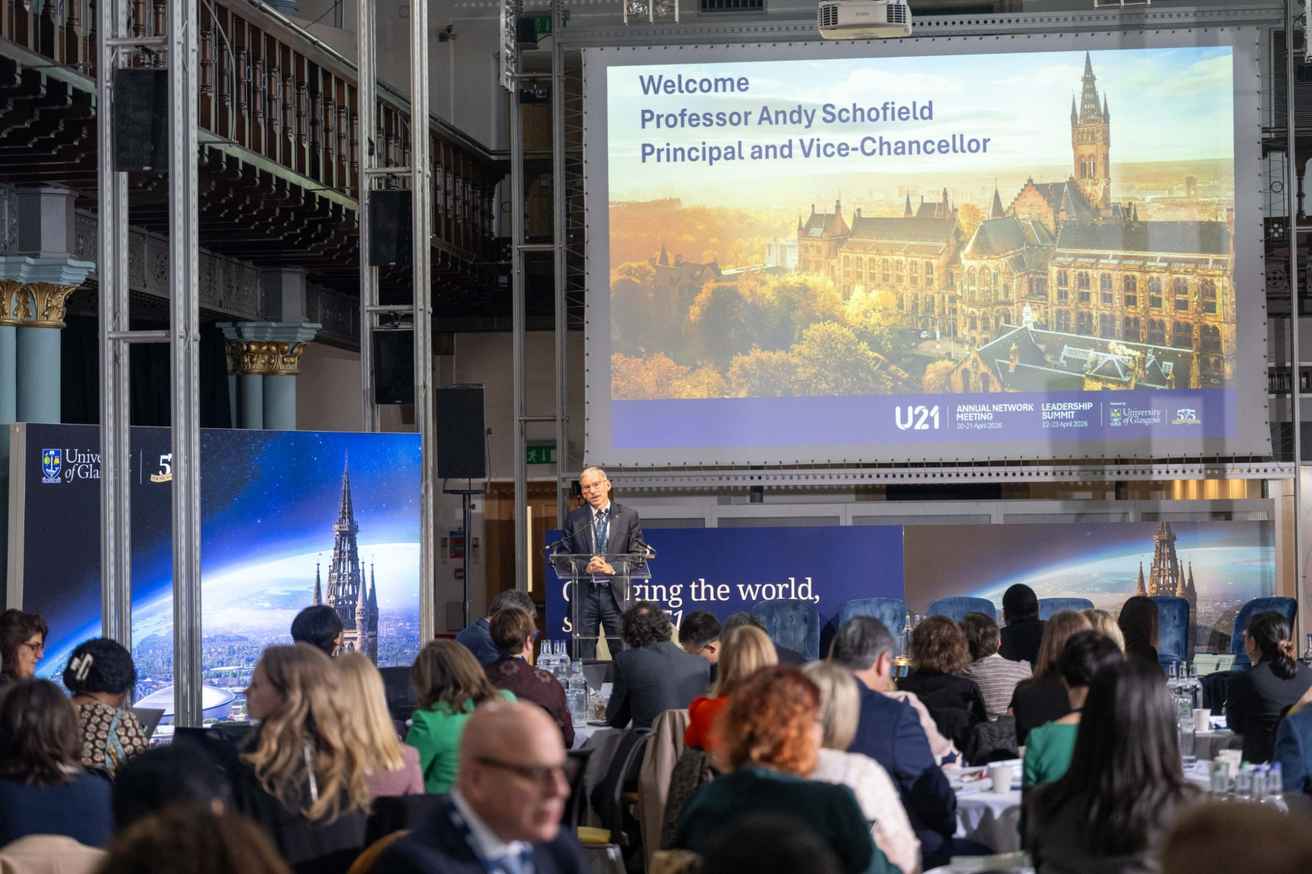
The Summit programme brought together a rich mix of keynote addresses, panel discussions, and leadership exchanges spanning critical themes such as geopolitics, artificial intelligence, sustainability, and leadership development. This richness was further enhanced by an outstanding group of global speakers who brought diverse perspectives from across academia, policy, and industry.
Contributions from Nobel Laureate Professor Sir David MacMillan, Professor Robbert Dijkgraaf, former Dutch Minister of Education, Culture and Science, Kiran Mazumdar-Shaw, founder of Biocon, and Brian McBride, Chair of Trainline PLC, offered powerful insights into the intersections of science, innovation, leadership, and technological change. Alongside them, Baroness Katherine Grainger, Chancellor of the University of Glasgow and Chair of the British Olympic Association, and senior leaders from across the U21 network and wider sector, helped to shape discussions that were both thought-provoking and grounded in real-world impact.
Sessions explored questions at the very heart of our shared mission: how universities can exercise global influence in a shifting external landscape; how we prepare students for an uncertain future; and how we ensure that knowledge continues to serve society in meaningful and inclusive ways. They encouraged candid and curious dialogue, challenging us to ask difficult questions and reflect critically on our role.
It is precisely this spirit of openness, reflection, and collective ambition that made hosting the U21 Leadership Summit during our 575th year both symbolic and strategic. The University of Glasgow was founded on international exchange, and today our global partnerships remain central to how we deliver impact and fulfil our mission.
The Summit, and the wider U21 programme, demonstrates the tangible value of deep, sustained collaboration. By bringing together university leaders, policymakers, and external partners, the event created space not only for shared dialogue but for action, for co-developing solutions, advancing research partnerships, and strengthening global connectivity.
For the University of Glasgow, engagement in U21 directly supports our ambitions to expand international partnerships, enhance student experience, and deliver world-changing research. It is a platform through which we can work collectively to address the greatest challenges of our time, from climate change to inequality and technological disruption.
The timing of the Summit also aligns closely with another defining moment in the University’s journey, the launch of our new ten-year strategy, World-Changing Glasgow: University for the World.
Published during our 575th anniversary year, this strategy sets out a bold ambition to transform lives through ideas and action, grounded in world-leading research, education, and innovation. It places partnership, local, national, and international, at its heart, recognising that our success depends on collaboration with our students, the communities we serve, as well as industry, government, and international partners.
The themes of the U21 Leadership Summit and our new strategy are deeply aligned. Both highlight the importance of global collaboration, the need for universities to demonstrate their societal value and rebuild public trust, and the role of institutions as civic anchors with a truly global reach. Central to both is also a clear recognition that meaningful progress, whether in research, learning & teaching, or innovation, depends on strong, sustained partnerships that enable universities to deliver real impact.
This alignment reinforces a clear message that our future direction will not be defined in isolation, but in partnership with each other, and the global communities that we serve. None of us can succeed by working in silos. Progress depends on our willingness to share knowledge openly, to learn from one another’s experiences, and to act collectively in pursuit of common goals.
Our 575th anniversary provides a powerful lens through which to view these developments. It is a moment to celebrate the University’s long-standing contributions to knowledge, innovation, and society, while also setting out a clear direction for the future.
The U21 Leadership Summit exemplified this dual perspective, bringing together centuries of academic tradition with forward-looking dialogue on the future of higher education. It highlighted that while our history provides a strong foundation, it is through collaboration and innovation that we will continue to make a meaningful difference.
For our international partners, the message from Glasgow is clear. The future of higher education will be shaped through collaboration, both within the sector and in partnership with our wider communities, grounded in trust and a shared sense of purpose. By working together, across institutions, disciplines, and borders, we can strengthen our collective impact, build resilience, and ensure that universities continue to serve as powerful forces for good in an increasingly complex and interconnected world.
We look forward to continuing this journey together, and to seeing where our shared ambition and collaboration will take us next.
Article on the U21 summit in
The Chronical of Higher Education
U21 news story
Universitas21