


PGR Review Hub
Welcome to your central space for all things related to the PGR Review Process.
System Update
The current PGR system will be gradually phased out over the coming months as we prepare for annual reviews. A new and improved system will launch in January, offering enhanced functionality and a smoother experience.
What’s Next?
MyCampus is live for initial reviews only to take place. You will receive an email prompt to log in when appropriate.
PURPOSE
- Track progress: Assess your stage of study
- Mandatory: APR is required for all research students
- Reflect: Review training, milestones, achievements, and challenges
- Feedback: Gain input on research, development, and performance
PROCESS
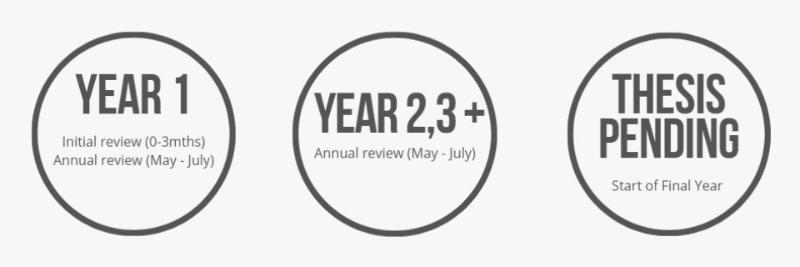
This is a general guide. Individual circumstances may vary. If unsure, seek school specific guidance from your Postgraduate Convenor.
Year 1
Initial Review
PGR professional services staff will create your Initial Review form in the MyCampus Initial Review Portal. You will receive an email to log in and complete the Student Self‑Assessment.
Initial Review - Student User Guide
Students requirements:
- Meet with your supervisor(s) to:
- Complete and review the Training Needs Assessment Form.
- Agree on a training plan and discuss Graduate Skills Pathway courses.
- Complete the Researcher Development Log .
- Prepare a Literature Review (approx. 2000–3000 words, 3–4 pages plus references) including:
- Summary of relevant scientific literature.
- Scientific aims of your research project.
- Proposed experimental approaches/study design.
- Upload the training needs assessment form, literature review, Inkpath training transcript, researcher development log and any other appropriate documents to your self-assessment form on MyCampus. These are mandatory. Do not click 'submit' until all docs are uploaded and your self-assessment is complete.
- Meet with your supervisor(s) and review panel to discuss the Literature Review, Researcher Development Log and Training Needs Assessment.
- Your supervisor(s) and review panel completes their online assessment.
- You complete your student statement online.
- PGR Convenor reviews and assigns a recommendation.
Notes:
- Initial reviews should start approx 3 months after your start date.
- If you started on/after 1 March, you may not have an initial review. Instead, combine it with your annual review during the summer. Confirm this with your supervisor and inform the Graduate School.
- There is a 5MB individual file size limit but multiple files can be uploaded.
Annual Review – Student Requirements (MyCampus transition in summer)
PGR professional services staff will create your Annual Review form in the MyCampus Annual Review Portal. You will receive an email to log in and complete the Student Self‑Assessment.
Annual Review - Student User Guide
- Timeline: Arrange review dates with supervisors/panel reviewers between May–July.
- Report: Submit a scientific journal–style report (max 3000 words) including:
- Abstract
- Introduction
- Materials and Methods
- Results and Discussion (combined if appropriate)
- 500–1000 word section outlining next year’s work, including potential pitfalls/solutions
- Data Management Plan: Prepare a plan for your research projects (required for progression). Training and templates are available.
- training on how to write a data management plan.
- Template data management plans here.
- Inkpath Transcript: Download your Inkpath transcript showing the mandatory courses you have taken in year 1 as part of your Graduate Skills Pathway.
- Presentation: Deliver an oral, or poster presentation to your supervisory panel by the end of Year 1.
- Submission: When completing the self-assessment upload the following docs:
- Scientific journal-style report progress
- Data management plan
- Inkpath transcript
- Assessment:
- Formal meetings with your supervisors - supervisors complete reports on MyCampus
- Formal meeting with two panel reviewers - panel completes reports on MyCampus
- You complete the student statement on MyCampus.
- PGR Convenor reviews and issues recommendation.
- Completion: Aim to finish by 31 July to allow Graduate School progression in MyCampus and registration for the next academic year. If delays are expected, contact school admin and the Graduate School.
Notes:
Deadlines may vary; confirm requirements with your Postgraduate Convenor.
There is a 5MB individual file size limit but multiple files can be uploaded
Years 2, 3 +
Annual Review
PGR professional services staff will create your Annual Review form in the MyCampus Initial Review Portal. You will receive an email to log in and complete the Student Self‑Assessment.
Annual Review - Student User Guide
- Timeline: Arrange review dates with supervisors/panel reviewers between May–July.
- Report: Submit a scientific journal–style report (max 3000 words) including:
- Abstract
- Introduction
- Materials and Methods
- Results and Discussion (combined if appropriate)
- 500–1000 word section outlining next year’s work, including potential pitfalls/solutions
- Data Management Plan: Prepare and submit a plan for your research projects (required for progression). Training and templates are available.
- training on how to write a data management plan.
- Template data management plans here.
- Inkpath Transcript: Download your Inkpath transcript showing the mandatory courses you have taken in year 1 as part of your Graduate Skills Pathway.
- Presentation: Deliver an oral or poster presentation to your supervisory panel.
- Submission: Upload the following docs
- Scientific journal–style report and progress
- Data management plan
- Inkpath transcript
- Assessment:
- Formal meetings with your supervisors - they complete reports on MyCampus
- Formal meeting with two panel reviewers - they complete a report on MyCampus
- You complete the student statement on MyCampus
- PGR Convenor reviews and issues their recommendation
- Completion: Aim to finish by 31 July to allow Graduate School progression in MyCampus and registration for the next academic year. If delays are expected, contact school admin and the Graduate School.
Notes:
Deadlines may vary; confirm requirements with your Postgraduate Convenor.
There is a 5MB individual file size limit but multiple files can be uploaded
Thesis Pending - Final Year
1. Final Year Interview
When: Do at least 8 months prior to submission deadline
- You will be interviewed on your progress in thesis writing within a year of your thesis submission deadline.
- In the case of MSc(R) students, your assessors may discuss this at the progress review.
- Your local Postgraduate Conveners will arrange this interview.
2. Submission of Thesis
When: Within 4 years
- All full-time PhD, MD, MVM and DDS students must submit within 4 years of commencing their period of research.
- Supervisors and students must know the thesis submission date. You must submit the thesis by this deadline. You can find this 'End date' on your student summary MyCampus.
- If you need an extension or suspension of study, please email a formal letter to the Graduate School.
3. Intention to Submit a Thesis
When: Approximately 3-6 months before thesis submission deadline
- Complete your intention to submit on TAP.
- This begins the process of organising a Committee of Examiners for your viva voce (oral exam).
- Read Before you Submit your thesis for more information.
Additional information
Part-time Students
- The above review format for initial and annual review is the same for part time students and followed for each year of study, until the thesis pending year. Initial reviews are required between 0-3 months of starting. If you start in October it should be completed by the end of January.
- Part-time students will make less progress than full-time students in one academic year. It is still important to review the progress made in that time.
- The minimum length of part-time PhD study is 5 years. The maximum period for thesis submission is no later than 8 years.
MSc by Research Students
- MSc by Research students must take part in the Initial and Annual reviews.
- Students undertake 1 year research and 1 year thesis pending.
- The literature review and project plan follow the same timelines as for PhD students.
DTP Programmes
Precision Medicine DTP students follow the regular process of doing an initial review in Jan and the annual review in May.
For all other enquiries about your review process at a local level use the contact details provided below:
Wellcome-IIB Programme
First year students on the IIB complete two rotations and then join their PhD lab in April/May. You don’t complete the initial review as you won't yet know where you will be based at the usual initial review time in Jan/Feb.
Instead, complete your annual review in MyCampus. Email the Graduate School to let them know you have to go straight to your annual review in case they need to override the initial review section.
Here is what you need to complete as part of your annual review:
- Submit a rotation report: this is a journal style article that gives you the same experience of writing as other students for the annual review. Ideally from the rotation in the final PhD lab, although not all students join a lab they rotated through.
- A PhD proposal - akin to the literature review and project plan that ‘regular’ students submit for their initial review. The format of this is based on funder requirements and includes hypothesis, aims, over-view timeline for the project.
- Data management plan as required for all students at annual review.
- Training needs assessment form (as for all students).
- Researcher development log (as for all students).
With these forms and the usual meeting, your assessors will be able to judge your understanding of the project, your ability to present and analyse data, and discuss the interaction with your supervisor(s).
Precision Medicine DTP
Precision Medicine DTP students follow the regular process of doing an initial review in Jan and an annual review in May.
See the instructions above in the main text.
Multi-Morbidity Programme
Students on the Multi-Morbidity programme do participate in the annual review process. Follow the process above.
If you have any questions, contact your programme administrator: multimorbidityphd@glasgow.ac.uk
Furth of Glasgow: Annual Progress Review
- Discuss methods and frequency of communication with your supervisor in advance.
- You must still complete the annual progress requirements when studying away from or “furth of" Glasgow.
- Your appointed supervisor in the field is expected to contribute to your annual report.
- Your School can arrange a Zoom interview at a convenient time.
- The Graduate School adheres to the University's Furth of Glasgow policy.
Duties of the Reviewer/Assessor
The Postgraduate Convener, in consultation your supervisor(s), appoints your reviewer/assessors. The reviewer/assessor, where possible, will be familiar with the area of research.
The reviewer/assessor encourages both student and supervisor to adopt best practices. They assist with solving problems that arise. This can include any problems that may arise between the student and the supervisor.
The role is mainly pastoral and includes the following:
- Maintaining regular, informal contact with the student during the course of the research. There will be an informal discussion about progress at least once per semester.
- Maintaining regular contact with the supervisor during the course of the research project. Ensuring awareness of difficulties that might arise.
- Encouraging the student to raise problems with the Graduate School or Postgraduate Convener.
- Providing an alternative conduit for information between the student and supervisor. The aim is to solve problems at an early stage.
- Discussing the content of the student’s annual progress report.
- Adding a paragraph to the annual report on the quality and progress of the research and training.
Your Supervisory Team Roles
Project Supervisor
You should know your primary supervisor and any co-supervisors. Early in your studies, clarify who is responsible for guiding your research, providing resources, and giving feedback. If you have multiple supervisors, hold regular joint meetings to keep everyone informed. While you may work daily with a postdoc or senior researcher, you must also meet regularly with your supervisor. Beyond informal interactions, arrange formal supervisory meetings, take notes, and share them for agreement. This ensures clarity on training, experiments, data analysis, and publications. As most projects involve multiple researchers, discuss authorship for abstracts and manuscripts with your supervisor at the earliest stage.
Panel Reviewers/Assessors
You will have two reviewers not directly involved in your project. They assess your annual progress and provide advice throughout the year. Reviewer 1, familiar with your field, can help with ideas, data, or experimental plans, and is available if issues arise beyond your supervisor. Reviewer 2, though outside your area, is an experienced researcher who can offer broader scientific and personal guidance. Use their expertise for fresh perspectives beyond your group. If unsure who your reviewers are, contact your Postgraduate Convener or Administrator via your School website.
Postgraduate Convenor (PGC)
PG Convenors are Graduate School members who review annual progress and recommend registration each October. You can contact them if issues cannot be resolved with supervisors or reviewers. Alert your PGC promptly if you face serious concerns, such as health or personal circumstances affecting your studies
FAQs
- I'm trying to log on to the PGR System but it's not letting me in.
- The current PGR system will be getting phased out in favour of a new system. Contact the Graduate School: mvls@glasgow.ac.uk
- The current PGR system will be getting phased out in favour of a new system. Contact the Graduate School: mvls@glasgow.ac.uk
- I'm trying to log in to MyCampus to create my initial review form, why is it not working?
- It is not you that creates the form, it is your local PGR professional services team that does this.
- You will be notified by email when your form has been created and when you can log in to complete it.
- I started midway through the academic year. When should my first review take place?
- If you started in Jan/Feb you have until APRIL 30 to fully complete the initial review.
- If you started between March/June you will combine your initial review with your annual review.
- I started in Aug, when do I do my initial review and why have I been charged extra fees?
- You should fully complete their initial review at the usual time in January.
- The financial year ends on 31 July but the new academic term starts in October for PGR students. If you started in Aug/Sept you will be charged one/two months extra fees for (technically) starting in the previous academic year. When you reach your final year of supervised research you will have one/two months less fees.
- I'm a DTP student/Wellcome student doing two lab rotations, do I do an initial review?
- No you do not, go straight to annual review during the summer after your lab rotations.
- No you do not, go straight to annual review during the summer after your lab rotations.
- Do part-time students also hold their initial review in January, or can this be pushed to a little later to get feedback on more developed work?
- Part-time students follow the same procedure above as all other students. Initial reviews are normally completed within the first 0-3 months of starting. If you start after March, then it would be combined in the annual review.