Community Orientated Medical Experience Track (COMET)
What is COMET?
The University of Glasgow Medical School's Community Orientated Medical Experience Track (COMET).
COMET was launched in 2019 and funded by the Scottish Government to give selected medical students an enhanced and immersive experience of General Practice, which will equip them with the requisite skills to become the next generation of leaders of Primary Care in Scotland.
Entry to this scheme will be from among successful entrants to the MBChB course. Applicants will apply to Year 1 of the MBChB Course in the normal way via UCAS for entry in September the following year. Information on entry requirements for the MBChB Programme can be found here: https://www.gla.ac.uk/schools/medicine/mus/admissions/. An interview or entry is not guaranteed.
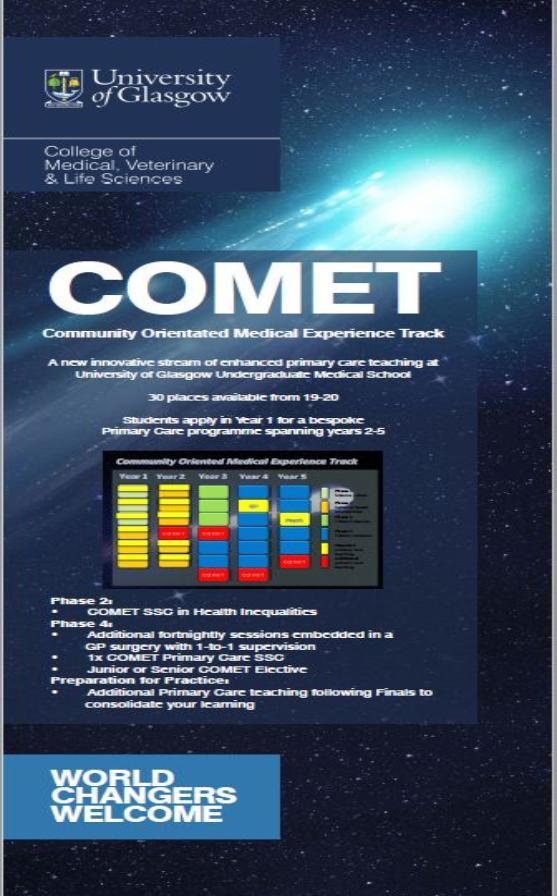
Once students have commenced the MBChB Course, there will be an application process specifically for a place on COMET. There are 30 places available on the COMET scheme for each year. The COMET programme is promoted to students during 1st year and applications open during the 1st semester of 2nd year. Successful students embark on the COMET programme from Year 2 until the end of Preparation for Practice in Year 5. The COMET curriculum covers all aspects of General Practice with a rich exposure to real life clinical practice during the 4 years of the programme; central to COMET is increased patient contact and an authentic experience of Primary Care in Scotland.
The COMET students would continue on the usual MBChB curriculum with exposure to all the other teaching and specialties. The additional COMET teaching throughout years 2-5 of the MBChB course consists of the following;
- Year 2 – COMET SSC – in Health Inequalities
- Year 3, 4 and 5 – one day per month in the same General Practice (GP Longitudinal Placement) for 2 years + 1 x COMET SSC + 1 x COMET elective
- Year 5 – additional 5 days of Primary Care teaching during Preparation for Practice. These days are spent in your GP Longitudinal Placement practice.
Student Selected Components (SSCs)
Glasgow students complete 3 SSCs (student selected components) during their studies; each SSC lasts for either 4 or 5 weeks. COMET students must undertake 2 out of the 3 in Primary Care, with the first being a core topic of Health Inequalities in Year 2. This SSC looks at the Social Determinants of Health (poverty, employment, the impact of health care policies and health care systems on health) and students will spend time in a range of health and community settings, meeting patients, service users, volunteers and professionals including time within a Deep End practice (the Deep End practices are the top 100 most deprived practices in Scotland).
Of the 2 remaining SSCs that Glasgow students undertake, only 1 must be from a menu of COMET-specific choices, and this COMET SSC can be completed in either 3rd or 4th year. The SSCs are blended with a mix of clinical time in General Practice for 3 days each week and online self-directed learning resources. The 3rd year COMET SSCs must be picked from the following menu of COMET-specific options: Treatment Burden & Multimorbidity, Realistic Medicine, Deep End Patients, Frailty & Care of the Elderly, and Equality, Diversity, Inclusion & Intersectionality.
If students choose to complete their 2nd COMET SSC in 4th year, then they can choose from the 4th year menu or self-propose. The COMET Y4 SSC menu is the same blended model that exists in Y3 but with different topics: Leadership, Adolescent Health, Clinical Reasoning, Deep End General Practice, and Gender Based Violence. If a student self-proposes they can pick a topic of their choosing.
Electives
University of Glasgow students complete two electives: a Junior Elective (at the end of year 4) and a Senior Elective (after finals) during Year 5.
COMET students must complete one of their two electives in Primary Care and will have a variety of options to choose from including overseas experiences.
Junior Elective: at the end of Year 4 (Junior), during the summer break period between year 4 & 5 (June - August). The Junior Elective duration can be a minimum of 2 weeks up to a maximum of 8 weeks. The recommended time is 4 weeks.
Senior Elective: after finals in Year 5 (Senior), after completion of the MLA and the Preparation for Practice block (May). This elective will therefore take place during term time and will be more structured. The Senior Elective placement must comprise a minimum of 16 teaching days up to a maximum of 20 days and its duration must be 4 weeks.
These electives could be based entirely in General Practice or be Primary Care related with a broad remit - just check with the COMET Lead first to see if your proposal would be acceptable. You could look at the differences in presentation and management of common conditions between primary care and secondary; a chance to experience the different roles a GP plays in a patient’s journey and, if undertaking an elective abroad, an opportunity to consider the impact of the healthcare system on illness. The options are only limited by your imagination!
GP Longitudinal Placement (GPLP)
The GP Longitudinal Placement -these extra sessions in General Practice would occur during Phase 4 of the curriculum which starts halfway through Year 3 until Final exams in year 5; covering a 2-year period. The students will be allocated a GP surgery to attend for 2 years on their own or in pairs. These sessions occur during your normal timetable and are not in your own time. This unprecedented level of personalised teaching within a practice will be invaluable in honing students’ medical skills while giving an authentic experience of General Practice. Students will benefit from being embedded within one surgery – becoming part of the team! Students will spend time in observed surgeries with members of the Primary Care Team – GPs, practice nurses, Advanced Nurse practitioners (ANPs). They will have the opportunity to conduct student-led surgeries under GP supervision and accompany the GP on home visits. Students will spend time with district nurses, pharmacists, financial inclusion workers and addiction workers and receive tutorials on agreed topics with case-based discussions (CBD). There will be formative assessments that you will undertake with your GP supervisor and which will be uploaded to your e-portfolio e.g. case based discussions, mini- CEX, thought provoking events
Preparation for Practice (PfP)
Students will return to their GP Longitudinal Placement practices for a further 5 days.
During this placement students will undertake entirely student led surgeries with GP supervision. They will be expected to take a full history and examination before preparing differential diagnoses, a management plan including medication and dosages while outlining appropriate follow up.
There will be supervised interpretation of results e.g. on docman (the electronic system used for results and clinical letters) with actions discussed and management planned.
Students will attend practice/team meetings e.g. palliative care, vulnerable children.
If students express interest in academic General Practice, research or teaching, then some time can be spent within the Academic Department of General Practice at the University of Glasgow.
COMET – application and selection process
During Year 1 students will be informed about the COMET programme and invited to contact key staff to express an interest. The COMET Lead is Prof Lynsay Crawford - lynsay.crawford@glasgow.ac.uk.
In the 1st semester of year 2, there will be a COMET information session following which students would apply for one of the 30 places on the COMET programme. Successful applicants would then follow the COMET curriculum, in addition to the core MBChB during years 2-5.
If a COMET student decides they wish to withdraw from the programme (at any point in the curriculum) they are free to do so. Any vacancies created would then be available to students, who have registered their interest in COMET, to apply for a place.
General Practice – information and resources
General Practice – information and resources