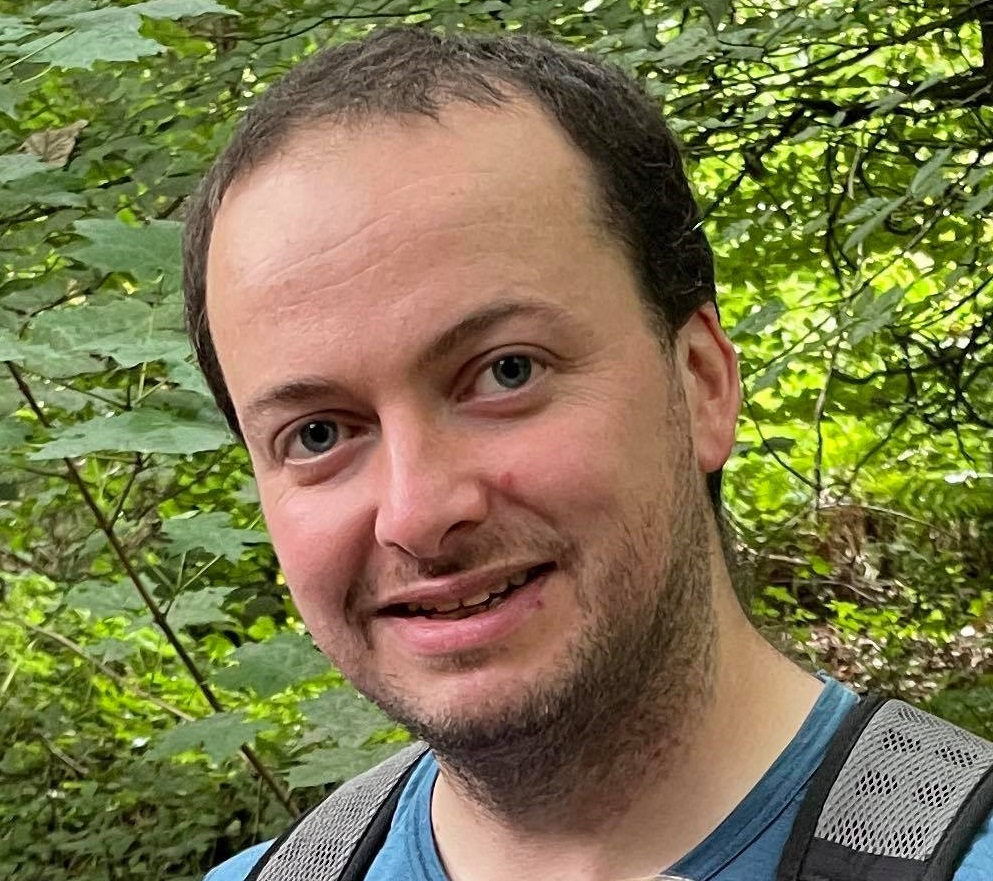
Dr Iain Neill
- Lecturer in Magmatic Processes (School of Geographical & Earth Sciences)
telephone:
01413 305477
email:
Iain.Neill@glasgow.ac.uk
Molema Building, University Avenue, G12 8QQ
 https://orcid.org/0000-0002-4168-3931
Biography
BSc, Geoscience, University of St Andrews 2003-2007
PhD, "Tectono-magmatic evolution of the SE Caribbean Plate", Cardiff University 2007-2011
PDRA, "Orogenic Plateau Magmatism", Durham University 2011-2014
University Teacher, University of Glasgow 2014-2016
Lecturer, University of Glasgow 2016-2018
PgCAP, University of Glasgow 2018
Lecturer in Magmatic Processes, University of Glasgow 2018-
Research interests
I am a native of Dingwall in Ross and Cromarty, and was introduced to geology through an enthusiastic teacher in the last years of Higher Geology in Scottish schools. My undergraduate degree in Geoscience at St Andrews taught me the value of careful and detailed observation and integrative thinking. I now generate a range of field, petrographic, geochemical and geochronological data largely from igneous, metamorphic and faulted rocks. I synthesise data to solve geological problems of relevance to society, including energy generation, resource exploration, and infrastructure development.
Global geological interests have taken me to the Caribbean and the South Caucasus, challenging plate tectonic models and explaining the occurrence of mantle-derived magmatism during continental collision. Today, the future of Scotland, particularly the Scottish Highlands, matters most to me professionally. The application of geological knowledge and research can contribute to its sustainable development, including via deep geothermal energy. I am keen to work with those interested in economics, politics, engineering and rural development, across academia, industry and politics, and especially with community organisations at the coalface of supporting and growing their local areas whilst facing major challenges resulting from new energy infrastructure.
For PhD and MSc by Research opportunities, please see the Supervision tabs below.
Publications
2026
MacRae, Careen, Neill, Iain  ORCID: https://orcid.org/0000-0002-4168-3931, Milne, Eilidh J.M., Paterson, Bruce, Struthers, Emma, Stephens, W. Ed, Gemmell, Chloe A.R., Hundeboell, Victor, Wildman, Mark ORCID: https://orcid.org/0000-0001-9402-7164 and Strachan, Rob A.
(2026)
The U-Pb geochronology of Ordovician to Devonian plutonism in the Northern Highlands of Scotland.
Scottish Journal of Geology, 62(1),
sjg2025-011.
(doi: 10.1144/sjg2025-011)
Curtis, A. et al. (2026) The UK and Ireland geophysical array. Astronomy and Geophysics, 67(3), 3.31-3.37. (doi: 10.1093/astrogeo/atag017)
2025
Neill, Iain ORCID: https://orcid.org/0000-0002-4168-3931 and Kerr, Andrew C
(2025)
The Caribbean-Colombian oceanic plateau.
In: Shelnutt, Greg and Denysyzn, Steve (eds.)
Phanerozoic Large Igneous Provinces: A Comparative Approach.
Elsevier.
(Accepted for Publication)
Stubbs, Amanda R., Khudhur, Faisal W.K. ORCID: https://orcid.org/0000-0002-3295-1180, Power, Ian M., McDade, Linzi, Friel, Mark, Neill, Iain ORCID: https://orcid.org/0000-0002-4168-3931 and MacDonald, John ORCID: https://orcid.org/0000-0002-8609-804X
(2025)
Optimizing the management of quarry fines for on-site carbon removal: Implications of grain size and mineralogy on CO2 mineralization.
International Journal of Greenhouse Gas Control, 143,
104344.
(doi: 10.1016/j.ijggc.2025.104344)
Gemmell, Chloe A.R., Neill, Iain ORCID: https://orcid.org/0000-0002-4168-3931, Wildman, Mark ORCID: https://orcid.org/0000-0001-9402-7164, MacRae, Careen, Currie, David and Einsle, Joshua F. ORCID: https://orcid.org/0000-0001-8263-8531
(2025)
New integrations of U-Pb zircon data from Caledonian intrusions in the Southern Uplands of Scotland.
Lithos, 494-95,
107941.
(doi: 10.1016/j.lithos.2024.107941)
2024
Stubbs, Amanda, MacDonald, John ORCID: https://orcid.org/0000-0002-8609-804X and Neill, Iain ORCID: https://orcid.org/0000-0002-4168-3931
(2024)
Mechanisms of secondary carbonate precipitation on felsic, intermediate and mafic igneous rocks: a case study for NW Scotland.
Scottish Journal of Geology, 60(2),
(doi: 10.1144/sjg2024-003)
2023
Milne, Eilidh J. M., Neill, Iain ORCID: https://orcid.org/0000-0002-4168-3931, Bird, Anna C., Millar, Ian L., McDonald, Iain, Dempsey, Edward D., Olive, Valerie ORCID: https://orcid.org/0000-0002-3905-2946, Odling, Nic and Waters, Emma C. ORCID: https://orcid.org/0000-0002-5612-8316
(2023)
Caledonian hot zone magmatism in the “Newer Granites”: insight from the Cluanie and Clunes plutons, Northern Scottish Highlands.
Journal of the Geological Society, 180(2),
jgs2022-076.
(doi: 10.1144/jgs2022-076)
2022
van Mesdag, Savanna, MacDonald, John ORCID: https://orcid.org/0000-0002-8609-804X, Neill, Iain ORCID: https://orcid.org/0000-0002-4168-3931 and Jump, Alistair
(2022)
Anthropogenic Biodiversity and Geodiversity - Can Legacy Industrial Waste Help Offset Falling Global Biodiversity?
EGU General Assembly 2022, Vienna, Austria, 23–27 May 2022.
(doi: 10.5194/egusphere-egu22-1352)
2021
Meliksetian, Khachatur, Neill, Iain ORCID: https://orcid.org/0000-0002-4168-3931, Barfod, Dan N. ORCID: https://orcid.org/0000-0001-8934-4034, Milne, Eilidh J.M., Waters, Emma C., Navasardyan, Gevorg, Grigoryan, Edmond, Olive, Valerie ORCID: https://orcid.org/0000-0002-3905-2946, Odling, Nicholas and Karakhanian, Arkady
(2021)
Pleistocene - Holocene volcanism at the Karkar geothermal prospect, Armenia.
Quaternary Geochronology, 66,
101201.
(doi: 10.1016/j.quageo.2021.101201)
Brown, J.R., Cooper, G.F., Nowell, G.M., Macpherson, C.G., Neill, I. ORCID: https://orcid.org/0000-0002-4168-3931 and Prytulak, J.
(2021)
Isotopic compositions of plagioclase from plutonic xenoliths reveal crustal assimilation below Martinique, Lesser Antilles arc.
Frontiers in Earth Science, 9,
682583.
(doi: 10.3389/feart.2021.682583)
2020
Kheirkhah, Monireh, Neill, Iain ORCID: https://orcid.org/0000-0002-4168-3931, Allen, Mark B., Emami, Mohammad H. and Shahraki Ghadimi, Ali
(2020)
Distinct sources for high-K and adakitic magmatism in SE Iran.
Journal of Asian Earth Sciences, 196,
104355.
(doi: 10.1016/j.jseaes.2020.104355)
Eskandari, Amir, Deevsalar, Reza, De Rosa, Rosanna, Shinjo, Ryuichi, Donato, Paola and Neill, Iain ORCID: https://orcid.org/0000-0002-4168-3931
(2020)
Geochemical and isotopic constraints on the evolution of magma plumbing system at Damavand Volcano, N Iran.
Lithos, 354-55,
105274.
(doi: 10.1016/j.lithos.2019.105274)
2019
Yeganehfar, Hadi, Deevsalar, Reza, Ahadnejad, Vahid, Shinjo, Ryuichi and Neill, Iain ORCID: https://orcid.org/0000-0002-4168-3931
(2019)
Biotite compositional variations – a physicochemical approach to investigate crustal involvement and ore potential in Middle Jurassic plutonic rocks from the Malayer-Boroujerd Plutonic complex, W Iran.
Neues Jahrbuch fur Mineralogie, Monatshefte, 196(1),
pp. 19-42.
(doi: 10.1127/njma/2019/0131)
2018
Deevsalar, Reza, Shinjo, Ryuichi, Wang, Kuo-Lung, Yaganehfar, Hadi and Neill, Iain ORCID: https://orcid.org/0000-0002-4168-3931
(2018)
Gabbroic-dioritic dykes from the Sanadaj-Sirjan Zone: windows on Jurassic and Eocene geodynamic processes in the Zagros Orogen, western Iran.
Journal of the Geological Society, 175(6),
pp. 915-933.
(doi: 10.1144/jgs2017-156)
Deevsalar, Reza, Shinjo, Ryuichi, Liégeois, Jean P., Valizadeh, Mohammad V., Ahmadian, Jamshid, Yeganehfar, Hadi and Neill, Iain ORCID: https://orcid.org/0000-0002-4168-3931
(2018)
Subduction-related mafic to felsic magmatism in the Malayer-Boroujerd plutonic complex, western Iran.
Swiss Journal of Geosciences, 111(1-2),
pp. 269-293.
(doi: 10.1007/s00015-017-0287-y)
2017
Deevsalar, Reza, Shinjo, Ryuichi, Ghaderi, Majid, Murata, Mamoru, Hoskin, P.W.O., Oshiro, Shoma, Wang, Kuo-Lung, Lee, Hao Yang and Neill, Iain ORCID: https://orcid.org/0000-0002-4168-3931
(2017)
Mesozoic-Cenozoic mafic magmatism in Sanandaj-Sirjan Zone, Zagros
Orogen (Western Iran): geochemical and isotopic inferences from Middle
Jurassic and Late Eocene gabbros.
Lithos, 284-85,
pp. 588-607.
(doi: 10.1016/j.lithos.2017.05.009)
2015
Zhange, J., Davidson, J.P., Humphreys, M.C.S., Macpherson, C.G. and Neill, I. ORCID: https://orcid.org/0000-0002-4168-3931
(2015)
Magmatic enclaves and andesitic lavas from Mt. Lamington, Papua New Guinea: Implications for recycling of earlier-fractionated minerals through magma recharge.
Journal of Petrology, 56(11),
pp. 2223-2256.
(doi: 10.1093/petrology/egv071)
Hastie, A.R., Fitton, J.G., Mitchell, S.F., Neill, I. ORCID: https://orcid.org/0000-0002-4168-3931, Nowell, G.M. and Millar, I.L.
(2015)
Can fractional crystallization, mixing and assimilation processes be responsible for jamaican-type adakites? Implications for generating eoarchaean continental crust.
Journal of Petrology, 56(7),
pp. 1251-1284.
(doi: 10.1093/petrology/egv029)
Kheirkhah, M., Neill, I. ORCID: https://orcid.org/0000-0002-4168-3931 and Allen, M.B.
(2015)
Petrogenesis of OIB-like volcanic rocks in a continental collision zone: Late Cenozoic magmatism of eastern Iran.
Journal of Asian Earth Sciences, 106(1),
pp. 19-33.
(doi: 10.1016/j.jseaes.2015.02.027)
Neill, Iain ORCID: https://orcid.org/0000-0002-4168-3931, Meliksetian, Khachatur, Allen, Mark B., Navasardyan, Gevorg and Kuiper, Klaudia
(2015)
Petrogenesis of mafic collision zone magmatism: the Armenian sector of the Turkish-Iranian Plateau.
Chemical Geology, 403,
pp. 24-41.
(doi: 10.1016/j.chemgeo.2015.03.013)
2014
Neill, Iain ORCID: https://orcid.org/0000-0002-4168-3931, Kerr, Andrew C., Chamberlain, Kevin R., Schmitt, Axel K., Urbani, Franco, Hastie, Alan R., Pindell, James L., Barry, Tiffany L. and Millar, Ian L.
(2014)
Vestiges of the proto-Caribbean seaway: origin of the San Souci Volcanic Group, Trinidad.
Tectonophysics, 626,
pp. 170-185.
(doi: 10.1016/j.tecto.2014.04.019)
Kaislaniemi, L., van Hunen, J., Allen, M. B. and Neill, I. ORCID: https://orcid.org/0000-0002-4168-3931
(2014)
Sublithospheric small-scale convection: a mechanism for collision zone magmatism.
Geology, 42(4),
pp. 291-294.
(doi: 10.1130/G35193.1)
2013
Neill, I. ORCID: https://orcid.org/0000-0002-4168-3931, Meliksetian, Kh., Allen, M.B., Navarsardyan, G. and Karapetyan, S.
(2013)
Pliocene–Quaternary volcanic rocks of NW Armenia: magmatism and lithospheric dynamics within an active orogenic plateau.
Lithos, 180-18,
pp. 200-215.
(doi: 10.1016/j.lithos.2013.05.005)
Kheirkhah, M., Neill, I. ORCID: https://orcid.org/0000-0002-4168-3931, Allen, M.B. and Ajdari, K.
(2013)
Small-volume melts of lithospheric mantle during continental collision: Late Cenozoic lavas of Mahabad, NW Iran.
Journal of Asian Earth Sciences, 74,
pp. 37-49.
(doi: 10.1016/j.jseaes.2013.06.002)
Neill, Iain ORCID: https://orcid.org/0000-0002-4168-3931, Kerr, Andrew C., Hastie, Alan R., Pindell, James L. and Millar, Ian L.
(2013)
The Albian-Turonian Island arc rocks of Tobago, West Indies: geochemistry, petrogenesis, and Caribbean plate tectonics.
Journal of Petrology, 54(8),
pp. 1607-1639.
(doi: 10.1093/petrology/egt025)
Allen, M. B., Kheirkhah, M., Neill, I. ORCID: https://orcid.org/0000-0002-4168-3931, Emami, M. H. and Mcleod, C. L.
(2013)
Generation of arc and within-plate chemical signatures in collision zone magmatism: quaternary lavas from Kurdistan Province, Iran.
Journal of Petrology, 54(5),
pp. 887-911.
(doi: 10.1093/petrology/egs090)
Hastie, Alan R., Mitchell, Simon F., Treloar, Peter J., Kerr, Andrew C., Neill, Iain ORCID: https://orcid.org/0000-0002-4168-3931 and Barfod, Dan N. ORCID: https://orcid.org/0000-0001-8934-4034
(2013)
Geochemical components in a Cretaceous island arc: The Th/La–(Ce/Ce*)Nd diagram and implications for subduction initiation in the inter-American region.
Lithos, 162-63,
pp. 57-69.
(doi: 10.1016/j.lithos.2012.12.001)
2012
Neill, Iain ORCID: https://orcid.org/0000-0002-4168-3931, Kerr, Andrew C., Hastie, Alan R., Pindell, James L., Millar, Ian L. and Atkinson, Nicola
(2012)
Age and petrogenesis of the Lower Cretaceous North Coast Schist of Tobago, a fragment of the Proto–Greater Antilles Inter-American arc system.
Journal of Geology, 120(4),
pp. 367-384.
(doi: 10.1086/665798)
2011
Neill, Iain ORCID: https://orcid.org/0000-0002-4168-3931, Kerr, Andrew C., Hastie, Alan R., Stanek, Klaus-Peter and Millar, Ian L.
(2011)
Origin of the Aves Ridge and Dutch-Venezuelan Antilles: interaction of the Cretaceous 'Great Arc' and Caribbean-Colombian Oceanic Plateau?
Journal of the Geological Society, 168(2),
pp. 333-348.
(doi: 10.1144/0016-76492010-067)
2010
Neill, Iain ORCID: https://orcid.org/0000-0002-4168-3931, Gibbs, Jennifer A., Hastie, Alan R. and Kerr, Andrew C.
(2010)
Origin of the volcanic complexes of La Désirade, Lesser Antilles: implications for tectonic reconstruction of the Late Jurassic to Cretaceous Pacific-proto Caribbean margin.
Lithos, 120(3-4),
pp. 407-420.
(doi: 10.1016/j.lithos.2010.08.026)
2009
Neill, I. ORCID: https://orcid.org/0000-0002-4168-3931 and Stephens, W. E.
(2009)
The Cluanie granodiorite, NW Highlands of Scotland: a late Caledonian pluton of trondhjemitic affinity.
Scottish Journal of Geology, 45(2),
pp. 117-130.
(doi: 10.1144/0036-9276/01-373)
Articles
MacRae, Careen, Neill, Iain ORCID: https://orcid.org/0000-0002-4168-3931, Milne, Eilidh J.M., Paterson, Bruce, Struthers, Emma, Stephens, W. Ed, Gemmell, Chloe A.R., Hundeboell, Victor, Wildman, Mark ORCID: https://orcid.org/0000-0001-9402-7164 and Strachan, Rob A.
(2026)
The U-Pb geochronology of Ordovician to Devonian plutonism in the Northern Highlands of Scotland.
Scottish Journal of Geology, 62(1),
sjg2025-011.
(doi: 10.1144/sjg2025-011)
Curtis, A. et al. (2026) The UK and Ireland geophysical array. Astronomy and Geophysics, 67(3), 3.31-3.37. (doi: 10.1093/astrogeo/atag017)
Stubbs, Amanda R., Khudhur, Faisal W.K. ORCID: https://orcid.org/0000-0002-3295-1180, Power, Ian M., McDade, Linzi, Friel, Mark, Neill, Iain ORCID: https://orcid.org/0000-0002-4168-3931 and MacDonald, John ORCID: https://orcid.org/0000-0002-8609-804X
(2025)
Optimizing the management of quarry fines for on-site carbon removal: Implications of grain size and mineralogy on CO2 mineralization.
International Journal of Greenhouse Gas Control, 143,
104344.
(doi: 10.1016/j.ijggc.2025.104344)
Gemmell, Chloe A.R., Neill, Iain ORCID: https://orcid.org/0000-0002-4168-3931, Wildman, Mark ORCID: https://orcid.org/0000-0001-9402-7164, MacRae, Careen, Currie, David and Einsle, Joshua F. ORCID: https://orcid.org/0000-0001-8263-8531
(2025)
New integrations of U-Pb zircon data from Caledonian intrusions in the Southern Uplands of Scotland.
Lithos, 494-95,
107941.
(doi: 10.1016/j.lithos.2024.107941)
Stubbs, Amanda, MacDonald, John ORCID: https://orcid.org/0000-0002-8609-804X and Neill, Iain ORCID: https://orcid.org/0000-0002-4168-3931
(2024)
Mechanisms of secondary carbonate precipitation on felsic, intermediate and mafic igneous rocks: a case study for NW Scotland.
Scottish Journal of Geology, 60(2),
(doi: 10.1144/sjg2024-003)
Milne, Eilidh J. M., Neill, Iain ORCID: https://orcid.org/0000-0002-4168-3931, Bird, Anna C., Millar, Ian L., McDonald, Iain, Dempsey, Edward D., Olive, Valerie ORCID: https://orcid.org/0000-0002-3905-2946, Odling, Nic and Waters, Emma C. ORCID: https://orcid.org/0000-0002-5612-8316
(2023)
Caledonian hot zone magmatism in the “Newer Granites”: insight from the Cluanie and Clunes plutons, Northern Scottish Highlands.
Journal of the Geological Society, 180(2),
jgs2022-076.
(doi: 10.1144/jgs2022-076)
Meliksetian, Khachatur, Neill, Iain ORCID: https://orcid.org/0000-0002-4168-3931, Barfod, Dan N. ORCID: https://orcid.org/0000-0001-8934-4034, Milne, Eilidh J.M., Waters, Emma C., Navasardyan, Gevorg, Grigoryan, Edmond, Olive, Valerie ORCID: https://orcid.org/0000-0002-3905-2946, Odling, Nicholas and Karakhanian, Arkady
(2021)
Pleistocene - Holocene volcanism at the Karkar geothermal prospect, Armenia.
Quaternary Geochronology, 66,
101201.
(doi: 10.1016/j.quageo.2021.101201)
Brown, J.R., Cooper, G.F., Nowell, G.M., Macpherson, C.G., Neill, I. ORCID: https://orcid.org/0000-0002-4168-3931 and Prytulak, J.
(2021)
Isotopic compositions of plagioclase from plutonic xenoliths reveal crustal assimilation below Martinique, Lesser Antilles arc.
Frontiers in Earth Science, 9,
682583.
(doi: 10.3389/feart.2021.682583)
Kheirkhah, Monireh, Neill, Iain ORCID: https://orcid.org/0000-0002-4168-3931, Allen, Mark B., Emami, Mohammad H. and Shahraki Ghadimi, Ali
(2020)
Distinct sources for high-K and adakitic magmatism in SE Iran.
Journal of Asian Earth Sciences, 196,
104355.
(doi: 10.1016/j.jseaes.2020.104355)
Eskandari, Amir, Deevsalar, Reza, De Rosa, Rosanna, Shinjo, Ryuichi, Donato, Paola and Neill, Iain ORCID: https://orcid.org/0000-0002-4168-3931
(2020)
Geochemical and isotopic constraints on the evolution of magma plumbing system at Damavand Volcano, N Iran.
Lithos, 354-55,
105274.
(doi: 10.1016/j.lithos.2019.105274)
Yeganehfar, Hadi, Deevsalar, Reza, Ahadnejad, Vahid, Shinjo, Ryuichi and Neill, Iain ORCID: https://orcid.org/0000-0002-4168-3931
(2019)
Biotite compositional variations – a physicochemical approach to investigate crustal involvement and ore potential in Middle Jurassic plutonic rocks from the Malayer-Boroujerd Plutonic complex, W Iran.
Neues Jahrbuch fur Mineralogie, Monatshefte, 196(1),
pp. 19-42.
(doi: 10.1127/njma/2019/0131)
Deevsalar, Reza, Shinjo, Ryuichi, Wang, Kuo-Lung, Yaganehfar, Hadi and Neill, Iain ORCID: https://orcid.org/0000-0002-4168-3931
(2018)
Gabbroic-dioritic dykes from the Sanadaj-Sirjan Zone: windows on Jurassic and Eocene geodynamic processes in the Zagros Orogen, western Iran.
Journal of the Geological Society, 175(6),
pp. 915-933.
(doi: 10.1144/jgs2017-156)
Deevsalar, Reza, Shinjo, Ryuichi, Liégeois, Jean P., Valizadeh, Mohammad V., Ahmadian, Jamshid, Yeganehfar, Hadi and Neill, Iain ORCID: https://orcid.org/0000-0002-4168-3931
(2018)
Subduction-related mafic to felsic magmatism in the Malayer-Boroujerd plutonic complex, western Iran.
Swiss Journal of Geosciences, 111(1-2),
pp. 269-293.
(doi: 10.1007/s00015-017-0287-y)
Deevsalar, Reza, Shinjo, Ryuichi, Ghaderi, Majid, Murata, Mamoru, Hoskin, P.W.O., Oshiro, Shoma, Wang, Kuo-Lung, Lee, Hao Yang and Neill, Iain ORCID: https://orcid.org/0000-0002-4168-3931
(2017)
Mesozoic-Cenozoic mafic magmatism in Sanandaj-Sirjan Zone, Zagros
Orogen (Western Iran): geochemical and isotopic inferences from Middle
Jurassic and Late Eocene gabbros.
Lithos, 284-85,
pp. 588-607.
(doi: 10.1016/j.lithos.2017.05.009)
Zhange, J., Davidson, J.P., Humphreys, M.C.S., Macpherson, C.G. and Neill, I. ORCID: https://orcid.org/0000-0002-4168-3931
(2015)
Magmatic enclaves and andesitic lavas from Mt. Lamington, Papua New Guinea: Implications for recycling of earlier-fractionated minerals through magma recharge.
Journal of Petrology, 56(11),
pp. 2223-2256.
(doi: 10.1093/petrology/egv071)
Hastie, A.R., Fitton, J.G., Mitchell, S.F., Neill, I. ORCID: https://orcid.org/0000-0002-4168-3931, Nowell, G.M. and Millar, I.L.
(2015)
Can fractional crystallization, mixing and assimilation processes be responsible for jamaican-type adakites? Implications for generating eoarchaean continental crust.
Journal of Petrology, 56(7),
pp. 1251-1284.
(doi: 10.1093/petrology/egv029)
Kheirkhah, M., Neill, I. ORCID: https://orcid.org/0000-0002-4168-3931 and Allen, M.B.
(2015)
Petrogenesis of OIB-like volcanic rocks in a continental collision zone: Late Cenozoic magmatism of eastern Iran.
Journal of Asian Earth Sciences, 106(1),
pp. 19-33.
(doi: 10.1016/j.jseaes.2015.02.027)
Neill, Iain ORCID: https://orcid.org/0000-0002-4168-3931, Meliksetian, Khachatur, Allen, Mark B., Navasardyan, Gevorg and Kuiper, Klaudia
(2015)
Petrogenesis of mafic collision zone magmatism: the Armenian sector of the Turkish-Iranian Plateau.
Chemical Geology, 403,
pp. 24-41.
(doi: 10.1016/j.chemgeo.2015.03.013)
Neill, Iain ORCID: https://orcid.org/0000-0002-4168-3931, Kerr, Andrew C., Chamberlain, Kevin R., Schmitt, Axel K., Urbani, Franco, Hastie, Alan R., Pindell, James L., Barry, Tiffany L. and Millar, Ian L.
(2014)
Vestiges of the proto-Caribbean seaway: origin of the San Souci Volcanic Group, Trinidad.
Tectonophysics, 626,
pp. 170-185.
(doi: 10.1016/j.tecto.2014.04.019)
Kaislaniemi, L., van Hunen, J., Allen, M. B. and Neill, I. ORCID: https://orcid.org/0000-0002-4168-3931
(2014)
Sublithospheric small-scale convection: a mechanism for collision zone magmatism.
Geology, 42(4),
pp. 291-294.
(doi: 10.1130/G35193.1)
Neill, I. ORCID: https://orcid.org/0000-0002-4168-3931, Meliksetian, Kh., Allen, M.B., Navarsardyan, G. and Karapetyan, S.
(2013)
Pliocene–Quaternary volcanic rocks of NW Armenia: magmatism and lithospheric dynamics within an active orogenic plateau.
Lithos, 180-18,
pp. 200-215.
(doi: 10.1016/j.lithos.2013.05.005)
Kheirkhah, M., Neill, I. ORCID: https://orcid.org/0000-0002-4168-3931, Allen, M.B. and Ajdari, K.
(2013)
Small-volume melts of lithospheric mantle during continental collision: Late Cenozoic lavas of Mahabad, NW Iran.
Journal of Asian Earth Sciences, 74,
pp. 37-49.
(doi: 10.1016/j.jseaes.2013.06.002)
Neill, Iain ORCID: https://orcid.org/0000-0002-4168-3931, Kerr, Andrew C., Hastie, Alan R., Pindell, James L. and Millar, Ian L.
(2013)
The Albian-Turonian Island arc rocks of Tobago, West Indies: geochemistry, petrogenesis, and Caribbean plate tectonics.
Journal of Petrology, 54(8),
pp. 1607-1639.
(doi: 10.1093/petrology/egt025)
Allen, M. B., Kheirkhah, M., Neill, I. ORCID: https://orcid.org/0000-0002-4168-3931, Emami, M. H. and Mcleod, C. L.
(2013)
Generation of arc and within-plate chemical signatures in collision zone magmatism: quaternary lavas from Kurdistan Province, Iran.
Journal of Petrology, 54(5),
pp. 887-911.
(doi: 10.1093/petrology/egs090)
Hastie, Alan R., Mitchell, Simon F., Treloar, Peter J., Kerr, Andrew C., Neill, Iain ORCID: https://orcid.org/0000-0002-4168-3931 and Barfod, Dan N. ORCID: https://orcid.org/0000-0001-8934-4034
(2013)
Geochemical components in a Cretaceous island arc: The Th/La–(Ce/Ce*)Nd diagram and implications for subduction initiation in the inter-American region.
Lithos, 162-63,
pp. 57-69.
(doi: 10.1016/j.lithos.2012.12.001)
Neill, Iain ORCID: https://orcid.org/0000-0002-4168-3931, Kerr, Andrew C., Hastie, Alan R., Pindell, James L., Millar, Ian L. and Atkinson, Nicola
(2012)
Age and petrogenesis of the Lower Cretaceous North Coast Schist of Tobago, a fragment of the Proto–Greater Antilles Inter-American arc system.
Journal of Geology, 120(4),
pp. 367-384.
(doi: 10.1086/665798)
Neill, Iain ORCID: https://orcid.org/0000-0002-4168-3931, Kerr, Andrew C., Hastie, Alan R., Stanek, Klaus-Peter and Millar, Ian L.
(2011)
Origin of the Aves Ridge and Dutch-Venezuelan Antilles: interaction of the Cretaceous 'Great Arc' and Caribbean-Colombian Oceanic Plateau?
Journal of the Geological Society, 168(2),
pp. 333-348.
(doi: 10.1144/0016-76492010-067)
Neill, Iain ORCID: https://orcid.org/0000-0002-4168-3931, Gibbs, Jennifer A., Hastie, Alan R. and Kerr, Andrew C.
(2010)
Origin of the volcanic complexes of La Désirade, Lesser Antilles: implications for tectonic reconstruction of the Late Jurassic to Cretaceous Pacific-proto Caribbean margin.
Lithos, 120(3-4),
pp. 407-420.
(doi: 10.1016/j.lithos.2010.08.026)
Neill, I. ORCID: https://orcid.org/0000-0002-4168-3931 and Stephens, W. E.
(2009)
The Cluanie granodiorite, NW Highlands of Scotland: a late Caledonian pluton of trondhjemitic affinity.
Scottish Journal of Geology, 45(2),
pp. 117-130.
(doi: 10.1144/0036-9276/01-373)
Book Sections
Neill, Iain ORCID: https://orcid.org/0000-0002-4168-3931 and Kerr, Andrew C
(2025)
The Caribbean-Colombian oceanic plateau.
In: Shelnutt, Greg and Denysyzn, Steve (eds.)
Phanerozoic Large Igneous Provinces: A Comparative Approach.
Elsevier.
(Accepted for Publication)
Conference or Workshop Item
van Mesdag, Savanna, MacDonald, John ORCID: https://orcid.org/0000-0002-8609-804X, Neill, Iain ORCID: https://orcid.org/0000-0002-4168-3931 and Jump, Alistair
(2022)
Anthropogenic Biodiversity and Geodiversity - Can Legacy Industrial Waste Help Offset Falling Global Biodiversity?
EGU General Assembly 2022, Vienna, Austria, 23–27 May 2022.
(doi: 10.5194/egusphere-egu22-1352)
Grants
Co-I: GRANITES – Geothermal Resource Assessment using New Investigative Techniques and Emerging Strategies 2026: Amount: £5,000.
PI: Islay Energy Trust via Carbon Neutral Islands/Scottish Government 2026: The geothermal potential of Islay. Amount £15,500.
Co-I: NERC Isotope Facilities grant-in-kind, with Joe Armstrong, Chloe Gemmell (Aberdeen), Simon Tapster (British Geological Survey), Fraser Gardiner (Aberdeen Minerals) 2025: Testing regional magmatic controls on Ni-Cu sulphide prospectivity in the Grampian aged Mafic-Ultramafic intrusions of NE Scotland. Amount £89,040.
Co-I: NERC Isotope Facilities grant-in-kind, with Sam Bright, Marc Reichow, Andrew Miles (Leicester), Rob Strachan (Portsmouth), Nick Roberts and Matt Horstwood (British Geological Survey), and Mike Searle (Oxford) 2025: Using plutons to test large transcurrent fault displacements in collisional orogens: the Great Glen Fault, Scotland. Amount £48,400.
PI: NERC Isotope Facilities grant-in-kind, with Euan McIntosh (Western Gold) 2025: Caledonian Porphyry Copper: Why Kilmelford? Amount £33,700.
PI: EPSRC Impact Acceleration Account 2024: The geothermal potential of Inner Moray Firth granites: a community-grounded approach. £5000.
PI: NERC Isotope Facilities grant-in-kind, with Prof Rob Strachan (Portsmouth) and Nick Roberts and Dan Condon (British Geological Survey) 2024: What's in a Date? A systematic approach to improving the geological interpretation of zircon U-Pb studies. £66,675.
PI: NERC Isotope Facilities grant-in-kind, with Prof Javier Escuder Viruete (Instituto Geológico y Minero de España) and Prof Julie Prytulak (University of Durham) 2023: Testing a two-arc model of Caribbean Plate evolution using mantle source forensics. £19,950.
Co-I: Carnegie Trust 2023 and 2024 with Paul Eizenhofer and Antoniette Greta Grima on i) zircon dating and geochemistry with respect to landscape evolution in northern Asia and ii) geodynamic modelling of flat slab scenarios. £30,000.
Co-I: NERC, with University of Hull 2023-2024: Barcoding magmas: Applying machine learning in zircon geochemistry to increase provenance accuracy. £80,764.
Co-I: Oil and Gas Innovation Centre, with Getech 2018: Predicting the presence of weathered fractured granite basement reservoirs. £71,000.
Co-I: National Academy of Sciences of Armenia (foreign collaborator) for fieldwork in 2016 and 2017: Archaeovolcanological and achaeoseismological studies in Armenia applying 14C, Ar-Ar and 3He isotope age estimates. €2500.
PI: Carnegie Trust for the Universities of Scotland Research Incentive Grant 2016: Fire and shaking in the South Caucasus: connecting geo-archaeology and hazards in Armenia. £7459.
PI: Geological Society of London Elspeth Matthews Fund 2016: Fire and Shaking in the South Caucasus: carbon dating Armenia's recent geological past. £1930.
Supervision
Available supervision:
PhD: PhD projects are available on topics relating to my research interests, above. Some suggested areas:
- Relationships between faulting, fluids, melts, metasomatism and rock strengthening and weakening in major crustal faults, and their implications for Net Zero infrastructure in partnership with the British Geological Survey [will be advertised via https://iapetus.ac.uk, search for Glasgow projects].
- Geological opportunities during the energy transition, for example, constraining the shallow to deep geothermal potential of a region or area of interest, or constraining sources and processes behind critical raw materials. A range of field and laboratory techniques can be involved depending on the project.
- Geological connections between plate tectonics, geodynamics, magmatism and plate reconstruction and resources. This might include modelling in collaboration with modelling-focused co-supervisors.
- Exploring Human Geography connections between communities, organisations and the land beneath their feet, Just Transition in the Highlands of Scotland, understanding the acceptance of geological solutions to the energy transition. Such projects could be combined in an interdisciplinary fashion with geological research, or form projects in their own right [opportunities for candidates to study communities and the land beneath their feet in their home area may be advertised via https://www.divein.org.uk/].
- For projects involving large amounts of field and analytical science, a prospective student must arrange to have funds in place either individually or from a sponsor to cover tuition, living costs and the cost of research itself. Research costs will be in the region of £10,000 for a PhD project. Scholarships are potentially available and candidates should inspect: https://www.gla.ac.uk/schools/ges/research/postgraduate/ to see if any opportunities are posted. An opportunity to apply for a Research Council-funded PhD will usually be listed at https://iapetus.ac.uk/ each October and opportunities may also appear for modelling-focused projects at https://www.exageo.org/.
MSc by Research: Self-funded MSc by Research projects are available to start each October and potentially outside this timeframe. Some suggested areas:
- Deskwork, structural and sampling fieldwork, petrography, thermal testing, and modelling of the geothermal potential of regions of your choice.
- Hard rock geology topics with singular hypotheses testable with field and modest amounts of laboratory data, which might include geochemical analysis or geochronology. Come and chat about these, as I am interested in all parts of Scotland, particularly on igneous and metamorphic rocks and stratigraphy. I am most keen to support work in the British Isles as these are more predictable for MScR durations [see examples of current and past projects, below].
- The research component of an MScR lasts for one year, with a further year to hand in a thesis. See https://www.gla.ac.uk/postgraduate/research/geology/#tab=fees: the cost is 1 x year of tuition [20% alumni discount], coverable by a state loan, plus bench fee of at least £1000. Scholarships are not available. The fee covers basic analytical expenses and a candidate should cover some or all field studies if included. We would work to augment a project beyond the basic premise, potentially from external sources such as https://sages.ac.uk/, local geological societies such as https://geologyglasgow.org.uk/ and national organisations such as https://www.isotopesuk.org/ and https://www.geolsoc.org.uk/careers-and-training/funding-opportunities/.
Current students:
James Campbell, What is a tectonic slide, anyway? MSc by Research
Katy Maxwell, Orogeny and resources from the magmatic record of Argyll, MSc by Research
Edana Sutherland, The geothermal potential of Islay, MSc by Research, followed by a PhD on the geothermal potential of rural Scotland.
Declan Beggan, Caledonian Porphyry Copper: Why Kilmelford? MSc by Research
Co-I, PhD: Sam Bright (Leicester, CENTA), Tong Chai (China Scholarship Council), Amanda Stubbs (IAPETUS)
Co-I, MSc by Research: Oliver Gilmore
- Chai, Tong
Economic eruptions: modelling the formation of MtAp deposits
Graduated students:
PI, MSc by Research:
Victor Hundeboll "The tectonomagmatic evolution of Southern Kintyre", 2026. Destination: Exploration and Quarrying Geologist.
Careen MacRae "The Geochronology of Plutonism
Associated with the Great Glen Fault, Northern Scottish Highlands", 2024 [read about it here: https://doi.org/10.1144/sjg2025-011]. Destination: PhD research, Edinburgh.
Chloe Gemmell "Timing and distribution of post-subduction magmatism in the Southern Uplands of Scotland: New insights from U-Pb zircon data of Caledonian igneous bodies", 2024 [read about it here: https://doi.org/10.1016/j.lithos.2024.107941]. Destination: PhD research, Aberdeen.
Euan McIntosh "Economic mineralisation of the Loch Maree Group and Tectonic Correlation of the Lewisianoid inliers of Scardroy and Orrin", 2021. Destination: Exploration Geologist, Western Gold.
Eilidh Milne "The Great Glen Caledonian Igneous Suite", 2020 [read about it here: https://doi.org/10.1144/jgs2022-076]. Destination: Ecological Consultant, Redwing Ecology.
Co-I, PhD:
Joshua Brown (Durham, IAPETUS), Jose del Angel Lozano (Glasgow), Savana van Mesdag (Glasgow, IAPETUS).
Co-I, MSc by Research: Ciara Fallon, Kimberley Pentland, Ryan Mooney, Shona Swan, Andrew Hattie, Christopher Holdsworth (all Glasgow).
Teaching
Fundamental Geology - Fieldwork - Synthesis of Observations and Concepts - The Application of Geology to the Energy Transition
Honours Geology BSc
- Igneous and Metamorphic Geology
- Geological Skills and Environmental Geoscience Skills
- Leader of day field courses
- Leader of Ullapool component of Northern Highlands Field Course
- Advanced Geological Skills
Level 4 Geology BSc
- Independent Research Dissertation supervision (2015-)
Earth Futures MSc
- Global Challenges on the Resource Transition, Rural Transitions, and Environmental Assessment
Past
- Level 1 Earth Science laboratories, minerals and resource geology
- Level 2 Earth Science materials and igneous geology
- Level 2 Arran residential field trip
- Level 3 Tenerife residential field trip
- Level 3 Oban, Mull, Ullapool, Fort William residential trips
- Level 3 Igneous Geochemistry and Metamorphic geology
- Level 4 Earth Science Independent Laboratory Research Projects
- Level 3/4 Geological Synthesis and Application
- Level 5 Analytical Methods
- MSc Academic and Professional Skills
Research datasets
Additional information
I am available for new collaborations and potentially consultancy work particularly related to Scottish geology. Please contact by e-mail in the first instance.
Senior Adviser of Studies for Geology and Environmental Geoscience (2022)
Learning and Teaching Enhancement Officer for Geographical and Earth Sciences (2019-2023).
Co-ordinator for the Earth Systems Research Group MSc by Research degree in GES (2020-).
Co-ordinator for Honours Geology (2022-2023).
Careers and Further Education co-ordinator for Level 4-5 Geology and Environmental Geoscience (2019-).
Advisor of Studies in Geology or Environmental Geoscience (2016-).
Mental health first aid-trained (2016-).
Nominee for 'Best Thesis Supervisor' at the SRC Teaching Awards, 2017, for 'Best Feedback', 2018 and for 'Outstanding Contribution', 2022.
Associate Editor for Scottish Journal of Geology (2023-) and Results in Earth Sciences (2023-2025).
Member of the Editorial Board for Lithos (2016-).
NERC Exploring the Frontiers Panel (2023).
Overseas reviewer for the Government of Ireland scholarship and fellowship schemes (2021).
Google Scholar: https://scholar.google.co.uk/citations?user=uNqMLsoAAAAJ&hl=en.
TV: Great Coastal Railway Journeys, Freemantle Media for the BBC, Season 1, Episode 17, Broadcast 15th February 2022 (Contributer).
Community Talk: NW Highlands Geopark Geoheritage Festival Talk Series: Geothermal potentials in the N of Scotland: https://vimeo.com/1047446268.
Geological Society of Glasgow Talk: https://www.youtube.com/watch?v=xOokfZgxMxE&t=1s
Written media: Atlas Obscura on the use of slate for the World stone skimming championships https://www.atlasobscura.com/articles/stone-skimming-championship-spaceship-studies.