Dr Carlos Garcia Nunez
- Senior Lecturer (Electronic & Nanoscale Engineering)
email:
Carlos.GarciaNunez@glasgow.ac.uk
University Avenue, James Watt South Building, room 460, Glasgow, Scotland, G12 8QQ
 https://orcid.org/0000-0001-5518-6189
Biography
Brief Bio
Dr Carlos García Núñez is Senior Lecturer in Electronics and Nanoscale Engineering at the University of Glasgow’s James Watt School of Engineering. He is Co-Director of the Microelectronics Laboratory (meLAB) and leads the Smart Materials Group. A Chartered Engineer and experimental physicist, he has more than 15 years of experience in the development of thin films, semiconductor nanowires, graphene and other nanostructured functional materials.
His research operates at the interface of materials science, photonics and electronic engineering, connecting materials synthesis and deposition with advanced characterisation, modelling, device integration and prototype development. His research programme is organised around three interconnected themes: Photonics and Optoelectronics, Functional Nanomaterials, and Energy and Self-Powered Systems. Together, these themes support a distinctive research vision focused on engineering light, matter and energy through multifunctional materials.
Current research activities include semiconductor-nanowire and three-dimensional graphene photodetectors; high-reflectivity, low-loss and antireflection optical coatings; piezoelectric and triboelectric thin films; energy-harvesting devices; self-powered sensors; and tribophotonic and electro-optic systems. These technologies have applications in gravitational-wave detection, quantum and biosensing technologies, healthcare, sustainable energy, intelligent sensing and human–machine interfaces.
Since obtaining his first academic appointment in 2018, Dr García Núñez has established an independent and internationally connected research programme, leading multidisciplinary projects with academic and industrial partners across the United Kingdom, Europe, North America and Asia. His work spans fundamental investigation of material–property relationships through to functional demonstrators, intellectual property and commercial translation.
Dr García Núñez received his BSc in Physics in 2009 and MSc in Advanced Materials and Nanotechnology in 2010 from the Universidad Autónoma de Madrid (UAM). He subsequently joined UAM’s Electronics and Semiconductors Group under a competitive Spanish FPI Fellowship, obtaining his PhD in Physics summa cum laude in 2015. His doctoral research focused on electronic devices based on Zn3N2 thin films and ZnO and GaAs nanowires and included research secondments at the University of Alabama and the Walter Schottky Institute (Munich, Germany).
In 2015, he joined the University of Glasgow as a Postdoctoral Research Associate, working initially on printed semiconductor nanowires, flexible electronics and electronic skin, and subsequently on the optoelectronic assembly of nanostructures for energy-storage applications. In 2018, he was appointed Lecturer in Physics at the University of the West of Scotland, where he joined the Institute of Thin Films, Sensors and Imaging. He returned to the University of Glasgow as Lecturer in Electronics and Nanoscale Engineering in 2023 and was promoted to Senior Lecturer in 2025.
He is a Chartered Engineer (CEng), Fellow of the Higher Education Academy (FHEA), Member of the Institute of Physics (MInstP) and Senior Member of the IEEE (SMIEEE).
Research Track Record
Dr García Núñez has established a strong record of independent research leadership. He has authored or co-authored more than 190 scholarly outputs, comprising peer-reviewed journal articles and international conference publications, together with one book, one book chapter and two intellectual-property outputs. His publication portfolio includes a growing body of senior- and corresponding-author research led by members of his team.
As of August 2026, his work had attracted more than 17,000 citations, with an h-index of 53 and an i10-index of 86 on Google Scholar. He has also been included in the Stanford University/Elsevier global database of the world’s top 2% most-cited scientists. His research has appeared in journals including Science Advances, ACS Nano, Advanced Functional Materials, Nano Energy, Chemical Engineering Journal, Advanced Electronic Materials and Applied Optics.
His research programme has received competitive support from EPSRC, STFC, the British Council, and university–industry initiatives. It is strengthened by collaborations with academic institutions, national research facilities and technology companies, supporting the translation of fundamental materials research into devices, prototypes and commercially relevant technologies.
Dr García Núñez contributes to the wider research community through membership of the EPSRC Peer Review College, leadership and participation in international funding panels, editorial activities and the coordination of collaborative research initiatives.
Research interests
Research Interests
Dr Carlos García Núñez’s research focuses on thin films and nanostructured functional materials for photonics, sensing and self-powered systems. His work investigates how the composition, structure, morphology and interfaces of materials determine their optical, electronic, mechanical and electromechanical properties—and how these relationships can be engineered to create improved devices.
His research encompasses the complete materials-to-device pathway: material synthesis and thin-film deposition; micro- and nanostructuring; structural, compositional and functional characterisation; multiphysics modelling; device fabrication; and experimental validation. Particular emphasis is placed on semiconductor nanowires, graphene, piezoelectric and triboelectric thin films, optical coatings and material-enabled photonic devices.
The research is organised around three interconnected themes:
- Functional Materials and Nanostructures: synthesis and engineering of semiconductor nanowires, graphene structures and functional thin films, including ZnO, AlN, SiNx and SiOxNy. This work examines how deposition and processing conditions control material properties and device performance.
- Optical and Photonic Materials and Devices: development of broadband photodetectors, low-loss high-reflectivity mirrors, bio-inspired antireflection surfaces and electro-optic devices for applications spanning gravitational-wave detection, infrared molecular sensing, quantum technologies and integrated photonics.
- Energy and Self-Powered Systems: development of triboelectric and piezoelectric energy harvesters, tribotronic devices and autonomous sensing platforms capable of converting mechanical activity into electrical energy, sensing information or optical modulation.
A distinctive element of this research is the development of bespoke experimental methods and hardware–software platforms for measuring properties including piezoelectric response, triboelectric charge transfer, photoresponsivity, optical absorption and scattering, mechanical loss and spectral transmission. Finite-element and multiphysics modelling are used alongside experiments to investigate resonant behaviour, understand device operation and guide materials and device optimisation.
Functional materials and nanostructures are subsequently integrated into devices using cleanroom micro- and nanofabrication, thin-film patterning, contact printing and dielectrophoretic assembly. This integrated approach enables fundamental discoveries in materials science to be translated into demonstrators and technologies with potential societal and industrial impact.
Research Projects
The following selected research programmes illustrate the Smart Materials Group’s materials-to-device approach, from the engineering of functional materials and nanostructures through to device validation and industrial translation.
BIO-MIRAR — Bio-Inspired MIR Coatings for Molecular Sensing
BIO-MIRAR develops bio-inspired, subwavelength “moth-eye” antireflection nanostructures for high-transmission optical components operating across the 8–11 μm mid-infrared spectral range. The project initially focuses on nanostructuring both surfaces of GaAs components to suppress reflection and increase the amount of light reaching a molecular-detection region integrated with diamond.
The programme combines electromagnetic design, lithography, semiconductor etching, surface characterisation and infrared optical testing. Working with industrial partners, it aims to establish a scalable route from optimised nanostructure geometry to prototype validation, with future extension of the technology to diamond and other infrared materials.
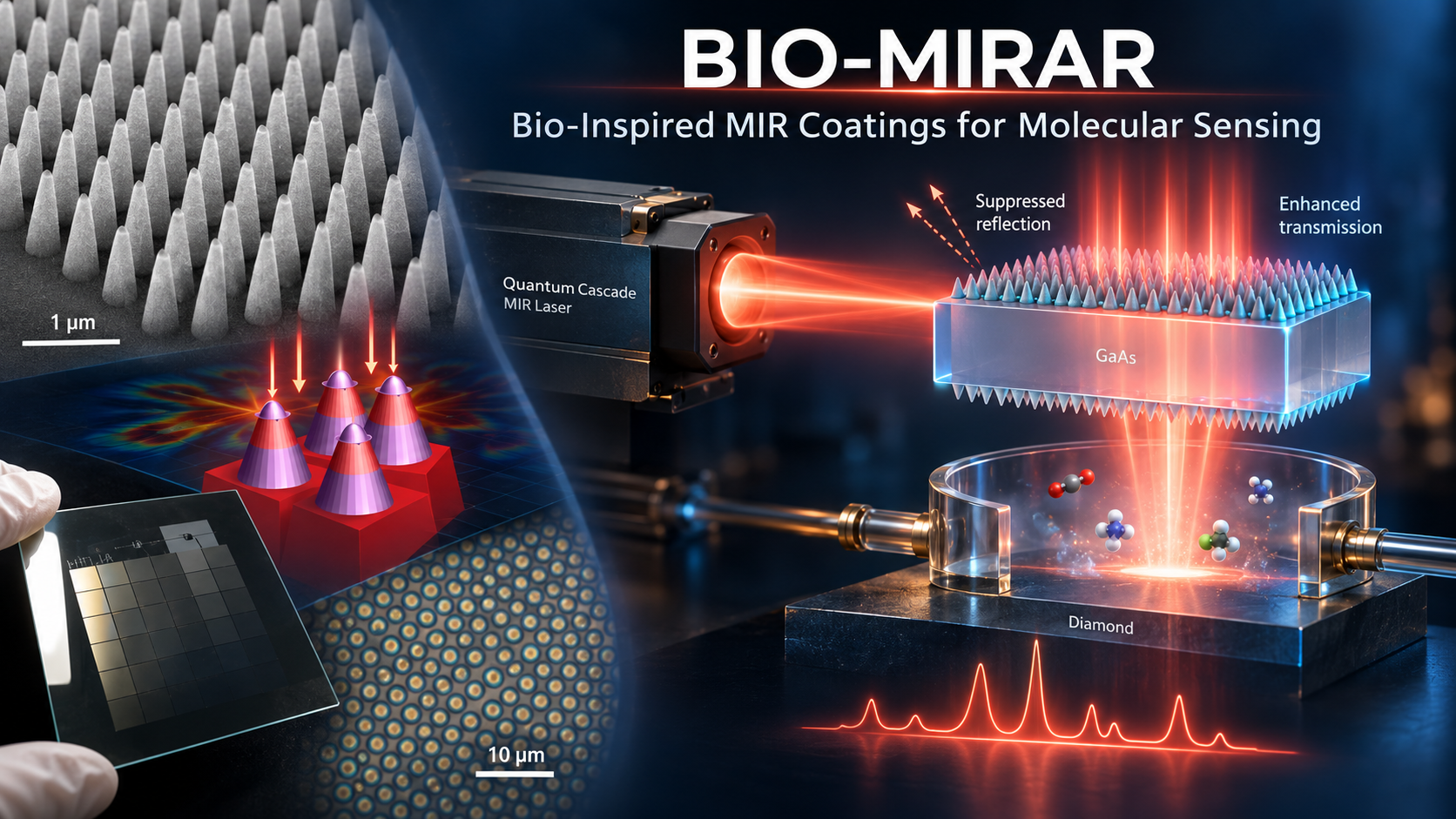
BIO-MIRAR vision: bio-inspired nanostructures suppress reflection and enhance mid-infrared transmission within a molecular-sensing platform.
CRYONITRIDE — Low-Loss Mirrors for Cryogenic Gravitational-Wave Detectors
CRYONITRIDE investigates silicon nitride and silicon oxynitride thin-film coatings for the highly reflective mirrors required in current and future gravitational-wave detectors. The research examines how deposition conditions, chemical composition, microstructure and thermal processing influence refractive index, optical absorption, scattering and mechanical loss.
The objective is to develop coating architectures that combine high optical reflectivity with exceptionally low optical and mechanical losses, including under cryogenic operating conditions. This work brings together plasma-enhanced chemical vapour deposition, physical vapour deposition, advanced compositional analysis, optical-loss measurements and multilayer mirror design.
Read our related research in Applied Optics.
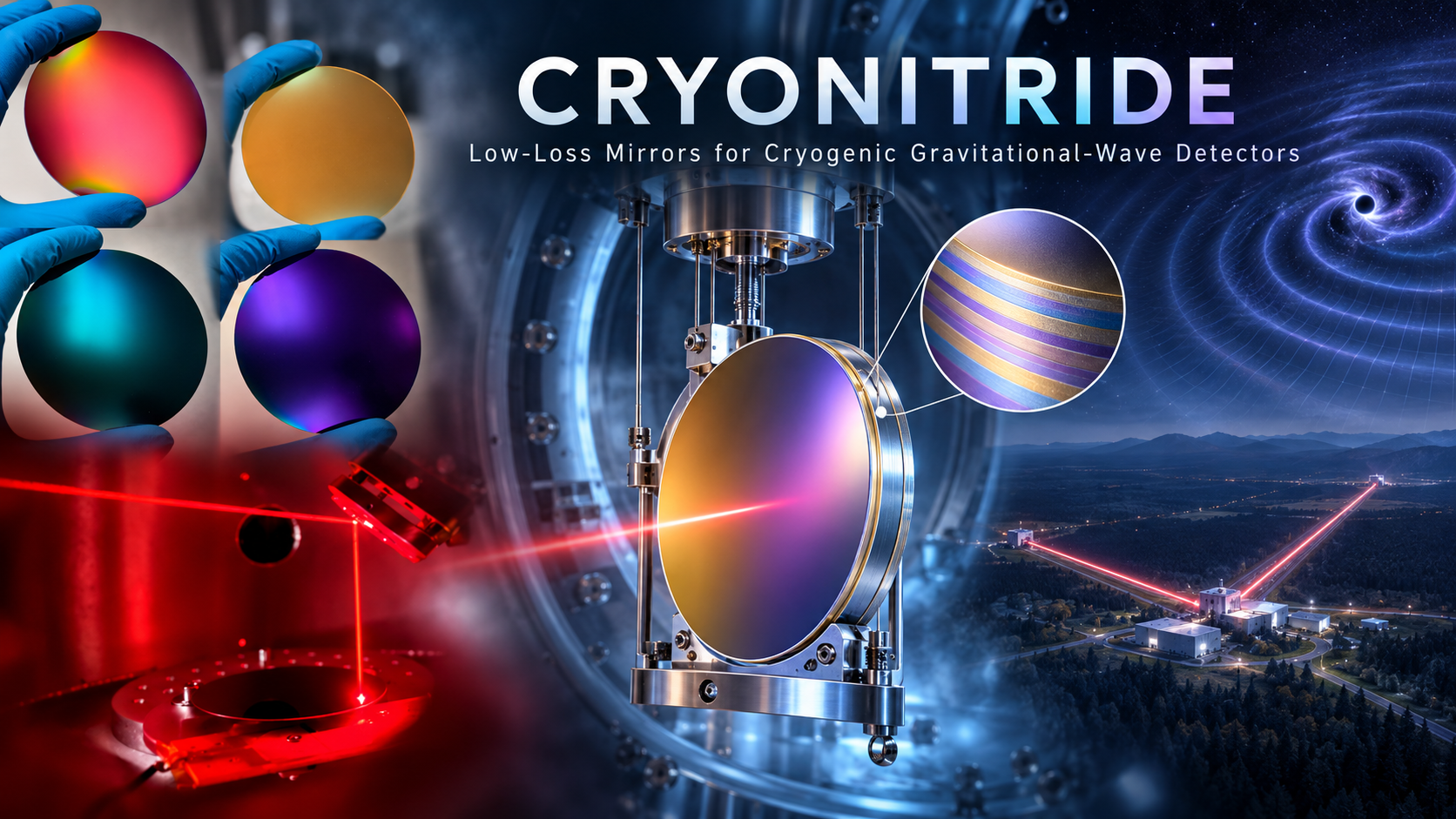
CRYONITRIDE vision: compositionally engineered nitride coatings for low-loss, high-reflectivity mirrors in next-generation gravitational-wave observatories.
LIGHTENG — Self-Powered Photonic Circuits
LIGHTENG explores a new class of self-powered tribophotonic devices in which mechanical activity is converted directly into an optical response. Triboelectric nanogenerators produce the high electric fields required to actuate thin-film Fabry–Pérot electro-optic modulators, removing the requirement for a conventional external high-voltage supply.
The project connects functional-material development, energy harvesting and tunable photonics within a single device architecture. It has progressed from proof-of-concept experiments to a portable demonstrator, establishing a pathway towards autonomous optical sensors, mechanically controlled photonic circuits and self-powered human–machine interfaces.
Read our related research in Chemical Engineering Journal.
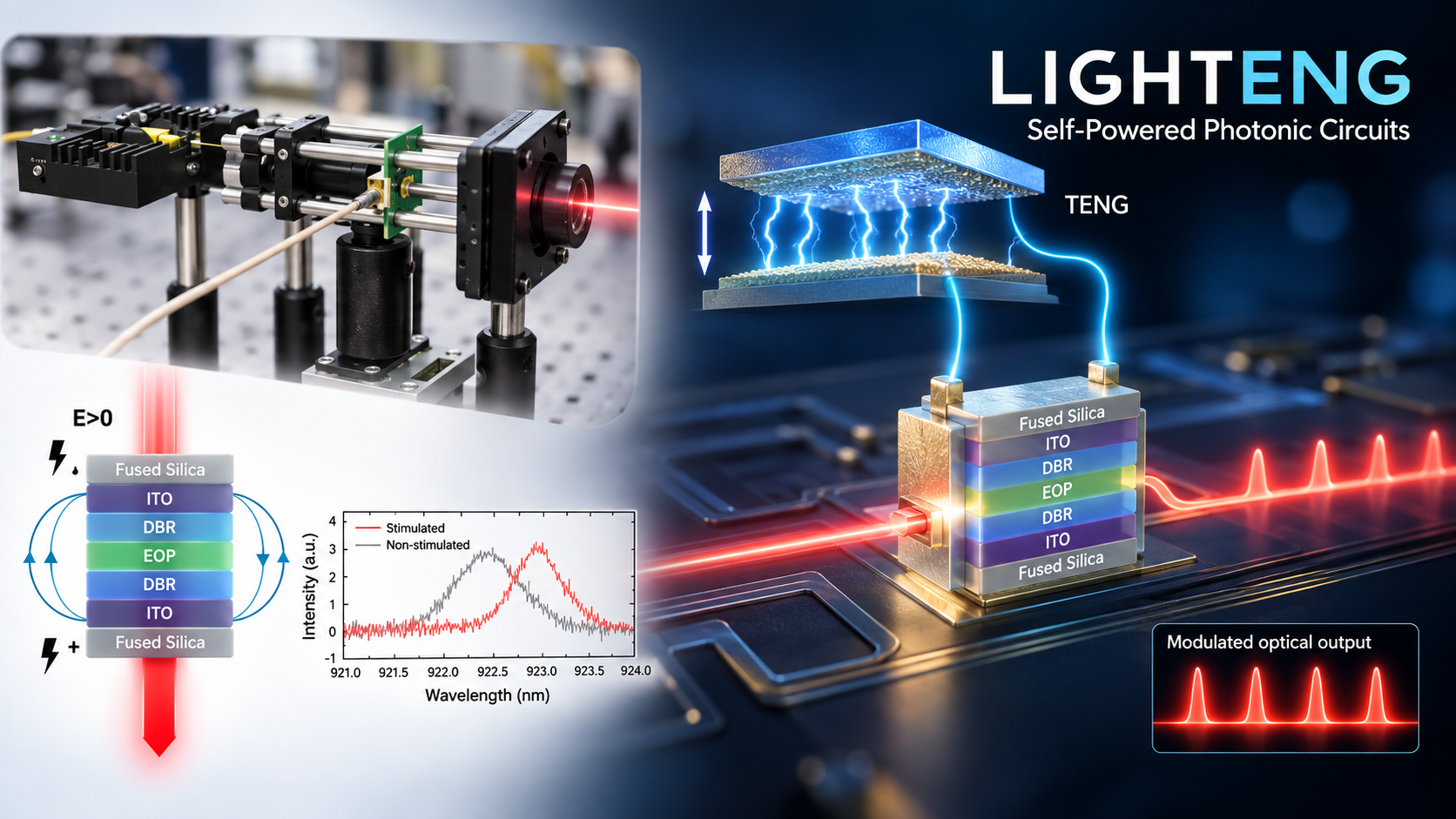
LIGHTENG vision: mechanical energy harvested by a triboelectric nanogenerator drives a thin-film electro-optic modulator to produce a tunable optical output.
TRIBOSENSE — Self-Charging Hybrid Sensor Systems
TRIBOSENSE develops triboelectric, piezoelectric and hybrid material platforms capable of harvesting mechanical energy while simultaneously providing sensing information. The research connects material morphology, electron affinity, surface charge and contact electrification with the performance of nanogenerators, transistor-based sensors and hybrid energy systems.
These self-charging technologies are being investigated for pressure and motion sensing, healthcare monitoring, smart infrastructure and intelligent environments. By combining energy generation, sensing, signal control and energy storage, the programme seeks to reduce dependence on batteries and enable more autonomous distributed sensor networks.
Read our related research in Nano Energy and Advanced Materials Technologies.
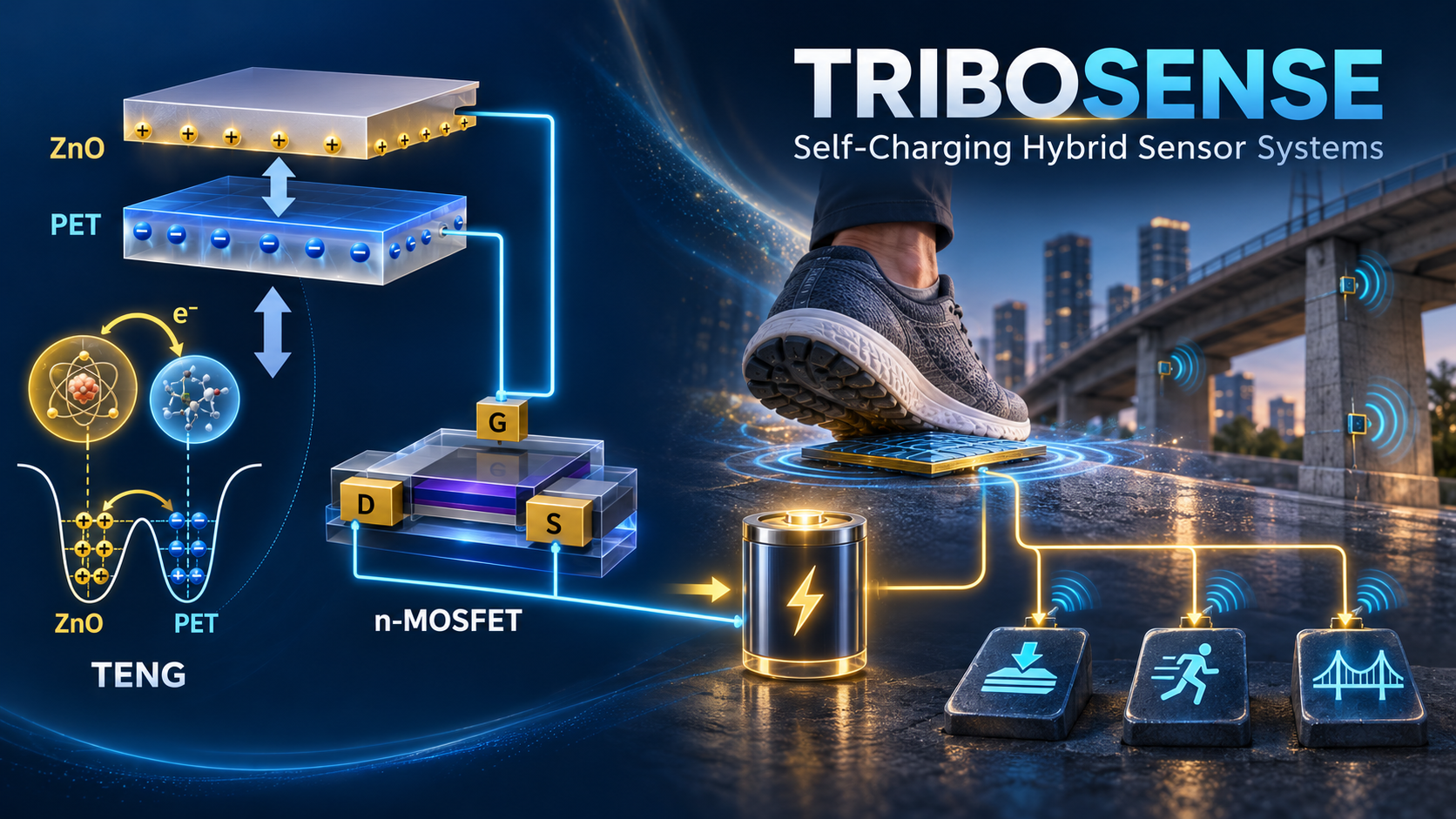
TRIBOSENSE vision: hybrid functional materials convert human and environmental mechanical activity into electrical energy and actionable sensing information.
These featured programmes are complemented by continuing research on semiconductor nanowires and three-dimensional graphene broadband photodetectors, piezoelectric AlN and ZnO thin films, MEMS energy harvesters and the heterogeneous integration of nanomaterials using contact printing and dielectrophoretic assembly. Foundational examples include publications in Nano Letters and Microsystems & Nanoengineering.
Publications
Selected publications
Ejaz, Ammara, McKinlay, Michael, Ahmadzadeh, Sam, Garcia, Manuel Pelayo, Fleming, Lewis, Mazur, Piotr, Mazur, Michal, Gibson, Des and Garcia Nunez, Carlos  ORCID: https://orcid.org/0000-0001-5518-6189
(2023)
Investigation and band gap analysis of pulsed Dc magnetron sputtered diamond‐like carbon to enhance contact‐electrification and durability of triboelectric nanogenerators.
Advanced Materials Technologies, 8(16),
2300450.
(doi: 10.1002/admt.202300450)
ORCID: https://orcid.org/0000-0001-5518-6189
(2023)
Investigation and band gap analysis of pulsed Dc magnetron sputtered diamond‐like carbon to enhance contact‐electrification and durability of triboelectric nanogenerators.
Advanced Materials Technologies, 8(16),
2300450.
(doi: 10.1002/admt.202300450)
Keel, Emma, Ejaz, Ammara, Mckinlay, Michael, Garcia, Manuel Pelayo, Caffio, Marco, Gibson, Des and Garcia Nunez, Carlos ORCID: https://orcid.org/0000-0001-5518-6189
(2023)
Three-dimensional graphene foam based triboelectric nanogenerators for energy systems and autonomous sensors.
Nano Energy, 112,
108475.
(doi: 10.1016/j.nanoen.2023.108475)
Garcia Nunez, C. et al. (2023) Amorphous dielectric optical coatings deposited by plasma ion-assisted electron beam evaporation for gravitational wave detectors. Applied Optics, 62(7), B209-B221. (doi: 10.1364/ao.477186) (PMID:37132933)
García Núñez, Carlos ORCID: https://orcid.org/0000-0001-5518-6189, Liu, Fengyuan ORCID: https://orcid.org/0000-0002-9909-4267, Navaraj, William, Christou, Adamos, Shakthivel, Dhayalan and Dahiya, Ravinder ORCID: https://orcid.org/0000-0002-3858-3841
(2018)
Heterogeneous integration of contact-printed semiconductor nanowires for high performance devices on large areas.
Microsystems and Nanoengineering, 4,
22.
(doi: 10.1038/s41378-018-0021-6)
(PMID:31057910)
(PMCID:PMC6220160)
García Núñez, Carlos ORCID: https://orcid.org/0000-0001-5518-6189, Braña, Alejandro F., López, Nair and García, Basilio J.
(2018)
A novel growth method to improve the quality of GaAs nanowires grown by Ga-assisted chemical beam epitaxy.
Nano Letters, 18(6),
pp. 3608-3615.
(doi: 10.1021/acs.nanolett.8b00702)
García Núñez, Carlos ORCID: https://orcid.org/0000-0001-5518-6189, Navaraj, William Taube, Polat, Emre O. and Dahiya, Ravinder ORCID: https://orcid.org/0000-0002-3858-3841
(2017)
Energy autonomous flexible and transparent tactile skin.
Advanced Functional Materials, 27(18),
1606287.
(doi: 10.1002/adfm.201606287)
Garcia Nunez, C. ORCID: https://orcid.org/0000-0001-5518-6189, Sachsenhauser, M., Blashcke, B., García Marín, A., Garrido, Jose A. and Pau, Jose L.
(2015)
Effects of hydroxylation and silanization on the surface properties of ZnO nanowires.
ACS Applied Materials and Interfaces, 7(9),
pp. 5331-5337.
(doi: 10.1021/am508752m)
(PMID:25675135)
All publications
2026
McKinlay, Michael, Rüßeler, Anna Karoline, Fleming, Lewis, Gibson, Des, Heidari, Hadi ORCID: https://orcid.org/0000-0001-8412-8164, Wienke, Andreas and García Núñez, Carlos ORCID: https://orcid.org/0000-0001-5518-6189
(2026)
Self-powered tribophotonic devices for nonlinear electro-optic modulation.
Chemical Engineering Journal, 545,
179360.
(doi: 10.1016/j.cej.2026.179360)
Keel, Emma, Mazur, Michal, Domaradzki, Jarosław, Wojcieszak, Damian, Fleming, Lewis, Abbas, Qaisar, Ntola, Michelle, Caffio, Marco, Garcia Nunez, Carlos ORCID: https://orcid.org/0000-0001-5518-6189 and Gibson, Des
(2026)
Structural, composition, optical, electrical, and electrochemical characterization of three-dimensional graphene foam.
Nanoscale Advances,
(doi: 10.1039/d6na00510a)
(PMID:42699356)
(PMCID:PMC13544372)
(Early Online Publication)
Shojaei Baghini, Mahdieh ORCID: https://orcid.org/0000-0003-3685-5441, McKinlay, Michael, Mukherjee, Dibyajyoti, Garcia Nunez, Carlos ORCID: https://orcid.org/0000-0001-5518-6189 and Heidari, Hadi ORCID: https://orcid.org/0000-0001-8412-8164
(2026)
S-Band FeGa/ZnO Magnetoelectric Resonating Antennas for Ultra-Compact Microwave Devices.
In: IEEE International Magnetics Conference (INTERMAG 2026), Manchester, UK, 13-17 April 2026,
ISBN 9798331557638
(doi: 10.1109/INTERMAGShortPapers68882.2026.11595963)
Shojaei Baghini, M. et al. (2026) Bio-integrated µBots with overtone ultrawideband magnetoelectric antennas for wireless telemetry. Science Advances, 12(27), eaec7011. (doi: 10.1126/sciadv.aec7011) (PMID:42384785) (PMCID:PMC13322252)
Lindsay, C. et al. (2026) Optical, composition, durability, and environmental properties of the microwave plasma-assisted sputter-deposited silicon nitride. Applied Optics, 65(5), A176-A186. (doi: 10.1364/ao.578043)
Saunders, K. et al. (2026) Optical losses in SiNx and SiOxNy coatings deposited by plasma-enhanced chemical vapor deposition for gravitational wave detectors. Applied Optics, 65(5), A187-A200. (doi: 10.1364/AO.578011)
2025
Zhang, Jungang, Selamneni, Venkatarao ORCID: https://orcid.org/0000-0003-2066-718X, Yalagala, Bhavani Prasad, King, Benjamin ORCID: https://orcid.org/0000-0002-8081-085X, Wang, Jiaoran, Khurelbaatar, Luvsanbat, García Núñez, Carlos ORCID: https://orcid.org/0000-0001-5518-6189, Wagih, Mahmoud ORCID: https://orcid.org/0000-0002-7806-4333, Amjadi, Morteza ORCID: https://orcid.org/0000-0003-2907-5025 and Heidari, Hadi ORCID: https://orcid.org/0000-0001-8412-8164
(2025)
Laser-engineered interfacial dielectrophoresis-aligned nanowire networks for transparent electromagnetic interference-shielding films.
ACS Nano, 19(51),
pp. 42760-42771.
(doi: 10.1021/acsnano.5c13772)
(PMID:41400278)
(PMCID:PMC12756913)
Shojaei Baghini, M. et al. (2025) Bio-integrated µBots with overtone ultra-wideband magnetoelectric antennas for wireless telemetry. arXiv, (doi: 10.48550/arXiv.2512.12311)
Adams, Sam, McKinlay, Michael, García Núñez, Carlos ORCID: https://orcid.org/0000-0001-5518-6189, Kang, Lei, Dixon, Steve, Gibson, Des and Feeney, Andrew ORCID: https://orcid.org/0000-0001-7170-1830
(2025)
Thin-film Flexural Ultrasonic Transducers for Air-coupled Measurement.
In: International Ultrasonics Symposium (IUS 2025), Utrecht, Netherlands, 15-18 Sep 2025,
ISBN 9798331523329
(doi: 10.1109/IUS62464.2025.11201545)
Ruiz-Garcia, Isidoro, Keel, Emma, Konanahalli, Ashwini, Gibson, Des, Amjadi Kolour, Morteza ORCID: https://orcid.org/0000-0003-2907-5025, Caffio, Marco, Heidari, Hadi ORCID: https://orcid.org/0000-0001-8412-8164 and Garcia Nunez, Carlos ORCID: https://orcid.org/0000-0001-5518-6189
(2025)
Sustainable occupancy sensing platform via triboelectric and piezoresistive pressure sensors.
IEEE Sensors Letters,
(doi: 10.1109/LSENS.2025.3589020)
(Early Online Publication)
Su, Hang, Huang, Shuo, Su, Dewen, Garcia Nuñez, Carlos ORCID: https://orcid.org/0000-0001-5518-6189, Heidari, Hadi ORCID: https://orcid.org/0000-0001-8412-8164, Zhang, Haopeng, Lan, Jingming, Gao, Xin and Yue, Hongyan
(2025)
L-Cysteine@Island-Like Co3S4 on Co3O4 nanosheet arrays heterostructure: electrochemical chiral sensing of L-tryptophan.
ACS Applied Nano Materials, 8(16),
pp. 8397-8406.
(doi: 10.1021/acsanm.5c01052)
Abac, A. G. et al. (2025) Search for continuous gravitational waves from known pulsars in the first part of the fourth LIGO-Virgo-KAGRA observing run. Astrophysical Journal, 983(2), 99. (doi: 10.3847/1538-4357/adb3a0)
Rüsseler, Anna Karoline, McKinlay, Michael, Matthes, Jonas N., Garcia Nuñez, Carlos ORCID: https://orcid.org/0000-0001-5518-6189, Gehrke, Philipp, Jupé, Marco, Hoffmann, Gerd-Albert, Wienke, Andreas and Ristau, Detlev
(2025)
Miniaturized Electro-Optical Modulator Based on Substrate-Free Thin Films.
In: SPIE Photonics West, San Francisco, CA, USA, 28-30 January 2025,
(doi: 10.1117/12.3040506)
Xie, Y. et al. (2025) Hollow transition metal chalcogenides derived from vanadium-based metal organic framework for hybrid supercapacitors with excellent energy-density and stability. Journal of Colloid and Interface Science, 680(B), pp. 446-455. (doi: 10.1016/j.jcis.2024.11.099)
2024
Nieto-Sierra, Lucía, Lloret, Fernando, Gallardo, Juan Jesús, García-Núñez, Carlos ORCID: https://orcid.org/0000-0001-5518-6189, Pelayo-García, Manuel, Alba, Gonzalo, Gibson, Des and Araujo, Daniel
(2024)
Systematic approach for high piezoelectric AlN deposition.
Journal of Alloys and Compounds, 1008,
176723.
(doi: 10.1016/j.jallcom.2024.176723)
McKinlay, Michael, Fleming, Lewis, Pelayo García, Manuel, Nieto Sierra, Lucía, Villar Castro, Pilar, Araujo, Daniel, García, Basilio Javier, Gibson, Des and Garcia Nunez, Carlos ORCID: https://orcid.org/0000-0001-5518-6189
(2024)
On the piezoelectric properties of zinc oxide thin films synthesised by plasma assisted DC sputter deposition.
Advanced Materials Interfaces, 11(32),
2400252.
(doi: 10.1002/admi.202400252)
Ghahremani Arekhloo, Negin, Wang, Huxi, Parvizi, Hossein, Tanwear, Asfand, Zuo, Siming, McKinlay, Michael, García Núñez, Carlos ORCID: https://orcid.org/0000-0001-5518-6189, Nazarpour, Kianoush and Heidari, Hadi ORCID: https://orcid.org/0000-0001-8412-8164
(2024)
Motion artifact variability in biomagnetic wearable devices.
Frontiers in Medical Technology, 6,
1457535.
(doi: 10.3389/fmedt.2024.1457535)
(PMID:39483990)
Pelayo Garcia, Manuel, Saddik, Karim Ben, Shojaei Baghini, Mahdieh ORCID: https://orcid.org/0000-0003-3685-5441, Hughes, Dave Allan, Gibson, Des, García, Basilio Javier and Garcia Nunez, Carlos ORCID: https://orcid.org/0000-0001-5518-6189
(2024)
Giant piezoelectric effect induced by porosity in inclined ZnO thin films.
Advanced Electronic Materials, 10(10),
2400138.
(doi: 10.1002/aelm.202400138)
McKinlay, Michael, Shojaei Baghini, Mahdieh ORCID: https://orcid.org/0000-0003-3685-5441, Pelayo Garcia, Manuel, Yalagala, Bhavani, Heidari, Hadi ORCID: https://orcid.org/0000-0001-8412-8164, Gibson, Des and Garcia Nunez, Carlos ORCID: https://orcid.org/0000-0001-5518-6189
(2024)
Study of triboelectric potential for tunable contact-electrification field effect transistors.
IEEE Sensors Letters, 8(9),
2503304.
(doi: 10.1109/LSENS.2024.3442311)
Pelayo Garcia, M., Gibson, D., McAughey, K. L., Hughes, D. A. and García Núñez, C. ORCID: https://orcid.org/0000-0001-5518-6189
(2024)
Ultra-inclined nanocolumnar ZnO films sputtered using a novel masking configuration providing controlled and restricted oblique angle deposition for enhanced sensing platforms.
Advanced Physics Research, 3(8),
2400020.
(doi: 10.1002/apxr.202400020)
Lindsay, Connor, Garcia Nunez, Carlos ORCID: https://orcid.org/0000-0001-5518-6189, Fleming, Lewis S., Pomfret, Jonathan, Saunders, Kirstin, Ahmadzadeh, Sam, Tait, Simon ORCID: https://orcid.org/0000-0003-0327-953X, Reid, Stuart, Martin, Iain ORCID: https://orcid.org/0000-0001-7300-9151 and Gibson, Des R.
(2024)
Microwave Plasma Assisted Sputtering of a Combined Ta2O5/SiO2 and a-Si:H/SiO2 Two Stack Optical Coating Design Concept for Gravitational Wave Detectors.
In: SPIE Optical Systems Design, Strasbourg, France, 7 - 11 April 2024,
(doi: 10.1117/12.3022968)
Saunders, Kirstin, Mazur, Michał, Clark, Caspar, Gibson, Des and Garcia Nunez, Carlos ORCID: https://orcid.org/0000-0001-5518-6189
(2024)
Optical and Structural Properties of Silicon Nitride Thin Films Deposited by Plasma Enhanced Chemical Vapor Deposition for High Reflectance Optical Mirrors.
In: SPIE Optical Systems Design, Strasbourg, France, 7-11 April 2024,
(doi: 10.1117/12.3022947)
Keel, Emma, Caffio, Marco, Gibson, Desmond R. and Garcia Nunez, Carlos ORCID: https://orcid.org/0000-0001-5518-6189
(2024)
Potential Broadband Photodetector Concept Based on Three-Dimensional Graphene Foam.
In: SPIE Photonics Europe, Strasbourg, France, 7 - 11 April 2024,
(doi: 10.1117/12.3017247)
Pelayo Garcia, Manuel, McKinlay, Michael, Gibson, Des and Garcia Nunez, Carlos ORCID: https://orcid.org/0000-0001-5518-6189
(2024)
High-Performance Piezophototronic Devices Based on Zinc Oxide Nanostructured Thin Films Synthesized by Physical Vapour Deposition.
In: SPIE Photonics Europe, Strasbourg, France, 7-11 April 2024,
(doi: 10.1117/12.3017252)
Khan, Muhammad Shahid, Murtaza, Imran, Shuja, Ahmed, Khan, Humaira Rashid, Abid, Rehan, Nuñez, Carlos García ORCID: https://orcid.org/0000-0001-5518-6189, Fahad, Shah, Tariq, Hassan and Naveed, Aneeqa
(2024)
Tailored NiO-pBOA-GNP ternary nanocomposite: advances in flexible supercapacitors and practical applications for wearable technology and environmental monitoring.
Journal of Energy Storage, 86(Part A),
111128.
(doi: 10.1016/j.est.2024.111128)
Abac, A. et al. (2024) Observation of gravitational waves from the coalescence of a 2.5−4.5 M⊙ compact object and a neutron star. arXiv, (doi: 10.48550/arXiv.2404.04248)
Abac, A. G. et al. (2024) Ultralight vector dark matter search using data from the KAGRA O3GK run. arXiv, (doi: 10.48550/arXiv.2403.03004)
2023
Khan, Muhammad Shahid, Murtaza, Imran, Shuja, Ahmed, Asghar, Muhammad Adeel, Garcia Nunez, Carlos ORCID: https://orcid.org/0000-0001-5518-6189, Abid, Rehan, Haider, Ali and Faraz, Muhammad
(2023)
Unveiling the electrochemical advantages of a scalable and novel aniline-derived polybenzoxazole-reduced graphene oxide composite decorated with manganese oxide nanoparticles for supercapacitor applications.
Journal of Energy Storage, 73(C),
109109.
(doi: 10.1016/j.est.2023.109109)
Garcia, Manuel Pelayo, Gibson, Desmond, Hughes, Dave Allan and Garcia Nuñez, Carlos ORCID: https://orcid.org/0000-0001-5518-6189
(2023)
A refined quasi-static method for precise determination of piezoelectric coefficient of nanostructured standard and inclined thin films.
Advanced Physics Research,
(doi: 10.1002/apxr.202300091)
Abbott, R. et al. (2023) Search for gravitational waves associated with fast radio bursts detected by CHIME/FRB during the LIGO–Virgo observing run O3a. Astrophysical Journal, 955(2), 155. (doi: 10.3847/1538-4357/acd770)
Novosound Limited (2023) Piezoelectric device and method of forming. .
Ejaz, Ammara, McKinlay, Michael, Ahmadzadeh, Sam, Garcia, Manuel Pelayo, Fleming, Lewis, Mazur, Piotr, Mazur, Michal, Gibson, Des and Garcia Nunez, Carlos ORCID: https://orcid.org/0000-0001-5518-6189
(2023)
Investigation and band gap analysis of pulsed Dc magnetron sputtered diamond‐like carbon to enhance contact‐electrification and durability of triboelectric nanogenerators.
Advanced Materials Technologies, 8(16),
2300450.
(doi: 10.1002/admt.202300450)
McGann, Greg, Garcia Nuñez, Carlos ORCID: https://orcid.org/0000-0001-5518-6189, Fleming, Lewis, Hutson, David, Waddell, Ewan and Gibson, Des
(2023)
Band gap engineering of Pb1-xCdxSe thin films providing mid-IR photoluminescent based light emitting diodes for use in non-dispersive infrared gas sensors.
IEEE Sensors Letters,
(doi: 10.1109/LSENS.2023.3307081)
Keel, Emma, Ejaz, Ammara, Mckinlay, Michael, Garcia, Manuel Pelayo, Caffio, Marco, Gibson, Des and Garcia Nunez, Carlos ORCID: https://orcid.org/0000-0001-5518-6189
(2023)
Three-dimensional graphene foam based triboelectric nanogenerators for energy systems and autonomous sensors.
Nano Energy, 112,
108475.
(doi: 10.1016/j.nanoen.2023.108475)
Song, S. et al. (2023) Tantalum oxide and silicon oxide mixture coatings deposited using microwave plasma assisted co-sputtering for optical mirror coatings in gravitational wave detectors. Applied Optics, 62(7), B73-B78. (doi: 10.1364/ao.477211) (PMID:37132888)
Garcia Nunez, C. et al. (2023) Amorphous dielectric optical coatings deposited by plasma ion-assisted electron beam evaporation for gravitational wave detectors. Applied Optics, 62(7), B209-B221. (doi: 10.1364/ao.477186) (PMID:37132933)
Escobedo, Pablo, Ramos-Lorente, Celia E., Ejaz, Ammara, Erenas, Miguel M., Martínez-Olmos, Antonio, Carvajal, Miguel A., Garcia Nunez, Carlos ORCID: https://orcid.org/0000-0001-5518-6189, de Orbe-Payá, Ignacio, Capitán-Vallvey, Luis F. and Palma, Alberto J.
(2023)
QRsens: Dual-purpose quick response code with built-in colorimetric sensors.
Sensors and Actuators B: Chemical, 376,
133001.
(doi: 10.1016/j.snb.2022.133001)
2022
Abbott, R. et al. (2022) Search for subsolar-mass binaries in the first half of Advanced LIGO’s and Advanced Virgo’s third observing run. Physical Review Letters, 129(6), 061104. (doi: 10.1103/PhysRevLett.129.061104)
Abbott, R. et al. (2022) Narrowband searches for continuous and long-duration transient gravitational waves from known pulsars in the LIGO-Virgo third observing run. Astrophysical Journal, 932(2), 133. (doi: 10.3847/1538-4357/ac6ad0)
Abbott, R. et al. (2022) All-sky, all-frequency directional search for persistent gravitational waves from Advanced LIGO’s and Advanced Virgo’s first three observing runs. Physical Review D, 105(12), 122001. (doi: 10.1103/PhysRevD.105.122001)
Douglas, Connor I., Nunez, Carlos Garcia ORCID: https://orcid.org/0000-0001-5518-6189, Caffio, Marco and Gibson, Des
(2022)
Ultra-thin graphene foam based flexible piezoresistive pressure sensors for robotics.
Key Engineering Materials, 922,
pp. 79-86.
(doi: 10.4028/p-oy94hj)
Abbott, R. et al. (2022) Search of the early O3 LIGO data for continuous gravitational waves from the Cassiopeia A and Vela Jr. supernova remnants. Physical Review D, 105(8), 082005. (doi: 10.1103/PhysRevD.105.082005)
Abbott, R. et al. (2022) Constraints on dark photon dark matter using data from LIGO’s and Virgo’s third observing run. Physical Review D, 105(6), 063030. (doi: 10.1103/PhysRevD.105.063030)
Abbott, R. et al. (2022) Search for intermediate-mass black hole binaries in the third observing run of Advanced LIGO and Advanced Virgo. Astronomy and Astrophysics, 659, A84. (doi: 10.1051/0004-6361/202141452)
Abbott, R. et al. (2022) Search for continuous gravitational waves from 20 accreting millisecond x-ray pulsars in O3 LIGO data. Physical Review D, 105(2), 022002. (doi: 10.1103/PhysRevD.105.022002)
2021
Abbott, R. et al. (2021) Search for lensing signatures in the gravitational-wave observations from the first half of LIGO–Virgo’s third observing run. Astrophysical Journal, 923(1), 14. (doi: 10.3847/1538-4357/ac23db)
Abbott, R. et al. (2021) Constraints from LIGO O3 data on gravitational-wave emission due to r-modes in the glitching pulsar PSR J0537–6910. Astrophysical Journal, 922(1), 71. (doi: 10.3847/1538-4357/ac0d52)
Abbott, R. et al. (2021) All-sky search for long-duration gravitational-wave bursts in the third Advanced LIGO and Advanced Virgo run. Physical Review D, 104(10), 102001. (doi: 10.1103/PhysRevD.104.102001)
Abbott, R. et al. (2021) Searches for continuous gravitational waves from young supernova remnants in the early third observing run of Advanced LIGO and Virgo. Astrophysical Journal, 921(1), 80. (doi: 10.3847/1538-4357/ac17ea)
Abbott, R. et al. (2021) All-sky search for continuous gravitational waves from isolated neutron stars in the early O3 LIGO data. Physical Review D, 104(8), 082004. (doi: 10.1103/PhysRevD.104.082004)
Abbott, R. et al. (2021) Search for anisotropic gravitational-wave backgrounds using data from Advanced LIGO and Advanced Virgo’s first three observing runs. Physical Review D, 104(2), 022005. (doi: 10.1103/PhysRevD.104.022005)
Abbott, R. et al. (2021) Upper limits on the isotropic gravitational-wave background from advanced LIGO and Advanced Virgo's third observing run. Physical Review D, 104(2), 022004. (doi: 10.1103/PhysRevD.104.022004)
Abbott, R. et al. (2021) Observation of gravitational waves from two neutron star–black hole coalescences. Astrophysical Journal Letters, 915(1), L5. (doi: 10.3847/2041-8213/ac082e)
Abbott, R. et al. (2021) Constraints on cosmic strings using data from the third Advanced LIGO–Virgo observing run. Physical Review Letters, 126(24), 241102. (doi: 10.1103/PhysRevLett.126.241102)
Abbott, R. et al. (2021) Diving below the spin-down limit: constraints on gravitational waves from the energetic young pulsar PSR J0537-6910. Astrophysical Journal Letters, 913(2), L27. (doi: 10.3847/2041-8213/abffcd)
Abbott, R. et al. (2021) All-sky search in early O3 LIGO data for continuous gravitational-wave signals from unknown neutron stars in binary systems. Physical Review D, 103(6), 064017. (doi: 10.1103/PhysRevD.103.064017)
2020
García Núñez, Carlos ORCID: https://orcid.org/0000-0001-5518-6189, Braña, Alejandro F, López, Nair, Pau, José L and García, Basilio J
(2020)
Single GaAs nanowire based photodetector fabricated by dielectrophoresis.
Nanotechnology, 31(22),
225604.
(doi: 10.1088/1361-6528/ab76ee)
(PMID:32187022)
2019
Manjakkal, Libu ORCID: https://orcid.org/0000-0001-7933-6321, Navaraj, William Taube, García Núñez, Carlos ORCID: https://orcid.org/0000-0001-5518-6189 and Dahiya, Ravinder ORCID: https://orcid.org/0000-0002-3858-3841
(2019)
Graphene–graphite polyurethane composite based high‐energy density flexible supercapacitors.
Advanced Science, 6(7),
1802251.
(doi: 10.1002/advs.201802251)
(PMID:30989034)
(PMCID:PMC6446598)
García Núñez, Carlos ORCID: https://orcid.org/0000-0001-5518-6189, Manjakkal, Libu ORCID: https://orcid.org/0000-0001-7933-6321 and Dahiya, Ravinder ORCID: https://orcid.org/0000-0002-3858-3841
(2019)
Energy autonomous electronic skin.
npj Flexible Electronics, 3,
1.
(doi: 10.1038/s41528-018-0045-x)
2018
Liu, Fengyuan ORCID: https://orcid.org/0000-0002-9909-4267, Yogeswaran, Nivasan, García Núñez, Carlos ORCID: https://orcid.org/0000-0001-5518-6189, Gregory, Duncan ORCID: https://orcid.org/0000-0002-4585-3280 and Dahiya, Ravinder ORCID: https://orcid.org/0000-0002-3858-3841
(2018)
Graphene-ZnO NWs Film for Large-Area UV Photodetector.
In: 2018 IEEE Sensors, New Delhi, India, 28-31 Oct 2018,
ISBN 9781538647073
(doi: 10.1109/ICSENS.2018.8589639)
García Núñez, Carlos ORCID: https://orcid.org/0000-0001-5518-6189, Vilouras, Anastasios ORCID: https://orcid.org/0000-0002-3966-5275, Navaraj, WWilliam Taube, Liu, Fengyuan ORCID: https://orcid.org/0000-0002-9909-4267 and Dahiya, Ravinder ORCID: https://orcid.org/0000-0002-3858-3841
(2018)
ZnO nanowires based flexible UV photodetector system for wearable dosimetry.
IEEE Sensors Journal, 18(19),
pp. 7881-7888.
(doi: 10.1109/JSEN.2018.2853762)
Manjakkal, Libu ORCID: https://orcid.org/0000-0001-7933-6321, García Núñez, Carlos ORCID: https://orcid.org/0000-0001-5518-6189, Dang, Wenting and Dahiya, Ravinder ORCID: https://orcid.org/0000-0002-3858-3841
(2018)
Flexible self-charging supercapacitor based on graphene-Ag-3D graphene foam electrodes.
Nano Energy, 51,
pp. 604-612.
(doi: 10.1016/j.nanoen.2018.06.072)
García Núñez, Carlos ORCID: https://orcid.org/0000-0001-5518-6189, Liu, Fengyuan ORCID: https://orcid.org/0000-0002-9909-4267, Navaraj, William, Christou, Adamos, Shakthivel, Dhayalan and Dahiya, Ravinder ORCID: https://orcid.org/0000-0002-3858-3841
(2018)
Heterogeneous integration of contact-printed semiconductor nanowires for high performance devices on large areas.
Microsystems and Nanoengineering, 4,
22.
(doi: 10.1038/s41378-018-0021-6)
(PMID:31057910)
(PMCID:PMC6220160)
García Núñez, Carlos ORCID: https://orcid.org/0000-0001-5518-6189, Braña, Alejandro F., López, Nair and García, Basilio J.
(2018)
A novel growth method to improve the quality of GaAs nanowires grown by Ga-assisted chemical beam epitaxy.
Nano Letters, 18(6),
pp. 3608-3615.
(doi: 10.1021/acs.nanolett.8b00702)
Garcia Nunez, Carlos ORCID: https://orcid.org/0000-0001-5518-6189, Navaraj, William Taube, Liu, Fengyuan ORCID: https://orcid.org/0000-0002-9909-4267, Shakthivel, Dhayalan and Dahiya, Ravinder ORCID: https://orcid.org/0000-0002-3858-3841
(2018)
Large-area self-assembly of silica microspheres/nanospheres by temperature-assisted dip-coating.
ACS Applied Materials and Interfaces, 10(3),
pp. 3058-3068.
(doi: 10.1021/acsami.7b15178)
(PMID:29280379)
Dahiya, R. ORCID: https://orcid.org/0000-0002-3858-3841, Navaraj, William Taube, García Núñez, C. ORCID: https://orcid.org/0000-0001-5518-6189, Shakthivel, D. and Liu, F. ORCID: https://orcid.org/0000-0002-9909-4267
(2018)
Electronic Skin with Energy Autonomy and Distributed Neural Data Processing.
4th Annual Innovations in Large Area Electronics Conference (innoLAE 2018), Cambridge, UK, 23-24 Jan 2018.
(Unpublished)
Garcia Nunez, Carlos ORCID: https://orcid.org/0000-0001-5518-6189, Liu, Fengyuan ORCID: https://orcid.org/0000-0002-9909-4267, Xu, Shen and Dahiya, Ravinder ORCID: https://orcid.org/0000-0002-3858-3841
(2018)
Integration Techniques for Micro/Nanostructure-Based Large-Area Electronics.
Cambridge University Press.
(doi: 10.1017/9781108691574)
2017
García Núñez, Carlos ORCID: https://orcid.org/0000-0001-5518-6189, Taube, William, Liu, Fengyuan ORCID: https://orcid.org/0000-0002-9909-4267 and Dahiya, Ravinder ORCID: https://orcid.org/0000-0002-3858-3841
(2017)
ZnO Nanowires Based Flexible UV Photodetectors for Wearable Dosimetry.
IEEE Sensors 2017, Glasgow, UK, 29 Oct - 01 Nov 2017.
ISBN 9781509010127
(doi: 10.1109/ICSENS.2017.8234428)
Taube Navaraj, William, García Núñez, Carlos ORCID: https://orcid.org/0000-0001-5518-6189, Shakthivel, Dhayalan, Vinciguerra, Vincenzo, Labeau, Fabrice, Gregory, Duncan H. ORCID: https://orcid.org/0000-0002-4585-3280 and Dahiya, Ravinder ORCID: https://orcid.org/0000-0002-3858-3841
(2017)
Nanowire FET based neural element for robotic tactile sensing skin.
Frontiers in Neuroscience, 11,
501.
(doi: 10.3389/fnins.2017.00501)
(PMID:28979183)
(PMCID:PMC5611376)
García Núñez, Carlos ORCID: https://orcid.org/0000-0001-5518-6189, Taube, William and Dahiya, Ravinder ORCID: https://orcid.org/0000-0002-3858-3841
(2017)
Electronic-Skin Based on Graphene for Robotics.
Graphene Innovation Entrepreneurship Summit, Wuxi, China, Sep 2017.
García Núñez, Carlos ORCID: https://orcid.org/0000-0001-5518-6189, Navaraj, William Taube, Polat, Emre O. and Dahiya, Ravinder ORCID: https://orcid.org/0000-0002-3858-3841
(2017)
Energy autonomous flexible and transparent tactile skin.
Advanced Functional Materials, 27(18),
1606287.
(doi: 10.1002/adfm.201606287)
Redondo-Cubero, A., Gómez-Castaño, M., García Núñez, C. ORCID: https://orcid.org/0000-0001-5518-6189, Domínguez, M., Vázquez, L. and Pau, J.L.
(2017)
Zinc Nitride Thin Films: Basic Properties and Applications.
In: Oxide-based Materials and Devices VIII, San Francisco, CA, USA, 29 Jan - 1 Feb 2017,
101051B.
(doi: 10.1117/12.2253044)
Navaraj, William, Shakthivel, Dhayalan, García Núñez, Carlos ORCID: https://orcid.org/0000-0001-5518-6189, Liu, Fengyuan ORCID: https://orcid.org/0000-0002-9909-4267, Gregory, Duncan ORCID: https://orcid.org/0000-0002-4585-3280 and Dahiya, Ravinder ORCID: https://orcid.org/0000-0002-3858-3841
(2017)
Metal-Assisted Chemical Etched Si Nanowires for High-Performance Large Area Flexible Electronics.
innoLAE 2017 Conference, Cambridge, United Kingdom, 31 Jan - 01 Feb 2017.
Taube, William, Liu, Fengyuan, Vilouras, Anastasios ORCID: https://orcid.org/0000-0002-3966-5275, Shakthivel, Dhayalan, Garcia Nunez, Carlos ORCID: https://orcid.org/0000-0001-5518-6189, Heidari, Hadi ORCID: https://orcid.org/0000-0001-8412-8164, Labeau, Fabrice, Gregory, Duncan ORCID: https://orcid.org/0000-0002-4585-3280 and Dahiya, Ravinder ORCID: https://orcid.org/0000-0002-3858-3841
(2017)
Modelling of Nanowire FETs Based Neural Network for Tactile Pattern Recognition in E-Skin.
In: BioCAS 2016, Shanghai, China, 17-19 Oct 2016,
pp. 572-575.
ISBN 9781509029594
(doi: 10.1109/BioCAS.2016.7833859)
Heidari, Hadi ORCID: https://orcid.org/0000-0001-8412-8164, Garcia Nunez, Carlos ORCID: https://orcid.org/0000-0001-5518-6189 and Dahiya, Ravinder ORCID: https://orcid.org/0000-0002-3858-3841
(2017)
E-Skin Module with Heterogeneously Integrated Graphene Touch Sensors and CMOS Circuitry.
In: IEEE Sensors 2016, Orlando, USA, 30 Oct - 02 Nov 2016,
ISBN 9781479982875
(doi: 10.1109/ICSENS.2016.7808760)
García Nuñez, Carlos ORCID: https://orcid.org/0000-0001-5518-6189, Braña, Alejandro F., Lopez, Nair, Pau, José L. and García, Basilio J.
(2017)
Photodetector Fabrication by Dielectrophoretic Assembly of GaAs Nanowires Grown by a Two-steps Method.
In: Optical Sensing, Imaging, and Photon Counting: Nanostructured Devices and Applications 2017, San Diego, CA, USA, 09-10 Aug 2017,
103530F.
ISBN 9781510611634
(doi: 10.1117/12.2274007)
Shakthivel, D., Liu, F. ORCID: https://orcid.org/0000-0002-9909-4267, García Núñez, C. ORCID: https://orcid.org/0000-0001-5518-6189, Taube, W. and Dahiya, R. ORCID: https://orcid.org/0000-0002-3858-3841
(2017)
Nanomaterials Processing for Flexible Electronics.
In: 2017 IEEE 26th International Symposium on Industrial Electronics, Edinburgh, UK, 19-21 Jun 2017,
pp. 2102-2106.
ISBN 9781509014125
(doi: 10.1109/ISIE.2017.8001581)
2016
Shakthivel, Dhayalan, García Núñez, Carlos ORCID: https://orcid.org/0000-0001-5518-6189 and Dahiya, Ravinder ORCID: https://orcid.org/0000-0002-3858-3841
(2016)
Inorganic semiconducting nanowires for flexible electronics.
In: Raad, Haider K. (ed.)
Flexible and Wearable Electronics: Design and Fabrication Techniques.
United Scholars Publications.
ISBN 9780692751718
Barradas, Nuno P., Garcia Nunez, C. ORCID: https://orcid.org/0000-0001-5518-6189, Redondo-Cubero, A., Shen, G., Kung, P. and Pau, J.L.
(2016)
Analytical simulation of RBS spectra of nanowire samples.
Nuclear Instruments and Methods in Physics Research Section B: Beam Interactions with Materials and Atoms, 371,
pp. 116-120.
(doi: 10.1016/j.nimb.2015.08.080)
Shakthivel, Dhayalan, Navaraj, William T., García Núñez, Carlos ORCID: https://orcid.org/0000-0001-5518-6189, Liu, F. and Dahiya, Ravinder ORCID: https://orcid.org/0000-0002-3858-3841
(2016)
Transfer Printing Si Nanowires for Flexible Large Area Electronics.
innoLAE 2016 Conference, Cambridge, England, 1-2 Feb 2016.
(Unpublished)
2015
Garcia Nunez, C. ORCID: https://orcid.org/0000-0001-5518-6189, Braña, A.F., López, N. and García, B.J.
(2015)
GaAs nanowires grown by Ga-assisted chemical beam epitaxy: Substrate preparation and growth kinetics.
Journal of Crystal Growth, 430,
pp. 108-115.
(doi: 10.1016/j.jcrysgro.2015.08.008)
Lopez, Nicaela, García Núñez, Carlos ORCID: https://orcid.org/0000-0001-5518-6189, Cervera, M., Yu, K.M., García, B.J., Braña de Cal, Alejandro F., Hernández, M.J., Martínez, M. and Walukiewicz, W.
(2015)
Chemical Beam Epitaxy of Dilute Nitrides for Intermediate Band Solar Cells.
31st North American Molecular Beam Epitaxy Conference, Mayan Riviera, Mexico, 4-7 Oct 2015.
(Unpublished)
García Marín, A., Garcia Nunez, C. ORCID: https://orcid.org/0000-0001-5518-6189, Rodríguez, P., Shen, G., Kim, S.M., Kung, P., Piqueras, J. and Pau, J.L.
(2015)
Continuous-flow system and monitoring tools for the dielectrophoretic integration of nanowires in light sensor arrays.
Nanotechnology, 26(11),
115502.
(doi: 10.1088/0957-4484/26/11/115502)
(PMID:25721912)
Garcia Nunez, C. ORCID: https://orcid.org/0000-0001-5518-6189, Brana, A.F., Lopez, N. and Garcia, B.J.
(2015)
On the Growth Mechanisms of GaAs Manowires by Ga-Assisted Chemical Beam Epitaxy.
In: 2015 10th Spanish Conference on Electron Devices (CDE), Madrid, Spain, 11-13 Feb 2015,
pp. 1-4.
(doi: 10.1109/CDE.2015.7087447)
Garcia Nunez, C. ORCID: https://orcid.org/0000-0001-5518-6189, Sachsenhauser, M., Blashcke, B., García Marín, A., Garrido, Jose A. and Pau, Jose L.
(2015)
Effects of hydroxylation and silanization on the surface properties of ZnO nanowires.
ACS Applied Materials and Interfaces, 7(9),
pp. 5331-5337.
(doi: 10.1021/am508752m)
(PMID:25675135)
García Núñez, Carlos ORCID: https://orcid.org/0000-0001-5518-6189, Braña, A.F., López, N., Pau, J.L. and García, B.J.
(2015)
Integration of GaAs Nanowires on Electronic Devices by Dielectrophoresis.
The 18th European Molecular Beam Epitaxy Workshop )EUROMBE 2015), Canazei, Italy, 15-18 Mar 2015.
García Núñez, Carlos ORCID: https://orcid.org/0000-0001-5518-6189, Braña de Cal, Alejandro F., Lopez, Nicaela, Pau, J.L. and Garcia, B.J.
(2015)
On the Dielectrophoretic Assembly of GaAs Nanowires in Electronic Devices.
31st North American Molecular Beam Epitaxy Conference, Mayan Riviera, Mexico, 4-7 Oct 2015.
(Unpublished)
López, N., Braña, A.F., Garcia Nunez, C. ORCID: https://orcid.org/0000-0001-5518-6189, Hernández, M.J., Cervera, M., Martínez, M., Yu, K.M., Walukiewicz, W. and García, B.J.
(2015)
Fabrication and Characterization of Multiband Solar Cells Based on Highly Mismatched Alloys.
In: 19th International Conference on Electron Dynamics in Semiconductors, Optoelectronics and Nanostructures (EDISON'19), Salamanca, Spain, 29 June - 02 July 2015,
012067.
(doi: 10.1088/1742-6596/647/1/012067)
2014
Garcia Nunez, C. ORCID: https://orcid.org/0000-0001-5518-6189, Pau, J.L., Ruíz, E., García Marín, A., García, B.J., Piqueras, J., Shen, G., Wilbert, D.S., Kim, S.M. and Kung, P.
(2014)
Enhanced fabrication process of zinc oxide nanowires for optoelectronics.
Thin Solid Films, 555,
pp. 42-47.
(doi: 10.1016/j.tsf.2013.12.011)
Pau, J.L., Garcia Nunez, C. ORCID: https://orcid.org/0000-0001-5518-6189, García Marín, A., Guerrero, C., Rodríguez, P., Borromeo, S. and Piqueras, J.
(2014)
Contact Properties and Surface Reaction Kinetics of Single ZnO Nanowire Devices Fabricated by Dielectrophoresis.
In: Oxide-based Materials and Devices V, San Francisco, CA, USA, 02-05 Feb 2014,
89871Q.
ISBN 9780819499004
(doi: 10.1117/12.2044456)
Garcia Nunez, C. ORCID: https://orcid.org/0000-0001-5518-6189, Braña, A. F., Pau, J. L., Ghita, D., García, B. J., Shen, G., Wilbert, D. S., Kim, S. M. and Kung, P.
(2014)
Surface optical phonons in GaAs nanowires grown by Ga-assisted chemical beam epitaxy.
Journal of Applied Physics, 115(3),
034307.
(doi: 10.1063/1.4862742)
2013
Garcia Nunez, C. ORCID: https://orcid.org/0000-0001-5518-6189, Jiménez-Trillo, J., García Vélez, M., Piqueras, J., Pau, J.L., Coya, C. and Álvarez, A.L.
(2013)
Sub-micron ZnO:N particles fabricated by low voltage electrical discharge lithography on Zn3N2 sputtered films.
Applied Surface Science, 285(Part B),
pp. 783-788.
(doi: 10.1016/j.apsusc.2013.08.129)
Garcia Nunez, C. ORCID: https://orcid.org/0000-0001-5518-6189, García Marín, A, Nanterne, P, Piqueras, J, Kung, P and Pau, J L
(2013)
Conducting properties of nearly depleted ZnO nanowire UV sensors fabricated by dielectrophoresis.
Nanotechnology, 24(41),
415702.
(doi: 10.1088/0957-4484/24/41/415702)
(PMID:24045231)
Garcia Nunez, C. ORCID: https://orcid.org/0000-0001-5518-6189, Braña, A.F., Pau, J.L., Ghita, D., García, B.J., Shen, G., Wilbert, D.S., Kim, S.M. and Kung, P.
(2013)
Pure Zincblende Ga(As,P) Nanowires Grown by Ga-assisted Chemical Beam Epitaxy.
7th Nanowire Growth Workshop, Lausanne, Switzerland, 10-12 June 2013.
pp. 205-212.
Garcia Nunez, C. ORCID: https://orcid.org/0000-0001-5518-6189, Braña, A.F., Pau, J.L., Ghita, D., García, B.J., Shen, G., Wilbert, D.S., Kim, S.M. and Kung, P.
(2013)
Pure zincblende GaAs nanowires grown by Ga-assisted chemical beam epitaxy.
Journal of Crystal Growth, 372,
pp. 205-212.
(doi: 10.1016/j.jcrysgro.2013.03.025)
Baldini, Francesco, Pau, Jose Luis, García Núñez, Carlos ORCID: https://orcid.org/0000-0001-5518-6189, García Marín, Antonio, Ruiz, Eduardo, Piqueras, Juan, Homola, Jiri and Lieberman, Robert A.
(2013)
Optical Sensors Based on Metal Oxide Nanowires for UV/IR Detection.
In: Optics+Optoelectronics (SPIE), Prague, Czech Republic, Apr 2013,
87740L.
(doi: 10.1117/12.2017256)
García Marín, A., Garcia Nunez, C. ORCID: https://orcid.org/0000-0001-5518-6189, Ruiz, E., Piqueras, J. and Pau, J.L.
(2013)
Fast response ZnO:Al/CuO nanowire/ZnO:Al heterostructure light sensors fabricated by dielectrophoresis.
Applied Physics Letters, 102(23),
232105.
(doi: 10.1063/1.4811128)
García Marín, A., García Núñez, Carlos ORCID: https://orcid.org/0000-0001-5518-6189, Ruiz, E., Piqueras, J. and Pau, J.L.
(2013)
p-type CuO Nanowire Photodetectors.
NanoPortugal 2013, Porto, Portugal, 13-15 Feb 2013.
García Marín, A., García Núñez, Carlos ORCID: https://orcid.org/0000-0001-5518-6189, Ruiz, E., Piqueras, J. and Pau, J.L.
(2013)
WO3 Nanoparticle-Functionalized Nanowires for NOx Sensing.
NanoPortugal 2013, Porto, Portugal, 13-15 Feb 2013.
Garcia Nunez, C. ORCID: https://orcid.org/0000-0001-5518-6189, Braña, A.F., Pau, J.L., Ghita, D., García, B.J., Shen, G., Wilbert, D.S., Kim, S.M. and Kung, P.
(2013)
Pure Zincblende Ga(As,P) Nanowires Grown by Ga-assisted Chemical Beam Epitaxy.
17th European Molecular Beam Epitaxy (E-MBE), Levi, Finlance, 10-13 Mar 2013.
pp. 205-212.
Pau, J. L., Garcia Nunez, C. ORCID: https://orcid.org/0000-0001-5518-6189, Garcia Marin, A., Ruiz, E. and Piqueras, J.
(2013)
Metal Oxide Nanowires as Building Blocks for Light Detectors, Gas Sensors and Biosensors.
In: 2013 Spanish Conference on Electron Devices (CDE), Valladolid, Spain, 12-14 Feb 2013,
pp. 171-174.
ISBN 9781467346665
(doi: 10.1109/CDE.2013.6481370)
Pau, J.L., García Marín, A. and García Núñez, Carlos ORCID: https://orcid.org/0000-0001-5518-6189
(2013)
NO Sensors for Disease Control and Medication Monitoring in Asthmatic Patients.
2013 Spanish Conference on Electron Devices (CDE), Valladolid, Spain, 12-14 Feb 2013.
2012
Garcia Nunez, C. ORCID: https://orcid.org/0000-0001-5518-6189, Pau, J.L., Hernández, M.J., Cervera, M., Ruíz, E. and Piqueras, J.
(2012)
Influence of air exposure on the compositional nature of Zn3N2 thin films.
Thin Solid Films, 522,
pp. 208-211.
(doi: 10.1016/j.tsf.2012.07.002)
Garcia Nunez, C. ORCID: https://orcid.org/0000-0001-5518-6189, Pau, J.L., Hernández, M.J., Cervera, M., Ruiz, E. and Piqueras, J.
(2012)
On the zinc nitride properties and the unintentional incorporation of oxygen.
Thin Solid Films, 520(6),
pp. 1924-1929.
(doi: 10.1016/j.tsf.2011.09.046)
Garcia Nunez, C. ORCID: https://orcid.org/0000-0001-5518-6189, Pau, J. L., Ruíz, E. and Piqueras, J.
(2012)
Thin film transistors based on zinc nitride as a channel layer for optoelectronic devices.
Applied Physics Letters, 101(25),
253501.
(doi: 10.1063/1.4767131)
García Núñez, Carlos ORCID: https://orcid.org/0000-0001-5518-6189, Pau, J.L., Ruíz, E., García, B.J. and Piqueras, J.
(2012)
Zinc Oxide and Gallium Doped Zinc Oxide Nanowires for Optoelectronics.
NanoSpain Conference 2012, Santander, Spain, 27 Feb. 1 Mar 2012.
García Núñez, Carlos ORCID: https://orcid.org/0000-0001-5518-6189, Ruiz, Eber, Garcia, B.J., Pau, J.L., Garcia Marin, A. and Piqueras, J.
(2012)
Enhanced Fabrication Process of Zinc Oxide Nanowires for Optoelectronics.
4th International Symposium on Transparent Conductive Materials, Crete, Greece, 21-26 Oct 2012.
2011
García Núñez, C. ORCID: https://orcid.org/0000-0001-5518-6189, Pau, J. L., Hernandez, M. J., Cervera, M. and Piqueras, J.
(2011)
Effect of the Deposition Temperature on the Properties of Zn3N2 Layers Grown by rf Magnetron Sputtering.
In: 2011 Spanish Conference on Electron Devices (CDE), Palma de Mallorca, Spain, 8-11 Feb 2011,
ISBN 9781424478651
(doi: 10.1109/SCED.2011.5744203)
Garcia Nunez, C. ORCID: https://orcid.org/0000-0001-5518-6189, Pau, J. L., Hernández, M. J., Cervera, M. and Piqueras, J.
(2011)
On the true optical properties of zinc nitride.
Applied Physics Letters, 99(23),
232112.
(doi: 10.1063/1.3663859)
García Núñez, Carlos ORCID: https://orcid.org/0000-0001-5518-6189
(2011)
High Mobility n-type Zn3N2 Thin Films as Channel for Thin Film Transistors.
35th Workshop on Compound Semiconductor Devices (WOCSDICE), Catania, Italy, 29 May - 1 June 2011.
García Núñez, Carlos ORCID: https://orcid.org/0000-0001-5518-6189
(2011)
High Mobility n-type Zn3N2 Thin Films as Channel for Thin Film Transistors.
XIV Jornada de Jóvenes Científicos del Instituto de Ciencia de Materiales Nicolás Cabrera, Madrid, Spain, 15 Dec 2011.
García Núñez, Carlos ORCID: https://orcid.org/0000-0001-5518-6189
(2011)
High Mobility n-type Zn3N2 Thin Films as Channel for Thin Film Transistors.
1st Annual Meeting of the AVANSENS Group, Madrid, Spain, 23-27 June 2011.
García Núñez, Carlos ORCID: https://orcid.org/0000-0001-5518-6189, Ghita, D. and Garcia, B. J.
(2011)
Sn Doped GaAs by CBE using Tetramethyltin.
In: 2011 Spanish Conference on Electron Devices (CDE), Palma de Mallorca, Spain, 8-11 Feb 2011,
ISBN 9781424478651
(doi: 10.1109/SCED.2011.5744204)
García Núñez, Carlos ORCID: https://orcid.org/0000-0001-5518-6189, Ghita, D. and Garcia, B. J.
(2011)
Sn Doped GaAs by CBE using Tetramethyltin.
In: 16th European Molecular Beam Epitaxy Workshop (E-MBE), Alpe d’Huez, France, 20-23 Mar 2011,
Pau, J. L., Abad, J. M., Hernandez, M. J., Cervera, M., Ruiz, E., Nuñez, C. ORCID: https://orcid.org/0000-0001-5518-6189, Lorenzo, E. and Piqueras, J.
(2011)
Investigation of Surface Plasmon Resonance in Au Nanoparticles Deposited on ZnO:Al Thin Films.
In: 8th Spanish Conference on Electron Devices, CDE'2011, Palma de Mallorca, Spain, 8-11 Feb 2011,
ISBN 9781424478651
(doi: 10.1109/SCED.2011.5744180)
Articles
McKinlay, Michael, Rüßeler, Anna Karoline, Fleming, Lewis, Gibson, Des, Heidari, Hadi ORCID: https://orcid.org/0000-0001-8412-8164, Wienke, Andreas and García Núñez, Carlos ORCID: https://orcid.org/0000-0001-5518-6189
(2026)
Self-powered tribophotonic devices for nonlinear electro-optic modulation.
Chemical Engineering Journal, 545,
179360.
(doi: 10.1016/j.cej.2026.179360)
Keel, Emma, Mazur, Michal, Domaradzki, Jarosław, Wojcieszak, Damian, Fleming, Lewis, Abbas, Qaisar, Ntola, Michelle, Caffio, Marco, Garcia Nunez, Carlos ORCID: https://orcid.org/0000-0001-5518-6189 and Gibson, Des
(2026)
Structural, composition, optical, electrical, and electrochemical characterization of three-dimensional graphene foam.
Nanoscale Advances,
(doi: 10.1039/d6na00510a)
(PMID:42699356)
(PMCID:PMC13544372)
(Early Online Publication)
Shojaei Baghini, M. et al. (2026) Bio-integrated µBots with overtone ultrawideband magnetoelectric antennas for wireless telemetry. Science Advances, 12(27), eaec7011. (doi: 10.1126/sciadv.aec7011) (PMID:42384785) (PMCID:PMC13322252)
Lindsay, C. et al. (2026) Optical, composition, durability, and environmental properties of the microwave plasma-assisted sputter-deposited silicon nitride. Applied Optics, 65(5), A176-A186. (doi: 10.1364/ao.578043)
Saunders, K. et al. (2026) Optical losses in SiNx and SiOxNy coatings deposited by plasma-enhanced chemical vapor deposition for gravitational wave detectors. Applied Optics, 65(5), A187-A200. (doi: 10.1364/AO.578011)
Zhang, Jungang, Selamneni, Venkatarao ORCID: https://orcid.org/0000-0003-2066-718X, Yalagala, Bhavani Prasad, King, Benjamin ORCID: https://orcid.org/0000-0002-8081-085X, Wang, Jiaoran, Khurelbaatar, Luvsanbat, García Núñez, Carlos ORCID: https://orcid.org/0000-0001-5518-6189, Wagih, Mahmoud ORCID: https://orcid.org/0000-0002-7806-4333, Amjadi, Morteza ORCID: https://orcid.org/0000-0003-2907-5025 and Heidari, Hadi ORCID: https://orcid.org/0000-0001-8412-8164
(2025)
Laser-engineered interfacial dielectrophoresis-aligned nanowire networks for transparent electromagnetic interference-shielding films.
ACS Nano, 19(51),
pp. 42760-42771.
(doi: 10.1021/acsnano.5c13772)
(PMID:41400278)
(PMCID:PMC12756913)
Shojaei Baghini, M. et al. (2025) Bio-integrated µBots with overtone ultra-wideband magnetoelectric antennas for wireless telemetry. arXiv, (doi: 10.48550/arXiv.2512.12311)
Ruiz-Garcia, Isidoro, Keel, Emma, Konanahalli, Ashwini, Gibson, Des, Amjadi Kolour, Morteza ORCID: https://orcid.org/0000-0003-2907-5025, Caffio, Marco, Heidari, Hadi ORCID: https://orcid.org/0000-0001-8412-8164 and Garcia Nunez, Carlos ORCID: https://orcid.org/0000-0001-5518-6189
(2025)
Sustainable occupancy sensing platform via triboelectric and piezoresistive pressure sensors.
IEEE Sensors Letters,
(doi: 10.1109/LSENS.2025.3589020)
(Early Online Publication)
Su, Hang, Huang, Shuo, Su, Dewen, Garcia Nuñez, Carlos ORCID: https://orcid.org/0000-0001-5518-6189, Heidari, Hadi ORCID: https://orcid.org/0000-0001-8412-8164, Zhang, Haopeng, Lan, Jingming, Gao, Xin and Yue, Hongyan
(2025)
L-Cysteine@Island-Like Co3S4 on Co3O4 nanosheet arrays heterostructure: electrochemical chiral sensing of L-tryptophan.
ACS Applied Nano Materials, 8(16),
pp. 8397-8406.
(doi: 10.1021/acsanm.5c01052)
Abac, A. G. et al. (2025) Search for continuous gravitational waves from known pulsars in the first part of the fourth LIGO-Virgo-KAGRA observing run. Astrophysical Journal, 983(2), 99. (doi: 10.3847/1538-4357/adb3a0)
Xie, Y. et al. (2025) Hollow transition metal chalcogenides derived from vanadium-based metal organic framework for hybrid supercapacitors with excellent energy-density and stability. Journal of Colloid and Interface Science, 680(B), pp. 446-455. (doi: 10.1016/j.jcis.2024.11.099)
Nieto-Sierra, Lucía, Lloret, Fernando, Gallardo, Juan Jesús, García-Núñez, Carlos ORCID: https://orcid.org/0000-0001-5518-6189, Pelayo-García, Manuel, Alba, Gonzalo, Gibson, Des and Araujo, Daniel
(2024)
Systematic approach for high piezoelectric AlN deposition.
Journal of Alloys and Compounds, 1008,
176723.
(doi: 10.1016/j.jallcom.2024.176723)
McKinlay, Michael, Fleming, Lewis, Pelayo García, Manuel, Nieto Sierra, Lucía, Villar Castro, Pilar, Araujo, Daniel, García, Basilio Javier, Gibson, Des and Garcia Nunez, Carlos ORCID: https://orcid.org/0000-0001-5518-6189
(2024)
On the piezoelectric properties of zinc oxide thin films synthesised by plasma assisted DC sputter deposition.
Advanced Materials Interfaces, 11(32),
2400252.
(doi: 10.1002/admi.202400252)
Ghahremani Arekhloo, Negin, Wang, Huxi, Parvizi, Hossein, Tanwear, Asfand, Zuo, Siming, McKinlay, Michael, García Núñez, Carlos ORCID: https://orcid.org/0000-0001-5518-6189, Nazarpour, Kianoush and Heidari, Hadi ORCID: https://orcid.org/0000-0001-8412-8164
(2024)
Motion artifact variability in biomagnetic wearable devices.
Frontiers in Medical Technology, 6,
1457535.
(doi: 10.3389/fmedt.2024.1457535)
(PMID:39483990)
Pelayo Garcia, Manuel, Saddik, Karim Ben, Shojaei Baghini, Mahdieh ORCID: https://orcid.org/0000-0003-3685-5441, Hughes, Dave Allan, Gibson, Des, García, Basilio Javier and Garcia Nunez, Carlos ORCID: https://orcid.org/0000-0001-5518-6189
(2024)
Giant piezoelectric effect induced by porosity in inclined ZnO thin films.
Advanced Electronic Materials, 10(10),
2400138.
(doi: 10.1002/aelm.202400138)
McKinlay, Michael, Shojaei Baghini, Mahdieh ORCID: https://orcid.org/0000-0003-3685-5441, Pelayo Garcia, Manuel, Yalagala, Bhavani, Heidari, Hadi ORCID: https://orcid.org/0000-0001-8412-8164, Gibson, Des and Garcia Nunez, Carlos ORCID: https://orcid.org/0000-0001-5518-6189
(2024)
Study of triboelectric potential for tunable contact-electrification field effect transistors.
IEEE Sensors Letters, 8(9),
2503304.
(doi: 10.1109/LSENS.2024.3442311)
Pelayo Garcia, M., Gibson, D., McAughey, K. L., Hughes, D. A. and García Núñez, C. ORCID: https://orcid.org/0000-0001-5518-6189
(2024)
Ultra-inclined nanocolumnar ZnO films sputtered using a novel masking configuration providing controlled and restricted oblique angle deposition for enhanced sensing platforms.
Advanced Physics Research, 3(8),
2400020.
(doi: 10.1002/apxr.202400020)
Khan, Muhammad Shahid, Murtaza, Imran, Shuja, Ahmed, Khan, Humaira Rashid, Abid, Rehan, Nuñez, Carlos García ORCID: https://orcid.org/0000-0001-5518-6189, Fahad, Shah, Tariq, Hassan and Naveed, Aneeqa
(2024)
Tailored NiO-pBOA-GNP ternary nanocomposite: advances in flexible supercapacitors and practical applications for wearable technology and environmental monitoring.
Journal of Energy Storage, 86(Part A),
111128.
(doi: 10.1016/j.est.2024.111128)
Abac, A. et al. (2024) Observation of gravitational waves from the coalescence of a 2.5−4.5 M⊙ compact object and a neutron star. arXiv, (doi: 10.48550/arXiv.2404.04248)
Abac, A. G. et al. (2024) Ultralight vector dark matter search using data from the KAGRA O3GK run. arXiv, (doi: 10.48550/arXiv.2403.03004)
Khan, Muhammad Shahid, Murtaza, Imran, Shuja, Ahmed, Asghar, Muhammad Adeel, Garcia Nunez, Carlos ORCID: https://orcid.org/0000-0001-5518-6189, Abid, Rehan, Haider, Ali and Faraz, Muhammad
(2023)
Unveiling the electrochemical advantages of a scalable and novel aniline-derived polybenzoxazole-reduced graphene oxide composite decorated with manganese oxide nanoparticles for supercapacitor applications.
Journal of Energy Storage, 73(C),
109109.
(doi: 10.1016/j.est.2023.109109)
Garcia, Manuel Pelayo, Gibson, Desmond, Hughes, Dave Allan and Garcia Nuñez, Carlos ORCID: https://orcid.org/0000-0001-5518-6189
(2023)
A refined quasi-static method for precise determination of piezoelectric coefficient of nanostructured standard and inclined thin films.
Advanced Physics Research,
(doi: 10.1002/apxr.202300091)
Abbott, R. et al. (2023) Search for gravitational waves associated with fast radio bursts detected by CHIME/FRB during the LIGO–Virgo observing run O3a. Astrophysical Journal, 955(2), 155. (doi: 10.3847/1538-4357/acd770)
Ejaz, Ammara, McKinlay, Michael, Ahmadzadeh, Sam, Garcia, Manuel Pelayo, Fleming, Lewis, Mazur, Piotr, Mazur, Michal, Gibson, Des and Garcia Nunez, Carlos ORCID: https://orcid.org/0000-0001-5518-6189
(2023)
Investigation and band gap analysis of pulsed Dc magnetron sputtered diamond‐like carbon to enhance contact‐electrification and durability of triboelectric nanogenerators.
Advanced Materials Technologies, 8(16),
2300450.
(doi: 10.1002/admt.202300450)
McGann, Greg, Garcia Nuñez, Carlos ORCID: https://orcid.org/0000-0001-5518-6189, Fleming, Lewis, Hutson, David, Waddell, Ewan and Gibson, Des
(2023)
Band gap engineering of Pb1-xCdxSe thin films providing mid-IR photoluminescent based light emitting diodes for use in non-dispersive infrared gas sensors.
IEEE Sensors Letters,
(doi: 10.1109/LSENS.2023.3307081)
Keel, Emma, Ejaz, Ammara, Mckinlay, Michael, Garcia, Manuel Pelayo, Caffio, Marco, Gibson, Des and Garcia Nunez, Carlos ORCID: https://orcid.org/0000-0001-5518-6189
(2023)
Three-dimensional graphene foam based triboelectric nanogenerators for energy systems and autonomous sensors.
Nano Energy, 112,
108475.
(doi: 10.1016/j.nanoen.2023.108475)
Song, S. et al. (2023) Tantalum oxide and silicon oxide mixture coatings deposited using microwave plasma assisted co-sputtering for optical mirror coatings in gravitational wave detectors. Applied Optics, 62(7), B73-B78. (doi: 10.1364/ao.477211) (PMID:37132888)
Garcia Nunez, C. et al. (2023) Amorphous dielectric optical coatings deposited by plasma ion-assisted electron beam evaporation for gravitational wave detectors. Applied Optics, 62(7), B209-B221. (doi: 10.1364/ao.477186) (PMID:37132933)
Escobedo, Pablo, Ramos-Lorente, Celia E., Ejaz, Ammara, Erenas, Miguel M., Martínez-Olmos, Antonio, Carvajal, Miguel A., Garcia Nunez, Carlos ORCID: https://orcid.org/0000-0001-5518-6189, de Orbe-Payá, Ignacio, Capitán-Vallvey, Luis F. and Palma, Alberto J.
(2023)
QRsens: Dual-purpose quick response code with built-in colorimetric sensors.
Sensors and Actuators B: Chemical, 376,
133001.
(doi: 10.1016/j.snb.2022.133001)
Abbott, R. et al. (2022) Search for subsolar-mass binaries in the first half of Advanced LIGO’s and Advanced Virgo’s third observing run. Physical Review Letters, 129(6), 061104. (doi: 10.1103/PhysRevLett.129.061104)
Abbott, R. et al. (2022) Narrowband searches for continuous and long-duration transient gravitational waves from known pulsars in the LIGO-Virgo third observing run. Astrophysical Journal, 932(2), 133. (doi: 10.3847/1538-4357/ac6ad0)
Abbott, R. et al. (2022) All-sky, all-frequency directional search for persistent gravitational waves from Advanced LIGO’s and Advanced Virgo’s first three observing runs. Physical Review D, 105(12), 122001. (doi: 10.1103/PhysRevD.105.122001)
Douglas, Connor I., Nunez, Carlos Garcia ORCID: https://orcid.org/0000-0001-5518-6189, Caffio, Marco and Gibson, Des
(2022)
Ultra-thin graphene foam based flexible piezoresistive pressure sensors for robotics.
Key Engineering Materials, 922,
pp. 79-86.
(doi: 10.4028/p-oy94hj)
Abbott, R. et al. (2022) Search of the early O3 LIGO data for continuous gravitational waves from the Cassiopeia A and Vela Jr. supernova remnants. Physical Review D, 105(8), 082005. (doi: 10.1103/PhysRevD.105.082005)
Abbott, R. et al. (2022) Constraints on dark photon dark matter using data from LIGO’s and Virgo’s third observing run. Physical Review D, 105(6), 063030. (doi: 10.1103/PhysRevD.105.063030)
Abbott, R. et al. (2022) Search for intermediate-mass black hole binaries in the third observing run of Advanced LIGO and Advanced Virgo. Astronomy and Astrophysics, 659, A84. (doi: 10.1051/0004-6361/202141452)
Abbott, R. et al. (2022) Search for continuous gravitational waves from 20 accreting millisecond x-ray pulsars in O3 LIGO data. Physical Review D, 105(2), 022002. (doi: 10.1103/PhysRevD.105.022002)
Abbott, R. et al. (2021) Search for lensing signatures in the gravitational-wave observations from the first half of LIGO–Virgo’s third observing run. Astrophysical Journal, 923(1), 14. (doi: 10.3847/1538-4357/ac23db)
Abbott, R. et al. (2021) Constraints from LIGO O3 data on gravitational-wave emission due to r-modes in the glitching pulsar PSR J0537–6910. Astrophysical Journal, 922(1), 71. (doi: 10.3847/1538-4357/ac0d52)
Abbott, R. et al. (2021) All-sky search for long-duration gravitational-wave bursts in the third Advanced LIGO and Advanced Virgo run. Physical Review D, 104(10), 102001. (doi: 10.1103/PhysRevD.104.102001)
Abbott, R. et al. (2021) Searches for continuous gravitational waves from young supernova remnants in the early third observing run of Advanced LIGO and Virgo. Astrophysical Journal, 921(1), 80. (doi: 10.3847/1538-4357/ac17ea)
Abbott, R. et al. (2021) All-sky search for continuous gravitational waves from isolated neutron stars in the early O3 LIGO data. Physical Review D, 104(8), 082004. (doi: 10.1103/PhysRevD.104.082004)
Abbott, R. et al. (2021) Search for anisotropic gravitational-wave backgrounds using data from Advanced LIGO and Advanced Virgo’s first three observing runs. Physical Review D, 104(2), 022005. (doi: 10.1103/PhysRevD.104.022005)
Abbott, R. et al. (2021) Upper limits on the isotropic gravitational-wave background from advanced LIGO and Advanced Virgo's third observing run. Physical Review D, 104(2), 022004. (doi: 10.1103/PhysRevD.104.022004)
Abbott, R. et al. (2021) Observation of gravitational waves from two neutron star–black hole coalescences. Astrophysical Journal Letters, 915(1), L5. (doi: 10.3847/2041-8213/ac082e)
Abbott, R. et al. (2021) Constraints on cosmic strings using data from the third Advanced LIGO–Virgo observing run. Physical Review Letters, 126(24), 241102. (doi: 10.1103/PhysRevLett.126.241102)
Abbott, R. et al. (2021) Diving below the spin-down limit: constraints on gravitational waves from the energetic young pulsar PSR J0537-6910. Astrophysical Journal Letters, 913(2), L27. (doi: 10.3847/2041-8213/abffcd)
Abbott, R. et al. (2021) All-sky search in early O3 LIGO data for continuous gravitational-wave signals from unknown neutron stars in binary systems. Physical Review D, 103(6), 064017. (doi: 10.1103/PhysRevD.103.064017)
García Núñez, Carlos ORCID: https://orcid.org/0000-0001-5518-6189, Braña, Alejandro F, López, Nair, Pau, José L and García, Basilio J
(2020)
Single GaAs nanowire based photodetector fabricated by dielectrophoresis.
Nanotechnology, 31(22),
225604.
(doi: 10.1088/1361-6528/ab76ee)
(PMID:32187022)
Manjakkal, Libu ORCID: https://orcid.org/0000-0001-7933-6321, Navaraj, William Taube, García Núñez, Carlos ORCID: https://orcid.org/0000-0001-5518-6189 and Dahiya, Ravinder ORCID: https://orcid.org/0000-0002-3858-3841
(2019)
Graphene–graphite polyurethane composite based high‐energy density flexible supercapacitors.
Advanced Science, 6(7),
1802251.
(doi: 10.1002/advs.201802251)
(PMID:30989034)
(PMCID:PMC6446598)
García Núñez, Carlos ORCID: https://orcid.org/0000-0001-5518-6189, Manjakkal, Libu ORCID: https://orcid.org/0000-0001-7933-6321 and Dahiya, Ravinder ORCID: https://orcid.org/0000-0002-3858-3841
(2019)
Energy autonomous electronic skin.
npj Flexible Electronics, 3,
1.
(doi: 10.1038/s41528-018-0045-x)
García Núñez, Carlos ORCID: https://orcid.org/0000-0001-5518-6189, Vilouras, Anastasios ORCID: https://orcid.org/0000-0002-3966-5275, Navaraj, WWilliam Taube, Liu, Fengyuan ORCID: https://orcid.org/0000-0002-9909-4267 and Dahiya, Ravinder ORCID: https://orcid.org/0000-0002-3858-3841
(2018)
ZnO nanowires based flexible UV photodetector system for wearable dosimetry.
IEEE Sensors Journal, 18(19),
pp. 7881-7888.
(doi: 10.1109/JSEN.2018.2853762)
Manjakkal, Libu ORCID: https://orcid.org/0000-0001-7933-6321, García Núñez, Carlos ORCID: https://orcid.org/0000-0001-5518-6189, Dang, Wenting and Dahiya, Ravinder ORCID: https://orcid.org/0000-0002-3858-3841
(2018)
Flexible self-charging supercapacitor based on graphene-Ag-3D graphene foam electrodes.
Nano Energy, 51,
pp. 604-612.
(doi: 10.1016/j.nanoen.2018.06.072)
García Núñez, Carlos ORCID: https://orcid.org/0000-0001-5518-6189, Liu, Fengyuan ORCID: https://orcid.org/0000-0002-9909-4267, Navaraj, William, Christou, Adamos, Shakthivel, Dhayalan and Dahiya, Ravinder ORCID: https://orcid.org/0000-0002-3858-3841
(2018)
Heterogeneous integration of contact-printed semiconductor nanowires for high performance devices on large areas.
Microsystems and Nanoengineering, 4,
22.
(doi: 10.1038/s41378-018-0021-6)
(PMID:31057910)
(PMCID:PMC6220160)
García Núñez, Carlos ORCID: https://orcid.org/0000-0001-5518-6189, Braña, Alejandro F., López, Nair and García, Basilio J.
(2018)
A novel growth method to improve the quality of GaAs nanowires grown by Ga-assisted chemical beam epitaxy.
Nano Letters, 18(6),
pp. 3608-3615.
(doi: 10.1021/acs.nanolett.8b00702)
Garcia Nunez, Carlos ORCID: https://orcid.org/0000-0001-5518-6189, Navaraj, William Taube, Liu, Fengyuan ORCID: https://orcid.org/0000-0002-9909-4267, Shakthivel, Dhayalan and Dahiya, Ravinder ORCID: https://orcid.org/0000-0002-3858-3841
(2018)
Large-area self-assembly of silica microspheres/nanospheres by temperature-assisted dip-coating.
ACS Applied Materials and Interfaces, 10(3),
pp. 3058-3068.
(doi: 10.1021/acsami.7b15178)
(PMID:29280379)
Taube Navaraj, William, García Núñez, Carlos ORCID: https://orcid.org/0000-0001-5518-6189, Shakthivel, Dhayalan, Vinciguerra, Vincenzo, Labeau, Fabrice, Gregory, Duncan H. ORCID: https://orcid.org/0000-0002-4585-3280 and Dahiya, Ravinder ORCID: https://orcid.org/0000-0002-3858-3841
(2017)
Nanowire FET based neural element for robotic tactile sensing skin.
Frontiers in Neuroscience, 11,
501.
(doi: 10.3389/fnins.2017.00501)
(PMID:28979183)
(PMCID:PMC5611376)
García Núñez, Carlos ORCID: https://orcid.org/0000-0001-5518-6189, Navaraj, William Taube, Polat, Emre O. and Dahiya, Ravinder ORCID: https://orcid.org/0000-0002-3858-3841
(2017)
Energy autonomous flexible and transparent tactile skin.
Advanced Functional Materials, 27(18),
1606287.
(doi: 10.1002/adfm.201606287)
Barradas, Nuno P., Garcia Nunez, C. ORCID: https://orcid.org/0000-0001-5518-6189, Redondo-Cubero, A., Shen, G., Kung, P. and Pau, J.L.
(2016)
Analytical simulation of RBS spectra of nanowire samples.
Nuclear Instruments and Methods in Physics Research Section B: Beam Interactions with Materials and Atoms, 371,
pp. 116-120.
(doi: 10.1016/j.nimb.2015.08.080)
Garcia Nunez, C. ORCID: https://orcid.org/0000-0001-5518-6189, Braña, A.F., López, N. and García, B.J.
(2015)
GaAs nanowires grown by Ga-assisted chemical beam epitaxy: Substrate preparation and growth kinetics.
Journal of Crystal Growth, 430,
pp. 108-115.
(doi: 10.1016/j.jcrysgro.2015.08.008)
García Marín, A., Garcia Nunez, C. ORCID: https://orcid.org/0000-0001-5518-6189, Rodríguez, P., Shen, G., Kim, S.M., Kung, P., Piqueras, J. and Pau, J.L.
(2015)
Continuous-flow system and monitoring tools for the dielectrophoretic integration of nanowires in light sensor arrays.
Nanotechnology, 26(11),
115502.
(doi: 10.1088/0957-4484/26/11/115502)
(PMID:25721912)
Garcia Nunez, C. ORCID: https://orcid.org/0000-0001-5518-6189, Sachsenhauser, M., Blashcke, B., García Marín, A., Garrido, Jose A. and Pau, Jose L.
(2015)
Effects of hydroxylation and silanization on the surface properties of ZnO nanowires.
ACS Applied Materials and Interfaces, 7(9),
pp. 5331-5337.
(doi: 10.1021/am508752m)
(PMID:25675135)
Garcia Nunez, C. ORCID: https://orcid.org/0000-0001-5518-6189, Pau, J.L., Ruíz, E., García Marín, A., García, B.J., Piqueras, J., Shen, G., Wilbert, D.S., Kim, S.M. and Kung, P.
(2014)
Enhanced fabrication process of zinc oxide nanowires for optoelectronics.
Thin Solid Films, 555,
pp. 42-47.
(doi: 10.1016/j.tsf.2013.12.011)
Garcia Nunez, C. ORCID: https://orcid.org/0000-0001-5518-6189, Braña, A. F., Pau, J. L., Ghita, D., García, B. J., Shen, G., Wilbert, D. S., Kim, S. M. and Kung, P.
(2014)
Surface optical phonons in GaAs nanowires grown by Ga-assisted chemical beam epitaxy.
Journal of Applied Physics, 115(3),
034307.
(doi: 10.1063/1.4862742)
Garcia Nunez, C. ORCID: https://orcid.org/0000-0001-5518-6189, Jiménez-Trillo, J., García Vélez, M., Piqueras, J., Pau, J.L., Coya, C. and Álvarez, A.L.
(2013)
Sub-micron ZnO:N particles fabricated by low voltage electrical discharge lithography on Zn3N2 sputtered films.
Applied Surface Science, 285(Part B),
pp. 783-788.
(doi: 10.1016/j.apsusc.2013.08.129)
Garcia Nunez, C. ORCID: https://orcid.org/0000-0001-5518-6189, García Marín, A, Nanterne, P, Piqueras, J, Kung, P and Pau, J L
(2013)
Conducting properties of nearly depleted ZnO nanowire UV sensors fabricated by dielectrophoresis.
Nanotechnology, 24(41),
415702.
(doi: 10.1088/0957-4484/24/41/415702)
(PMID:24045231)
Garcia Nunez, C. ORCID: https://orcid.org/0000-0001-5518-6189, Braña, A.F., Pau, J.L., Ghita, D., García, B.J., Shen, G., Wilbert, D.S., Kim, S.M. and Kung, P.
(2013)
Pure zincblende GaAs nanowires grown by Ga-assisted chemical beam epitaxy.
Journal of Crystal Growth, 372,
pp. 205-212.
(doi: 10.1016/j.jcrysgro.2013.03.025)
García Marín, A., Garcia Nunez, C. ORCID: https://orcid.org/0000-0001-5518-6189, Ruiz, E., Piqueras, J. and Pau, J.L.
(2013)
Fast response ZnO:Al/CuO nanowire/ZnO:Al heterostructure light sensors fabricated by dielectrophoresis.
Applied Physics Letters, 102(23),
232105.
(doi: 10.1063/1.4811128)
Garcia Nunez, C. ORCID: https://orcid.org/0000-0001-5518-6189, Pau, J.L., Hernández, M.J., Cervera, M., Ruíz, E. and Piqueras, J.
(2012)
Influence of air exposure on the compositional nature of Zn3N2 thin films.
Thin Solid Films, 522,
pp. 208-211.
(doi: 10.1016/j.tsf.2012.07.002)
Garcia Nunez, C. ORCID: https://orcid.org/0000-0001-5518-6189, Pau, J.L., Hernández, M.J., Cervera, M., Ruiz, E. and Piqueras, J.
(2012)
On the zinc nitride properties and the unintentional incorporation of oxygen.
Thin Solid Films, 520(6),
pp. 1924-1929.
(doi: 10.1016/j.tsf.2011.09.046)
Garcia Nunez, C. ORCID: https://orcid.org/0000-0001-5518-6189, Pau, J. L., Ruíz, E. and Piqueras, J.
(2012)
Thin film transistors based on zinc nitride as a channel layer for optoelectronic devices.
Applied Physics Letters, 101(25),
253501.
(doi: 10.1063/1.4767131)
Garcia Nunez, C. ORCID: https://orcid.org/0000-0001-5518-6189, Pau, J. L., Hernández, M. J., Cervera, M. and Piqueras, J.
(2011)
On the true optical properties of zinc nitride.
Applied Physics Letters, 99(23),
232112.
(doi: 10.1063/1.3663859)
Books
Garcia Nunez, Carlos ORCID: https://orcid.org/0000-0001-5518-6189, Liu, Fengyuan ORCID: https://orcid.org/0000-0002-9909-4267, Xu, Shen and Dahiya, Ravinder ORCID: https://orcid.org/0000-0002-3858-3841
(2018)
Integration Techniques for Micro/Nanostructure-Based Large-Area Electronics.
Cambridge University Press.
(doi: 10.1017/9781108691574)
Book Sections
Shakthivel, Dhayalan, García Núñez, Carlos ORCID: https://orcid.org/0000-0001-5518-6189 and Dahiya, Ravinder ORCID: https://orcid.org/0000-0002-3858-3841
(2016)
Inorganic semiconducting nanowires for flexible electronics.
In: Raad, Haider K. (ed.)
Flexible and Wearable Electronics: Design and Fabrication Techniques.
United Scholars Publications.
ISBN 9780692751718
Conference or Workshop Item
Dahiya, R. ORCID: https://orcid.org/0000-0002-3858-3841, Navaraj, William Taube, García Núñez, C. ORCID: https://orcid.org/0000-0001-5518-6189, Shakthivel, D. and Liu, F. ORCID: https://orcid.org/0000-0002-9909-4267
(2018)
Electronic Skin with Energy Autonomy and Distributed Neural Data Processing.
4th Annual Innovations in Large Area Electronics Conference (innoLAE 2018), Cambridge, UK, 23-24 Jan 2018.
(Unpublished)
García Núñez, Carlos ORCID: https://orcid.org/0000-0001-5518-6189, Taube, William, Liu, Fengyuan ORCID: https://orcid.org/0000-0002-9909-4267 and Dahiya, Ravinder ORCID: https://orcid.org/0000-0002-3858-3841
(2017)
ZnO Nanowires Based Flexible UV Photodetectors for Wearable Dosimetry.
IEEE Sensors 2017, Glasgow, UK, 29 Oct - 01 Nov 2017.
ISBN 9781509010127
(doi: 10.1109/ICSENS.2017.8234428)
García Núñez, Carlos ORCID: https://orcid.org/0000-0001-5518-6189, Taube, William and Dahiya, Ravinder ORCID: https://orcid.org/0000-0002-3858-3841
(2017)
Electronic-Skin Based on Graphene for Robotics.
Graphene Innovation Entrepreneurship Summit, Wuxi, China, Sep 2017.
Navaraj, William, Shakthivel, Dhayalan, García Núñez, Carlos ORCID: https://orcid.org/0000-0001-5518-6189, Liu, Fengyuan ORCID: https://orcid.org/0000-0002-9909-4267, Gregory, Duncan ORCID: https://orcid.org/0000-0002-4585-3280 and Dahiya, Ravinder ORCID: https://orcid.org/0000-0002-3858-3841
(2017)
Metal-Assisted Chemical Etched Si Nanowires for High-Performance Large Area Flexible Electronics.
innoLAE 2017 Conference, Cambridge, United Kingdom, 31 Jan - 01 Feb 2017.
Shakthivel, Dhayalan, Navaraj, William T., García Núñez, Carlos ORCID: https://orcid.org/0000-0001-5518-6189, Liu, F. and Dahiya, Ravinder ORCID: https://orcid.org/0000-0002-3858-3841
(2016)
Transfer Printing Si Nanowires for Flexible Large Area Electronics.
innoLAE 2016 Conference, Cambridge, England, 1-2 Feb 2016.
(Unpublished)
Lopez, Nicaela, García Núñez, Carlos ORCID: https://orcid.org/0000-0001-5518-6189, Cervera, M., Yu, K.M., García, B.J., Braña de Cal, Alejandro F., Hernández, M.J., Martínez, M. and Walukiewicz, W.
(2015)
Chemical Beam Epitaxy of Dilute Nitrides for Intermediate Band Solar Cells.
31st North American Molecular Beam Epitaxy Conference, Mayan Riviera, Mexico, 4-7 Oct 2015.
(Unpublished)
García Núñez, Carlos ORCID: https://orcid.org/0000-0001-5518-6189, Braña, A.F., López, N., Pau, J.L. and García, B.J.
(2015)
Integration of GaAs Nanowires on Electronic Devices by Dielectrophoresis.
The 18th European Molecular Beam Epitaxy Workshop )EUROMBE 2015), Canazei, Italy, 15-18 Mar 2015.
García Núñez, Carlos ORCID: https://orcid.org/0000-0001-5518-6189, Braña de Cal, Alejandro F., Lopez, Nicaela, Pau, J.L. and Garcia, B.J.
(2015)
On the Dielectrophoretic Assembly of GaAs Nanowires in Electronic Devices.
31st North American Molecular Beam Epitaxy Conference, Mayan Riviera, Mexico, 4-7 Oct 2015.
(Unpublished)
Garcia Nunez, C. ORCID: https://orcid.org/0000-0001-5518-6189, Braña, A.F., Pau, J.L., Ghita, D., García, B.J., Shen, G., Wilbert, D.S., Kim, S.M. and Kung, P.
(2013)
Pure Zincblende Ga(As,P) Nanowires Grown by Ga-assisted Chemical Beam Epitaxy.
7th Nanowire Growth Workshop, Lausanne, Switzerland, 10-12 June 2013.
pp. 205-212.
García Marín, A., García Núñez, Carlos ORCID: https://orcid.org/0000-0001-5518-6189, Ruiz, E., Piqueras, J. and Pau, J.L.
(2013)
p-type CuO Nanowire Photodetectors.
NanoPortugal 2013, Porto, Portugal, 13-15 Feb 2013.
García Marín, A., García Núñez, Carlos ORCID: https://orcid.org/0000-0001-5518-6189, Ruiz, E., Piqueras, J. and Pau, J.L.
(2013)
WO3 Nanoparticle-Functionalized Nanowires for NOx Sensing.
NanoPortugal 2013, Porto, Portugal, 13-15 Feb 2013.
Garcia Nunez, C. ORCID: https://orcid.org/0000-0001-5518-6189, Braña, A.F., Pau, J.L., Ghita, D., García, B.J., Shen, G., Wilbert, D.S., Kim, S.M. and Kung, P.
(2013)
Pure Zincblende Ga(As,P) Nanowires Grown by Ga-assisted Chemical Beam Epitaxy.
17th European Molecular Beam Epitaxy (E-MBE), Levi, Finlance, 10-13 Mar 2013.
pp. 205-212.
Pau, J.L., García Marín, A. and García Núñez, Carlos ORCID: https://orcid.org/0000-0001-5518-6189
(2013)
NO Sensors for Disease Control and Medication Monitoring in Asthmatic Patients.
2013 Spanish Conference on Electron Devices (CDE), Valladolid, Spain, 12-14 Feb 2013.
García Núñez, Carlos ORCID: https://orcid.org/0000-0001-5518-6189, Pau, J.L., Ruíz, E., García, B.J. and Piqueras, J.
(2012)
Zinc Oxide and Gallium Doped Zinc Oxide Nanowires for Optoelectronics.
NanoSpain Conference 2012, Santander, Spain, 27 Feb. 1 Mar 2012.
García Núñez, Carlos ORCID: https://orcid.org/0000-0001-5518-6189, Ruiz, Eber, Garcia, B.J., Pau, J.L., Garcia Marin, A. and Piqueras, J.
(2012)
Enhanced Fabrication Process of Zinc Oxide Nanowires for Optoelectronics.
4th International Symposium on Transparent Conductive Materials, Crete, Greece, 21-26 Oct 2012.
García Núñez, Carlos ORCID: https://orcid.org/0000-0001-5518-6189
(2011)
High Mobility n-type Zn3N2 Thin Films as Channel for Thin Film Transistors.
35th Workshop on Compound Semiconductor Devices (WOCSDICE), Catania, Italy, 29 May - 1 June 2011.
García Núñez, Carlos ORCID: https://orcid.org/0000-0001-5518-6189
(2011)
High Mobility n-type Zn3N2 Thin Films as Channel for Thin Film Transistors.
XIV Jornada de Jóvenes Científicos del Instituto de Ciencia de Materiales Nicolás Cabrera, Madrid, Spain, 15 Dec 2011.
García Núñez, Carlos ORCID: https://orcid.org/0000-0001-5518-6189
(2011)
High Mobility n-type Zn3N2 Thin Films as Channel for Thin Film Transistors.
1st Annual Meeting of the AVANSENS Group, Madrid, Spain, 23-27 June 2011.
Conference Proceedings
Shojaei Baghini, Mahdieh ORCID: https://orcid.org/0000-0003-3685-5441, McKinlay, Michael, Mukherjee, Dibyajyoti, Garcia Nunez, Carlos ORCID: https://orcid.org/0000-0001-5518-6189 and Heidari, Hadi ORCID: https://orcid.org/0000-0001-8412-8164
(2026)
S-Band FeGa/ZnO Magnetoelectric Resonating Antennas for Ultra-Compact Microwave Devices.
In: IEEE International Magnetics Conference (INTERMAG 2026), Manchester, UK, 13-17 April 2026,
ISBN 9798331557638
(doi: 10.1109/INTERMAGShortPapers68882.2026.11595963)
Adams, Sam, McKinlay, Michael, García Núñez, Carlos ORCID: https://orcid.org/0000-0001-5518-6189, Kang, Lei, Dixon, Steve, Gibson, Des and Feeney, Andrew ORCID: https://orcid.org/0000-0001-7170-1830
(2025)
Thin-film Flexural Ultrasonic Transducers for Air-coupled Measurement.
In: International Ultrasonics Symposium (IUS 2025), Utrecht, Netherlands, 15-18 Sep 2025,
ISBN 9798331523329
(doi: 10.1109/IUS62464.2025.11201545)
Rüsseler, Anna Karoline, McKinlay, Michael, Matthes, Jonas N., Garcia Nuñez, Carlos ORCID: https://orcid.org/0000-0001-5518-6189, Gehrke, Philipp, Jupé, Marco, Hoffmann, Gerd-Albert, Wienke, Andreas and Ristau, Detlev
(2025)
Miniaturized Electro-Optical Modulator Based on Substrate-Free Thin Films.
In: SPIE Photonics West, San Francisco, CA, USA, 28-30 January 2025,
(doi: 10.1117/12.3040506)
Lindsay, Connor, Garcia Nunez, Carlos ORCID: https://orcid.org/0000-0001-5518-6189, Fleming, Lewis S., Pomfret, Jonathan, Saunders, Kirstin, Ahmadzadeh, Sam, Tait, Simon ORCID: https://orcid.org/0000-0003-0327-953X, Reid, Stuart, Martin, Iain ORCID: https://orcid.org/0000-0001-7300-9151 and Gibson, Des R.
(2024)
Microwave Plasma Assisted Sputtering of a Combined Ta2O5/SiO2 and a-Si:H/SiO2 Two Stack Optical Coating Design Concept for Gravitational Wave Detectors.
In: SPIE Optical Systems Design, Strasbourg, France, 7 - 11 April 2024,
(doi: 10.1117/12.3022968)
Saunders, Kirstin, Mazur, Michał, Clark, Caspar, Gibson, Des and Garcia Nunez, Carlos ORCID: https://orcid.org/0000-0001-5518-6189
(2024)
Optical and Structural Properties of Silicon Nitride Thin Films Deposited by Plasma Enhanced Chemical Vapor Deposition for High Reflectance Optical Mirrors.
In: SPIE Optical Systems Design, Strasbourg, France, 7-11 April 2024,
(doi: 10.1117/12.3022947)
Keel, Emma, Caffio, Marco, Gibson, Desmond R. and Garcia Nunez, Carlos ORCID: https://orcid.org/0000-0001-5518-6189
(2024)
Potential Broadband Photodetector Concept Based on Three-Dimensional Graphene Foam.
In: SPIE Photonics Europe, Strasbourg, France, 7 - 11 April 2024,
(doi: 10.1117/12.3017247)
Pelayo Garcia, Manuel, McKinlay, Michael, Gibson, Des and Garcia Nunez, Carlos ORCID: https://orcid.org/0000-0001-5518-6189
(2024)
High-Performance Piezophototronic Devices Based on Zinc Oxide Nanostructured Thin Films Synthesized by Physical Vapour Deposition.
In: SPIE Photonics Europe, Strasbourg, France, 7-11 April 2024,
(doi: 10.1117/12.3017252)
Liu, Fengyuan ORCID: https://orcid.org/0000-0002-9909-4267, Yogeswaran, Nivasan, García Núñez, Carlos ORCID: https://orcid.org/0000-0001-5518-6189, Gregory, Duncan ORCID: https://orcid.org/0000-0002-4585-3280 and Dahiya, Ravinder ORCID: https://orcid.org/0000-0002-3858-3841
(2018)
Graphene-ZnO NWs Film for Large-Area UV Photodetector.
In: 2018 IEEE Sensors, New Delhi, India, 28-31 Oct 2018,
ISBN 9781538647073
(doi: 10.1109/ICSENS.2018.8589639)
Redondo-Cubero, A., Gómez-Castaño, M., García Núñez, C. ORCID: https://orcid.org/0000-0001-5518-6189, Domínguez, M., Vázquez, L. and Pau, J.L.
(2017)
Zinc Nitride Thin Films: Basic Properties and Applications.
In: Oxide-based Materials and Devices VIII, San Francisco, CA, USA, 29 Jan - 1 Feb 2017,
101051B.
(doi: 10.1117/12.2253044)
Taube, William, Liu, Fengyuan, Vilouras, Anastasios ORCID: https://orcid.org/0000-0002-3966-5275, Shakthivel, Dhayalan, Garcia Nunez, Carlos ORCID: https://orcid.org/0000-0001-5518-6189, Heidari, Hadi ORCID: https://orcid.org/0000-0001-8412-8164, Labeau, Fabrice, Gregory, Duncan ORCID: https://orcid.org/0000-0002-4585-3280 and Dahiya, Ravinder ORCID: https://orcid.org/0000-0002-3858-3841
(2017)
Modelling of Nanowire FETs Based Neural Network for Tactile Pattern Recognition in E-Skin.
In: BioCAS 2016, Shanghai, China, 17-19 Oct 2016,
pp. 572-575.
ISBN 9781509029594
(doi: 10.1109/BioCAS.2016.7833859)
Heidari, Hadi ORCID: https://orcid.org/0000-0001-8412-8164, Garcia Nunez, Carlos ORCID: https://orcid.org/0000-0001-5518-6189 and Dahiya, Ravinder ORCID: https://orcid.org/0000-0002-3858-3841
(2017)
E-Skin Module with Heterogeneously Integrated Graphene Touch Sensors and CMOS Circuitry.
In: IEEE Sensors 2016, Orlando, USA, 30 Oct - 02 Nov 2016,
ISBN 9781479982875
(doi: 10.1109/ICSENS.2016.7808760)
García Nuñez, Carlos ORCID: https://orcid.org/0000-0001-5518-6189, Braña, Alejandro F., Lopez, Nair, Pau, José L. and García, Basilio J.
(2017)
Photodetector Fabrication by Dielectrophoretic Assembly of GaAs Nanowires Grown by a Two-steps Method.
In: Optical Sensing, Imaging, and Photon Counting: Nanostructured Devices and Applications 2017, San Diego, CA, USA, 09-10 Aug 2017,
103530F.
ISBN 9781510611634
(doi: 10.1117/12.2274007)
Shakthivel, D., Liu, F. ORCID: https://orcid.org/0000-0002-9909-4267, García Núñez, C. ORCID: https://orcid.org/0000-0001-5518-6189, Taube, W. and Dahiya, R. ORCID: https://orcid.org/0000-0002-3858-3841
(2017)
Nanomaterials Processing for Flexible Electronics.
In: 2017 IEEE 26th International Symposium on Industrial Electronics, Edinburgh, UK, 19-21 Jun 2017,
pp. 2102-2106.
ISBN 9781509014125
(doi: 10.1109/ISIE.2017.8001581)
Garcia Nunez, C. ORCID: https://orcid.org/0000-0001-5518-6189, Brana, A.F., Lopez, N. and Garcia, B.J.
(2015)
On the Growth Mechanisms of GaAs Manowires by Ga-Assisted Chemical Beam Epitaxy.
In: 2015 10th Spanish Conference on Electron Devices (CDE), Madrid, Spain, 11-13 Feb 2015,
pp. 1-4.
(doi: 10.1109/CDE.2015.7087447)
López, N., Braña, A.F., Garcia Nunez, C. ORCID: https://orcid.org/0000-0001-5518-6189, Hernández, M.J., Cervera, M., Martínez, M., Yu, K.M., Walukiewicz, W. and García, B.J.
(2015)
Fabrication and Characterization of Multiband Solar Cells Based on Highly Mismatched Alloys.
In: 19th International Conference on Electron Dynamics in Semiconductors, Optoelectronics and Nanostructures (EDISON'19), Salamanca, Spain, 29 June - 02 July 2015,
012067.
(doi: 10.1088/1742-6596/647/1/012067)
Pau, J.L., Garcia Nunez, C. ORCID: https://orcid.org/0000-0001-5518-6189, García Marín, A., Guerrero, C., Rodríguez, P., Borromeo, S. and Piqueras, J.
(2014)
Contact Properties and Surface Reaction Kinetics of Single ZnO Nanowire Devices Fabricated by Dielectrophoresis.
In: Oxide-based Materials and Devices V, San Francisco, CA, USA, 02-05 Feb 2014,
89871Q.
ISBN 9780819499004
(doi: 10.1117/12.2044456)
Baldini, Francesco, Pau, Jose Luis, García Núñez, Carlos ORCID: https://orcid.org/0000-0001-5518-6189, García Marín, Antonio, Ruiz, Eduardo, Piqueras, Juan, Homola, Jiri and Lieberman, Robert A.
(2013)
Optical Sensors Based on Metal Oxide Nanowires for UV/IR Detection.
In: Optics+Optoelectronics (SPIE), Prague, Czech Republic, Apr 2013,
87740L.
(doi: 10.1117/12.2017256)
Pau, J. L., Garcia Nunez, C. ORCID: https://orcid.org/0000-0001-5518-6189, Garcia Marin, A., Ruiz, E. and Piqueras, J.
(2013)
Metal Oxide Nanowires as Building Blocks for Light Detectors, Gas Sensors and Biosensors.
In: 2013 Spanish Conference on Electron Devices (CDE), Valladolid, Spain, 12-14 Feb 2013,
pp. 171-174.
ISBN 9781467346665
(doi: 10.1109/CDE.2013.6481370)
García Núñez, C. ORCID: https://orcid.org/0000-0001-5518-6189, Pau, J. L., Hernandez, M. J., Cervera, M. and Piqueras, J.
(2011)
Effect of the Deposition Temperature on the Properties of Zn3N2 Layers Grown by rf Magnetron Sputtering.
In: 2011 Spanish Conference on Electron Devices (CDE), Palma de Mallorca, Spain, 8-11 Feb 2011,
ISBN 9781424478651
(doi: 10.1109/SCED.2011.5744203)
García Núñez, Carlos ORCID: https://orcid.org/0000-0001-5518-6189, Ghita, D. and Garcia, B. J.
(2011)
Sn Doped GaAs by CBE using Tetramethyltin.
In: 2011 Spanish Conference on Electron Devices (CDE), Palma de Mallorca, Spain, 8-11 Feb 2011,
ISBN 9781424478651
(doi: 10.1109/SCED.2011.5744204)
García Núñez, Carlos ORCID: https://orcid.org/0000-0001-5518-6189, Ghita, D. and Garcia, B. J.
(2011)
Sn Doped GaAs by CBE using Tetramethyltin.
In: 16th European Molecular Beam Epitaxy Workshop (E-MBE), Alpe d’Huez, France, 20-23 Mar 2011,
Pau, J. L., Abad, J. M., Hernandez, M. J., Cervera, M., Ruiz, E., Nuñez, C. ORCID: https://orcid.org/0000-0001-5518-6189, Lorenzo, E. and Piqueras, J.
(2011)
Investigation of Surface Plasmon Resonance in Au Nanoparticles Deposited on ZnO:Al Thin Films.
In: 8th Spanish Conference on Electron Devices, CDE'2011, Palma de Mallorca, Spain, 8-11 Feb 2011,
ISBN 9781424478651
(doi: 10.1109/SCED.2011.5744180)
Patents
Novosound Limited (2023) Piezoelectric device and method of forming. .
Grants
Research Funding and Partnerships
Since establishing his independent academic research programme in 2018, Dr García Núñez has secured or co-secured more than £1.7 million in competitive research, innovation and doctoral-training funding as Principal Investigator and Co-Investigator.
His funding portfolio spans UK research councils, international programmes, knowledge-transfer partnerships, industrial collaborations and university-funded initiatives. It supports an integrated programme in thin films and nanostructured functional materials for photonics, sensing, energy harvesting and self-powered systems.
Selected Grants and Funded Projects
-
BIO-MIRAR: Bio-Inspired MIR Coatings for Molecular Sensing
EPSRC Photonics and Quantum Accelerator Early Impact Award, Principal Investigator, £50,000, 2026–2027. -
LIGHTENG: Self-Powered Tribotronic Electro-Optical Modulators for Advanced Photonic Circuits
EPSRC Photonics and Quantum Accelerator, Principal Investigator, £49,705, 2025–2026. -
CRYONITRIDE: Silicon Nitride Optical Coatings for Cryogenic Gravitational-Wave Detectors
STFC Industrial CASE Plus, Principal Investigator, £111,642, 2023–2027, with Helia Photonics. -
TRIBOSENSE: Self-Charging Hybrid Energy and Sensor Systems
EPSRC Doctoral Training Partnership studentship, Principal Investigator, £82,574, from 2023. -
Investigations in Gravitational Radiation
STFC Consolidated Grant, Co-Investigator; £9.9 million consortium value, including £317,297 awarded to UWS, 2021–2024. -
FleEnSys: Advanced Energy Harvesters and Energy-Storage Devices for Self-Powered Flexible Systems
British Council and Higher Education Commission of Pakistan, Principal Investigator; £500,000 international programme, 2020–2023. -
Knowledge Transfer Partnerships in Advanced Thin-Film Technologies
Two Innovate UK KTP projects with Teer Coatings and Semefab, Co-Investigator; combined project value of £443,284, 2020–2023. -
Glancing-Angle Deposition of Nanostructured ZnO Thin Films for Ultrasonic Sensing and Imaging
CENSIS doctoral studentship, Principal Investigator, £70,521, with Novosound. -
Microwave-Plasma-Assisted Deposition of Piezoelectric Thin Films for Imaging and Sensing
Royal Society Short Industry Fellowship, Principal Investigator, £24,359, with Novosound.
These awards are complemented by Royal Society, Carnegie Trust, SUPA, Research Innovation Scotland and University of Glasgow funding for research equipment, international mobility, proof-of-concept studies and collaborative network development.
Supervision
Line Manager PDRA (Total: 3): (1) Dr Ammara Ejaz (Oct’21– Oct’23); (2) Dr Lewis Fleming (Nov’21– Oct’23); (3) Dr Hongyan Yue (May’24– May’25).
First Supervisor PhD Student (Total: 7): (1) Matthew Dowhan (Oct’19–June’20); (2) Manuel Pelayo (Dec’20–Dec’23); (3) Greg McGann (Oct’21–Dec’23); (4) Michael McKinlay (Oct’22–Oct’26); (5) Kirstin Saunders (Oct’23–Mar’27); (6) Jiaqi Zong (Jan’25–); (7) Patrick Millar (Jul’25–)
MSc Students (Total: 18): (1) Siqi Hao (AY18-19); (2) Greig Oliver (AY19-20); (3) Xiao Meng (AY19-20); (4) Xiaoxiao Xie (AY19-20); (5) Jordan Hill (AY21-22); (6) Peter O’Hanlon (Jun’24–Aug’24); (7) Xuan Li (Jun’24–Aug’24); (8) Fengzhu Zhou (Oct’24–Jul’25); (9) Lakshesh Mayank Shah (Oct’24–Jul’25); (10) Yuan Ding (Oct’24–Jul’25); (11) Xingtong Wang (Oct’24–Jul’25); (12) Yuhang Nan (Oct’24–Jul’25); (13) Zheng Tan (Oct’24–Jul’25); (14) Xiaoou Jiang (Oct’24–Jul’25); (15) Chen Zhihan (May’26–Sep’26); (16) Kelsarkar Radha Basavraj (May’26–Sep’26); (17) Peng Yifei (May’26–Sep’26); (18) Samuel Jerom (May’26–Sep’26).
Hons Students (Total: 12): (1) Greig Oliver (AY18-19); (2) Caitlin McGallagly (AY18-19); (3) Caitlin McKenzie (AY19-20); (4) Jordan Hill (AY19-20); (5) Marc Gill (AY21-22); (6) Ardiana Nela (AY21-22); (7) Connor Lindsay (AY21-22); (8) Marco Dicosta (AY22-23); (9) Cormac Smith (AY22-23); (10) Nour Wakaf (AY23-24); (11) Sarah Aldhuwaihi (Nov’24–Mar’25); (12) Lewis Ross (Nov’24–Mar’25);
Second Supervisor PhD Student (Total: 6): (1) Connor Douglas (Jan’21–Nov’21); (2) Sander Vervoort (Oct’19– Oct’22); (3) Emma Keel (Sep’22–); (4) Connor Lindsay (Sep’22–); (5) Mahdieh S. Baghini (Sep’23–Mar’25); (6) Laura Mazon (Sep’23–).
Assessor PhD Student (Total: 4): (1) Jian Song (Oct’19– Oct’22); (2) Sijia Cai (Oct’19– Oct’22); (3) W.K. Adza (Feb’20– Feb’23); (4) Sam Ahmadzadeh (Oct’20– Oct’23)
Teaching
- At the University of Glasgow (UofG) in the UK: (BEng modules) Engineering Maths 1 (AY23-24, AY24-25, AY25-26, AY26-27); Business Planning and Management 4 ENG4208 (AY26-27).
- At the University of the West of Scotland (UWS) in the UK: (PhD modules) SUPA Introductory to Data Analysis (AY18-19, AY19-20, AY20-21, AY21-22, AY22-23). (BS modules) Electromagnetism (AY18-19, AY19-20, AY20-21, AY21-22, AY22-23); Advanced Optics (AY18-19, AY19-20, AY20-21, AY21-22, AY22-23); Oscillations, Waves and Fields (AY18-19, AY19-20, AY20-21, AY21-22, AY22-23); (MS modules) Thin Film Devices and Applications (AY18-19, AY19-20, AY20-21); Theory of Thin Films (AY21-22).
- At Changchun University of Science and Technology (CUST) in China: (BS modules) Applied Optics (AY21-22, AY22-23); Thin Film Devices and Applications (AY22-23).
- At the University of Glasgow in the UK: (BE modules) Team Design Project 3 (AY15-16, AY16-17, AY17-18).
- At the Universidad Autónoma de Madrid (UAM) in Spain: (BS modules) Electric Circuits - Boston University program (AY13-14, AY14-15); Digital Electric Circuits (AY12-13); Electric Circuits (AY13-14, AY14-15).
- At the Universidad de Oviedo: (Modules for Academics) Piezoelectric Materials (AY22-23).
Additional information
COMMISSIONS OF TRUST
A. Esteem:
2026 – Fellow of Durham Institute of Research, Development, and Invention.
2026 – Chair at NT-K panel at the Swedish Research Council.
2025 – 2026 Vice-chair at Centre for Net Zero High Density Buildings (CeNZHighDB)
2024 – Member of EPSRC Peer Review College.
2024 – Member of the International Society of Optics and Photonics (SPIE).
2023 – Member of the Institute of Electrical & Electronic Engineering (MIEEE).
2024 – 2025 Vice-Chair at NT-K panel at the Swedish Research Council.
2023 – 2024 Reviewer at NT-K panel at the Swedish Research Council.
2021 – Advisory Group: “Promoting Photonics and Quantum Technology in Scottish Schools”.
2020 – Member of the Institute of Physics (MInstP).
2020 – 2023 Member of Laser Interferometer Gravitational-Wave Observatory (LIGO).
2019 – Fellow of the Higher Education Academy (FHEA).
2018 – 2023 Member of Scottish Universities Physics Alliance (SUPA).
2018 – Senior Member of the society of Spanish Researchers in the United Kingdom (SRUK).
2015 – 2018 Helping Hands. Student club established funding from The Chancellor’s Fund.
2011 – 2015 Institute of Electrical & Electronic Engineering IEEE (Student’11).
B. Editorship:
2026 – 2028 Guest Editor of Nanoenergy Communications
2024 – 2026 Review Editor of Frontiers in Carbon
2022 – 2024 Review Editor of Frontiers Physics – Condensed Matter Physics
2020 – 2021 Guest Editor of the Frontiers in MDPI – Sensors journal.
2019 – 2021 Guest Editor of the Frontiers in MDPI – Applied Sciences journal.
2019 – Assistant to the Editorial Board of IEEE Sensors journal.
C. Conference Chair:
2025 Tribo-Energy & Sensing 2026 conference, Stockholm, Sweden (Scientific Committee).
2021 Spanish Conference on Electron Devices (CDE) Conference, Sevilla, Spain.
2017 IEEE Sensors Conference, Glasgow, UK (2017).
D. Refereeing Activities:
- External PhD Viva Examiner (7): (1) Mark Fletcher at University of Glasgow; (2) Sergio Catalan at Universidad Autónoma de Madrid; (3) Fabiane Fantinelli Franco at University of Glasgow; (4) Isidoro Ruiz Garcia at Universidad de Granada; (5) Richard Gibson at University of Strathclyde; (6) Daniel Carrasco at Universidad Complutense de Madrid; (7) TBC at Cardiff University
- Internal PhD Viva Examiner (5): (1) Alain Loh at UWS; (2) David Vine at UWS; (3) Ahmed Elhady at UWS; (4) Aamir Ghouri at UWS; (5) Shashank Mishra at UofG
- PhD Viva Convener (3): (1) Yu Chen at UofG; (2) Zhao Wang at UofG; (3) TBC at UofG
- Reviewer for scientific journals (2010-present) https://publons.com/researcher/1546175/carlos-garcia-nunez/
E. Institutional Administrative Responsibilities:
2023 – MSc project coordinator for EEE programme at University of Glasgow (200 students).
2019 – 2023 Erasmus coordinator: Division of Physical Sciences at University of the West of Scotland.
INVITED INSTITUTIONAL PRESENTATIONS
2024 EMRS Society, Warsaw (Poland) - 2024 Fall Meeting. (300 attendees)
2023 Workshop “Techn. Perspective from Materials to Circuits” IIUI (Pakistan) (250 attendees).
2022 Grant Accelerator Programme. Yellow Pathway: “Developing your proposal” (UK).
2021 Workshop “Int. Energy Systems: Battery & Beyond” IIUI (Pakistan) (280 attendees).
2020 Pain Workshops at Universidad Rey Juan Carlos, Madrid (Spain) (120 attendees).
2020 Virtual Workshop 1D Nano APP, Unicamp and IFGW (Brazil) (90 attendees).
2019 Pain Conference, Zaragoza (Spain).
2017 Graphene Innovation Entrepreneurship Summit, Wuxi (China).
PUBLIC ENGAGEMENT AND OUTREACH
I convey the importance of my research to the broader audience, similar to my previous public engagement activities: Live demo at IEEE Sensors Vancouver, Canada (2025); Live demo at Glasgow & Edinburgh Science Festivals (2025); Live demo at SRPe Conference (2022); Live demo at 7th technology Summit and Annual Conference CENSIS (2022); “Meet the Expert” at Exhibition Centre, Glasgow UK (2017); Invited speaker at Pint of Science, Glasgow UK (2017); Live demo at IEEE Sensors, Glasgow UK (2017); Hosted Nuffield foundation high school students (2016); Participating European Researchers’ Night (Explorathon) at Glasgow Science Centre, Glasgow UK (2016); Live demo at TEDxGlasgow, Glasgow UK (2016). I played a key role in mentoring three of my PhD students to found a new Photonics & Quantum Student Club, funded by the Chancellor’s Fund (2025), developing experimental kits to communicate advanced concepts in high schools across Scotland.