

‘When Every Hope Has Gone’: Grief, Rage and Refuge in a Merciless Age
Published: 11 September 2025
Alison Phipps' Ebor Lecture in Theology and Public Life, 20 May 2026, York Minster and York St John University
Content Warning: Genocide; Death; War; Violence.
Watch the full lecture on YouTube.
Alison Phipps, UNESCO Chair for Refugee Integration through Education, Languages, and Arts, University of Glasgow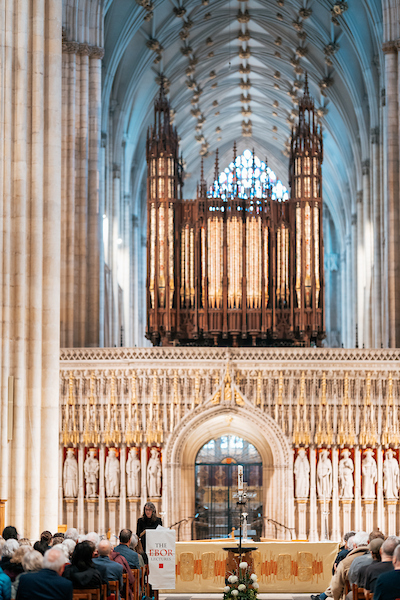
Lecture transcript
Tell us about hope? Where do you get your hope from? What gives you hope? is a question I’m asked again and again about my life with refugees. How do you keep on keeping on? It’s an increasingly urgent, insistent ‘menace’, as my friend Peter Matheson, called it.
Enter the wild with care, my love - opens The Lost Words Blessing, with Karine Polwart singing into gaping hopeless wounds of grief
Enter the wild with care, my love
And speak the things you see
Let new names take and root and thrive and grow[1]
Grief
The inexorable call on my life’s work – what the Māori call ‘mahi’, we might say vocation – is to live and work with those seeking refuge for the good of all.
It’s a continuation, I realise, of the work of my ancestors and of the service and action they rendered, humble and faithful non-conformist ‘saints’, without fuss.
For now, this work is held, in the UNESCO Chair for Refugee Integration through Education, Languages and Arts, and sustained by the statement in UNESCO’s founding documents that if wars are made in the minds of people then it is in the minds of people that the defences of peace must be constructed.
I see this as the work of holding the bowl of tears and expanding the space for joy.
It used to be work I undertook in hope – menaced by the hope of sane immigration policies; hope resting on the Refugee Convention to which we are signatories with ‘a proud history etc. etc’; hope in the basic generosity of people; hope in our voting system; hope in policies which offer protection and a new start; hope in the slogans of ‘hope not hate’, ‘we have more in common’; hope in the many decades of intercultural research which have shown that war and persecution, cruelty and fear are really bad ways of responding to people in need, and that that fear, literally Xeno-phobia – can be countered by education, relationship and good practice. It’s now work accompanied constantly by grief and hopelessness.
The carefully planned, patiently prepared Victory of the oligarchs, the violent men of war, the angry deportationists, seems absolute. I don’t know how long their reign and rise will last. I certainly don’t have much expectation that we will come to our senses before it’s too late, and its already far too late for many.
My inbox cries out daily with requests for help and refuge from the persecuted, from lands where the suffering is not only immense, but also fully aligned to the one key legal requirement for recognition as a refugee: A well-found fear of persecution.
I bring you bad news.
Successive governments of these lands in recent years have effectively taken the UK out of the refugee convention. There is no longer even a rhetoric of ‘a proud tradition of….’ Or ‘safe and legal routes’ – there simply are no routes left for the majority.
On 4th March 2026 the UK Government announced that scholars from Cameroon, Sudan, Myanmar and Afghanistan would no longer be allowed to enter the country for the purpose of study. They must use ‘other routes to humanitarian protection’. For which there are none available. More countries, we understand, will soon be added to the list of the excluded. The promised ‘Refugee Study visa’ is yet to materialise.
And even as you travel far from heather, crag and river
May you like the little fisher, set the stream alight with glitter
May you enter now as otter without falter into water
The beauty of this Lost Words Blessing dissolves when I think of those entering, with falter, into water, in the last resort of hope to see loved ones again, of the watery graves of the Mediterranean and the Channel. The important work of The Missing Migrants Project estimates 34, 869 people have died in the Mediterranean or are ‘missing’ since 2014. That’s roughly 4 times the total number of students at the University of York St John, to set the figure in context. It’s half the estimated number killed in The Gaza Strip, in Palestine since 2023. Between 2018 and 2025 162 people died crossing The Channel, according to The Missing Migrants Project of IOM, though deaths also go unreported, ungrievable as Butler explains, some lives are.
We might think of war as dividing populations into those who are grievable and those who are not. An ungrievable life is one that cannot be mourned because it has never lived, that is, it has never counted as a life at all. (Butler, 2009)(Judith Butler, Frames of War: When Is Life Grievable?)
When lives are made ungrievable, - as with refugees – I believe our work is to grieve them, nonetheless.
A group of women, Collectivas, we (UNESCO Chair) worked with in Mexico took it upon themselves to document the women killed in femicide – for being women – whose deaths went unrecorded by the municipalities, creating vast embroidered banners which they dropped from 4 storey buildings in ritual actions of remembering those who once ‘set the stream alight with glitter’, and are now dead and otherwise ungrieved.
Hannah Rose Thomas, my recent PhD student and Portrait artist, and our affiliate artists in residence I.D. Campbell and Robert McNeil have all understood that in a context of commemoration, where the most painted person in the world is the Late Queen Elizabeth II, leaning over a canvas to paint those who are ungrievable, with brush stroke, oils, pastels and gold leaf or egg tempura, is an act of prayer, an assertation of grievability.
But it is not hope. It is grief.
Rage
At times this inexorable violence against people seeking protection, engenders rage, spilling over onto the streets, that kind of anger that comes in the face of intractable injustice and the hopelessness of petition.
Let’s be really clear: There are really no routes remaining to the U.K. that are safe or legal except for those who can quite literally buy their way in. The immigration fees, health surcharges and financial obstacles are eye-watering. The Refugee Convention has been put through a shredder in the Home Offices of the world. It’s precious language, mothballed. Actual and performative cruelty are the mechanism by which the Oligarchs remain victorious. This isn’t about one single, genocidally minded country – Russia, UAE, Sudan, Ethiopia, Cameroon, Myanmar, Israel – or even about the suppliers of the weaponry to those countries to carry out their slaughter – It’s about a chaos of decisions affecting those forced to leave their homes, under evacuation orders and threats of annihilation – which both create and follow the flows of capital between those who profit from this system, the very few, and those who are immiserated by it. It is estimated that the Catholic Overseas Relief Services lost £1 billions overnight when the President of the United States cut USAID last year;
When my own ODA funded portfolio was cut in 2021 – overnight – my partners in Zimbabwe and Burkina Fasso said ‘This is violent news. We will be sent to gaol”, “This is what happens when you trust money from the British.” In 2026 the Government further cut ODA assistance to 0.3% from the statutory 0.7% in order to fund the expansion of the military, using much of what is left to fund the detention estate costs imposed by private contracts, for ware-housing people seeking asylum, in limbo.
Cited in the House of Lords debate, Romilly Greenhill, chief executive of the Bond network of humanitarian organisations, called the decision a “short-sighted and appalling move”. She added: “Slashing the already diminished UK aid budget to fund an uplift in defence is a reckless decision that will have devastating consequences for millions of marginalised people worldwide”.
We hear the language of rage. ‘Slashing’, ‘reckless’, ‘devastating consequences.
In the context of the live streaming of mortal agony from Gaza, Palestine and muting of the same from The Sudan, Myanmar and Afghanistan, for women and girls, there is open mouthed horror, learned helpless and the kinds of ‘giving up’ that index the absence of hope. I speak to my colleagues from Eritrea and Zimbabwe “But what can you do” they say, accurately assessing the hopelessness for what it is. Hopeless.
“What do you do when a dictator takes over your country, declaring that anyone who thinks like you will be less of a citizen, less safe?, asks Ece Temelkuran, in Nation of Strangers, “When there is no court to protect you any longer, who do you turn to? […] When it is declared that cruelty is the new rule and caring for people is a crime, will you join the mass hysteria of hatred mimicking their fury, so that you are safe? (Temelkuran 2026: 147)
I have never, in my many years of research with refugees, and the many successful campaigns I’ve been part of for evacuations and the rights of asylum been more despairing or defeated. Every small step forward is met with a raft of new obstacles which even a couple of years ago would have been unthinkable – permanent family separations, the end to hope of routes to permanent settlement, institutionalisation of radically different care frameworks if you are a minor seeking asylum or you are not. I could go on. It’s literally my job to receive and think hard about the bad news and all the things preventing real, life-giving work of hospitality, and settling people down well.
So far, our frameworks have failed. Our decolonial research has failed; our feminist ethic of care has failed. Our belief that ‘it’ must never happen again, has failed (Kapila: 2013). Our politics has failed. Our protests have failed. Our laws have failed. Our systems of justice appear to have failed; Our higher education and our organised religion have failed; our sociologies and ethics have failed. Our theologies have, in the main, been unfit for the task, maybe for some here our faith has failed. The momentary win – and it really was a win – in Kenmure Street on 13 May 2021 (I was there too), when the local community on the Southside of Glasgow prevented the deportation of two Sikh men who were our neighbours – was - it seems, the exception that proved the rule.
A Merciless Age
What is revealed as the mask slips is the mercilessness; the way that the violence of coloniality has persisted and been fanned back into a raging fire. This fire encroaches here as the elderly protestors, faithful people – often Quakers, non-conformists, fellow Members of the Iona Community, trade unionists, people of will - to whom we owe so many of our freedoms - are arrested on terrorism charges, not ‘merely’ for ‘breaching the peace’. Court Proceedings and retrials are held under extreme restrictions. What has always been the case – that the powerful can get away with murder – is in plain sight, establishing itself as a new consensus.
Buckle up and ready yourselves for mass deportations and detentions, say several of our political parties; performative cruelty which is, importantly, actual cruelty sees actual children taken from mothers. Integration with communities, which is the only way integration can happen, is a pipedream.
Look to the sky with care, my love
And speak the things you see
Let new names take and root and thrive and grow
It is in this merciless context of necropolitics – the politics of death– as Mbembe terms it; that words from within the Christian theological tradition have found themselves returning to the discourse of social scientific, arts and humanities research and also to the world of protest.
Joy,
Charity cast as kindness.
Hope.
As they have moved from being words used within contested theological contexts to ones which have been sloganized we have seen a consumerist desire emerge for those who bear the suffering to also perform the joy, kindness, and hope, for us.
In his lecture “Is there Hope for the Holy Land?” in St Martin in the Fields, in 2025, Daniel Munayer, speaking on a visit from his home in the Occupied Palestinian Territories, said:
“For Palestinians to talk about hope during these times is absurd. And this is a conversation that needs to be managed very carefully.[…] “In the Palestinian context hope has been misused and abused” “Why, he asks, do people need to jump to hope all the time? What about the reality of our suffering? Our need for justice? Why do you need Palestinians to be hopeful? It’s as if we always need something from the oppressed to make us to feel better.”
And even as you journey on past dying stars exploding
Like the gilded one in flight, leave your little gifts of light
Munayer continues, “Hope [has] become[s] a wishful thing, a type of “quick medicine” for the tragedies of Palestine. People have turned hope into a means of evading responsibility and becoming passive. If Palestinians are hopeful we can feel better and be optimistic. But hope is not optimism. He says:
"This is an age of monsters.
An age of absurdity
An age which places our greed for hope under erasure.
An age where everyone is talking about kindness and compassion or asking, ‘where is your humanity?’
An age where public life discourse coarsens, ill-informed and frighted mobs turn up to yell the abuse of ‘paedo’ or ‘rapist’ outside the UKs lucrative for-profit ex-hotel detention estate, beating down on others because it feels good to ‘win’ like that, violently, for a moment, before the regret creeps in and lasts a lifetime, a death-time."
‘Kindness’ is on every focus group and staff survey and book title in my field; ‘Hope’ is in the title of every postdoc project crossing my desk, betraying the failure of politics and imagine
“We are already in the game” says Temelkuran “not playing but being played […] paralysed by shock before the limitless shame of the new world order” (2026: 156)
When Every hope is Gone.
So, I have news. And it is good news.
In not dissimilar times T. S. Eliot wrote that ‘hope would be hope for the wrong thing’ – a hoping for hope itself won’t do. When hope is gone we are left with work - work of solidarity: solidarity in grief. Solidarity in rage. Solidarity as the work of love. Solidarity is refuge, and it is made in what Hyab Yohannes, our brilliant scholar in the UNESCO Chair, calls the poetics of refuge.
“The phrase we remained ‘calm and alive’ emerged as a recurring theme in our conversations and encounters with those seeking refuge. It speaks of the indomitable human capacity to endure, adapt, and uphold a sense of dignity, even within the dehumanising depths of despair. It is a reminder of our fugitive and abyssal (de)existence in a world overwhelmed by violence and systemic marginalisations. Yet, ‘we remained calm and alive’ also invokes the poetics of life that rise beyond mere survival.’ (Yohannes, 2025: 135)
Speaking in 2024, at the SOLAS festival, Scotland, my late friend, theologian and former leader of the Iona Community, Kathy Galloway, was asked by her activist host ‘tell us what gives you hope’
“I’m not very interested in hope” said Kathy, “I’m far more interested in courage, faith and cheerfulness”.
Courage, faith and cheerfulness are words said daily in a prayer from the Iona Community. They are what we ask for, for our work of solidarity, justice and peace. We do not ask one another or our maker – whoever that may indeed be – for hope. Hope is not in the prayer for the Iona Community.
To live a Christian life, as I understand it, is to live through the hopelessness of Good Friday – through the torture and execution of a Jewish man living in occupied Palestine, whose trial and charges of terrorism and insurrection were rigged, to live the betrayal that the Palestinians and so very many of those who have sought refuge in our own lands, and in many others, have encountered. It is to stay in and with life as love when every human hope has gone. In what we learn of Jesus in the Gospels we find that everything we thought of as winning, is losing, and everything we thought was losing, is winning. This is the upside-down world of the Beatitudes. Blessed are those who mourn. A Lost blessing indeed.
And in the dead of night my darling,
find the gleaming eye of starling
Like the little aviator,
Sing your heart to all dark matter
Pause
We don’t know how long This Particular Victory of the Oligarchs will last. We do know that the asylum and refugee system in its entirety enhances the colonial foundations upon which it is built. It others. It denies agency. It silences. It enacts suspicion. It is racially selective. It is linguistically monoglot. It is radically unfit for the purpose of ‘Refugee Protection’ and entirely in the service of disposability of human beings tagged with labels of ungrievability by the Home Office, here, and their equivalents elsewhere in South Africa, Argentina. United States, Ethiopia. We only need to look to the Jewellery laws in Denmark – whereby people (mainly women) seeking asylum had their jewellery taken from them to ‘pay’ for their accommodation – and the floating of a similar idea by the present Home Secretary for the UK – to see the ways in which the stripping of dignity and imposition of shame and wounding, poverty and erasure are all normalised now in UK asylum and refugee discourse.
My PhD student Nerea Bello Sagarazazu, is busy making rings, with words in many languages, open circles of gift giving to restore what is being stolen, in new forms. Neither hope nor hopelessness but the active, critical making and wearing of mutualised solidarity.
Walk through the world with care, my love
And sing the things you see
Let new names take and root and thrive and grow
The Refuge of Poetics in a Merciless Age
Maybe there is another tonality to be heard in this, because you are – I expect - exhausted by this, by this hopelessness, this endless ‘forwarding’ of outrage, horror and helplessness?
Not everyone is inside these stories, not everyone has been asked to handfast to courage, faith and cheerfulness. And as Graeber says (Graeber, 2013), many are excluded by circumstance, even from the material privilege of doing good.
At the height of our campaigning for the evacuation of 88 full scholarship holders from Gaza to the United Kingdom to take up their scholarships to study at universities here, I had the fortune to be in a room with a senior civil servant from the Foreign and Commonwealth Office and I raised the question of the Gaza Evacuations and parity with other contexts. “If I thought it would help, I’d get down on my knees and beg” I said. The official looked me in the eye declaring it would never happen, smiling pityingly with a hint of ridicule. “It must be very difficult for you to ask me this on behalf of others.” When the 88th student arrived and I greeted them at the airport I did remember this conversation. It had been a hopeless moment and but honest too. And I did go home from that airport on that indeed joyful day with a momentary swagger. The momentary uncomfortable refuge of ‘winning.’
Rowan Williams asks in his lectures to The World Community for Christian Meditation (2015):0
"I sometimes wonder what life in the church would be like if we had never developed the concept of winning and losing. […] there is not going to be a situation of sublime clarity in which one group’s views will prevail because the other group simply says, ‘Oh, I see it all now.’ (Rowan Williams, The Spirit in the Desert, pp.11-12)
The commodification and greed for hope, is bound in to an idea of winning so I’d like to ask what our culture and society might look like – ordinarily - if we are not in the shallow business of winning or losing?
And even as you stumble through machair sands eroding….
Wait without hoping on those systems that have failed.
Let them be unredeemable for now.
When our foster daughter was age-disputed – as so many children have been – and taken from us into detention, threatened with deportation, moved from a legal system where she could receive legal aid, to one where we had to raise £8,000 overnight the neighbours just stepped in, little donations, travel cards, and casseroles galore. “I didn’t know what else to do, so I made you some food?”
Food. And surprises.
Our daughter’s best friend’s brother, Douglas, aged 10, came home at the height of this with a letter from his Primary School saying his local MEP was going to be visiting and would the children please prepare questions. Douglas said that he wanted to know why our daughter, Rima, who’d already been separated from her parents once, had to be separated again? The MEP, Catherine Stihler, was so moved by this question that she took the slot she’d drawn for asking a question of the President of the European Parliament, to ask the question posed to her by Douglas, aged 10. We didn’t know at the time, but that kind of question triggers a good deal of action, and the UK Government were asked to allow the claim, and all those like it, and to enact the spirit and the letter of the law. Detentions of children in the UK stopped and our campaign was one of the reasons. Our daughter was eventually recognised as a refugee.
Through most of that time I was hopeless, experiencing the full violence of the immigration system against the force of our love. For a few precious years saw an alleviation. Children are back in the detention estate again now. Age dispute has got worse. But we learned something then about digging in for the long term and about trusting in the unexpected like the chance questions of ten-year-old.
Let the fern unfurl your grieving,
let the heron still your breathing
When the UNESCO Chair was in augurated at the University of Glasgow in 2017 I wanted the lecture to be one which demonstrated the full range of what languages and arts can do and invited 22 dancers from Noyam Institute for African Dance, who I’d worked with in Ghana, in the equatorial rain forest, to come and dance the lecture themselves. Many had never travelled from their hometown and didn’t have birth certificates, immunisations or passports. All but two were refused by the Home Office on the grounds that they must be lying about knowing me – a UK Professor and UNESCO Chair. It took questions in the House of Commons and a media campaign for this and other similar examples (there have been many) to mean that eventually all but two arrived and danced the lecture. In another case, I even received a late-night message from a journalist and an MP saying, “you can stand down, The Daily Mail are demanding the visas are granted.” Obviously, this is no way to run an immigration system.
Let the selkie swim you deeper, oh my little silver-seeker
Even as the hour grows bleaker, be the singer and the speaker
There are people amongst us who have stayed with similar struggles, alongside the pain and the hopelessness for decades.
When St George’s Place, Glasgow, home to the South African Consulate, changed its name at the height of the anti-apartheid struggles, to Nelson Mandela Place, ensuring all letters (we wrote letters back then) were addressed to the South African Consul, Nelson Mandela Place, the name of their most notorious political prisoner, there was no demanding of hope from Mandela, or from those stuck in the thick of the struggle. But there was an undemanding solidarity in action, which still brings a smile, whenever that story is told.
For my team fifteen years of loyal work with Gaza had to happen and a violence beyond comprehension, before a movement world-wide, emerged, integrating old knowledge, newly known, sloganizing solidarity and hope but also doing the hard work. For my Māori friends, over a hundred and eighty years and counting….
Shadia Qubti reminds us of this in her 2025 Peace Summit Conference lecture– Seeds in Hostile Ground, as she carefully re-reads the Parable of the Sower and the Seed, through Palestinian Liberation Theology. The seed falling on good ground would be harvested for the landowners, that falling on stoney ground, or among the thorns, might endure until the conditions were ripe for others to enjoy the harvest. Social Work academics Avril Bellinger and Deirdre Ford enact this in their work sharing seeds as their ‘hand outs’ in lectures, asking us to think about how to care for the life of these seeds, how to find people who might provide the conditions they need, for when the time is right.
What these practices demonstrate – and there are so very many that fill my life with utter delight –– is that solidarity has not gone, it insists on the right to be ordinary, liberating us from demanding a transactional hope of others. It mutualises as Sitholé puts it (Sitholé, 2024) effortlessly,
I see it in my daughter beginning to imagine how her passion for baking, learned, apparently in my kitchen, might become a viable business; she makes endless wedding cakes and birthday cakes for friends and for our unexpected grandchildren, who entered our childless home and brought glorious, devasting chaos. A radically ordinary, delicious, cheerfulness that has nothing at all to do with winning or losing and everything to do with stubbornly ordinary love.
And when every hope is gone,
My colleagues in Gaza and I have been doing the work of mutual solidarity for 17 years continuously. There is no hope. But we still get to work; teaching, lecturing, examining students, marking dissertations, putting together research projects. Rebuilding higher education, ordinarily.
We decided, last month, to hold an online launch for my co-authored anthology of poetry, with the students of my assassinated colleague and co-investigator on a grant, Refaat Alareer in Gaza (he wrote a poem about a kite). We held this as a space for new poetry to be spoken from Gaza, by the students.
"These are not poems written in quiet rooms. They are written under collapsing ceilings, typed on phones with failing batteries, memorised because paper may not survive. They are carried in voices, in breath, in memory.
In places where homes are lost and landscapes altered beyond recognition; poetry becomes more than expression. It becomes a way of holding on to humanity. A way of naming what is happening when numbers and images cannot fully speak. A way of remembering.
Poetry crosses borders when people cannot. It moves through language, through silence, through distance."
Writes Nazmi Al Masri, their professor.
The next thing we knew our publishers, Wild Goose Publication – the publishing house of The Iona Community - had issued contracts and published the young people’s work in a book called Let us Throw War Away. This isn’t hope. It’s the dignity of work. Insisting on life, without bitterness or accusation. This was just what this small publishing house, could do. Then and there.
The Lost Words Blessing ends with the words
When every hope is gone
May the raven call you home
This suggests a calling onwards to a place, a destination, a home.
Who calls you home, when the Raven cannot sing?
When home is the mouth of a shark? (Warsan Shari) When millions of you are scattered across the globe, and no one wants you?
Of course, our voices crack….and grief is raw. Of course we take refuge in broken memes at a loss.
But you need more from me than hopelessness. And I hope, I’ve given you a bit of courage, maybe some faith, perhaps even a little cheerfulness.
In closing I come back to this image of a raven, seemingly calling the dead over the threshold, when every hope is gone, and offer a different reading.
Perhaps the raven is the one of the Haida traditions of Turtle Island, and from so many indigenous wisdom stories, the one exhausted from battling with Eagle to bring the moon back to light up the darkness that had descended onto the earth, after it was stolen and held in captivity to shine solely for the Eagle’s own greedy purposes.
How might you to make a nest for the raven, so that you might be home for raven, for the ones weary from flight and embattled?.
A home found in a calling which speaks of the labour of solidarity, the work of love, the ordinary, everyday acts of grieving the ungrievable, the small peace benches, and paper cranes, the wearing of scarves that bring a smile, the holding out for witness that just lets people know there are still pockets of kindness that create webs of connection, for now.
Making something that might still survive as a refuge, a sanctuary, after so much darkness will always seem like a lost cause. But it is my testimony, that you will also find courage, faith over a very long durée, and a good deal of cheerfulness.
When every hope is gone,
May the raven call you home
[1] Extracts from The Lost Words Blessing, by Karine Polwart: from Spell Songs; The Lost Words.
First published: 11 September 2025