



IUCN UK Peatland Programme
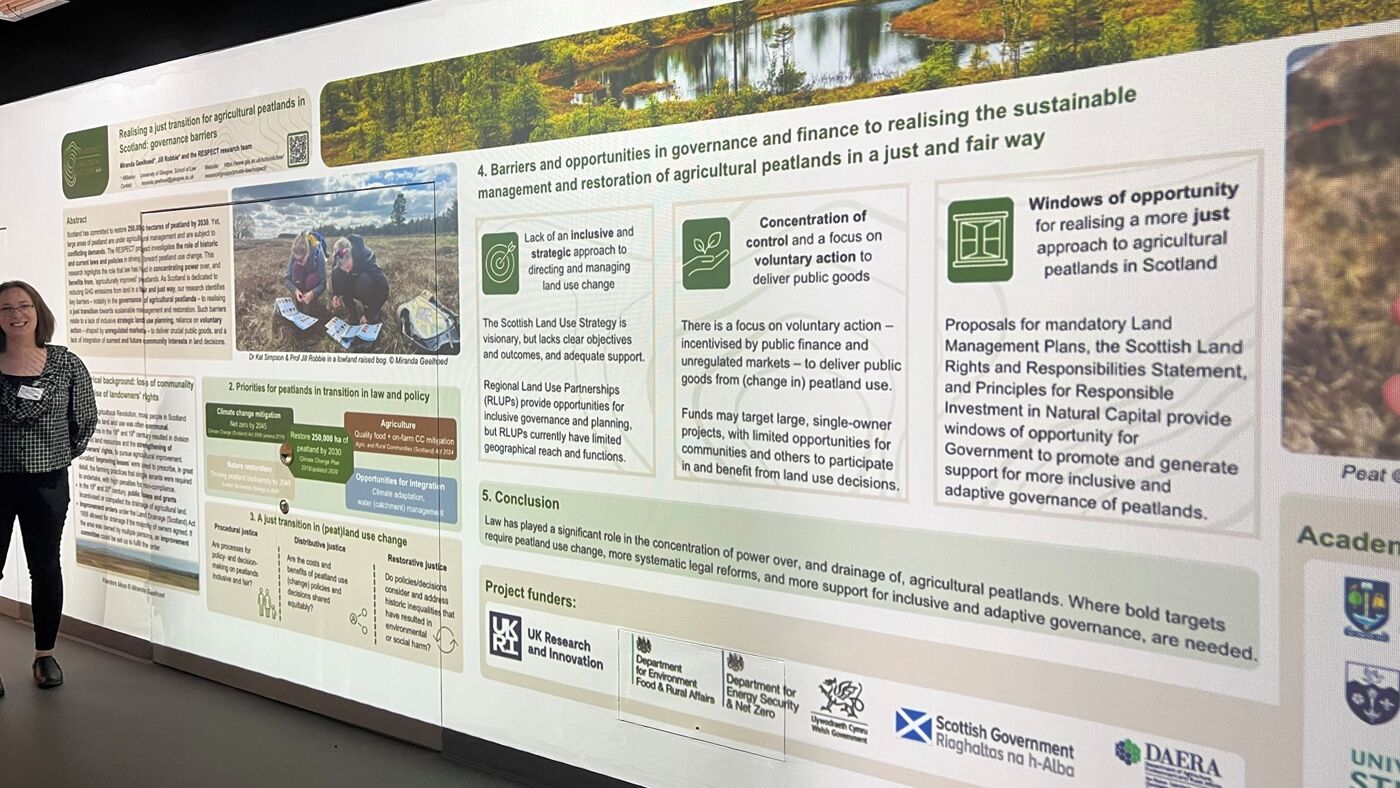
Members of the RESPECT team recently braved Storm Amy to travel to the 2025 IUCN UK Peatland Programme Conference in Derry/Londonderry.
The University of Glasgow uses cookies for analytics. Find out more about our Privacy policy.
Necessary cookies enable core functionality. The website cannot function properly without these cookies, and can only be disabled by changing your browser preferences.
Analytical cookies help us improve our website. We use Google Analytics. All data is anonymised.
Clarity helps us to understand our users’ behaviour by visually representing their clicks, taps and scrolling. All data is anonymised.
RESPECT - Rapid Engagement with Stressed Peatland Environments and Communities in Transformation
An interdisciplinary project to support and upscale the protection, restoration and sustainable management of agricultural peatlands in Scotland and England
Peatlands are one of the world’s most important natural habitats. These habitats store large amounts of carbon, contribute to flood risk management and support biodiverse landscapes. But today, around 80% of UK peatlands are damaged. Instead of storing carbon, they are releasing it and adding to climate change. Protecting and restoring peatlands is urgent if we want to achieve the UK’s “net zero” climate goals.
The RESPECT project (Rapid Engagement with Stressed Peatland Environments and Communities in Transformation) is working to understand and fix that. Our aim is to produce data, methods, landholder tools and proposals for governance reforms to change agricultural practices on peatland and contribute to the UK’s net zero target.
The RESPECT project is a partnership between the University of Glasgow, the University of Hull, Newcastle University and the University of Stirling. The project is affiliated with the Land Use for Net Zero, Nature and People (LUNZ) Hub.

RESPECT is focused on two areas, the Forth Catchment in Scotland and the Humber Catchment in England.
In these areas, we are:
RESPECT was awarded £4.5 million by the UKRI Land Use for Net Zero Research programme over three years.
The project is co-funded by the UKRI, the Department for Environment, Food and Rural Affairs (on behalf of England and Wales), the Department for Energy Security and Net Zero, the Department of Agriculture, Environment and Rural Affairs in the Northern Ireland, and the Scottish Government.
The RESPECT project has been co-designed to meet the needs of partner organisations, as well as a set of wider stakeholders. Project partners take part in regular stakeholder meetings and they provide access to data, assistance with site visits and advice that is invaluable to the project’s success.
Project partners also play a key role in the dissemination of research outputs. Findings will be shared with partners and presented at relevant conferences, such as those organised by Community Land Scotland, the IUCN UK Peatland Programme, Natural England and NatureScot.
We are grateful to be able to draw on this support and would like to thank each of the project partners for their participation.
The 11 project partners of the RESPECT project are:
The project is organised around four core interdisciplinary work packages:
The RESPECT project is a major interdisciplinary research collaboration that brings together experts from four universities to tackle some of the most complex challenges facing peatlands today.
RESPECT integrates diverse academic perspectives from law, environmental and human geography, anthropology, archaeology and environmental history, ecology and environmental economics to build a holistic understanding of the historic and present realities of peatland use and management. The team works across disciplines to collect and analyse data, engage with landholders, communities and stakeholders, and develop practical decision-support tools that help inform sustainable use and restoration choices. RESPECT's collaborative approach also ensures that our policy outputs are shaped by a range of interdisciplinary insights, thereby strengthening the evidence base for policy making.

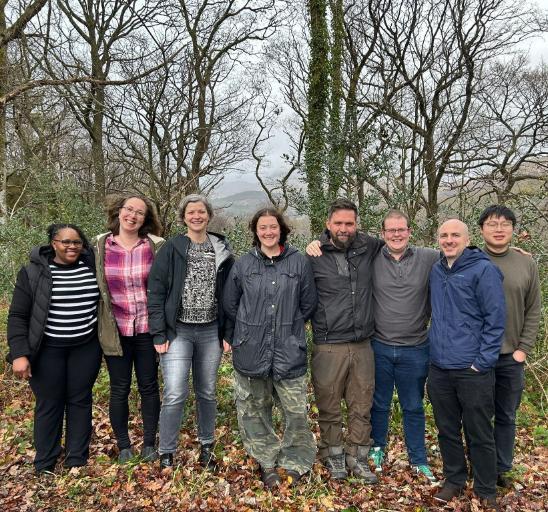
RESPECT team members meet regularly to build bridges across disciplines. From left to right: Mary Nthambi, Miranda Geelhoed, Jill Robbie, Ada Shaw, Alex Skarlatos-Currie, Stuart Munro, Stuart Brown and Wenguang Tang
Jill Robbie is a Professor of Property Law and the Natural Environment in the School of Law at the University of Glasgow. She is the Principal Investigator of the RESPECT project, a co-lead of Work Package 4 and a contributor to Work Packages 2 and 3.
Adrian Bass is a Reader in Biogeochemistry in the School of Geographical & Earth Sciences at the University of Glasgow. Adrian is a co-lead of the RESPECT project and work package 1, and a contributor to work package 3.
Jane Bunting is a Reader in Geography in the School for Environment and Life Sciences at the University of Hull. She is a long term ecologist with research interests focused on better understanding of the long term ecological dynamics of cultural landscapes, mostly from pollen records. Jane is a co-lead of the RESPECT project and a contributor to work package 1.
Deborah Dixon is a Professor of Geography in the School of Geographical & Earth Sciences at the University of Glasgow. She is an internationally recognised scholar in feminist geopolitics. Deborah is a co-lead of the RESPECT project and work package 2, and a contributor to work packages 3 and 4.
Graham Ferrier is a Professor of Earth Observation Science in the School of Environmental Sciences at the University of Hull. His research seeks to develop new insights into sustainability, impacts of climate change, environmental processes and anthropogenic effects on the environment at a wide range of spatial and temporal scales. Graham is a co-lead of the RESPECT project and work package 3, and a contributor to work package 1.
Nick Hanley is Chair in Environmental and One Health Economics in the School of Biodiversity, One Health & Veterinary Medicine at the University of Glasgow. He is an environmental economist who mainly works on the application of economic methods to biodiversity conservation, one health problems and measures of sustainability. Nick is a co-lead of the RESPECT project and a contributor to work packages 2 and 3.
Larissa Naylor is a Professor of Geomorphology and Environmental Geography in the School of Geographical & Earth Sciences at the University of Glasgow. She is a coastal geomorphologist who works at the interface of geomorphology, ecology and engineering. Larissa is a co-lead of the RESPECT project and work package 4.
Amy Proctor is a Senior Lecturer in the Centre for Rural Economy at Newcastle University. She is a social scientist whose research on sustainable land and livestock management focuses specifically on the role and expertise of farmers and their advisers. Amy is a co-lead of the RESPECT project and a contributor to work packages 2 and 4.
Katherine Simpson is a Lecturer in One Health and Environmental Economics in the School of Health & Wellbeing at the University of Glasgow. She has over ten years of research experience in interdisciplinary collaboration with ecologists, environmental scientists and policy specialists. Katherine is a co-lead of the RESPECT project and work package 2, and a contributor to work package 3.
Jens-Arne Subke is a Professor in Biological and Environmental Sciences at the University of Stirling. He is an ecosystem scientist interested in understanding the response of terrestrial ecosystems to changes in environmental conditions. Jens-Arne is a co-lead of the RESPECT project and work package 3, and a contributor to work package 1.
Nicki Whitehouse is a Professor of Archaeological Science in the School of Humanities at the University of Glasgow. She is an archaeological scientist working within environmental archaeology and palaeoecology and has particular expertise in the archaeology and palaeoecology of peatlands, wetlands, agriculture and land use. Nicki is a co-lead of the RESPECT project and work package 1, and a contributor to work packages 2 and 3.
Jiren Xu is a Lecturer in Remote Sensing & GIS in the School of Social & Environmental Sustainability at the University of Glasgow. He is an environmental scientist with an interdisciplinary background. Jiren is a co-lead of the RESPECT project and a contributor to work packages 1 and 3.
Phil Barratt is a Research Associate and an Affiliate Researcher in Archaeology in the School of Humanities at the University of Glasgow. Phil is a contributor to work package 1 of the RESPECT project.
Stuart Brown is a Research Associate in the Centre for Rural Economy at Newcastle University. Stuart is a contributor to work package 4 of the RESPECT project.
Devon Burke is a Centre Administrator and Project Coordinator at the University of Glasgow. She is the Project Administrator of the RESPECT project.
Alex Currie is a Research Associate in the School of Geographical & Earth Sciences at the University of Glasgow. He is a contributor to work package 2 of the RESPECT project.
Miranda Geelhoed is a Research Associate in the School of Law at the University of Glasgow. Her background is in law and governance, with a focus on agriculture, land, biodiversity, climate and human rights. Miranda is a contributor to work package 4 of the RESPECT project.
Muhammad Jehanzaib is a Research Associate in the School of Natural Sciences at the University of Stirling. His research expertise includes peatland hydrology, hydroclimatic extremes, and the application of machine learning and artificial intelligence in hydrology. He is a contributor to Work Package 3 of the RESPECT project.
Stuart Munro is a Geospatial Technician in Archaeology in the School of Humanities at the University of Glasgow. He has an interest in archaeological fieldwork methodology, remote sensing primarily employing drone-based survey solutions, digital landscape modelling, and GIS and spatial analysis. Stuart is a contributor to work package 1 of the RESPECT project.
Mary Nthambi is a Research Associate in the School of Biodiversity, One Health & Veterinary Medicine within the College of Medical, Veterinary & Life Sciences at the University of Glasgow. She is a contributor to work package 2 of the RESPECT project.
Adeline Shaw is a PhD Candidate in the School of Law at the University of Glasgow. Her PhD examines the motivations and barriers faced by landowners, farmers and other stakeholders in adopting peatland restoration practices and is part of the RESPECT project. She is a contributor to work package 2.
Wenguang Tang is a Research Associate in the School of Geographical & Earth Sciences at the University of Glasgow. He is a contributor to work package 1 of the RESPECT project.
Peatlands sit at the heart of net zero targets, nature recovery ambitions, and social policy goals. Our research aims to inform policy making in Scotland and England.
© 2026 University of Glasgow - RESPECT project. All rights reserved. No part of this website may be reproduced without prior written permission. Image credits for the pictures on this page are listed below: