

2026 Election Policy Insights: Migration
Published: 28 April 2026
28 April 2026: Next in our Election 2026 Policy Insight series, Dr Dan Fisher explores migration - a policy area reserved to the UK Parliament but with far‑reaching consequences for devolved responsibilities in Scotland. He writes that changing UK and Scottish political dynamics are likely to make the implementation and contestation of migration policy increasingly complex in the coming parliamentary term.
28 April 2026: Next in our Election 2026 Policy Insight series, Dr Dan Fisher explores migration - a policy area reserved to the UK Parliament but with far‑reaching consequences for devolved responsibilities in Scotland. He writes that changing UK and Scottish political dynamics are likely to make the implementation and contestation of migration policy increasingly complex in the coming parliamentary term.
Policy Insights by Dr Dan Fisher
Policy Insights: Migration in the Scottish Parliament
Migration is a key area of concern for voters headed to the polls on May 7th. Immigration is reserved to the UK Parliament, but intersects with devolved policy areas – including housing, education and employment. In previous parliamentary sessions, there has been broad political consensus in support for immigration to Scotland, in response to demographic pressures and labour market shortages, and pitching Scotland as a place of refuge for those fleeing war. The rise of Reform UK has challenged this consensus, contributing to the increased salience of immigration among the public.
This Policy Insight covers both ‘regular migration’ and ‘forced migration’, treating them for the most part as separate issues. Regular migration refers to people who have chosen to cross borders voluntarily and are able to do so through visa routes or travel agreements between countries. Forced migration, by contrast, refers to the involuntary movements of groups or individuals due to factors beyond their control. Forced migrants will often cross borders without prior authorisation, which is not illegal if the purpose is to claim asylum.
Migration in Parliament
Over the past five years, migration has been a salient but unevenly articulated issue in the Scottish Parliament, surfacing often in response to developments at Westminster. This reflects the asymmetry of the devolution settlement: immigration policy is reserved to the UK Parliament, while many of its consequences fall within devolved competences such as housing, education and welfare. Parliamentary debate has therefore centred on questions of responsibility and the limits of existing constitutional arrangements.
Pro-independence parties (Scottish National Party (SNP); Scottish Greens) have regularly drawn attention to the fact that Scottish institutions are responsible for managing the impacts of immigration policymaking without controlling the policy levers that shape them. In contrast, the Scottish Conservatives (pre the 2024 Westminster election), in particular, maintained that immigration is a reserved matter requiring UK-level solutions that the Scottish Parliament should be seeking to support.
Both Scottish Labour and the Scottish Liberal Democrats have recognised the constraints imposed by the current devolution settlement while placing greater emphasis on improving policy coordination and delivery within it. Though critical of the previous UK Government’s approach to migration, both parties have predominantly focused their efforts on addressing pressures on local authorities and strengthening intergovernmental working, rather than advancing more fundamental constitutional change.
Forced migration crisis
Issues regarding forced migration – such as asylum determination and asylum accommodation – are reserved to the UK Parliament. In this context, the Scottish Government’s role over the last five years has been shaped primarily by its need to respond to UK-level policymaking. As a result, it is impossible to discuss Scottish Government migration policy over the last five years without first setting UK-level political developments in this context.
Successive UK governments have struggled to effectively manage forced migration. The previous Conservative UK government sought to respond to spiking small boat arrivals from 2020 onwards by creating a two-tier system of refugees in the UK depending on mode of arrival (Nationality and Borders Act 2022), mandating the detention and swift removal of persons arriving in the UK by irregular means (Illegal Migration Act 2023) and determining that Rwanda is a safe country to which people can be removed (Safety of Rwanda Act 2024).
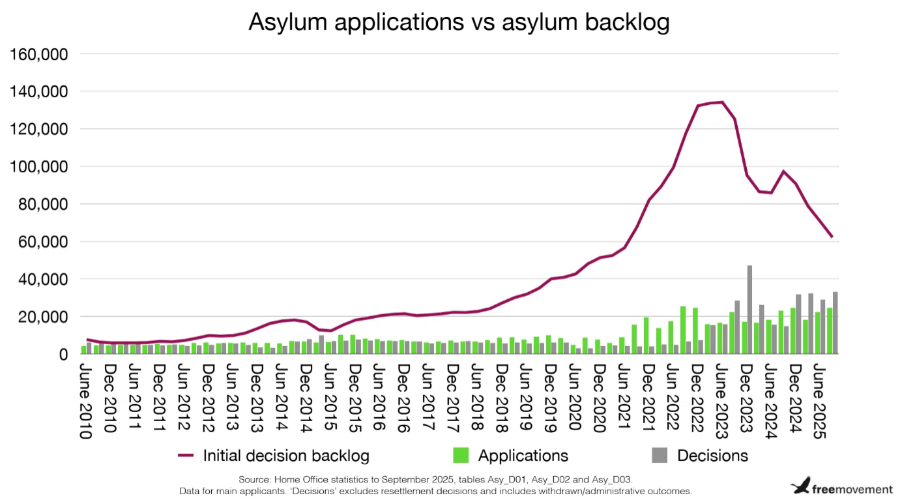
Home Office asylum determinations were practically paused during this period of strict legislative action – yet forced migrants (predictably) continued to arrive. As a result, the backlog of asylum cases ballooned out of all previous proportions (see Figure 1). This backlog meant that the UK government had to find creative solutions to find much more asylum accommodation, which contributed to the decision to house people seeking asylum in hotels across the UK.
The current UK Labour government has brought down the asylum backlog to 49,000 pending applications from a peak of over 130,000 in 2022 and 91,000 in 2024, by employing more Home Office caseworkers and reducing decision-making times. However, as refused asylum applicants have the right of appeal, the speed of asylum decision-making has also coincided with a spike in asylum appeals. The UK government is now exploring new means of reducing asylum appeal times.
Figure 1:
Glasgow City was previously the only Scottish local authority participating in the UK Government’s asylum dispersal scheme. However, asylum seekers were subsequently accommodated on a contingency basis in hotels and other sites across multiple local authority areas from 2022 onwards as part of a nationwide expansion of asylum dispersal. Where local authorities previously participated voluntarily in the UK government’s asylum dispersal scheme, participation is now mandatory.
Significant concerns have been raised by human rights campaigners regarding the use of hotel accommodation, including the mental and physical effects on those living there and rising community tensions. Local authorities have also highlighted concerns regarding the expansion of asylum dispersal, noting additional pressures on housing supply, healthcare, education and social services. A report by the Equalities, Human Rights and Civil Justice Committee highlighted these concerns and drew further attention to the challenges faced by people seeking asylum in Scotland to access legal support, English language classes, public transport, medical attention and mental health support.
Recent Scottish Government actions regarding forced migration
The Scottish Government has over the last five years consistently expressed strong support for people seeking refuge, reflected in both parliamentary debates and a range of policy initiatives. However, delivery has been uneven. Budget constraints, Covid-19, UK government asylum policy changes and the Russian invasion of Ukraine have limited the scale and pace of policy delivery. A short summary of key developments is discussed below.
Right to vote for refugees in Scottish and local elections (2020)
The extension of voting rights through the Scottish Elections (Franchise and Representation) Act 2020 marked a significant shift towards a more inclusive model of political participation. The Act enfranchised foreign nationals with leave to remain, including refugees, in Scottish Parliament and local elections.
Ending Destitution Together strategy
The Ending Destitution Together Strategy (2021) sets out a joint Scottish Government and COSLA commitment to preventing and mitigating destitution among people with insecure immigration status, strengthening coordination between national and local actors and the third sector. It seeks to improve access to early advice, advocacy and practical support – including specialist immigration advice to help individuals resolve or regularise their status – while promoting a preventative, rights-based approach through access to basic needs, coordinated casework and local safety nets. A Strategy update in 2024 highlighted sharply rising demand and increasing case complexity linked to UK asylum policy changes – underscoring the need for stronger prevention, more consistent provision and a more coordinated, system-wide response.
New Scots Refugee Integration Strategy
The third New Scots Refugee Integration Strategy (2024), developed by the Scottish Government in partnership with COSLA and the Scottish Refugee Council, reaffirmed a commitment to “integration from day one”. The accompanying Delivery Plan (2025) set out priorities across housing, education, employment and service coordination, underpinned by a rights-based and participatory approach shaped by the experiences of people seeking protection. Early progress has been supported through funding for the Scottish Refugee Council to provide a Scotland-wide integration service. Following the Review of Community Learning and Development in Scotland, £500,000 was secured to support the hard work of language learning for New Scots in Glasgow through the provision of additional ESOL classes. Nevertheless challenges persist, particularly regarding community cohesion where asylum hotels have been opened, as well as the uneven implementation of the Strategy across local areas.
Trafficking and exploitation strategy
Scotland’s Trafficking and Exploitation Strategy (2025) complements wider forced migration policy by focusing on the protection of people at risk of, or experiencing, exploitation. It plays a key role in addressing the risks of exploitation that can arise within the current UK asylum system and in supporting recovery and longer-term stability for affected individuals. The Strategy emphasises early identification, multi-agency coordination and access to specialist support, including safe accommodation, advocacy and legal advice. In doing so, it provides an important safeguarding framework within Scotland’s broader rights-based approach to migration.
Free bus travel for asylum seekers
The Scottish Government committed to extending concessionary travel to people seeking asylum, recognising its role in improving access to services and integration. However, implementation has been delayed and inconsistent. A proposed national scheme was initially announced, then paused and effectively withdrawn in 2024 due to budget pressures, before being reintroduced as a pilot scheme from the 1st of December 2025 to the 31st of March 2026 following sustained advocacy.
Access to higher education
A legal campaign group, Just Right Scotland, ran a sustained campaign - Our Grades not Visas - that highlighted barriers faced by young people educated in Scotland to access further education due to their immigration status. The group successfully argued their case at the Court of Session, which found that the rules governing migrant student's access to tuition funding were unlawful in light of articles in the European Convention on Human Rights. The Scottish Government subsequently extended home fee status and student support eligibility to refugees, stateless persons and those with discretionary leave or humanitarian protection.
Regular migration as a solution
Whereas forced migration has created policy challenges for governments, there has been broad political consensus that regular migration is an opportunity to improve the Scottish economy and to potentially slow the alarming rates of depopulation, especially in Scotland’s rural areas and islands.
The previous Scottish Government published a Population Strategy in 2021. It argued that Scotland faces a distinct demographic challenge to the rest of the UK that merited a distinct ‘Scottish Visa’ system within the existing UK immigration system. The Independent Expert Advisory Group on Migration and Population (Scotland) has previously suggested running a Remote and Rural Migration Scheme for Scotland. Such a scheme would require cooperation with the UK Government to relax conditions for skilled worker visas for employers in designated areas, support a Scottish Visa targeted at designated areas of Scotland, and operate a job-based scheme potentially in partnership with local authorities.
Beyond a separate migration scheme to encourage migration to Scotland, or to its towns, rural areas and islands, the next Scottish Government will need to extend the work being undertaken as part of its Action Plan to Reduce Depopulation. Housing shortages, limited employment opportunities and poor access to services and public transportation currently act as drivers of depopulation and inhibitors of in-migration to rural and island Scotland. Research on this issue by Migration Policy Scotland (MPS) indicates that a multi-level approach will be required to collaboratively tackle rural depopulation. According to MPS, such multi-level policymaking would require: a shared vision of the future; an inclusive process to coordinate policy changes; flexible frameworks to adapt to local needs and capacities; mechanisms for spreading resource, learnings and building capacity; and an understanding of resource that includes both finance and local resources.
Thus, rural population strategies will depend on the involvement by local authorities, employers, communities and third sector organisations in shaping and delivering local migration initiatives. This points to the importance of combining national strategic direction and funding with greater local flexibility and capacity, enabling migration to align with labour market needs while addressing wider structural conditions such as housing availability, service access, transport and digital connectivity. From this perspective, migration should be understood not as a standalone intervention but as one strand of a broader place‑based strategy.
The next five years
Migration – and forced migration in particular – is likely to remain a key issue for the next Scottish Government. Although the asylum backlog has been reduced, there is little evidence to suggest that the UK Government will reduce forced migration to the UK. Meanwhile the UK Government has continued to bring forth major changes to UK immigration rules and is continuing with plans to create a new Independent Appeals Body to handle asylum appeals more quickly. These changes (and others to come) will have knock-on effects for devolved responsibilities – including, for instance, heaping further pressure on the provision of legal aid in Scotland.
Opinion polls suggest that Reform UK will return a sizeable number of elected members to the next Scottish Parliament. Where previously the Scottish Parliament has managed to maintain broad political consensus on migration by viewing forced migration predominantly through a human rights lens and regular migration through an economic and demographic lens, this picture is likely to change in the next Parliamentary term. Reform UK frames migration as part of the problem behind housing shortages in Scotland, and their expected success is challenging previously held beliefs that Scotland generally has a more positive outlook on migration compared to the rest of the UK. It is therefore unclear whether the next Scottish Government will remain supportive of migration – both in voice and/or action.
Migration is likely to remain a central political issue, particularly in the context of the Scottish local elections due in May 2027. Local authorities already play a pivotal role in shaping how national asylum and immigration policies are experienced in practice, through their responsibilities for housing, services and community relations. To date, many Scottish local authorities have been at the forefront of efforts to provide a welcoming environment for forced migrants. However, shifts in their political composition could produce a more fragmented and potentially less supportive landscape. While a restrictive UK Government has often provided a clear point of contrast for the Scottish Government, emerging political pressures at the local level may prove more complex to navigate, reshaping how migration policy is implemented – and contested – across Scotland.
Author
Dr Dan Fisher is a Research Associate at the University of Glasgow Centre for Public Policy. He is a political geographer with an interest in borders, processes of asylum determination and refugee integration.
Download this Policy Insights piece as a PDF:
CPP Election 2026 Policy Insights - Migration
Election 2026 Policy Insights
The Centre for Public Policy’s Election Policy Insights series seeks to enhance and inform the key debates defining the future of the country, offering comprehensive insight on policy issues and ways forward.
CPP on Elections 2026
Visit our dedicated elections webpage for more expert insights
Image by pixelshot via Canva Pro
First published: 28 April 2026
<< Outputs
Author
Dr Dan Fisher is a Research Associate at the University of Glasgow Centre for Public Policy. He is a political geographer with an interest in borders, processes of asylum determination and refugee integration.
Election 2026 Policy Insights
The Centre for Public Policy’s Election Policy Insights series seeks to enhance and inform the key debates defining the future of the country, offering comprehensive insight on policy issues and ways forward.
CPP on Elections 2026
Visit our dedicated elections webpage for more expert insights
Download and read this a PDF: CPP Election 2026 Policy Insights - Migration