

Policy Insights: Access to Justice and the need for Civil Legal Aid Reform in Scotland
Published: 16 February 2026
16 February 2026: University of Glasgow experts share insights into how legal aid should be reformed to strengthen access to justice in Scotland. The legal aid sector in Scotland is at a pivotal moment – provider capacity is rapidly shrinking as burnout and unsustainable fees bite, and people are finding it increasingly challenging to access legal advice to enforce their rights. Putting the legal aid sector on a sustainable footing will be urgent work for the incoming government.
16 February 2026: University of Glasgow experts share insights into how legal aid should be reformed to strengthen access to justice in Scotland. The legal aid sector in Scotland is at a pivotal moment – provider capacity is rapidly shrinking as burnout and unsustainable fees bite, and people are finding it increasingly challenging to access legal advice to enforce their rights. Putting the legal aid sector on a sustainable footing will be urgent work for the incoming government.
Legal aid promotes access to justice for all, not just those who can afford it. It is a foundational tenet for realising the Vision for Justice in Scotland and a human-rights based approach more broadly. Without a well-functioning legal aid system, people are forced to represent themselves – risking unbalancing the equality of arms, or more likely, do not pursue a remedy, risking a rights violation going unaddressed. Beyond being vital for a healthy democracy where the rule of law is upheld, ‘legal aid can also be smart economics’. The value of state funded legal advice and representation is well evidenced, with studies suggesting a return of £9 for every £1 spent on providing legal aid, or a £9,000 saving per case receiving free specialist legal advice.
Scotland is rightly proud of having legal aid that is available for a wide range of legal problems, including to prevent people from becoming homeless and to help women fleeing domestic violence. The majority of legal aid work is carried out by individual solicitors whose firms are registered to provide legal aid through a model referred to a judicare. This is where a solicitor will apply for legal aid on behalf of their client and be responsible for submitting an account for payment at the conclusion of each individual legal aid case. Despite an uncapped budget to spend on judicare, however, there is a widening gap between this shared understanding of the importance of legal aid and the reality of trying to find a legal aid lawyer in Scotland. Survivors of domestic abuse, for example, are having to call 30 to 60 solicitors before they can find one with capacity to take their case. This briefing examines this misalignment between the vision for justice and people’s ability to access legal advice and representation in practice. It makes recommendations for the incoming government about how a shared vision for an accessible and sustainable legal aid system can be realised.
Policy Insights by Dr Jo Hynes, Fiona McPhail and Jack Smith
Civil legal aid deserts
Scotland has a system of state funded legal advice and representation (legal aid) to ensure that financial means are not a barrier for people to access justice. The legal aid scheme can offer legal advice and/ or representation in a range of court or tribunal settings to help people solve their legal problems and to enforce their rights. Legal aid can also play a key role in preventing legal issues from escalating to court, through the effective use of Advice & Assistance. Such forms of early intervention reduce costs on the legal system as a whole.
Yet across Scotland, “legal aid deserts” are appearing, where people who are eligible for legal aid struggle or are wholly unable to find a solicitor with capacity to take on their case. The recent report by the Equalities, Human Rights and Civil Justice Committee notes the ‘alarming’ scale of the legal aid desert problem, suggesting that ‘people's capacity to exercise their legal rights is being severely compromised and as such so too is their capacity to realise their human rights’. The Scottish Government response to this report accepts that ‘challenges persist in relation to certain case types and geographic locations’.
The challenges of legal aid deserts are related to the ongoing retention crisis, where civil legal aid lawyers are increasingly leaving the sector. The ‘barrage of overwork, financial unsustainability and serious emotional and wellbeing concerns’ facing young legal aid lawyers has been documented in England and Wales and was captured in a small scale 2017 report commissioned by the Law Society of Scotland. Jo Wilding’s more recent research highlights the existence of these issues in Scotland – in particular the issue of the ‘brain drain’ of newly qualified staff to better paid and less stressful roles in the public sector. The scale of the retention problem is significant, with 41% of solicitors who responded to a recent Law Society of Scotland survey ‘either planning to stop legal aid work within two years or unsure whether they will continue’.
Unmet legal demand as the ‘canary in the coalmine’
The scale of the problem facing the Scottish legal aid sector could be even greater than it currently appears. Whilst the lengthy waiting lists of legal aid providers demonstrate that there is unmet legal demand, this is likely to be the ‘tip of the iceberg’ of broader unmet legal need as not everyone with a legal problem will seek legal advice. Yet as the Scottish Legal Aid Board (SLAB) notes, ‘[t]here are few readily available proxy, let alone specific, measures of legal need’. The challenge is therefore likely to be much bigger than we know.
We should view the growing evidence base of unmet legal demand – of support organisations finding it exceptionally difficult to make referrals and legal aid providers having to turn eligible clients away – as the ‘canary in the coalmine’ and an urgent call to action. We urgently need more evidence to better understand the scale of unmet legal need and who is slipping through the cracks in the current provision, as well as short term action from the Scottish government while broader fixes are considered.
One way to capture evidence of the scale of unmet legal need could be to conduct research with Members of Scottish Parliament (MSPs). Using the prevalence of legal problems in constituent surgeries as a proxy for the legal need that is going unmet by the current legal aid provider base has been successfully done in a number of studies in England and Wales, including with collaborative research partnerships between universities, law firms and the third sector. Research with MSPs could provide a helpful snapshot of unmet legal need. From research already conducted in Scotland, we know that the sampled MSPs received on average 881 cases per year and 80% of these cases related to a public service and 7% related to a dispute between individuals. It is therefore likely that MSPs are seeing a significant volume of legal problems in their constituent surgeries, like their English and Welsh counterparts. Larger scale attitudinal studies, such as the approach taken by Alan Paterson and Hazel Genn in their Paths to Justice and Paths to Justice Scotland projects, could build on these snapshots and provide a broader understanding of how the public explores solving ’justiciable problems’ in Scotland with the current provision of legal aid.
Short term solutions to increase access to justice and address advice deserts
What is clear from the Committee’s report and the Parliamentary Debate on this report is the need for urgent reform pending the introduction of a new legal aid bill. The Scottish Government recently committed to certain legal aid reforms (including funding a new traineeship scheme), and announced a 13% increase in legal aid fees from September 2026. Both of these measures respond to the need to attract new graduates into legal aid work and retain existing legal aid solicitors. We welcome these actions and propose two further steps that can be taken that do not require primary legislation.
1. Increasing the eligibility threshold for Advice & Assistance
The eligibility thresholds for Advice and Assistance (A&A) were last fixed in 2011 and presently exclude anyone with a ‘disposable income’ of £245 per week or savings totalling more than £1,716 from accessing legal A&A. SLAB in their response to the Committee note that the failure to increase this threshold has likely reduced the number of eligible people in Scotland to 30%. A&A is a type of legal aid which can ensure that early legal advice is sought which could avoid the need for legal proceedings further down the line. For example, a private tenant who receives a notice to leave could obtain legal advice on her options and whether or not she would have a defence to any tribunal proceedings for her eviction. Solicitors will regularly use A&A to negotiate with the other side in a legal dispute. Therefore, increasing access to legal A&A would likely save taxpayers money further down the line by ensuring the early provision of legal advice before matters are escalated.
2. Widen use of the Grant Funding regime under section 4A Legal Aid (Scotland) Act 1986
The Scottish legal aid system allows for the use of grant funding to target legal aid towards certain types of legal issues or geographical areas where the Scottish Government believes there to be a particular need. This has previously been used to respond to increased need for legal advice in the aftermath of an economic recession and to respond to the particular needs of women experiencing domestic abuse. Grant funding could be made available to commercial firms as well as law centres and advice agencies and could arguably cover activities such as Public Legal Education. In contrast with the judicare budget, which is uncapped and demand led, expenditure on grant funding has decreased from £4.9 million in 2017 to £2.2 million in 2024-25. Recipients of grant funding have raised concerns as to the sustainability of the current grant funding regime, which tends to be limited to 12 months of funding and does not always cover the full costs of delivering the programme. There is an opportunity to reconsider the use of grant funding to respond to some of the demand issues which were presented in evidence to the Committee.
Longer term reform
Any package of reform that does not include long-term change carries a significant risk of leaving the door open for future crises. While there appears to be a welcome consensus in the legal community on the need for long-term reform amongst practitioners, SLAB, and the Scottish Government, precisely what that reform should look like is less clear.
We are encouraged by the Scottish Government’s commitment to introducing a new Legal Aid Bill. We support the recommendation of the EHRCJ Committee that a new Bill should consider other models of delivery, beyond the current judicare model of funding work on a case-by-case basis. Practitioners have repeatedly raised concerns about the administrative burden of legal aid work under the current model, including in evidence to the EHRCJ.
Piloting a High Trust Model
The response to similar concerns raised by practitioners in the Netherlands was to adopt a ‘High Trust’ model, whereby trusted providers would face streamlined processes when applying for legal aid on behalf of clients and requesting payment upon completion of work. For larger legal aid providers (i.e. those submitting over 50 applications in a year), rather than having every file audited on request for payment, as is the case under the current model in Scotland, they would instead have a sample of their files audited up to four times a year for those firms holding more than 400 legal aid cases per year. For the firms operating under the High Trust model requests for payment are automatically approved. If problems are identified at audit, the Legal Aid Board has the power to withdraw payment for non-compliant files, to review more files, or revert to auditing all files on request for payment. The result of this ‘High Trust’ model has been a more efficient system, and a high rate of retention for solicitors in the sector with over 90% being active for at least five consecutive years.
Legal Aid solicitors in Scotland are already required to submit random samples of files for regular peer review to ensure compliance with regulations. The Law Society of Scotland and SLAB therefore already have data available to them to help identify firms with high levels of compliance that could be considered ‘trusted providers’ under a similar model to that used in the Netherlands. We would support any move to build mutual trust between providers and SLAB and would encourage consideration of what elements of the Dutch system could be incorporated into long-term review of the legal aid system in Scotland. We would urge the Scottish Government to consider a pilot of a high trust system in advance of any Legal Aid Bill being laid before Parliament. It is our view there is nothing preventing such a pilot being run immediately.
It is of fundamental importance that access to justice is prioritised by the Scottish Government and SLAB. This must be the guiding principle in any programme of long-term reform. We believe that any Legal Aid Bill should include clear statutory duties for SLAB to make available legal aid for the purposes of ensuring access to justice. The system should be sufficiently flexible to be able to respond to challenges such as the current crisis without the need for primary legislation.
The University of Glasgow’s role in supporting Legal Aid reform
At the University of Glasgow, we are committed to proactively engaging in the reform of Legal Aid. This piece is written and informed by discussions with key stakeholders in a policy lab we have hosted. We note and welcome the Scottish Government’s commitment to build a robust evidence base on unmet need, and it is our intention to contribute to that evidence base through research on what unmet need is, its extent, and its causes.
We are glad to see that Public Legal Education is being recognised for the important role it plays in addressing unmet legal need. The University of Glasgow’s GO Justice Centre provides PLE opportunities for law students introducing them to social justice issues ordinarily covered by legal aid whilst raising awareness of the role of the law and lawyers in protecting peoples most basic rights See for example our work with The Marie Trust .
We also recognise the responsibility we have in helping to produce the next generation of legal aid lawyers and will continue to explore ways of incorporating legal aid further into our teaching, employability work, and extra-curricular opportunities for students, like our Homeless Rights Project. However, the system must be reformed for new lawyers to want to enter and stay in the legal aid sector, or it risks collapse.
The Law Society of Scotland have recently published a briefing Justice Matters, calling for amongst other things greater investment in legal aid. Since then, the Scottish Government have laid draft Regulations introducing a 13% increase in fees for legal aid solicitors which if passed, will take effect in September 2026. Increasing expenditure in legal aid plays a vital role in closing the access to justice gap. The above short- and longer-term reforms come with varying degrees of additional cost, but as we show at the outset, upfront investment in legal aid makes good economic sense.
Authors
Fiona McPhail is a legal aid practitioner and lecturer in welfare rights and social justice in the School of Law at the University of Glasgow.
Jack Smith is a lecturer on diploma in professional legal practice at the University of Glasgow's School of Law. Jack was an associate at one of Scotland’s leading civil legal aid firms before joining the University.
Dr Jo Hynes is a Research Associate in the School of Law at the University of Glasgow. She is a legal geographer whose work explores justice system design and the use of ethnographic methods in legal contexts.
Download this Policy Insights as PDF
Policy Insights - Legal Aid Reform
Policy Insights
The Centre for Public Policy’s ‘Policy Insights’ series gets into the detail of policy challenges facing Scotland, the UK and international communities, taking a longer-form approach compared to our regular blogs series.
It allows academic researchers from the University of Glasgow and beyond the opportunity and flexibility to provide more in-depth analysis into nuanced and multi-layered policy issues, offering solutions and ways forward.
Preview image by Karola G from Pexels via Canva Pro
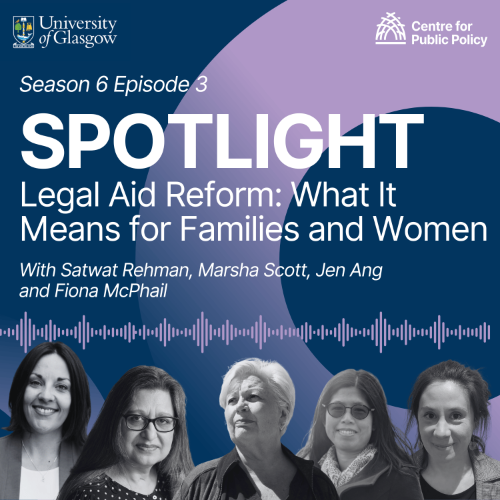
Listen to UofG Spotlight podcast on Legal Aid Reform
Fiona McPhail joined host Kezia Dugdale on the UofG Spotlight podcast in November 2025, alongside UofG colleague Jen Ang, about the Scottish Government's ongoing consideration of Legal Aid Reform.
Listen - Legal Aid Reform: What it means for families and women
First published: 16 February 2026
<< Outputs