

Data with Impact event shines a spotlight on the Scottish Longitudinal Education Outcomes (LEO) dataset
Published: 19 November 2026
19 November 2026: A recent event co-hosted by ADR Scotland and the University of Glasgow's School of Education and Centre for Public Policy explored how linked data can help better understand learner journeys, career outcomes and inequalities in Scotland.
19 November 2026: A recent event co-hosted by ADR Scotland and the University of Glasgow's School of Education and Centre for Public Policy explored how linked data can help better understand learner journeys, career outcomes and inequalities in Scotland.
This blog is crossposted from ADR Scotland - you can view the original here
A recent event co-hosted by ADR and the University of Glasgow's School of Education and Centre for Public Policy explored how linked data can help better understand learner journeys, career outcomes and inequalities in Scotland.
How can linked data help us better understand learner journeys, career outcomes and inequalities in Scotland?
That was the question at the heart of ADR Scotland's latest Data with Impact event, delivered in partnership with the University of Glasgow School of Education and the Centre for Public Policy on 9 November 2026.
Bringing together researchers, policymakers and analysts, the event explored the growing potential of the Scottish Longitudinal Education Outcomes (LEO) dataset and how it can support better evidence, better policy and better outcomes for people across Scotland.
Read the event summary via the ADR Scotland website
Unlocking the potential of Scottish LEO
Professor Iain Atherton (Edinburgh Napier University and ADR Scotland) and Professor Catherine Lido (University of Glasgow) opened the day by reflecting on the importance of collaboration in unlocking the value of Scotland’s administrative data.
ADR UK Deputy Director Rosie French, then looked at plans to strengthen and harmonise LEO data across the four UK nations, creating new opportunities for comparative research.
Euan Shields (Scottish Government) introduced Scottish LEO, and its potential to link information on education, employment, earnings, benefits and demographics. With school data planned to be added in 2027, the opportunities for research are set to grow further.
Dr Stephen Powell (Research Data Scotland) placed Scottish LEO within ADR Scotland’s wider flagship datasets programme and highlighted upcoming ADR UK funding opportunities for researchers interested in using the resource.
Research with real-world impact
A highlight of the event was hearing how researchers are already using, or preparing to use, LEO to investigate real-world challenges.
Presentations explored topics including:
- the early careers of nursing graduates, using Scottish LEO to challenge assumptions around degree completion, employment and career destinations (Professor Iain Atherton),
- research into underemployment, demonstrating how linked data including English LEO can reveal long-term trends and identify groups most affected (Mridula Gopalan, University of Glasgow).
- ethnic inequalities in education and employment pathways, including how educational success does not always translate into equal labour market outcomes using English LEO (Tomiris Gilazh, University of Bristol)
- and upcoming research examining disability transitions into the labour market in Scotland to address the disability employment gap (Ondrej Hoberla, University of Glasgow).
While the topics varied, they shared a common goal: using linked data to understand how opportunities develop over time, where inequalities emerge and where intervention could make the biggest difference.
From evidence to policy
Dr Claire MacRae (Centre for Public Policy, University of Glasgow), said:
“Governments are facing increasingly complex, inter-related challenges which cannot be understood or addressed in isolation.”
Her presentation explored how administrative data can help policymakers understand what works, for whom, and where policies might have unintended consequences.
Professor Catherine Lido and a fireside discussion featuring Kirstie Corbett, Emma Sinclair (Scottish Government) and Dr Silvia Behrens (University of Glasgow and ADR Scotland) widened the conversation to education reform, public sector challenges and the growing need for evidence to support learning throughout people’s lives.
Building the future together
The afternoon breakout sessions gave delegates the chance to think about what comes next, generating ideas ranging from improving outcomes for under-represented groups to new ways of understanding wellbeing, educational success and employment.
One thing was clear: there is a real appetite to use linked data to tackle some of Scotland’s most pressing challenges.
As Professor Iain Atherton reflected:
“The event demonstrated the potential of linked education data to support research that can make a real contribution to policy. The Scottish LEO dataset promises to be a valuable addition to the flagship portfolio. Congratulations to Euan and everyone involved in making this possible. I'm excited to see how the dataset develops and the new research opportunities it will create.”
Professor Catherine Lido added:
“The University of Glasgow was privileged to host the launch of the Scottish LEO data, as it offers researchers and policy-makers alike an exciting opportunity to deepen our understanding of inclusive learner journeys across Scotland into skilled employment. We are excited to tap future research avenues helping us identify inequalities in educational progression and outcomes, and generate a wider evidence-base to support more equitable learning opportunities for all.”
As Scottish LEO develops, so too will the opportunities to use it to answer important questions about education, employment and inequality.
A summary of the event is now available. The message from the day was simple: the appetite is there, the opportunities are growing, and there is plenty more to come.
This blog is crossposted from ADR Scotland - you can view the original here
Read the event summary via the ADR Scotland website
First published: 19 November 2026
This blog is crossposted from ADR Scotland - you can view the original here
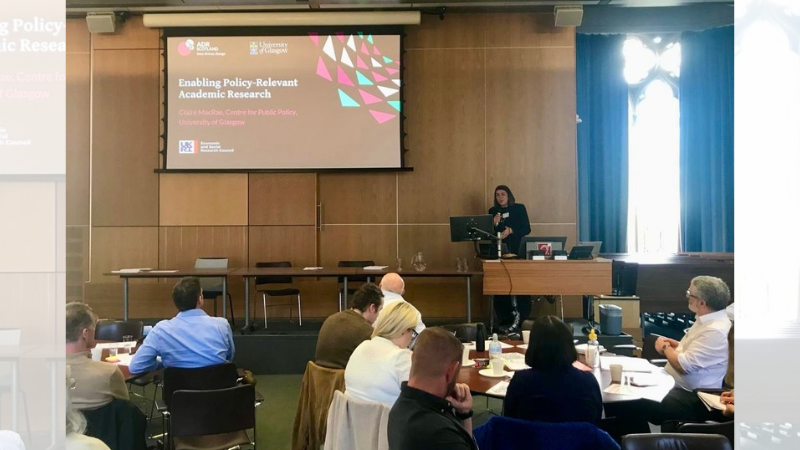
Dr Claire MacRae, Senior Lecturer at the UofG Centre for Public Policy, speaking at the event