

System which can spot infections in 20 mins could fight antimicrobial resistance
Published: 8 January 2026
A new technique which slashes the time taken to diagnose microbial infections from days to minutes could help save lives and open up a new front in the battle against antibiotic resistance, researchers say.
A new technique which slashes the time taken to diagnose microbial infections from days to minutes could help save lives and open up a new front in the battle against antibiotic resistance, researchers say.
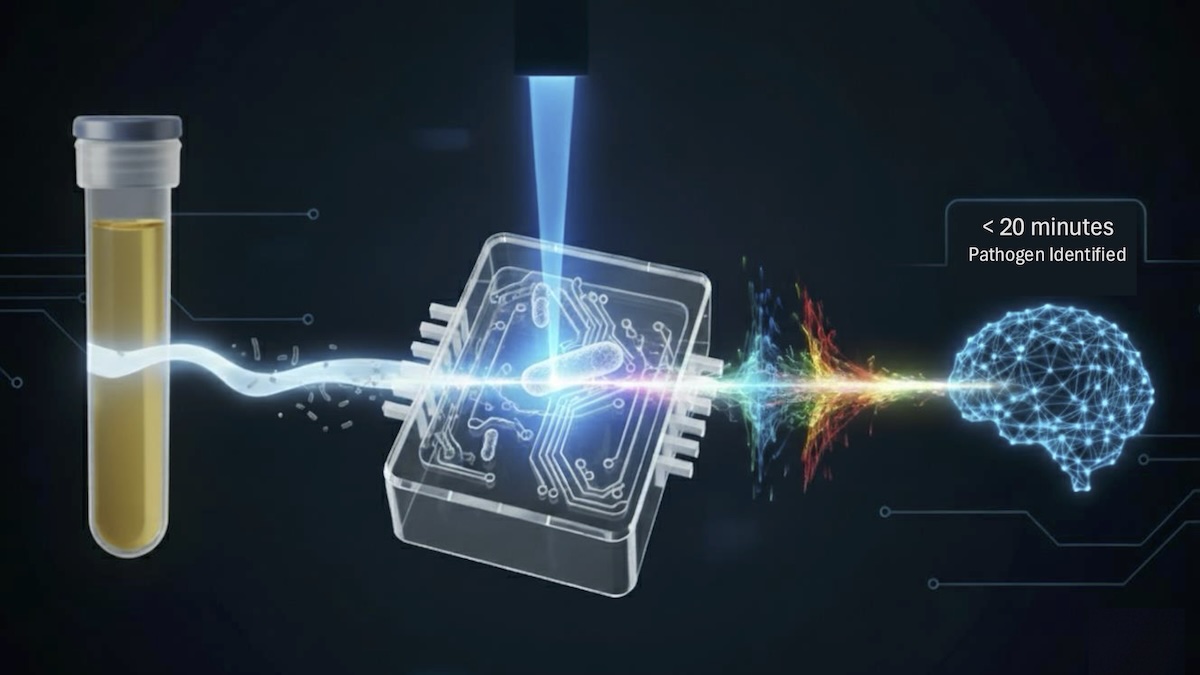
Engineers and clinicians from the UK and China are behind the breakthrough system, called AutoEnricher. It combines microfluidic technology with sophisticated analysis and machine learning to enable the diagnosis of pathogens in just 20 minutes.
In a paper published in the journal Nature Communications, the researchers show how they validated the effectiveness of their system on hundreds of real patient samples, delivering diagnoses with 95% accuracy even in samples with very low concentrations of pathogens. They also demonstrate how AutoEnricher can diagnose multiple simultaneous infections.
In the future, the system could be a valuable tool to tackle antimicrobial resistance, a rapidly-accelerating global threat to human health which caused five million deaths in 2019 and is projected to kill 10 million people a year by 2050.
Dr Jiabao Xu of the University of Glasgow’s James Watt School of Engineering is one of the paper’s first authors. She said: “One of the major drivers of antibiotic resistance is the misuse or overuse of drugs to treat infections. Currently, it can take days or even weeks to culture microbes taken from patient samples in the lab to enable diagnosis. That means doctors often have to act urgently and use antibiotics to treat patients suffering from life-threatening conditions like sepsis or pneumonia without knowing for sure if they actually have a bacterial infection.”
The University of Glasgow’s Professor Jon Cooper, a corresponding author, said: “AutoEnricher advances personalised medicine by compressing diagnostic timelines and enhancing antimicrobial decision-making. This new instrument will help enable doctors to match the right antibiotic to an infection at the right time, improving patient outcomes while reducing the potential for the emergence of antimicrobial resistance.”
The team’s system combines innovative hardware and software to enable a rapid two-stage diagnosis. In the first stage, the system uses a microfluidic device developed by the team to scrub human cells from samples of patients’ blood, urine or spinal fluid, leaving behind only pathogen cells.
In the second stage, the unique chemical fingerprint of the pathogen cells is identified using a technique called Raman spectroscopy. The fingerprint is then analysed by a machine learning tool developed by the team. The tool, which was trained on a database of 342 clinical isolates from 36 species of bacteria and fungi, can provide a diagnosis by analysing as few as 10 pathogen cells in less than 20 minutes.
The team validated AutoEnricher’s performance with the help of three hospitals in China, who provided samples from a total of 305 patients. The samples were also tested using conventional lab methods to culture the bacteria to enable diagnosis. AutoEnricher’s diagnosis matched the conventional lab method’s outcomes 95% of the time, and also managed to pick out mixed infections which were missed by the lab culture tests.
Professor Wei Huang of the University of Oxford, a co-investigator on the project, said: “These are really encouraging results from the largest study of its kind conducted on real patient samples. We’ve shown that this single-cell approach to diagnosis can rapidly deliver remarkably accurate results, and even pick out multiple infections which are much harder to spot using conventional lab culture methods.”
Professor Huabing Yin of the University of Glasgow, the senior author of the paper, said: “The next step is to apply AutoEnricher to a much larger cohort of patient samples in a proper clinical study. We’re already working on the first steps towards making that happen, and we hope that AutoEnricher will make a real difference in addressing the spread of antimicrobial resistance in the years to come.”
The team’s paper, titled ‘Rapid culture-free diagnosis of clinical pathogens via integrated microfluidic-Raman micro-spectroscopy’ is published in Nature Communications.
First published: 8 January 2026