

Guidance for Appeal Manager / Appeal Panel
Introduction
This guide outlines best practice for colleagues undertaking the role of Appeal Manager as part of the University’s Disciplinary policy. This guide provides clear direction to ensure that all appeal hearings are conducted fairly, transparently, and in accordance with policy, safeguarding the rights and responsibilities of all parties involved.
What does the role entail?
The Disciplinary Appeal Manager is responsible for chairing the disciplinary appeal hearing and ensuring the process is conducted in a fair, impartial, and procedurally sound manner. Their role is to review the grounds for appeal and reassess the case based on the evidence presented, without bias or prior involvement in the original investigation or hearing.
Key responsibilities include:
- Reviewing all relevant documentation, including the original investigation report, disciplinary hearing outcome letter, and any new evidence submitted as part of the appeal.
- Ensuring both the employee and the presenting manager (typically the original Disciplinary Hearing Manager) have a full and fair opportunity to present their case.
- Asking appropriate questions to clarify facts, test the robustness of the original decision, and assess the validity of the appeal grounds.
- Considering all relevant information before reaching a decision on whether to uphold, overturn, or amend the original findings.
- Determining an appropriate outcome or sanction, if applicable, in line with the University’s disciplinary framework and ensuring consistency with policy and precedent.
The Appeal Hearing Manager must remain impartial throughout and base their decision solely on the evidence presented during the appeal process. They must not have had any prior involvement in the case or any connection that could compromise their objectivity.
Background/Overview
Grounds for Appeal
The University’s Disciplinary Policy confirms that appeals are not intended to be a rehearing of the original case. Instead, they provide an opportunity to challenge the outcome based on specific grounds. In practice, these grounds may not always be clearly defined and may require clarification with the appellant before proceeding.
Effectively, appeals are an employee’s opportunity (mechanism) to challenge perceived unfairness in the Disciplinary process and they also provide an opportunity for an employer to reflect and assess the process, to test its fairness and to correct any potential mistakes.
Appeals may be submitted on one or more of the following grounds:
Procedural Error
Claims that there were flaws in the process leading to the original decision. This may include:
- Failure to follow University policy or legal requirements.
- Insufficient notice of the disciplinary hearing.
- Denial of the right to be accompanied.
Such errors may undermine the fairness of the process and justify reconsideration of the outcome.
Unreasonable Decision
Concerns that the decision or sanction was disproportionate or not supported by the evidence. Examples include:
- A disciplinary sanction perceived as excessive for the breach of policy.
Focus should be placed on whether the decision was significantly out of line with the evidence considered.
New Evidence
New information that was not reasonably available at the time of the original decision and could materially affect the outcome. This may include:
- A recent medical diagnosis that offers mitigation for the behaviour in question.
- Additional witnesses who have come forward.
- New documentation or evidence that was previously inaccessible.
Appeal Hearing Structure
Appeals are heard by an independent and normally more senior manager, referred to as the Appeal Manager. In cases involving dismissal, the appeal will be heard by a panel consisting of:
- A Chair (a more senior colleague, minimum Grade 7).
- An appropriately trained person, as required by University Ordinances.
For employees engaged in teaching, learning provision, or research, the trained panel member must be a senior academic staff member, selected from a group jointly proposed by University Management and recognised Trade Unions, and approved by Court.
The People & OD, Policy & Employee Relations team maintains the current list of approved trained appeal managers.
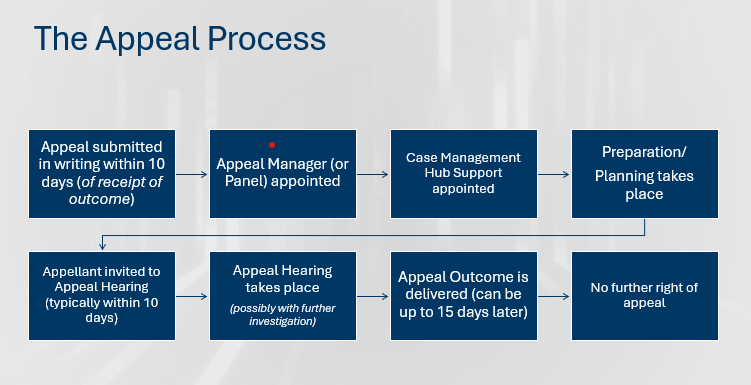
The appeal process is outlined below:
Preparing for the Hearing
Prior to the appeal hearing, the Disciplinary Appeal Manager should undertake the following steps to ensure the process is fair, well-structured, and compliant with University policy:
- Get familiar with the University’s Disciplinary Policy, Appeals Procedure, and any related frameworks.
- Review all relevant documentation, including the original investigation report, disciplinary hearing outcome letter, appeal submission, and any new evidence provided by the employee.
- Ensure access to case files on SharePoint, including the case timeline and supporting documents, to inform your pre-reading and questioning.
- Allocate sufficient time for pre-reading, focusing on the grounds for appeal and any inconsistencies or new information requiring clarification.
- Meet with the assigned Employee Relations (ER) Partner to plan the hearing, confirm logistics, and discuss any case-specific considerations.
- Liaise with the ER Partner to arrange invitation letters for all parties and to develop a meeting plan (or “script”) outlining the structure, format, and key questions. This plan should remain flexible and responsive to the appeal hearing’s flow.
- Confirm attendance of all relevant parties, including the employee, their representative (if applicable), the presenting manager (typically the original Disciplinary Hearing Manager), and any witnesses.
- Arrange a suitable venue that ensures privacy, accessibility, and minimal disruption.
- Block out diary time for the appeal hearing and any necessary pre-meetings or follow-up discussions.
- Agree timescales for completion of the appeal process and communicate any anticipated delays to the Commissioning Manager, especially if they exceed the timeframe outlined in the University’s Appeals process.
Conducting the Appeal Hearing
The Disciplinary Appeal Manager is responsible for chairing the appeal hearing and ensuring it is conducted in a fair, impartial, and procedurally sound manner. During the hearing, they should:
- Open the appeal hearing by outlining its purpose, the appeal grounds, the process to be followed, and expectations for respectful conduct.
- Ensure procedural fairness, allowing both the employee and the presenting manager (typically the original Hearing Manager or nominee) to present their case without interruption.
- Maintain control of the appeal hearing, intervening when necessary to keep discussion focused, respectful, and within scope.
- Take notes or ensure a note-taker is present to record key points, questions, and decisions.
- Ask questions to clarify facts, assess the credibility of the evidence, and explore the grounds for appeal. The ER Partner may also ask follow-up questions to ensure all relevant matters are addressed.
- Adjourn the appeal hearing if further information is required or if a break is needed for any party.
Further Investigation During the Appeal Process
While the aim is to conclude matters at the appeal hearing, there may be occasions where further investigation is necessary to clarify issues or address new information. This is assessed on a case-by-case basis, and support from the People & OD team should always be sought when such situations arise.
Further investigation can vary in scale and complexity. In some cases, it may involve a simple point of clarification, such as sending an email to confirm a specific action (e.g. “Did you do X?”). In others, it may require interviewing a new witness or conducting broader steps—such as analysing new data or system records—particularly where new evidence has been submitted as part of the appeal.
The scope of the investigation will influence the next steps:
- Minor clarifications can typically be addressed and incorporated into the decision without reconvening the hearing.
- More extensive investigations, which involve gathering substantive new evidence, may require a formal response. This could include producing a short report and sharing it with the appellant, followed by a reconvened hearing to allow for comment.
- In rare cases, it may be appropriate to repeat the investigation stage entirely, especially if the original process was significantly flawed or new evidence materially alters the context.
This approach applies primarily to disciplinary cases, where procedural fairness and the right to respond are critical.
If further investigation is likely to delay the process, clear communication with all parties is essential to maintain transparency and trust.
Post-Hearing Responsibilities
Following the appeal hearing, the Disciplinary Appeal Manager must reach a decision by carefully evaluating all evidence presented. This includes the original investigation report, disciplinary outcome, appeal submission, and any new information provided. Their role is to determine whether the original decision should be upheld, amended, or overturned, ensuring the process remains fair, impartial, and procedurally sound.
To do so, the Disciplinary Appeal Manager must:
- Remain impartial, basing their decision solely on the evidence presented during the appeal.
- Consider mitigating or aggravating factors, apply University policy consistently, and ensure any outcome is proportionate and reasonable.
- Document the rationale for their decision clearly, supporting transparency and enabling closure for all parties.
A key part of the appeal process involves comparing the rationale for the original decision against the grounds for appeal. The Appeal Hearing Manager should consider the following categories:
- Procedural Error
Were University policies and procedures followed correctly? Was initial questioning relevant to the allegations? Did the appellant have a sufficient right of reply, including the opportunity to present counter-evidence, and was this acted upon? - Unreasonable Decision
Was the evidence weighted fairly? Was the outcome based on facts and assessed on the balance of probabilities—meaning whether it was more likely than not that the misconduct occurred? Was the justification for the decision clear, and was any sanction fair and proportionate? - New Evidence
Is the new evidence genuinely new and not reasonably available during the original process? Would its inclusion have made a material difference to the original outcome?
If the appeal is upheld, the Disciplinary Appeal Manager may determine a revised outcome or sanction, in line with the University’s disciplinary framework and ensuring consistency with precedent.
Appeal Outcomes
The outcome of an appeal can be one of three things:
- The appeal is upheld – there is clear evidence to support the grounds of appeal
- The appeal is partially upheld – there is clear evidence to support some of the grounds of appeal
- The appeal is not upheld – there is no evidence to support the grounds of appeal
In cases of appeal against dismissal
If an appeal against a dismissal is upheld then the employee would be reinstated as if the original dismissal never happened (e.g. continuity of service and pay).
Where an appeal is partially upheld the appeal manager/panel will need to consider if that partial upholding changes the outcome. For example – in the case of dismissal, is that enough to overturn the dismissal and reinstate the employee. It is possible, for example, that an appeal finds that there were minor procedural failings however on balance these are determined to have no material effect on the overall decision.
Where an appeal is not upheld then the original decision stands (including dismissal where relevant). There is no further right of appeal and any other routes would be external (e.g. via Employment Tribunal).
Additional point to note– when it comes to communicating the outcome, it is critical and only fair that the appellant can clearly see what has been considered and the rationale as to why the appeal has failed. (Remember this outcome letter may form the basis of a future unfair dismissal claim). This is of course particularly relevant in cases where an appeal is not upheld. Outcome letters should be detailed and cover all key aspects, from what was taken into account, through to decisions (and reasons or justification for it).
People & OD support continues throughout the process but it is vital that they do not act a decision makers (for example, they don’t form part of the appeal panel). Decisions must be owned by appeal managers/panels (with willingness to stand by them at a potential Employment Tribunal where this becomes necessary).
The appeal manager also plays a key role in ensuring closure by confirming next steps and liaising with key stakeholders—including the Employee Relations (ER) Partner, local People & OD, and the Commissioning Manager—to ensure the process is completed consistently and with appropriate support.
Appeal outcomes are normally communicated in writing within 15 working days.
Key roles in the process
Commissioning Manager
The Commissioning Manager is responsible for appointing an appropriate manager to support each stage of the disciplinary process and issue the formal letter to confirm the appointment and associated details. They will work closely with the relevant local People &OD Business Partner to monitor and support the wellbeing of all parties involved as appropriate.
Upon receiving the investigation report, the Commissioning Manager will review the findings and decide whether to accept or reject the recommendations. They are also responsible for issuing the investigation outcome letter to the colleague and ensuring that any recommendations are actioned. This may include reflective learning, training and/or progression to a formal disciplinary hearing.
Investigation Manager
The Investigation Manager is appointed by the Commissioning Manager to lead a fair and impartial investigation into alleged misconduct. Their role is to gather evidence, interview relevant individuals, and compile a comprehensive report outlining the facts and recommendations. They do not make disciplinary decisions or participate in the hearing itself. Throughout the process, they work closely with the People & OD Business Partner to ensure procedural compliance and support the wellbeing of those involved.
Local POD Team/P&OD Business Partner
The local People & OD Business Partner is typically a first point of contact for managers engaging with the disciplinary process. They collaborate at the outset with the Commissioning Manager, providing guidance and support on appointing the Investigating and Hearing Managers, and supporting the framing of allegations where required.
Once initial setup is complete, the case is handed over to the Case Management Hub. The local P&OD Business Partner maintains communication with the line manager and the Employee Relations Partner to provide ongoing case updates and support.
Line Manager
The line manager (or suitable alternative if the line manager is directly involved in the case) plays a vital role in safeguarding the wellbeing of the colleague under investigation. They will remain in regular contact with their local People &OD Team at various stages throughout the process to offer practical and wellbeing support throughout the process and beyond.
Employee Relations Partner
The Employee Relations Partner (or Employee Relations Advisor), operating through the Case Management Hub, provides expert guidance and support throughout the disciplinary process. They advise Investigating Managers, Disciplinary Hearing Managers and Appeal Managers to ensure outcomes are fair, robust, and procedurally sound.
They support the Hearing Manager by offering guidance, including the development of meeting plans, correspondence and the interpretation of policy. They also liaise with the Commissioning Manager, and relevant local People & OD Business Partner to keep all stakeholders informed and updated.
Note taker
A designated note taker attends the investigation meetings to accurately record discussions. They are responsible for producing clear and timely summaries during each meeting.
Witnesses
Witnesses are individuals who provide factual, relevant information and/or evidence about the case, typically through direct observation or knowledge of the situation or event in question. When engaging witnesses, the Investigation Manager must respect confidentiality and share only information pertinent to their involvement. Full details of the allegations should only be disclosed when necessary.
Witnesses should only be questioned on matters directly relevant to their experience, such as incidents they have observed. While they are not usually accompanied during investigatory interviews, it is considered good practice to allow this if requested. Participation is voluntary; and efforts should be made to address any concerns and encourage cooperation. Witnesses may also provide their accounts in writing as a ‘witness statement.’
The Investigating Manager is responsible for identify and inviting appropriate witnesses. Colleagues involved in the investigation must not approach or influence witnesses or seek character references. All witnesses are expected to always maintain confidentiality.
Trade Union/Companion
They may address the hearing on behalf of the employee, present and sum up their case, and confer with the employee, however, they cannot answer questions on behalf of the employee unless agreed.
Other things to consider/navigate
Sickness absence
Depending on the length/reason for absence, the Appeal Manager may need to postpone the Disciplinary Appeal Hearing until the colleague is back at work. In the case of long-term absence, depending on the specific circumstances, it may be best practice to encourage the colleague to participate in the procedure especially if the absence is due to stress relating to the disciplinary. Occupational Health can give guidance to understand fitness to attend meetings.
It may also be necessary to consider whether or not adjustments could be made to the process to enable the employee to attend the Appeal Hearing. Potential reasonable adjustments might include:
- Holding the hearing at a venue closer to the employee’s home or at a mutually agreed location
- Incorporating frequent rest breaks into the meeting
- Allowing additional time for the employee to prepare for and present their case
- Allowing the employee to choose a companion from outside the usual categories, for example a family member or friend
- Allowing the employee to make written representations and
- Allowing the employee’s companion to take a more active role at the meeting
Adjustments such as these should be considered in the circumstances where they could prevent the disciplinary process from being put on hold, even where the employee is not disabled according to the definition in the Equality Act 2010.
Complexity
Disciplinary appeal hearings can involve sensitive and emotionally charged situations, requiring the Disciplinary Appeal Hearing Manager to exercise empathy, discretion, and sound judgement. They may need to navigate complex issues such as mental health, disability, or personal trauma, ensuring that the process remains fair while accommodating individual needs. Emotional responses from employees or witnesses should be handled with care, maintaining professionalism while offering appropriate support. Throughout, the Disciplinary Appeal Hearing Manager must strike a careful balance between maintaining confidentiality and ensuring transparency in how the hearing is conducted and decisions are reached.
Common pitfalls to avoid
- Insufficient preparation: Not reviewing case files, policies, or planning questions.
- Bias or prior involvement: Compromising impartiality by being too close to the case.
- Poor meeting control: Lack of structure, unclear communication, or failure to manage behaviour.
- Inadequate documentation: Not recording key decisions or rationale.
- Role confusion: Re-investigating instead of assessing presented evidence.
- Procedural errors: Skipping steps, delaying without notice, or inconsistent outcomes.
- Neglecting wellbeing: Failing to support those involved or liaise with People & OD.
Policies
- Disciplinary Policy
- Dignity at Work and Study Policy
- Code of Professional Conduct
- Expected Behaviour Policy
- Social Media Guidance webpages
- IT Services Code of Conduct – Regulations for the use of University ICT systems and facilities
- Glasgow Professional Behavioural Framework
- Personal Relationships Policy
- The University's Financial Regulations
- Research Ethics
- Research Misconduct Policy
- Grievance Policy & Procedure
- Probation Policy
- Policy for Managing Stress in the Workplace
Health and Wellbeing Resources
Information and guidance and wellbeing support for colleagues is available via:
- The University’s Health and Wellbeing Hub – Manager Zone
- The University’s Health and Wellbeing Hub
- Discussing Adjustments & Support
- Employee Assistance Programme (EAP) – provides confidential support to University employees and their family members, 24 hours a day, 365 days a year, 0800 882 4102.
- Champion Health app – provides online personalised wellbeing content, tools, trackers and includes a resources library. When registering enter access code: uog1451
- Able Futures –a mental health support service provided by Access to Work. There is no cost to using this confidential service and no waiting list. Support is available over the phone, video call and through email. Colleagues can call Able Futures on 0800 321 3137 or visit able-future.co.uk to sign up online.
- The University’s Mental Health First Aid Network – provide initial assistance and direct help for those wanting to talk about their mental health concerns.