Embedding Employability Framework
Enhance
Students are more likely to develop and retain transferable skills when they have opportunities to actively practise and apply them. While recognising skills is important, development happens when students use those skills in meaningful learning experiences and connect their learning to their future.
The Enhance stage builds on the work of Identify and Surface by creating opportunities for students to develop, practise and apply transferable skills through experiential learning.
Our approach
Within the Embedding Employability Framework, experiential learning refers to activities that help students both develop or practise a transferable skill and connect their learning to the world.
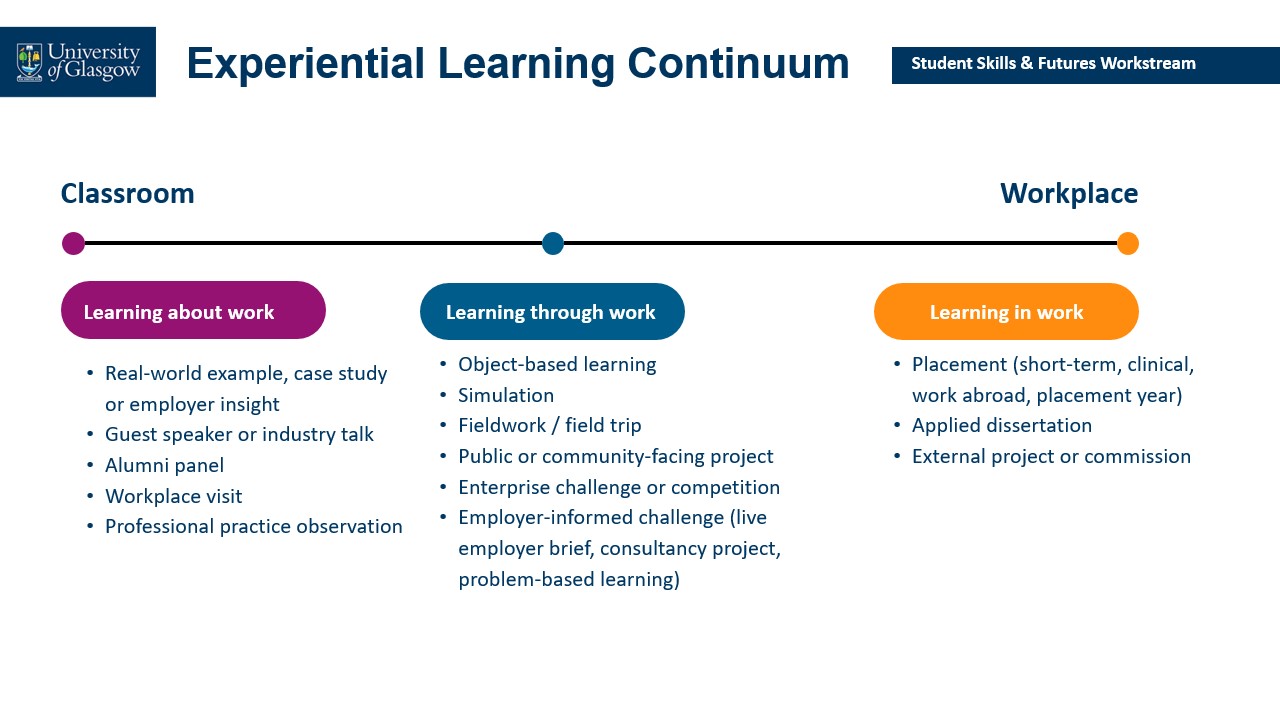
Our Experiential Learning Continuum (PDF) recognises that different experiences are needed in different contexts and introduces a range of opportunities across three categories:
- Learning about work: a short, one-time experience that helps students understand key concepts, trends and practices relevant to a particular industry or sector.
- Learning through work: an experience centred around a meaningful scenario that simulates elements of a professional role or broader aspects of an industry or sector.
- Learning in work: a longer experience where students apply their disciplinary knowledge and/or disciplinary and transferable skills within the workplace.
Experiential learning can take many forms and does not necessarily require placements, employer partnerships or major curriculum changes. Working with your College Employability & Skills Lead, you'll explore where experiential learning already exists within your course and how it can be enhanced to better support transferable skills development, application and reflection. Where appropriate, you may also identify opportunities to introduce new experiential learning activities that are meaningful, relevant and appropriate to your course.
What do you need to do?
Using one of the transferable skills identified during the Identify stage, you'll review existing experiential learning activities and consider how they support students to develop and apply that skill. This may involve making skills development more explicit within an established activity, enhancing an existing experiential learning activity, or introducing a new activity where appropriate.
What resources and support are provided at this stage?
- Our Experiential Learning Continuum, which emphasises the dynamic nature of experiential learning and recognises that different experiences are needed for different contexts.
- Guides to different formats of experiential learning and Case Studies demonstrating good practice
- Consultation and support from your College Employability & Skills Lead