

What is Curriculum for Life?
C4L courses are credit-bearing, elective modules designed to help students engage meaningfully with learning, knowledge, and ways of thinking and practicing beyond their core disciplines. Aligned with the UN Sustainable Development Goals, these courses focus on real-world challenges, foster future-ready skills, and encourage collaboration across subjects, Schools, and degree programmes, providing students with opportunities to develop themselves as global citizens, creative leaders, change makers and social innovators.
In the Academic Year 2026/2027, C4L courses will be available to Year 2 undergraduate students in the College of Arts & Humanities, Year 2 MA Social Science students, Year 1 and 2 BSc students in the College of Science & Engineering, and Year 1 and 2 BSc Psychology and Life Science students in the College of Medical, Veterinary, and Life Sciences.
They are a level 1 credit option, and each course is worth 20 credits and is compatible with progressing to a student's preferred Honours combination.
How can I get involved?
The call for Curriculum for Life courses for academic year 2027-28 and 2028-29 is now open. The team warmly invite you to find out more about the call via SharePoint and reach out to your College C4L Lead before beginning work on a course proposal. Please note the deadline for submissions is Friday the 25th of September, 5pm.
You can find out more on the SharePoint and find your College C4L Lead contact details here.
You can also check out the FAQs below.
I'm a student, what do I need to know?
You can find out more about Curriculum for Life via the student-facing webpages.
Frequently Asked Questions
Who is my College C4L Lead?
| College of Arts & Humanities | |
|---|---|
|
Medicine, Veterinary & Life Sciences |
|
|
College of Science & Engineering |
|
|
College of Social Sciences |
What makes C4L Courses Distinct?
The suite of courses being developed under the banner of Curriculum for Life (C4L) are credit bearing courses (SCQA level 7 or 8) that sit alongside our core disciplines and programmes but are designed to provide enriching opportunities that enable students to:
- Engage with societal challenges, foster creativity and problem-solving, and develop essential skills for the future.
- Actively participate in experiential learning as well as structured classroom environments.
- Experience learning beyond their chosen discipline, fostering lifelong development.
You can find out more about C4L characteristics and what makes these courses distinct on the SharePoint.
What C4L Courses are running in AY 2026-2027?
You can explore all of the Curriculum for Life (C4L) courses on the student-facing webpages. We have 21 courses under six new C4L themes; Climate & Environment, Creativity & Innovation, Health & Communities, Power & Justice, Leadership & Discovery, and Digital Literacy.
How can I get involved in developing a C4L Course for academic year 2027-28 and 2028-29?
If you're interested in contributing to the development of a C4L course for academic year 2027-28 and 2028-29 please speak to your C4L College Lead in the first instance and explore the SharePoint for details on how to submit a course proposal. Please note the deadline for submissions is Friday the 25th of September, 5pm.
What is required for my course to qualify as a C4L course?
All C4L courses are unified by programmatic aims and outcomes. To qualify as a C4L course, a course must align to the IDEA framework:
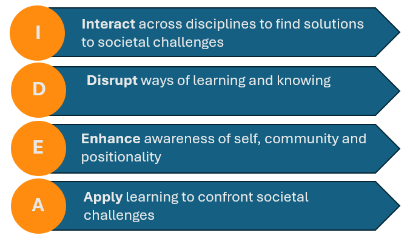
- Interact across disciplines to find solutions to societal challenges
- Disrupt ways of learning and knowing
- Enhance awareness of self, community and positionality
- Apply learning to confront societal challenges
C4L courses should not be introductory disciplinary courses adapted for a broader student body (e.g. statistics 101 for social scientists) but should start with a societal issue/challenge and encourage students to use their (to date) disciplinary learning and skills, working with students from other colleges to arrive at interdisciplinary solutions.
C4L courses are SCQA level 7 or level 8 and typically are 20 credits but can be 10 credit courses.
C4L courses encourage innovation in assessments. Exams are not permitted, and essays are only permitted if shown to be the best pedagogical fit. If your abstract is chosen to progress to Stage 2 (Course pitch) we will offer you support with assessment design.
The Future Skills Taxonomy and the Learning Through Assessment Framework
The University’s Future Skills Taxonomy and Learning Through Assessment Framework are institutional frameworks that every credit-bearing course is expected to use. Your PIP Annex Section 6 evidences how your course aligns with both: two to four skills from the Skills Taxonomy, traceable from your ILOs through learning activities to assessment and student-facing recognition, and a paragraph on LTA alignment.
In addition, the C4L team has carefully considered the challenges of engaging students in new forms of action-oriented pedagogy. In collaboration with the Student Skills and Futures workstream, we have embedded C4L characteristics into course design to support students in recognising and reflecting on their own transformation.
Each C4L course is designed to strengthen one or more of these characteristics:
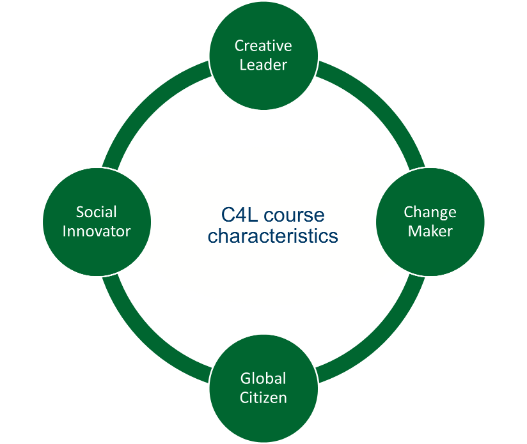
- Change-Maker: Driving solutions to sustainable futures; approaching wicked problems with curiosity; healthy and equitable futures through collaborative leadership.
- Creative Leader: Using evidence-based arguments to inspire others and drive collaborative action; be able to overcome and learn from setbacks and succeed in a variety of settings; have the confidence to generate and introduce ideas, products, and approaches.
- Global Citizen: Convey complex ideas strategically to other social actors and institutions; empathy and respect across communities; cooperate with and across diverse communities.
- Social Innovator: Building service and sustain meaningful partnerships; fostering new ways of thinking; challenging power and privilege to aid inclusion and belonging.
All C4L courses should:
-
Explicitly reference their chosen C4L characteristic within the aims of the course.
-
Course proposals must make clear how this characteristic is developed through teaching, learning, and assessment on a course through the aims and choice of methods of assessment.
While the selected characteristic does not require to be explicitly mentioned in the ILOs, we expect to see how the characteristic influenced the choice of assessment methods. The characteristics will be developed through student engagement with those aims and the broader pedagogical approaches involved in teaching, content and assessment.
This approach ensures that students not only gain practical competencies but also develop a strong sense of personal and academic growth throughout their C4L journey , anchoring their development in work-ready skills and reinforcing their identity as University of Glasgow students.
You can find out more about C4L charactertistics and eligibility on the SharePoint page.
Which students will be able to take a C4L Course in AY26/27?
In the Academic Year 2026/2027, C4L courses are available to:
- Year 2 undergraduate students in the College of Arts & Humanities
- Year 2 MA Social Science students
- Year 1 and 2 BSc/MSci students in the College of Science & Engineering
- Year 1 and 2 BSc Psychology and Life Science students in the College of Medical, Veterinary, and Life Sciences
C4L courses are also available to Visiting Students on the above programmes at the University.
We expect eligibility to remain the same but it may expand in the future to include more undergraduate students.
Do C4L courses need to be entirely new?
No,
This call seeks courses under the following 3 categories:
-
Redeveloped courses - Existing courses that are closely aligned to C4L principles and could, with some redevelopment, meet C4L criteria
-
New Courses - New courses that develop research-informed and transferable capabilities relevant across disciplinary boundaries.
-
Interdisciplinary courses - Courses that demonstrate genuine integration of disciplinary perspectives, methodologies and approaches to create new ways of understanding complex issues
Your College C4L Lead can work with you to align an existing course to C4L charactaersitics and eligibility.
What do we mean when we say C4L courses are ‘interdisciplinary’?
Since 2024, the C4L team has been working with colleagues across the University, including The Hunterian, to explore how interdisciplinary approaches can be embedded meaningfully within learning and teaching.
Building on this work, we are inviting colleagues to propose new interdisciplinary courses that bring together expertise, methodologies and perspectives from multiple disciplines to explore questions and challenges that cannot be addressed through a single disciplinary lens.
These courses should embody the principles of Curriculum for Life by creating opportunities for students from different disciplinary backgrounds to learn collaboratively and develop as global citizens, creative leaders, change makers and social innovators.
What Do We Mean by Interdisciplinary?
For this call, interdisciplinarity means more than bringing together content from different subjects.
Successful proposals should demonstrate genuine integration of disciplinary perspectives, methodologies and approaches to create new ways of understanding complex issues.
We are particularly interested in proposals that:
-
Bring together colleagues from two or more disciplines, Schools or Colleges.
-
Integrate different forms of evidence, enquiry and problem-solving.
-
Address significant societal, cultural, scientific or technological challenges.
-
Enable students to engage with multiple perspectives and ways of knowing.
-
Create learning experiences that would not be possible within a single discipline.
As Moran (2010) notes:
“The value of the term ‘interdisciplinary’ lies in its flexibility and indeterminacy, and that there are potentially as many forms of interdisciplinarity as there are disciplines.”
— Moran, J. (2010). Interdisciplinarity. Oxon: Routledge, p.14.