


From connecting continents to advancing healthcare
Using radio waves for remote health sensing
Imagine a future where your health is monitored continuously, effortlessly, without physical contact. Where early signs of illness are detected even before symptoms appear. And care is delivered proactively, rather than reactively, to optimise patient outcomes.
At the University of Glasgow, we’ve been changing the world for 575 years and now we’re shaping the future of healthcare with our remote health sensing research.
Professor Muhammad Ali Imran - a global leader in communication systems and the driving force behind Glasgow’s pioneering remote health sensing research - leads a multidisciplinary team exploring the application of Radio Frequency (RF) technologies, like those used in Wi-Fi and radar, to monitor vital health metrics in real time, without the need for wearables or invasive devices.
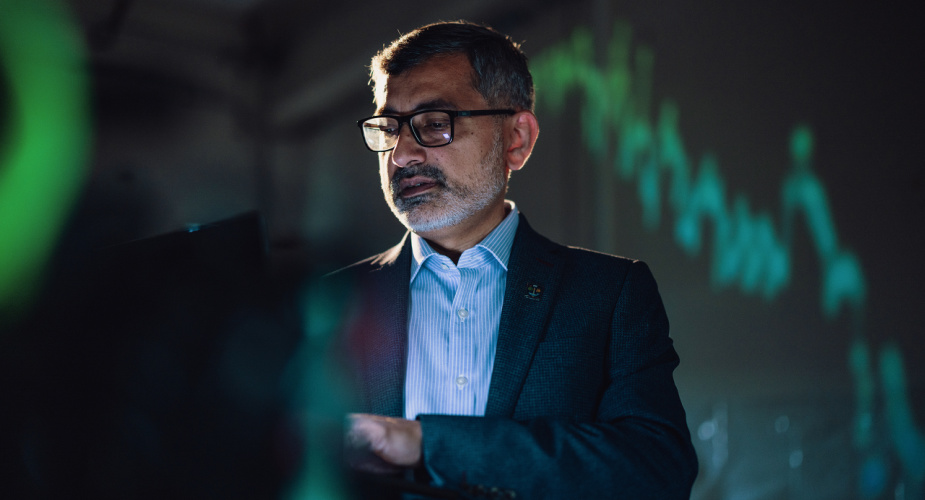
Professor Imran says: “RF signals can detect physical movements and physiological changes in the human body. But unlike traditional devices, RF-based sensing collects health data passively and continuously, requiring no conscious effort from the person monitored.”
Using baseline data of a healthy individual with their consent, remote health sensing can enable early detection of adverse changes in heartbeat, breathing rate, blood pressure and even gait, to detect susceptibility to a fall, so that multiple conditions can be diagnosed early and treated before they become more serious.
Meeting patients' needs
Glasgow scientists are exploring different ways of delivering remote health sensing to best meet patients’ needs.
Researchers are looking to integrate sensing and display technologies into a smart mirror, which could potentially be placed in a hallway at home, allowing users’ health vitals to be monitored daily in a single, defined space.
Other research is developing a programmable material that redirects RF signals through walls, around corners, and across floors to track vital health signs in complex living spaces such as care homes and hospitals. Among the numerous potential benefits of this technology, gait analysis could support care of the elderly by determining an individual’s risk of falling and enabling early interventions.
Innovative applications
RF health sensing is also being developed to recognise hand gestures, interpret sign language and support lip-reading, even under face coverings, opening entirely new communication possibilities for individuals who are deaf or hard of hearing. These innovations have huge implications for the development of assistive technology, including smart hearing aids and inclusive communication systems.
Breathing-related chest movements too, can be detected with high precision, allowing for accurate remote monitoring of respiration and heart rate. Researchers are also working to measure blood pressure remotely, removing the need for traditional cuff-based devices.
Revolutionising healthcare
“Remote health sensing represents a paradigm shift,” says Professor Imran, “it is more than just a technological breakthrough; it marks a fundamental reimagining of how we think about healthcare. With continuous, contactless, remote health sensing, healthcare systems can become more efficient, responsive and sustainable, easing the strain on resources while delivering higher-quality care.”
Revolutionising how healthcare is delivered and experienced, the University of Glasgow is pioneering the development of these smart, inclusive and scalable health technologies with the potential to improve patient outcomes globally.
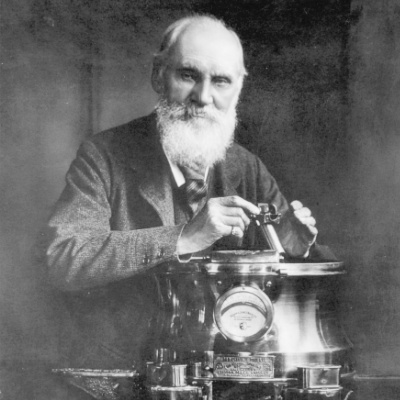
Lord Kelvin
Physicist and engineer, William Thomson, 1st Baron Kelvin (1824–1907), is globally renowned for his pioneering work in electricity, thermodynamics, and telegraphy.
Among his most celebrated achievements, Kelvin was scientific adviser on the Trans-Atlantic telegraph cable – the precursor to modern, high-capacity fibre optic cables - which revolutionised global communications, enabling the transmission of messages across the Atlantic in minutes instead of weeks by ship.
The vastly accelerated exchange of information had almost as profound an impact on business, diplomacy and news between Europe and North America in its time as the advent of the internet has globally today.
Find out more
Exploring cutting-edge technologies for wireless communication, intelligent sensing and future-ready healthcare.