

A University for the World
A new voice for cancer screening
Bowel cancer is one of the most common cancers, both in Scotland and Australia. Screening can help detect the disease early and save lives. However, people with intellectual disabilities in Scotland are much less likely to take part in bowel cancer screening than the general population, despite being nearly 2.5 times more likely to die from the disease. Researchers from the University of Glasgow and the University of Sydney are working to address this inequality with the help of voice-powered AI assistants.
Ultimately we hope this AI assistant can increase participation in screening for people who want to take part so that we are more likely to catch any cancers in the early stages when treatment is most effective." - Professor Katie Robb
Scotland has the highest incidence of bowel cancer in the UK. It remains the second most common cause of cancer death in Scotland. Bowel cancer screening saves lives. Dr Julie Ayre, Senior Research Fellow in the Sydney Health Literacy Lab in the Faculty of Medicine and Health’s School of Public Health, explained that, “If found early, more than 90% of bowel cancer cases can be treated effectively.”
In Scotland, the Scottish Bowel Screening Programme is free and sends home-testing kits to those aged 50 to 74 every two years. A similar service is offered by the Australian National Bowel Cancer Screening Program for Australians between the ages of 45 and 74. However, only 42% of Australians who are invited to take part in the program actually follow through. Scotland faces a similar problem with its own bowel cancer screening programme with only two-thirds of people invited participating.
Helping to access life-saving screening
The numbers taking part in bowel cancer screening are even lower among people with intellectual disabilities. The joint research programme between Glasgow and Sydney explored why this group is less likely to participate in screening and how uptake of these potentially life-saving tests could be improved.
The researchers found that the existing public health campaigns and information materials about bowel cancer screening do not meet the needs of people living with intellectual disabilities.
The researchers hope that the tool will encourage more people to take part in screening, helping to detect cancers earlier when treatment is most effective.
Refining Voice AI through international collaboration
The first prototype of Voice AI was developed for use in Scotland, in collaboration with Professor Katie Robb from the University of Glasgow’s School of Health and Wellbeing.
 By drawing on the strengths of each country’s bowel cancer education resources and comparing the attitudes of study participants in Australia and Scotland, the researchers have refined Voice AI to better meet the needs of diverse audiences and the differing services in each country.
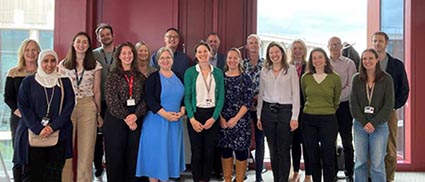
The project also drew on the unique skills and expertise of each institution. As part of the collaboration, Dr Ayre and Professor Robb's teams, together with the Voice AI collaborators, met at a symposium in Glasgow (pictured). "The opportunity to work with researchers from Sydney strengthened our understanding and potential impact of using AI to advance bowel screening for people with intellectual disabilities in both countries.” said Professor Katie Robb.
AI for good
 Working together the researchers developed the ‘Voice AI’ tool to connect users to existing resources, such as the Easy Read bowel cancer screening information, and turn the evidence-based guidance into personalised advice tailored to each user’s needs.
“It really complements current education and consent processes, rather than replacing them,” said Dr Ayre.
“Notably, since the project began, AI technology has progressed and we have been able to capitalise on these improvements by incorporating a large language model with Retrieval Augmented Generation (RAG) into the tool.”
As a result, the tool no longer relies on structured ‘scripts’ and can instead more flexibly answer any relevant question that the user asks, whilst drawing from a curated library of trusted resources.
The project is part of a larger investigation by the Sydney Health Literacy Lab into how assistive technologies like AI agents can be used responsibly to make healthcare more accessible and equitable for people with disabilities. People generally find generative AI tools easy to use, and they often provide information in a format that better meets their needs than official sources. Bowel cancer screening is a good place to start because people often have questions about the how to do bowel cancer screening but may feel self-conscious discussing the topic with another person.
The research team also worked to address accessibility and privacy concerns during this proof-of-concept trial.
Participants accessed Voice AI by telephone call – a simpler solution than downloading an app to a smartphone. This limits the amount of personal data that could be obtained, and means there’s no need to bring a device with a camera into the bathroom.
Bringing together expertise from Scotland and Australia
The project has also helped build a wider international research network. During the Sydney team's visit to Glasgow, the researchers hosted a one-day symposium that brought together colleagues from the Universities of Glasgow, Sydney, Edinburgh, Stirling and Melbourne, as well as University College London and the Scottish Bowel Screening Laboratory.
The team were supported by funding from the University of Sydney and University of Glasgow through the joint Health Inequalities Initiative, established by the Office of Global and Research Engagement at the University of Sydney and External Relations at the University of Glasgow. This funding has supported the researchers to meet and carry out their work together, with early results supporting a successful bid for $5 million in further support through the Australian National Health and Medical Research Council (NHMRC) Synergy Grant Program that will allow the project to expand its remit and deliver real benefits for people with intellectual disabilities.
“It’s still early days, but feedback from study participants shows how excited the community and healthcare professionals are to have an effective, easy to use tool that could help reduce the inequitable mortality rates for this treatable cancer.”

Funded UofG staff: Professor Katie Robb
School: Health and Wellbeing
College: Medical Veterinary & Life Sciences
Partner: University of Sydney, Australia
Partner co-Lead: Dr Julie Ayre, Senior Research Fellow in the Sydney Health Literacy Lab
Fund: Health Inequalities Initiative with the University of Sydney
Year of activity: 2024-2026
University of Glasgow's priority partnership with the University of Sydney: