

Fighting Wildfires from the Air: Exploring Safe and Effective Fire Suppression Strategies with Real-time Multi-physics Simulations
Supervisor: Dr Oyedoyin Dada
School: Engineering
Industry Partner: The UK Vertical Lift Network
Description:
Climate change has drastically increased the frequency and intensity of wildfires around the world[[1]]. Aerial firefighting plays a critical role in combating wildfires, yet these missions are challenging and hazardous. Aircraft must fly at low altitudes near complex terrains, within turbulent heatwaves and with low visibility, and operations must be carefully coordinated to avoid spreading flames/ember through aircraft wakes.
Pilot operations and mission planning are essential for safe and effective aerial firefighting, but real-world experimentation is significantly constrained by safety and environmental factors.
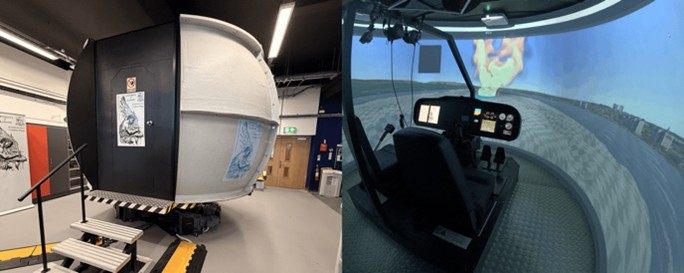
This project aims to explore safe and effective wildfire suppression strategies via high-resolution multi-physics modelling. It leverages the Daedalus-I Flight Simulation Framework[[2]](Fig1), an advanced multi-physics modelling facility developed by the UofG CFD Lab, capable of high-fidelity aerial firefighting simulations with real-time pilot interactions.
Methodologies/Workplan/Outcomes:
The project has three parts: (1)Training and benchmarking; (2)Pilot control evaluations; and (3)Mission planning optimisation.
Part 1(weeks1-3) focuses on training the student to operate Daedalus-I facility(Fig1) correctly and safely, delivering practical skills training and system benchmarking(outcome1).
Part 2(weeks3-7) then focuses on evaluating different pilot control strategies for aerial firefighting scenarios. This will involve quantification of workload and fire suppression effectiveness combining the NASA-Task-Load-Index and Cooper-Harper scales[[1]]. This will deliver valuable control strategy assessments for aerial firefighting operations(outcome2).
Part 3(week7-10) will focus on optimising mission planning. This will systematically maximise safety and effectiveness indicators by optimising e.g. approaching routes, timing/altitude for water release, and wake-fire interactions, delivering practical guidelines for mission planning(outcome3).
[1] Hart, S. G., and Staveland, L. E., “Development of NASA-TLX (Task Load Index): Results of Empirical and Theoretical Research,” Human Mental Workload, Vol. 52, Advances in Psychology, North-Holland, 1988, pp. 139–183. DOI: https://doi.org/10.1016/S0166-4115(08)62386-9.
[1] Angra, D., and Sapountzaki, K., “Climate Change Affecting Forest Fire and Flood Risk—Facts, Predictions, and Perceptions in Central and South Greece,” Sustainability, Vol. 14, (20), 2022.
[2] Daedalus I Flight Simulator of the University of Glasgow, https://www.gla.ac.uk/research/az/modellingandsimulation/real-timeaerialfirefighting/