

Is a ban on social media the answer to tackling online harms? What do young people really think?
Published: 18 June 2026
Ellie Craig is a final-year undergraduate student at the University of Glasgow, studying Politics and Sociology.
The 2026 UK Youth Poll shows that most young people support banning social media for under 16s, but this support varies significantly by age and that attitudes are shifting. Perhaps unsurprisingly, the data also highlights how central social media remains to young people’s access to information. Interestingly, the data also highlights that young people are divided over who should be responsible for tackling online harms.
The UK Government has just finished consulting on online safety proposals, understanding young people’s views is timely. Three topics from the youth poll data especially relate to this area; attitudes towards banning social media, how young people use social media as an information source, and who they believe should be responsible for regulating online harms. Together, these findings suggest that young people’s views are more complicated than current policy debates often assume.
Do young people support a ban on social media for under 16s?
The banning of social media for younger age groups has been one of the most divisive issues within the policy debate around online safety.
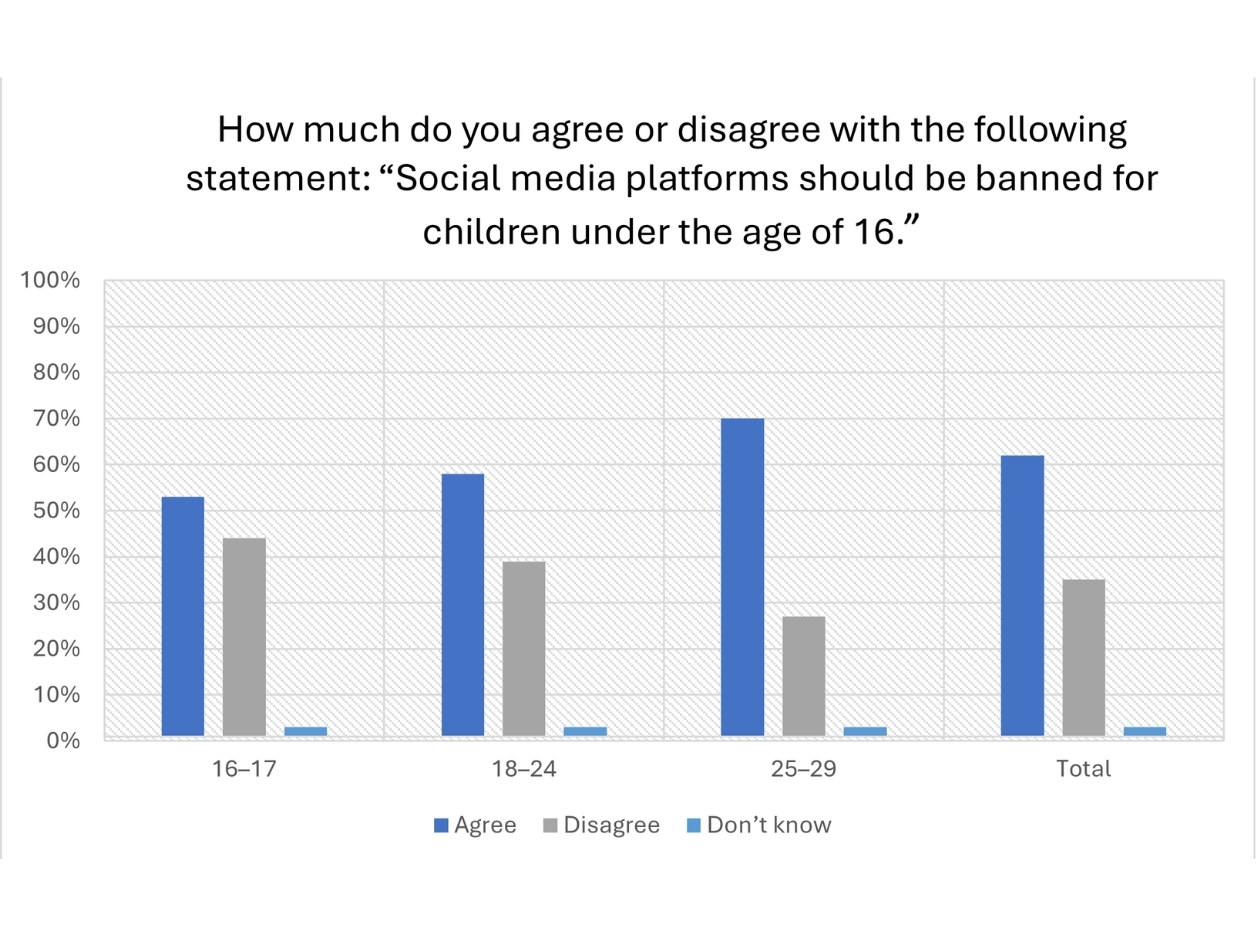
The 2026 youth poll data show that a clear majority are in support of banning social media for under 16s, with 62% of respondents agreeing with the proposal. However, the results also highlight important differences across age groups and suggest that attitudes may be becoming more contested over time.
While a majority support the ban, this represents a slight decline from 2025, where 67% of young people agreed with the proposal. Further to this, the most recent poll shows that around 1 in 3 young people oppose the ban, indicating that opinion is also far from unified.
The divide is even clearer by age. 70% of respondents aged 25-29 agree with this proposal, but this falls to just over half (53%) among 16-17-year-olds. Perhaps unsurprisingly, this indicates that those closer to direct impact of the policy are less convinced by a ban.
Importantly however, the poll does not include the views of 13–15-year-olds themselves, despite the fact that Ofcom have reported that 95% of this age group are active on social media. This raises questions about whose perspectives are actually being heard within debates around online safety.
How central is social media to young people’s lives?
These debates become more complicated when considering how embedded social media is in young people’s lives. A key argument made by those opposed to the ban is that young people use social media as a source of information.
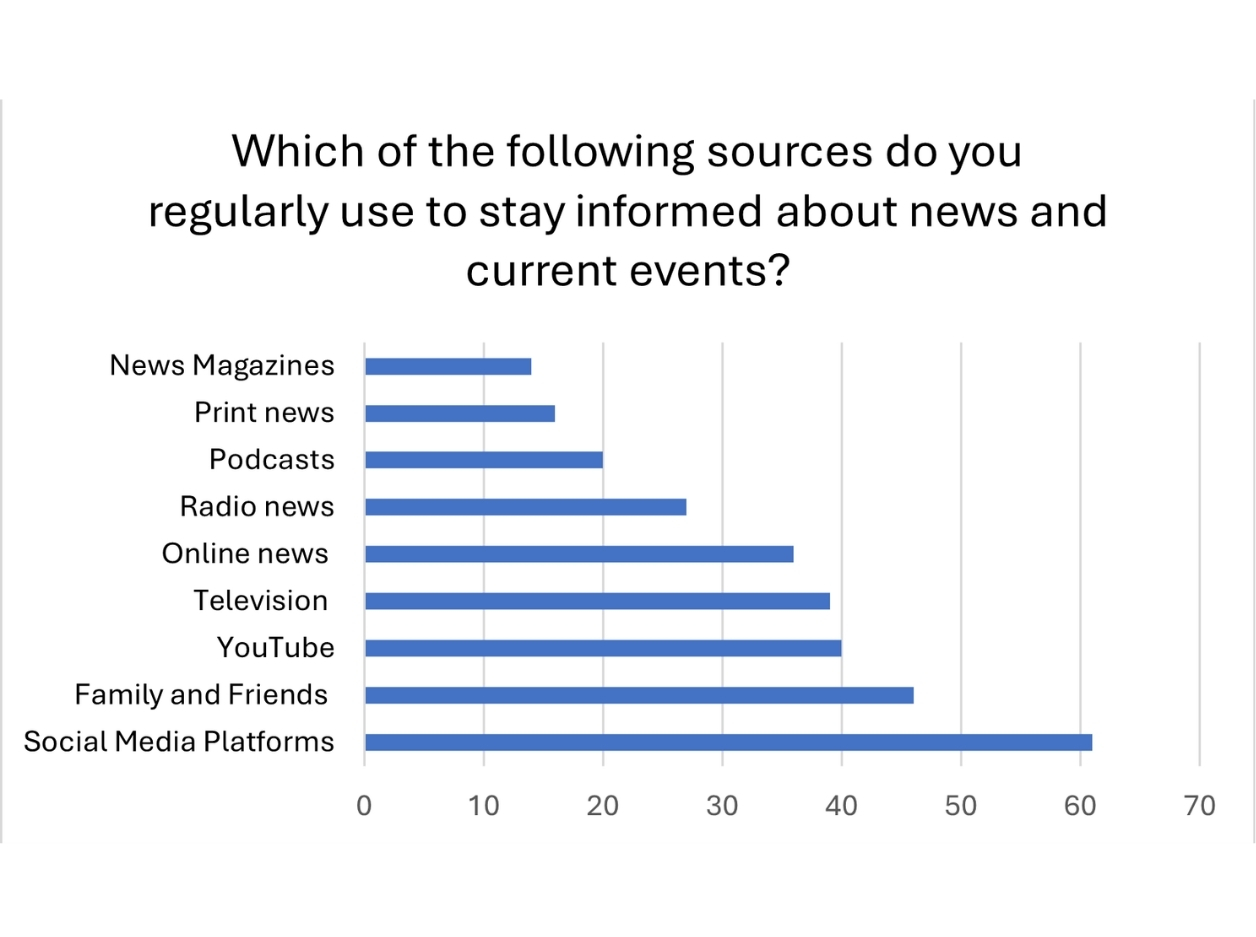
The Youth Poll data is clear. Social media is the most used source for staying informed about current events, with over 60% of young people regularly using platforms for this reason. This is substantially higher than traditional sources such as television (39%), online news websites (36%), or radio news (27%). Family and friends also play an important role, with this being the second most popular.
Taken together, these findings highlight that social media is only used by young people as a source of entertainment, but a central part of how young people engage with the world around them. A ban could risk not only limiting exposure to potential harms but also disrupting key channels through which young people access information, form opinions, and participate in public life.
Who should be responsible for regulation?
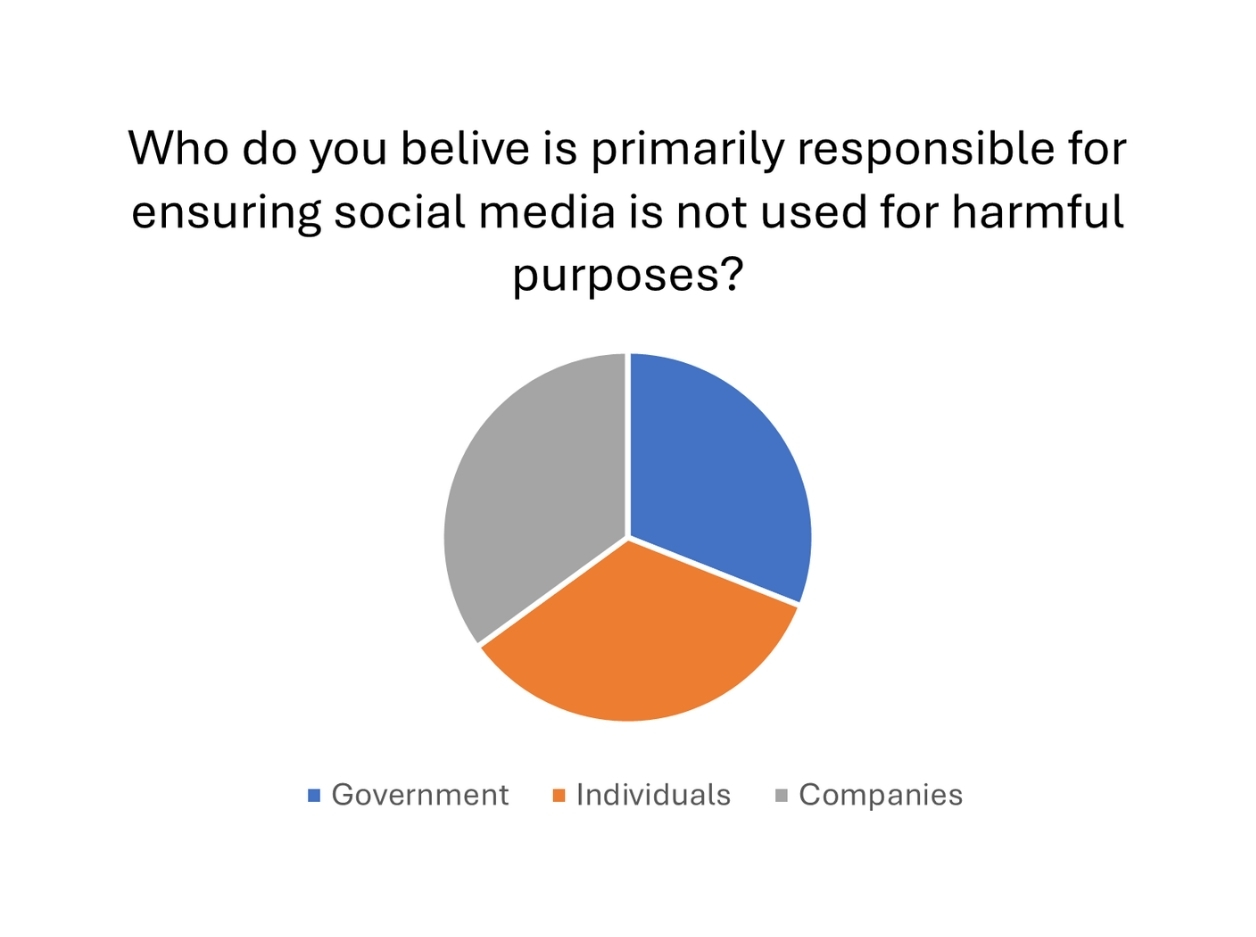
Despite proposals which largely centre individual and government responsibility, the Youth Poll results show that young people are divided on where responsibility should lie. Rather than placing such responsibility on a single actor, the responses are strikingly evenly distributed between Government (31%), Individuals (34%), and Companies themselves (35%).
So, rather than identifying a ingle actor as primarily responsible, the findings suggest that young people as a collective recognise multiple actors having a role in tacking online harms. This is particularly important in the context of current policy debates, which often isolate legislation or platform regulation as competing solutions.
Current proposals then, may fall short of young people’s expectations. If responsibility is understood as collective, then policies that focus too narrowly on restriction, such as bans, risk overlooking the broader ecosystem in which online harms occur, including the role of education and platform design.
Rethinking regulation
These findings show that social media regulation is far from straightforward. While most young people who took part in the 2026 UK Youth Poll support a ban for under 16s, support varies across ages and appears to be shifting over time.
At the same time, social media remains central in how young people access information, complicating efforts to regulate its use without wider consequences. Perhaps most significantly, young people do not place responsibility for online safety on any single actor, indicating support for a more balanced approach.
Therefore, current policy proposals risk oversimplifying both the problem and its solutions. If regulation is to be effective, it must move beyond one-dimensional approaches and instead reflect the nuanced perspectives of young people themselves.
This blog was initially published on the University of Glasgow's John Smith Centre news section.
First published: 18 June 2026
Ellie Craig is a final-year undergraduate student at the University of Glasgow, studying Politics and Sociology. This blog was part of the groundbreaking new course at the University of Glasgow: The John Smith Youth Poll Project