

Northern new ethnicities – C.L.R. James and teaching Sociology at Nelson and Colne College.
Published: 1 September 2026
Les Back recalls the long history of migrant radicalism and socialist struggle in a Lancashire town.
In my year as President of the British Sociological Association, I have been visiting schools across the UK where sociology is taught. After I told my Glasgow colleague Andy Smith that I was on my way to visit Nelson and Colne College in East Lancashire, he commented, ‘You know, that’s where CLR James lived in the thirties?’ I didn’t know, and this was my second visit.
Andy is an expert in the Trinidadian cricket-loving political intellectual C.L.R. James’s life and writing. A few days lter, a photocopy appeared in my pigeonhole: a chapter from Christian Høgsbjerg’s book C.L.R. James in Imperial Britain, which documented the influence that this mill town had on his thinking.
My host at Nelson and Colne College, Allana Shaw, is an inspiring teacher, and when I arrived in early June, she was excited to learn more about C.L.R. James’s life in Nelson. I asked her if we could visit some of the local sites where James had lived before school. She embraced the idea of some early-morning sociology tourism.
‘King Cotton’ created Nelson, and the plantations in the American South and India were central to providing the raw materials for the Industrial Revolution in Lancashire. People migrated from all over the UK to work in the mills that mushroomed along the valley from Burnley to Colne. From its very beginnings, everyone who settled there had come from somewhere else.
The number of St George’s flags being flown seemed to have increased since my last visit a year ago. Allana warned me that Reform is strong here today, and East Lancashire is very divided.
Amid the Industrial Revolution, democratic traditions of self-government and workers’ education flourished locally with women prominently involved. Nelson was a centre for religious non-conformity and Independent Methodism as well as a hotbed of radicalism from the Liberalism of Gladstone to the idealist socialism of the Independent Labour Party.
C.L.R. James ended up here through cricket. Nelson Cricket Club, which played in the Lancashire leagues, was hugely popular, with eight to ten thousand supporters flocking to watch them at their Seedhill ground. Trinidadian cricketer Learie Constantine had toured Britain in 1923 with the West Indies team. The brilliant all-rounder was invited by Nelson Cricket Club to turn professional and play for them in the Lancashire League.
Just a year older than C.L.R. James, Constantine had invited James to come to Nelson. After arriving in England in 1932, James spent a very unhappy ten weeks in London. He decided to take up Constantine’s offer to come live with him in Nelson at 3 Meredith Street. C.L R. James lived here between late May 1932 and March 1933.
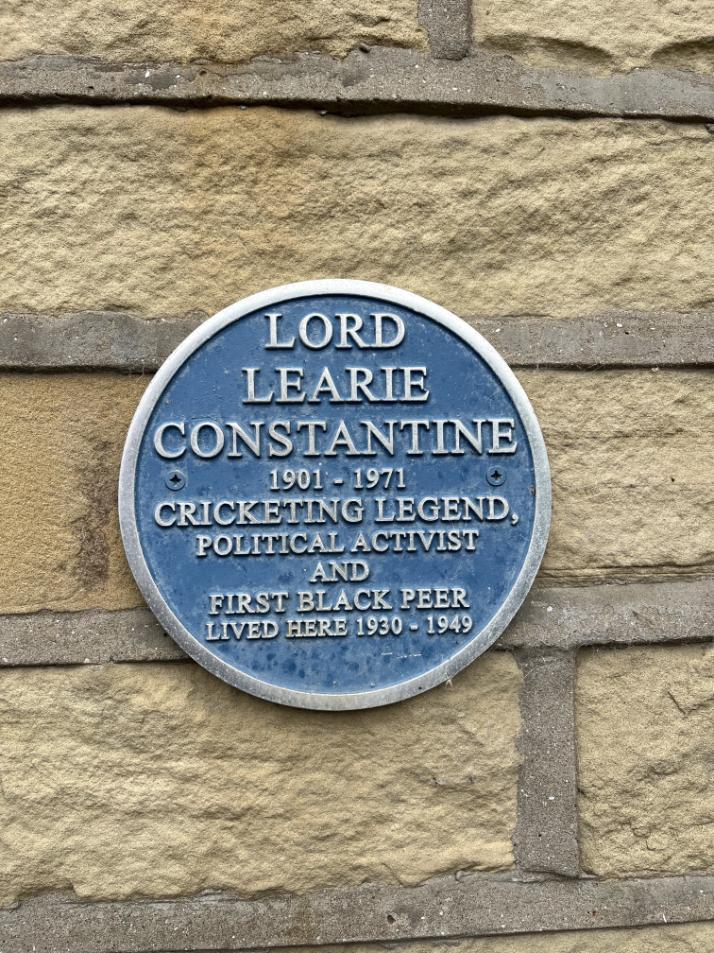
When Allana and I visited the modest four-roomed house, it didn’t seem fitting for a local sporting hero. Today, a plaque celebrates the fact that Leary Constantine and his family lived here for 19 years, and also that he went on to become the first Black peer of the realm. C.L.R James agreed to help his friend write an autobiography and help with the frequent requests to speak at political and workers’ educational gatherings.
James, a budding writer, was increasingly drawn into the currents of political life. He found the cricket-loving “humorously cynical working men” of Red Nelson a “revelation”. The radical atmosphere of this mill town earned it the nickname ‘Little Moscow ’, but after World War One the cotton industry was in decline. When James arrived in 1932, locals boycotted cinemas because the owners had tried to cut the wages of the local projector operators.
The small house on Meredith Street was James’s university. He read late into the night in his small upstairs room, studying Trotsky’s history of the Russian revolution and Spengler’s The Decline of the West. He lived there with Constantine, his wife Norma, and his daughter Gloria, who was just four then. Gloria remembered many years later how one night she was sitting with her mother in their living room and smelled something burning.
She ran upstairs to where ‘Nello’ – the nickname James was known by his friends - was studying. He was sitting in a cardigan in front of the electric fire, writing frantically but lost in concentration; he hadn’t noticed his cardigan was on fire! It was in that room that James wrote his famous pamphlet The Case for West-Indian Self-Government.
I asked Allana if we had time for a few more stops. I wanted to visit Scotland Road. ‘That’ll be okay,’ Allana said, ' school is on that street.’ Harry and Elizabeth Spencer owned a bakery and tea shop at 43 Scotland Road. On this summer morning, the premises were closed for renovation, but you could still see the wrought-iron sign of the bakery and imagine the tea shop above it.

Nello spent a lot of time there with Harry Spencer, who became a good friend. They also walked together, talked about music and books, and about Harry’s knowledge of local history and politics. James described his friend as a man of ‘sterling English character.’
When James planned his trips to Paris to research the Haitian Revolution, Harry and Elizabeth offered to loan him the money for the trip. It’s why his book on the slave rebellion The Black Jacobins, published in 1938, is dedicated to: ‘My good friends Harry and Elizabeth Spencer of Nelson, Lancashire’.
Those ten months C.L.R. James spent here in 1932-33 with cricket and radical political groups had a lasting impact on him. Christian Høgsbjerg concludes in his book that this experience “enabled James to imagine what a ‘Britain’ without empire might look like”. It is still only 8.30 a.m. when I check my wristwatch. I feel I’ve learned so much walking in James’s footsteps with Allana. “It’s not far” she says, “we have plenty of time”.
Arriving at Nelson and Colne Sixth Form, the cultural diversity of the students is immediately striking. There is a well-established, long-standing South Asian community, largely from Pakistan, as well as small numbers of African Caribbean, Arab, and mixed ethnicities.
I am here to give the sociology teachers a day off and to run sessions with all the students studying A Level sociology, numbering close to 100. My book New Ethnicities and Urban Culture, published in 1996, is part of the curriculum.
I start by showing them a very famous Conservative election poster from 1983, a besuited black man, and an Asian man with the caption “Labour says he's black, Tories say he's British”. The poster's implicit logic is that you cannot be both black/Asian and British. I use it to illustrate Stuart Hall’s ideas about the coupling of race and nation. I ask them if the number of St George’s flags flying in Nelson is an example of such a coupling. Many think it is about claiming Englishness for white people only.
Then we do an exercise together. I ask them to put themselves in the middle of a piece of paper and then create a mind map of all the places they are connected to. There is a heavy, industrious silence and furious scribbling. It’s time to report back. A young white woman said she identified as being northern; her mind map is just the word “northerness”, written like an arc around her name.
Another student draws lines tracing her connections to Pakistan and Norway, where some of her relatives live. Another young mixed-heritage woman said she was from Burnley and identified with Jamaica, Ireland, and England. Only one student mentioned Britishness. – “I am British Pakistani”. I say that Stuart Hall called this ‘new ethnicities’ and cultures of hybridity.
Some students mentioned faith and religion: "I'm from Nelson, and I identify with Pakistan and being a Muslim”. One of the young women in a niqab said excitedly that some of her family lived in Birmingham and she loved visiting them. Another said: “Being a Muslim, I read the Quran every day.”
Then we did a second exercise, and I asked them what their favourite things to do were. A female white student said: “Books are my favourite thing, I like reading.” Several girls in the group were wearing hijabs. One said, “I like to play netball.” Two others said they were obsessed with “F1 racing” – and why wouldn’t young Muslim girls be into Formula One racing? Their musical tastes were eclectic, and one girl said her favourite thing is dancing. One young Asian man said he just likes his PlayStation, while another said he loved cricket, and I replied that he lived in the right place for that.
One of the values of teaching sociology is that it helps our students to recover the traces of industrial and imperial history in their own town and their own lives. The classroom is an apt portrait of ordinary multicultural life, and what Britain after empire feels like as a simple fact of life. Still, outside in the surrounding streets, houses have poles flying St George and Union Jacks that flutter in the breeze like warning signs, set against the green Lancashire hills, that imperial nationalism will not go quietly without a fight. Walking in C.L.R James’s ghostly footsteps in Nelson offers a guide to what this place is and can be.

First published: 1 September 2026
<< Blog