Featured Publications
Lea Raible, Between facts and principles: jurisdiction in international human rights law
In International Human Rights Law, ‘jurisdiction’ is the centre of the debate on extraterritorial obligations. The purpose of the present paper is to a) analyse how facts and principles contribute to the explanation of jurisdiction in international human rights law and b) to show how this analysis could help sharpen the debate in this area by making the grounds of disagreement between different accounts explicit. It first describes international practice regarding jurisdiction and shows that it is committed to jurisdiction being a principle that responds to facts on the ground. Second, the paper describes two academic views on jurisdiction in detail. Next, it introduces the framework on facts and principles developed by Jerry Cohen. The idea is that facts only support principles if their relevance is explained by another principle that does not depend on facts. Finally, section 4 combines the framework with our insights into jurisdiction. If jurisdiction is best understood as a principle that responds to facts, this implies that jurisdiction cannot be explained by facts alone. It must instead reflect principles that are themselves not fact-dependent. Adhering to this framework allows for better explanation of jurisdiction and a clearer understanding of the different views on jurisdiction.
Alex Schwartz, The changing concepts of the constitution. Oxford Journal of Legal Studies
There have been several important formal changes to the United Kingdom’s constitution over the past few decades, including devolution to Northern Ireland, Scotland, and Wales; the incorporation of the European Convention on Human Rights in domestic law; and the creation of a new Supreme Court. This article is about the informal semantic changes that may have accompanied these formal changes. It focuses on several central concepts: parliamentary sovereignty, the rule of law, the separation of powers, devolution, and human rights. Using a recently developed machine learning method to analyse a massive corpus of parliamentary debate, the article gauges the extent to which these concepts have become more (or less) related to the meaning of the UK’s constitution in parliamentary discourse. Ultimately, the analysis supports some important theoretical expectations about the changing nature of the constitution, including the claim that parliamentary sovereignty is now a less significant concept for the meaning of the constitution than it once was.
Tom Mullen, Internal Review Systems and Administrative Justice
Internal review is a process whereby an administrative organization reconsiders its own decisions. The rationales typically offered for internal review are that it provides a means of challenging administrative decisions which is more accessible, quicker, and more cost-effective than external remedies such as appeals to tribunal and judicial review, and encourages improvement in the quality of initial decision-making in public administration. This chapter reviews the use made of internal review and evaluates the performance of several existing systems of internal review, concluding that they have failed to deliver the benefits claimed for them. Possible reasons for this failure are discussed and suggestions made as to what is required for internal review systems to achieve the aims to providing effective remedies for bad decisions and to contributing to improving initial decision-making.

Chris Gill and Tom Mullen, The managerial ombudsman
This article identifies a major development in the role and practice of the ombudsman. It argues that the New Public Management practices that have transformed public administration in the last 30 years have led to a more managerial approach to the ombudsman's work. The article's argument is developed through analysis of an empirical case study of the Scottish Public Services Ombudsman, which illustrates how the aims and techniques of managerialism have been deployed in the ombudsman context. The article evaluates the significance of these developments for the ombudsman institution and for the wider justice system. It examines the risks and opportunities inherent in this turn to managerialism and whether it represents a departure from the ombudsman's mission or a necessary adaptation to a changed world of public administration. In identifying the rise of the ‘managerial ombudsman’, the article provides a new framework for conceptualising developments in the modern ombudsman institution.
Lea Raible, Human Rights Unbound: A Theory of Extraterritoriality
This book develops a theory of extraterritorial human rights obligations in international law. It links debates on human rights theory with those relating to extraterritoriality and merges accounts of economic social and cultural rights with those of civil and political rights. It advances four main arguments aimed at changing the way we think about extraterritoriality of human rights. First, it is argued that the questions regarding extraterritoriality are really about justifying the allocation of human rights obligations to specific states. Second, the book shows that human rights as found in international human rights treaties are underpinned by the values of integrity and equality. Third, it is argued that these same values justify the allocation of human rights obligations towards specific individuals to public institutions—including states—that hold political power over said individuals. And fourth, the book argues that title to territory is best captured by the value of stability, as opposed to integrity and equality. If these arguments are successful, their consequence is a major shift in how we view extraterritorial human rights obligations. Namely, the upshot is that all standards in international human rights treaties that count as human rights require that a threshold of jurisdiction, understood as political power, is met. However, on the present account, this threshold is not just a conceptual necessity but a normative one as well. It is needed because it not only describes, but also justifies the allocation of obligations.
Kanstantsin Dzehtsiarou and Alex Schwartz, Electing Team Strasbourg: Professional Diversity on the European Court of Human Rights and Why it Matters
Reforms to the process for electing judges to the European Court of Human Rights have generally focused on identifying the most qualified individual candidates. This Article argues for a more holistic approach, advancing a theory of why professional diversity on the European Court of Human Rights is an asset in collegial decision making. The results of original interviews with several Strasbourg judges are presented, followed by an empirical analysis of the professional backgrounds of all judges elected to the European Court of Human Rights since 1998. Although the interviews indicate that the judges themselves see the value of professional diversity, the quantitative evidence suggests a trend in the direction of a more professionally homogenous bench. The Article concludes with some suggestions for how the promotion of professional diversity might be appropriately pursued in future reforms to the process for electing Strasbourg judges.
Tom Mullen, Brexit and the territorial governance of the United Kingdom
Reforms to the process for electing judges to the European Court of Human Rights have generally focused on identifying the most qualified individual candidates. This Article argues for a more holistic approach, advancing a theory of why professional diversity on the European Court of Human Rights is an asset in collegial decision making. The results of original interviews with several Strasbourg judges are presented, followed by an empirical analysis of the professional backgrounds of all judges elected to the European Court of Human Rights since 1998. Although the interviews indicate that the judges themselves see the value of professional diversity, the quantitative evidence suggests a trend in the direction of a more professionally homogenous bench. The Article concludes with some suggestions for how the promotion of professional diversity might be appropriately pursued in future reforms to the process for electing Strasbourg judges.

Alex Schwartz, An agent-based model of judicial power
That a court possesses the formal power of judicial review is no guarantee that its decisions will be obeyed. Courts are occasionally defied, and they can also be attacked in retaliation for decisions that frustrate the goals of political elites. Using a method of computer simulation called agent-based modelling, this article explores how new constitutional or supreme courts can act strategically to build their power while mitigating the risk of retaliation by the political branches. The simulations suggest that a court that avoids challenging the preferred policies of the political branches in high salience disputes will, ultimately, tend to exert more influence on constitutional law than a court that moves to establish its power early on in landmark cases. These findings vindicate the intuition that the growth of judicial power will normally depend on “baby steps”, i.e., relatively restrained and incremental (as opposed to sudden and bold) assertions of constitutional supremacy.
Alex Schwartz, International Judges on Constitutional Courts: Cautionary Evidence from Post-Conflict Bosnia
Hybrid constitutional courts are associated with deeply divided and post-conflict contexts where the impartiality of the domestic judiciary is suspect. Such courts enlist international (i.e., foreign) judges to create an ostensibly neutral counterbalance to the presumed political biases of local judges. This mixed-methods case study of the Constitutional Court of Bosnia-Herzegovina questions the value of these hybrid courts. Contrary to what might be expected, the results of multidimensional scaling indicate that Bosnia’s foreign judges have not provided a reliable counterbalance to apparent ethnonational divisions on the Court. Furthermore, qualitative analysis suggests that the foreign judges have contributed to several strategic mistakes that have probably harmed the Court’s tenuous authority. It is also suggested that the presence of international judges on constitutional courts may actually discourage the kind of strategic behavior that is needed to build and sustain judicial power, particularly in deeply divided and postconflict contexts.
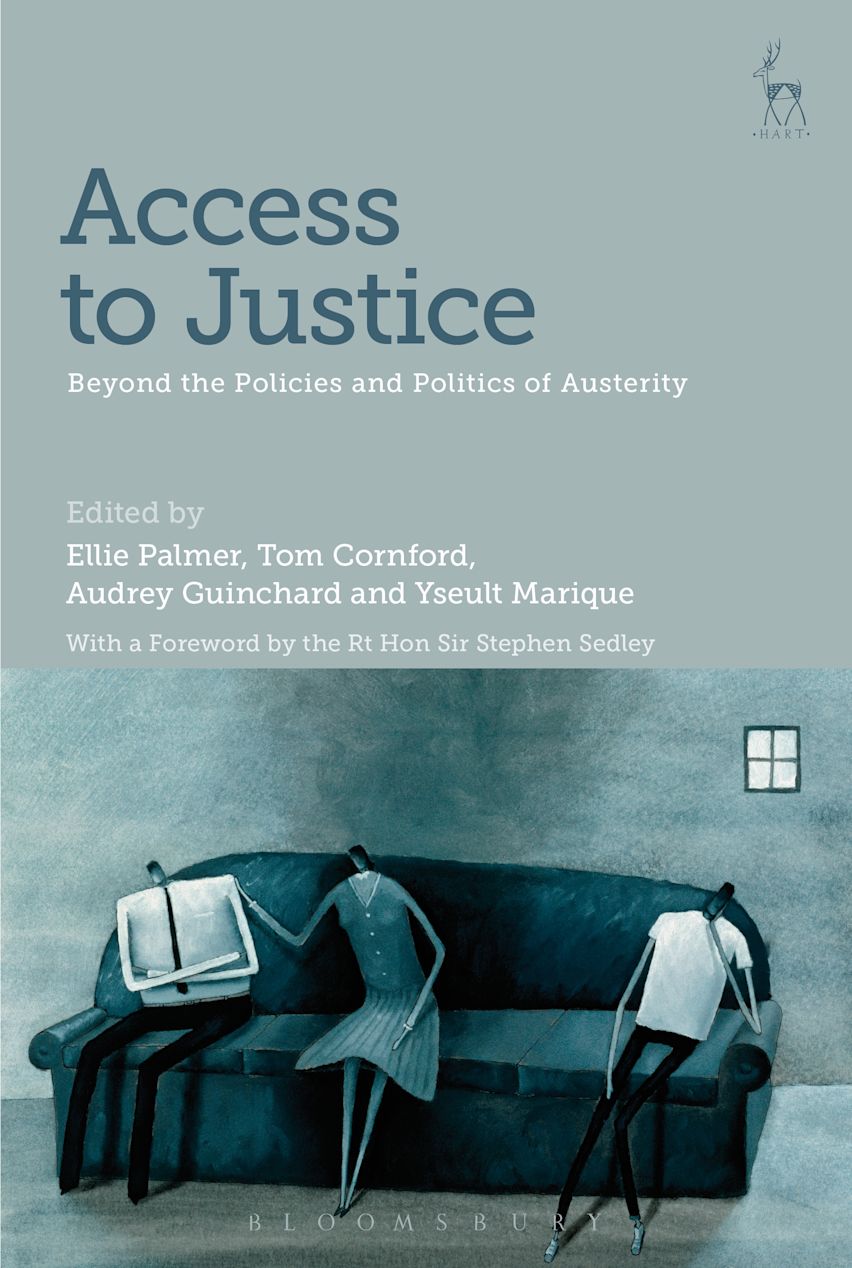
Tom Mullen, Access to Justice in Administrative Law and Administrative Justice
This chapter discusses access to justice in the context of administrative law and administrative justice. The focus will be mainly on the United Kingdom and English law dimensions of administrative law and administrative justice, but some account will be taken of developments in other parts of the UK. The meanings of these two expressions overlap substantially but are not identical. Both expressions are generally considered to include within their scope both the substantive principles of administrative law and the different types of remedies—judicial and non-judicial—that citizens may use to seek redress of grievances against the state, for example, courts, tribunals, inquiries, and complaints procedures including ombudsmen. The increasing use of the term ‘administrative justice’ in recent years has been associated with a strong emphasis on the importance of studying initial decision-making by public authorities,as opposed to administrative law scholarship’s traditional emphasis on remedies, and an increasing willingness to analyse the system of remedies as a whole.The term administrative justice is also conventionally regarded as including, not only decisions affecting citizens’ rights and interests, but also other aspects of how citizens are treated by public bodies. Administrative justice can, therefore, encompass the ‘non-decisional’ failings of public bodies such as delay, rudeness and insensitivity in their treatment of citizens.