

BEGIN research study on birth and early years grants in the UK
Published: 29 October 2026
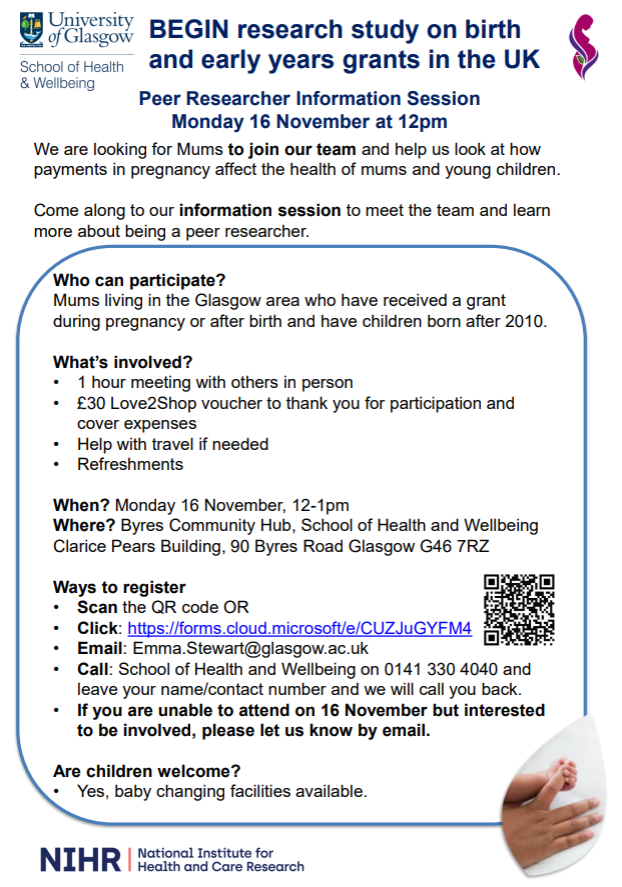
BEGIN explores how changes to cash payments for low-income families across the UK have affected the health of mothers and young children. Looking for mums living in the Glasgow area who have received a grant during pregnancy or after birth and have children born after 2010 to be peer researchers.
BEGIN explores how changes to cash payments for low-income families across the UK have affected the health of mothers and young children. The study takes place at a time when child poverty is rising and we know that the early years are crucial for long-term wellbeing.
Specifically, we are looking at changes made to payments given to low-income families. The first was a change made to the Sure Start Maternity Grant (which provides a one-off £500 payment in pregnancy). Before 2011 this payment was made for all children in a family, but since 2011 only first-born children can receive it. The second change was the introduction of the Best Start Grants in Scotland in 2018. The Best Start Grants replaced the Sure Start Maternity grants. They provide higher value payments to low-income families, in pregnancy (£754.65 for first-born children, £377.35 for all other children), at age 2-3.5 years (£314.45 for all children) and at the start of school (£314.45 for all children).
We are using data for all children born between 2003 and 2024 to look at whether child health changed after the payments changed, and whether these changes were smaller or greater for different types of families. We will speak to policy makers to find out more about the policies, and interview families to gather their views and experiences of these cash payment. A number of parents will become paid members of our study team, to help carry out the interviews and understand the findings. We will also form a lived experience panel of parents of young children. We will meet with them regularly to listen to their views, for example to make sure that we are looking at the most important aspects of health and presenting our findings in the most helpful way.
We are looking for mums living in the Glasgow area who have received a grant during pregnancy or after birth and have children born after 2010.
Peer researchers will work with the main research team to help design the study, create the interview questions, and find people who want to take part. As part of the project, they’ll get training and support to build their skills and confidence in doing qualitative research. The role involves up to 10 days of commitment over the next two years. Key tasks include attending training on research methods, helping to recruit people for interviews, helping with data analysis and getting involved with events/workshops.
Taking part in the project gives peer researchers the chance to:
• Build useful skills: learn how to do research, improve communication, and develop practical skills like teamwork, organisation, and problem‑solving.
• Meet new people: connect with researchers, professionals, and community groups, and become part of a supportive network.
• Get involved in important research: use lived experience to contribute to conversations, represent the voices of others, and help support better services and policies.
The peer researchers will be compensated for all time spent on the project. Help is also available for travel costs and childcare.
More information about the BEGIN project: https://www.gla.ac.uk/schools/healthwellbeing/research/publichealth/begin/
Register for peer researcher information session: https://forms.cloud.microsoft/e/CUZJuGYFM4
Contact: Emma.Stewart@glasgow.ac.uk
First published: 29 October 2026