

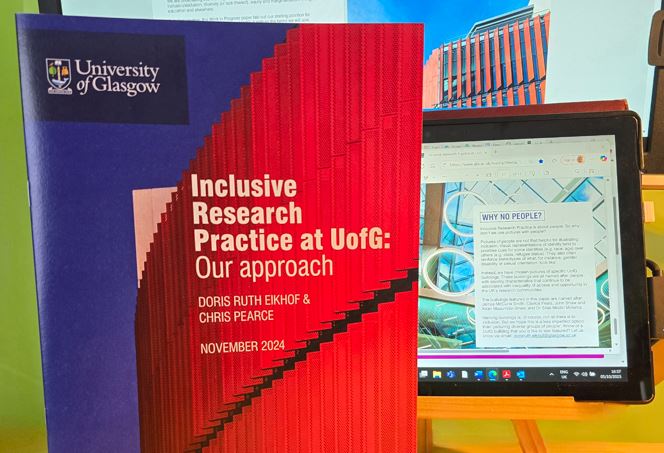
Download PDF Version: IRP at UofG: Our Approach
Download Text Only Version | COMING SOON
If you would like one (or more) printed copies of this Guide/Paper, please email DorisRuth.Eikhof@glasgow.ac.uk
Inclusive Research Practice at UofG: Our approach
Introduction
Our University of Glasgow Research Strategy 2020–2025 proposed that while the research landscape is changing, our core principles for research should stay the same: that we value the quality of our research over its quantity; that the University succeeds when our individual researchers succeed; that how research is done is as important as what is done. Our 2024 Research Strategy Progress Report demonstrates the positive impact of underpinning the delivery of our Research Strategy with those principles.
Inclusion is an important dimension of these three Research Strategy principles. Our UofG value “Inclusive Community” (University of Glasgow - MyGlasgow - MyGlasgow Staff - Our values) commits us to embracing diversity, putting people at the heart of everything we do and achieving fairness and equity of opportunity for all. Consequently, how we undertake, support, reward, celebrate and evaluate research needs to be experienced as fair, engaging, collegiate, empathetic and respectful as well as equitably designed.
Our core principles for research (1. That we succeed as a university when individuals succeed in their careers. 2. That we recognise the variety of contributions that are made to research. 3. That we value the quality of what we do over its quantity) already centre the experiences of individuals: we recognise that contributions to research come in many forms, and that as a university we succeed when individuals succeed in making these contributions and in building their careers. But while our other three UofG values already feature prominently in our research policies and initiatives (Our UofG values of Ambition & Excellence, Curiosity & Discovery and Integrity & Truth are reflected in, for instance our Research Strategy, Innovation Strategy or our Good Practice in Research: Monthly Programme of activities and events), we currently do not centre inclusion or ‘inclusive community’ in our research-related action plans, strategies or KPIs. Our Research Strategy 2020-2025 is based on the assumption that “researchers succeed in an environment that is fair and supportive”, but it does not explicitly reference inclusion or diversity in research. From 2024 onwards we will address this omission with a programme of work on inclusive research practice (IRP).
We are undertaking this work against a broader background of conversations about inclusion/exclusion, diversity (or lack thereof), equity and marginalisation, in higher education and elsewhere.
In its first iteration, this Work in Progress paper laid out our starting position for improving inclusive research practice at UofG: it defines the terms we will use; proposes elements of an inclusive research environment; and positions inclusive research practice within the University and sector context. Finally, it explains how we are approaching IRP as a programme of work.
This paper is deliberately a work in progress paper. It explains our thinking so we can invite conversations and feedback and make our approach to inclusive research practice one that is owned across our UofG research community.
Work in progress also means working to progress. We expect our understanding of inclusive research to evolve as we do that work. As our understanding develops, we may revise priorities, plans or definitions. As and when that happens, we will explain those changes in later iterations of this paper.
Key Terms
Research and policy offer a confusing range of definitions for key terms like equality, diversity and inclusion. In our work on inclusive research practice, we use the following key terms:
Inclusion is a perspective focused on experiences. It assesses the degree to which everything we do, individually and collectively, is experienced as open, participative, fair, connecting, empathic, respectful of difference and equitably designed. Inclusion considers our practices, processes, decisions, structures, interactions, relationships, allocations and communications. Because these are dynamic, living and lived aspects, inclusion is never ‘achieved’ but has to be constantly created and re-created.
Inclusion data operationalises the idea of practices that are, in this sense, ‘inclusive’ and creates indicators for monitoring and comparing progress within or across organisations. Inclusion data might provide, for instance, information on employee experiences or on investments in training programmes for people from minoritised communities.
Diversity is a measure of variation. It tells us how many different expressions of a characteristic are present in a group and how prominent each expression is. Diversity is measured for a particular group at a point in time or over a stretch of time. It is often expressed in percentages, e.g. X% type A, Y% type B, Z% type C. In the context of inclusive research practice our default will be to mean diversity of people rather than diversity of research output or disciplinary perspectives.
Diversity characteristics are individual identity characteristics that are relevant to experiences of inclusion and exclusion, discrimination, opportunity, advancement and outcomes. In the UK, nine such characteristics are protected by the 2010 Equality Act: age, disability, gender identity, marriage and civil partnership, pregnancy and maternity, race, religion or belief, sex, sexual orientation. Other relevant individual characteristics include (but are not limited to) class/socio economic background, caring responsibilities, geographical location, refugee status, language, experience of the care system, nationality.
Diversity data is numerical data about such individual identity characteristics.
Diversity and inclusion are often mentioned together. The – mostly implicit – assumption is that inclusive environments (workplaces, groups, companies etc.) result in diverse groups of people and diverse groups of people are a sign of inclusive behaviours and processes. This assumption is a false one: there is plenty of evidence that people can experience exclusion (e.g. not being able to contribute to decisions in a research project) or discrimination (e.g. regarding the authorship of papers) within diverse groups. Similarly, it is theoretically possible that an environment is inclusive in its practices while the group of people in it is not particularly diverse. But especially for large groups, inclusion without diversity is possible rather than probable. In the context of inclusive research practice, we will understand a lack of diversity as a useful warning sign of a potential lack of inclusive practice. But we will use diversity as an indicator cautiously and not assume causal relationships between diversity and inclusion.
Equality and equity are principles for allocating opportunity, material resources, attention, support etc. The principle of equality requests that everyone should be allocated the same share. The principle of equity stipulates that allocations should result in fair or just outcomes. Treating people equitably might mean allocating different amounts of opportunity, resources, attention or support to account for the different circumstances people find themselves in.
Research practice refers to everything we do to undertake, support, reward, celebrate and evaluate research and knowledge exchange in its broadest sense. It comprises the work and contributions of academic staff, research professional staff, professional service staff, students, colleagues in leadership and management positions, external partners – anyone involved in making research happen at UofG.
An Inclusive Research Environment
The overall aim of our work on inclusive research practice is to build a research environment at UofG in which (1) inclusion is recognised as a key dimension of “how research is done” and (2) we strive, individually and collectively, to ensure our research environment is inclusive.
An inclusive research environment is one in which how we undertake, support, reward, celebrate and evaluate research is experienced as fair, engaging, collegiate, empathetic and respectful as well as equitably designed.
In such a research environment we:
- enjoy difference of people, contributions, perspectives and actions, and understand difference as an asset;
- understand and enact inclusion as a dynamic & developing, and living and lived dimension of research;
- recognise that inclusive practice is part of research, and that it is an enhancing dimension to research, not an obstacle;
- demonstrate institutional and individual ability to invite difference into research, and to nurture it;
- understand and appreciate complexity and ambiguities, rather than feel threatened by them.
Working towards such an inclusive research environment means considering what we already do through an inclusion lens. We are not looking to build an inclusive research environment as a new or separate ‘thing’ in addition to our existing research environment. We look at what we already do, in various aspects of our research and research support, and ask how inclusive those practices already are and how they could be made more inclusive
Where conceptually appropriate, and where we have good quality data, we use diversity measures as indicators of how inclusive our research practice is. We expect diversity measures to be part of a broader portfolio of indicators, not targets in and of themselves.
We use ‘inclusive’ as an adjective or adverb (e.g.‘inclusive research practice’, ‘recruit inclusively’) to emphasise that inclusion is a dimension of what we do, individually and collectively: any of our actions can be more or less inclusive. Inclusion is not a state that we can achieve and move on from. We need to be inclusive in our research practice every time we engage in it. This aspect of ‘inclusion is in the making’ is what we mean when we define inclusion as a ‘living and lived dimension’ of our research environment.
This approach means that inclusive practice must be present and visible through everything we do. Creating an inclusive research environment is not something on the periphery or that relies on volunteered work. It is the task of everyone involved with research at UofG.
We start our work on inclusive research practice with the recognition that there is much to learn about inclusion (and diversity) in research. Such learning plays to our academic strengths and values. Curiosity, discovery and embracing new thinking are central UofG values. As a research community we also bring an understanding of complexity, paradox and the importance of tolerating ambiguity to our learning about inclusive practice. We will draw on these strengths to develop our understanding and practice of IRP.
Focusing on inclusive research practice allows us to build on what we already do well. It will give us concrete actions that can be adapted to the everyday reality and interests of individual colleagues and units. We expect this to be constructive, meaningful work that our UofG research community will find rewarding – and hopefully enjoyable – to engage with.
IRP In Context
Our emphasis on Inclusive Research is not being developed in a vacuum. There are significant sector efforts to improve all aspects of our research environment and research culture, but progress is slow. The need is pressing. There is significant evidence that “the UK’s research system” is not equitable or inclusive, and that substantial work and change is required to address the exclusion and marginalisation of people from certain groups across our research community. In 2020, Wellcome undertook an important survey of “What researchers think about the culture they work in”. The findings from this survey sparked conversations across the sector about creating a research culture that is not only fair and supportive, but also inclusive. In 2021, the UK Government published their R&D People & Culture Strategy and in 2023 UKRI published its first Equality, diversity and inclusion (EDI) strategy, setting out its ambition for a more diverse and inclusive research and innovation system. This has also initiated more requests from institutions for diversity data, especially with respect to talent funding streams (e.g. UKRI Future Leader Fellowships, Centres for Doctoral Training). Also in 2023, changes to the Research Excellence Framework (REF) were announced that placed an increased focus on People, Culture & Environment (PCE). In 2024, REF initiated its PCE indicators project that included a focus on Equality, diversity and inclusion.
At UofG, responsibility for EDI matters lies with the Senior Management Group (SMG). Members of SMG act as Equality Champions for one or more under represented groups and the Principal is acting as overall Equality Champion.
The University’s Equality and Diversity Strategy Committee (EDSC) manages the University’s EDI strategy and includes all the Equality Champions, as well as student and trade union representatives.
Our approach to inclusive research practice reflects our institutional values and our underlying research principles. We expect IRP to be a vehicle for ensuring our values feed through into our research environment and thereby act as a lever to help us achieve broader strategically important aims, including attracting, retaining & developing our people, attracting funding, and enhancing our reputation. In 2024, the University initiated the development of its next Research Strategy; inclusive research practice will be a topic in our institution-wide conversation about the next Research Strategy.
However, at present, IRP is not a prominent theme in our EDI architecture and conversations. Therefore, we will work to improve this position and to identify where and how inclusive research can usefully and beneficially be positioned.
Beyond UofG, we have a responsibility to share our experiences and learn from others, working with our peer institutions and building networks. Mechanisms such as the University’s Lab for Academic Culture and Wellcome-funded project on research culture (InFrame) support the implementation of local initiatives and help shape sector policies.

IRP as a Programme of Work
As a research community we know that curiosity, discovery and the development of new thinking typically do not run in linear processes that can be plotted and planned in advance. We also recognise that knowledge and understanding are applied gradually, even for the most groundbreaking paradigm shifts. Understanding and improving IRP will be no exception in this regard.
We therefore need to take a flexible and iterative approach to IRP. One that builds the testing of ideas and the reflection on application and outcomes into all we do.
Recognising the conceptual and practical differences between inclusion and diversity (what they are and at which levels they manifest), we are taking a twin track approach:
On inclusion: we are establishing an institution-wide approach to understanding and improving inclusive research practice that is designed for local, everyday implementation.
On diversity: we are pursuing a central effort to develop how we meaningfully understand and monitor diversity in research. We recognise diversity as an important collective-level symptom of how inclusive our research practice is individually and collectively.
We began our work on IRP by identifying four points as important to the processes of doing this work on inclusion and diversity:
- Identifying priority areas of research practice for practical improvement;
- Identifying principles for engaging with each other on inclusion in research;
- Defining terms, language and concepts that we use to understand and improve inclusion in research.
- Developing systems for charting progress.
Conventionally we might have started with a UofG-wide conversation about how we understand inclusion in research (Point 3) and about how we engage with each other on IRP (Point 2). But taking into account the dynamics of curiosity- and discovery-driven development of knowledge and understanding, we propose a more iterative process. We will use our existing understanding of inclusion and diversity to develop smaller practical interventions (Point 1) that have deliberate testing and reflection questions built in so we can iteratively build principles (Point 2), terms, language and concepts (Point 3) and systems for charting progress (Point 4).
This approach should also allow us to engage with fast developing HE sector conversations on EDI in research while maintaining the approach and foci we have chosen for UofG.
We are starting our work in the following areas:
- Diversity Data: We are developing tools to support our central efforts to monitor diversity in research. Our diversity data work is guided by the principles of protection, purpose and proportionality.
- UofG-internal/managed research opportunities: As a university we make decisions on who can access opportunities, e.g. through our Impact Accelerator Account projects, our fellowship programmes or demand-managed grant application schemes. We are reviewing how inclusive our processes for allocating such opportunities are and where we can make improvements.
- REF 2029 and PCE Pilots: Diversity and inclusion are key considerations in how we approach REF 2029 and how we participate in the PCE Pilots
- Demystifying Research & Knowledge Exchange Roles: To widen our pipeline into institutional roles that shape our research ecology, we are piloting internal initiatives that give interested colleagues more insight into which roles exist and what their remits are.
Download PDF Version: IRP at UofG: Our Approach
Download Text Only Version | COMING SOON