Privacy notice
Please read our privacy notice which covers all our in-person and online events. Should you have any questions please contact unesco-riela@glasgow.ac.uk
Download the Pdf version here: GDPR notice UNESCO RIELA 2025-2028
Privacy Notice for UNESCO RIELA programme of events 2025-2028
Your Personal Data
The University of Glasgow will be what’s known as the ‘Data Controller’ of your personal data processed in relation to events organised by the UNESCO Chair in Refugee Integration through Languages and the Arts for the period 2025 - 2028. This privacy notice will explain how The University of Glasgow will process your personal data.
Why we need it
We are collecting your basic personal data such as name and email address in order to contact you in case of cancellation and in order to add you to our mailing list. We may record online events and use images from the event for marketing purposes, on our website, in our newsletter and on social media. If you wish to remain anonymous, please let a member of the team know. At online events, you can change or remove your name and switch off your camera and microphone for the duration of the event. We will only collect data that we need in order to provide and oversee this service to you.
Legal basis for processing your data
We must have a legal basis for processing all personal data. In this instance, the legal basis is
- Consent – there is a consent clause on the registration form on Eventbrite
- All the personal data you submit is processed by staff at the University of Glasgow in the United Kingdom.
What we do with it and who we share it with
In addition,
- For online events we use Zoom. They comply with the European Union’s General Data Protection Regulation (GDPR). You can read their privacy statement
- Participants come from all over the world and may take screen grabs of the event.
- For registration to our events, we use Eventbrite. Their server is based in the United States, but they comply with the European Union’s GDPR. For more information, please see their privacy statement.
- The meetings will be passcode protected and only registered participants will be able to join. After the first 10 minutes, the meeting will be locked. Participants have the right to change their name and switch off their camera, if they wish to remain anonymous throughout the events.
How long we keep it for
Your data will be retained by the University for the duration of the UNESCO Chair project, which runs until 31 December 2028. After this time, data will be securely deleted.
What are your rights?*
You can request access to the information we process about you at any time. If at any point you believe that the information we process relating to you is incorrect, you can request to see this information and may in some instances request to have it restricted, corrected or, erased. You may also have the right to object to the processing of data and the right to data portability.
If you wish to exercise any of these rights, please contact the data protection office on dp@gla.ac.uk.
*Please note that the ability to exercise these rights will vary and depend on the legal basis on which the processing is being carried out.
Complaints
If you wish to raise a complaint on how we have handled your personal data, you can contact the University Data Protection Officer who will investigate the matter.
Our Data Protection Officer can be contacted at dataprotectionofficer@glasgow.ac.uk
If you are not satisfied with our response or believe we are not processing your personal data in accordance with the law, you can complain to the Information Commissioner’s Office (ICO) https://ico.org.uk/

Upcoming events
For full details of each event and to register, please visit our Eventbrite page unless another specific registration link is given.
Lots of our events are recorded and turned into podcast episodes. Why not head on over to our Podcast section to listen to some of them!
Find our team members at these upcoming events:
Date |
Event Details |
|---|---|
|
Thursdays |
Jenny Copsey, The Quaker Chaplain, is hosting a weekly 20 minute reflection meeting in the University's Peace Garden. Open to all, just turn up on a Thursday at 12noon. More information here. |
|
7 Oct 26 |
Pinar Aksu will be presenting at Decolonising through Art: Creative approaches to decolonise academia, organised by colleagues from the School of Education. Can movies, photography and podcasts help us to decolonise our courses? Our speakers will tell us about their work to start this process! This event is part of the LTD funded project 'Can the co-creation of films/video-podcasts cultivate interdisciplinary staff-student collaboration and help decolonise UofG courses across disciplines?' The PI is Dr Leyla De Amicis (SoE), and co-Is are: Drs. Ray Di Marco Campbell (SoE), Paulina Navrouzoglou (ASBS), Michele Vincent (SoSES), Zyra Evangelista (SoE), Diego Maria Malara (SoSCS), Elisa Segnini (SMLC). |
|
8 Oct 26 |
Exhibition at Perth MuseumLaunch: 8 October 2026 A new exhibition is coming to Perth Museum. Tawona ganyamatopé Sitholé has contributed to the project as a member of the advisory and steering group, alongside University of Glasgow colleague Peggy Brunache from the Beniba Slavery Centre. The exhibition launches on 8 October 2026 and runs from 9 October 2026 to 11 April 2027. |
|
15 Oct 26 |
Prof Sara Kindon our former visiting scholar is giving a public lecture in Durham.
Thursday October 15, 4.00-6.00pm Public Lecture Making sense of academic activism and decolonising solidarity in higher education in the face of forced displacement and anti-migrant sentiment
In a world of escalating forced displacement and intensifying anti-migrant sentiment, what does it mean to be an academic who refuses to look away? Drawing on data from a collective biography and collaborative interview process involving sixteen women academics across Australia, Aotearoa New Zealand, England, and Scotland, the lecture examines how our activism around forced migration is either rendered invisible or sits uncomfortably within institutional definitions of academic service, producing a range of affects, which influence the viability and sustainability of our solidarity. Extending a framework for enacting decolonising solidarity, the lecture emphasises the importance of cultivating trust, mutual recognition and collective liberation within activist and solidarity efforts. These affective dimensions – joy, humour and the strengthening of relationships – enhance activism and solidarity’s transformative potential within and beyond high education despite systemic challenges. |
|
22 Oct 26 |
Dr Philippa Whitford Speaking in GlasgowDr Philippa Whitford returns to Glasgow to share her experiences of pioneering NHS breast cancer surgery in Ayrshire, her 35 year connection with Gaza, and her nine years as an MP. Her talks have captivated audiences across Scotland, bringing together perspectives on breast cancer, Gaza and Westminster. Dr Whitford will be introduced by Alison Phipps, Professor of Languages and Intercultural Studies and UNESCO Chair in Refugee Integration through Languages and the Arts at the University of Glasgow. Thursday 22 October 2026 Organised by Glasgow Bethlehem Twinning Association in conjunction with the UNESCO Chair in Refugee Integration through Languages and the Arts. |
|
28 Oct 26 |
Esa Aldegheri will be presenting at the IMISCOE Forum on Promoting Afro-European Mediterranean Dialogue: Shifting Geographies of Migration. She is part of panel 2: Migration corridors and routes, and will be presenting A point of departure: Narrative migration mapping to challenge dominant narratives of ‘refugee journeys’ across the Mediterranean. |
|
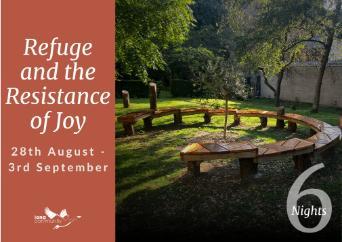
28 Aug 27 - 3Sep 27 |
|