

Sustainable Designs for Living and Learning (SDLL) is a three-year research programme, launched in 2025 and funded by the Arts and Humanities Research Council (AH/Z507404/1), that brings together researchers from the University of Glasgow and University of Strathclyde, Scotland’s National Centre for Languages (SCILT), local artists, teachers, Learning for Sustainability stakeholders and primary-school learners. The project explores how multilingualism, the arts and sustainability can be brought together through the creation of multilingual living spaces in Scottish primary schools. Working initially with three schools and expanding to a further ten, the project uses school gardens and other outdoor spaces as sites for learning, collaboration and research, with the aim of demonstrating how languages and cultural knowledge can become part of children’s engagement with their environments. Its distinctive approach is grounded in ‘permaculture’: a design philosophy originating from agriculture that seeks to create sustainable, regenerative systems by working with rather than against natural processes, while attending to relationships between environment, people and communities. The project’s interdisciplinary team includes artists, researchers, teachers and other professionals, who work together to explore how these ideas can be translated into everyday educational practice.
In SDLL, permaculture goes beyond its original focus on agriculture and becomes a framework through which language learning, creative practice, ecological care and collective forms of knowledge can be connected. It draws inspiration from the ways in which flourishing natural ecosystems organise themselves, asking how human environments might similarly be designed to work with, rather than against, ecological processes. Having been applied to such diverse areas as community development, organisational practice, settlement design and social resilience, it is less a fixed model or destination than a way of thinking: a practice of designing systems that are regenerative, resource-conscious and responsive to what is already present. SDLL extends this logic to apply the principles of interdependence, diversity and resourcefulness to the social and linguistic environment of the school. Here, linguistic diversity itself can be understood as a resource: rather than treating the languages children already speak as separate from or secondary to learning, the project seeks to draw on these existing linguistic repertoires alongside the languages introduced through schooling. In this sense, the permaculture principles are translated into an educational practice of working with what is already there, including children’s languages, knowledge and relationships, and using these resources to cultivate richer connections between learners, their communities and the environments they inhabit.
Find out more about Sustainable Designs for Living and Learning
Why is SDLL So Important?
Scotland provides a particularly relevant context for bringing multilingualism and sustainability together in primary education. Both are already established priorities within Scottish education. The 1+2 approach gives children an entitlement to learn additional languages from the early stages of schooling, while Learning for Sustainability is embedded within Curriculum for Excellence as a whole-school and cross-curricular commitment. Learning for Sustainability brings together sustainable development education, global citizenship and outdoor learning, reflecting Scotland’s response to the wider international call for education for sustainable development. Yet, despite these parallel commitments, multilingualism and sustainability are rarely approached as interconnected areas of learning.
Scotland’s primary schools are linguistically diverse, with children bringing a wide range of languages, cultural knowledge and lived experiences into the classroom. However, multilingualism can remain something that is acknowledged or celebrated rather than actively used as a resource for learning across the curriculum. SDLL starts from the question of how the languages already present in schools might instead be mobilised by teachers and children to explore sustainability: to deepen their understanding of environmental and social issues, to connect learning to their own experiences, and to enrich the ways in which sustainability can be imagined and discussed.
This matters because the language of sustainability is overwhelmingly English. When sustainability is approached through a single linguistic repertoire, other associations, meanings and forms of knowledge can remain inaccessible or simply go unused. Bringing different languages into the classroom means bringing in histories, connotations, associations and emotional resonances that go beyond the discursive relations within English language. Meanings are relational: they emerge through the words, concepts and discourses with which they are repeatedly connected. Drawing on children’s multilingual repertoires can therefore connect sustainability to their memories, experiences and relationships, allowing ideas that might otherwise remain abstract to become personally and culturally meaningful. Allowing our linguistic diversity and language-learning capacities to be something more than an object of celebration, something we recognise as functional, enabling and potentially regenerative is one of the goals of the project.
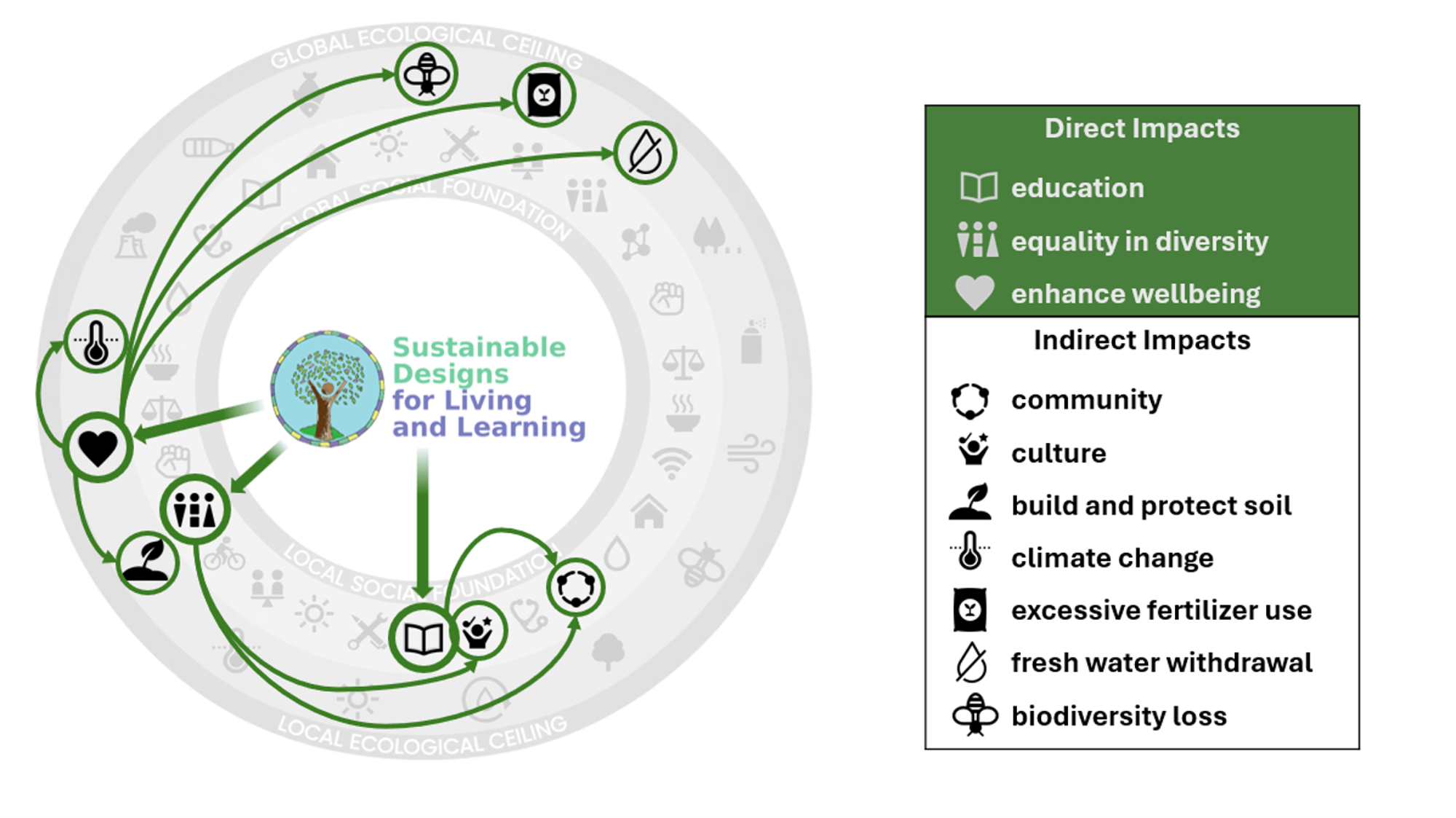
Sustainable Designs for Living and Learning and the Doughnut: Diagram showing the impact the work of Sustainable Designs for Living and Learning has on themes within the Doughnut Economics model.
SDLL delivers an educational programme focussing on equality in diversity through multilingualism and enhancing wellbeing through use of outdoor spaces as sites for learning, collaboration and research. These main aims also help to develop local community and culture, and the permaculture approach has potential to educate people on ecological domains such as building and protecting soil, and reducing excessive fertilizer use, freshwater withdrawals, biodiversity loss and climate change.
The Cycles
The practical work of SDLL follows the cyclical logic of permaculture. The project is currently in its first year, with the first three schools (Cradlehall Primary School in Inverness, Thornwood Primary School in Glasgow and West Primary School in Paisley) beginning by observing what is already there: the characteristics of their outdoor spaces, existing patterns in nature, the resources available to them and the needs of the school community. This first stage of observation provides the basis for imagining what each school’s living and learning space might become. The researchers work with artists Hamshya Rajkumar, Florence Logan and Louise McVey, who develop workshops and activities that use artistic practice as a means of engaging children in this process. Teachers are also introduced to permaculture through training delivered in collaboration with the Permaculture Association. The intention is not to impose a single garden design or a fixed set of activities on participating schools. Rather, schools are given the framework, resources and funding to develop the approach according to their own circumstances, allowing the process to respond to the particular spaces, communities and needs of each school.
The workshops begin from what children already know. Rather than starting by teaching children which plants are suited to a particular soil or climate, for example, they are invited to ask questions such as: What plants do you think would be happy here? They might paint the plants they imagine rather than simply being asked to name them, and then annotate their drawings using the languages available to them — English, Gaelic, any other language spoken at home, or another language they are learning. A similar approach is used to explore food and eating, drawing inspiration from the work of Giuseppe Arcimboldo, in which fruits, vegetables and other natural elements are composed into imaginative portraits. Children are invited to think about what they like to eat and to ask family members what foods they enjoy, particularly drawing on knowledge held in languages spoken at home. These foods then become the material for their own Arcimboldo-inspired “portraits”, where ingredients are assembled into faces or figures and annotated in the language in which they know the item, before bringing the work back into the school and exploring how it might be expressed in other languages. In this way, language learning emerges from something that the children already care about and want to communicate. The activities create a practical need for vocabulary, while simultaneously bringing family knowledge, children's experiences and different linguistic repertoires into the shared space of the school. Over time, these accumulated drawings, words, translations and associations contribute to the knowledge from which the garden itself can be designed.
The physical gardens, whose emergence in each participating school is the end goal of the programme, is a material continuation of the educational process. At this stage, schools are moving at different speeds: some have begun designing their gardens through drawings and plans, while others have already started growing plants in outdoor spaces or around their classrooms. Following the cyclical logic of permaculture, the project is structured around repeated annual cycles based on the SADIMET process (Survey, Analyse, Design, Implement, Maintain, Evaluate, Tweak). This means that schools do not move linearly towards a fixed outcome, but instead revisit and refine their ideas each year, using what they have learned in practice to adjust and develop their approach. This provides a structure within which schools can experiment and respond to changing circumstances, while the AHRC funding enables them to develop the necessary physical resources. Over the remaining two years of the programme, schools will continue to move through these cycles, returning to observation, redesign and adaptation in ways that allow both the gardens and the learning processes around them to evolve over time. Crucially, the ambition is for the resulting spaces to become part of the everyday life of the school: places that children and teachers continue to use, care for and learn from, rather than temporary installations that are celebrated as project outputs and subsequently neglected. The garden is intended to be both a product of the process and an infrastructure through which the process can continue.
Looking Ahead
The approach taken by SDLL resonates strongly with the principles of Doughnut Economics and with the ambitions articulated in the Thriving Glasgow Portrait. At its core, permaculture offers a systems approach that connects the dots between ecological, social and cultural dimensions: rather than isolating language learning, environmental sustainability or community life into separate domains, it works with the relationships between them and the ways in which they mutually shape one another. In this sense, it nurtures human nature by refusing to separate the languages children speak or learn from the ways in which they relate and make sense of the world. Instead, it integrates them into the processes of meaning-making, utilising that vast resource for learning about sustainability. In this sense, it draws on a distinctly human ability to shift perspective, to inhabit multiple forms of understanding, and to engage with the world through changing linguistic and cultural frames. Viewed through the Thriving Glasgow Portrait, SDLL contributes to education, strengthens communities, support equality through recognition of linguistic diversity, and enhances children’s wellbeing by creating opportunity to interact with nature.
Looking ahead, SDLL hopes that multilingual permaculture gardens will become more than individual project outputs and instead become an enduring part of learning and everyday school life. The ambition is to create spaces in which teachers and children live and learn together, and in which languages are understood as resources that can be actively used in teaching, communication and the creation of social spaces. From this perspective, the project is also concerned with a broader question of how we understand resources. Permaculture begins from an awareness of both scarcity and abundance: resources may be limited, but there is also an enormous amount already available to us that remains unused or under-recognised. SDLL applies this principle to language. The languages children and families already speak represent a form of social and educational abundance, with potential not only for celebrating diversity but for teaching, communicating, building relationships and creating shared spaces. One of the project's important longer-term goals is therefore developing an awareness of the linguistic resources already at their disposal, as well as developing confidence in using them.