


Locavore was founded in 2011 by Reuben Chesters, an environmental sciences graduate passionate about contributing to the liveability of our planet and the quality of human lives. Having previously established Glasgow’s well-known community organisation South Seeds, Reuben sought to have a deeper effect on Glasgow’s transition to sustainability. He identified local food-growing initiatives as one of the most effective ways to both contribute to elevating the quality of life and eradicating the detrimental effects that modern food consumption patterns have on the health of our planet. Approaching it strategically, he identified 3 main business objectives:
- Developing local food production capacities and supporting local farmers;
- Building the market for a local, alternative food system in Scotland’s Central Belt;
- Making locally grown, fresh products more accessible to the people of Scotland's Central Belt.
Since social impact is at the core of these three objectives, the Community Interest Company (CIC) structure was the perfect fit for the project. The company’s operations, employing over 55 people, are divided between three dimensions: growing, selling and delivering. Appreciating the impact and challenges that Locavore has faced in the 15 years of its existence requires discussing the three dimensions in detail.
Find out more about Locavore
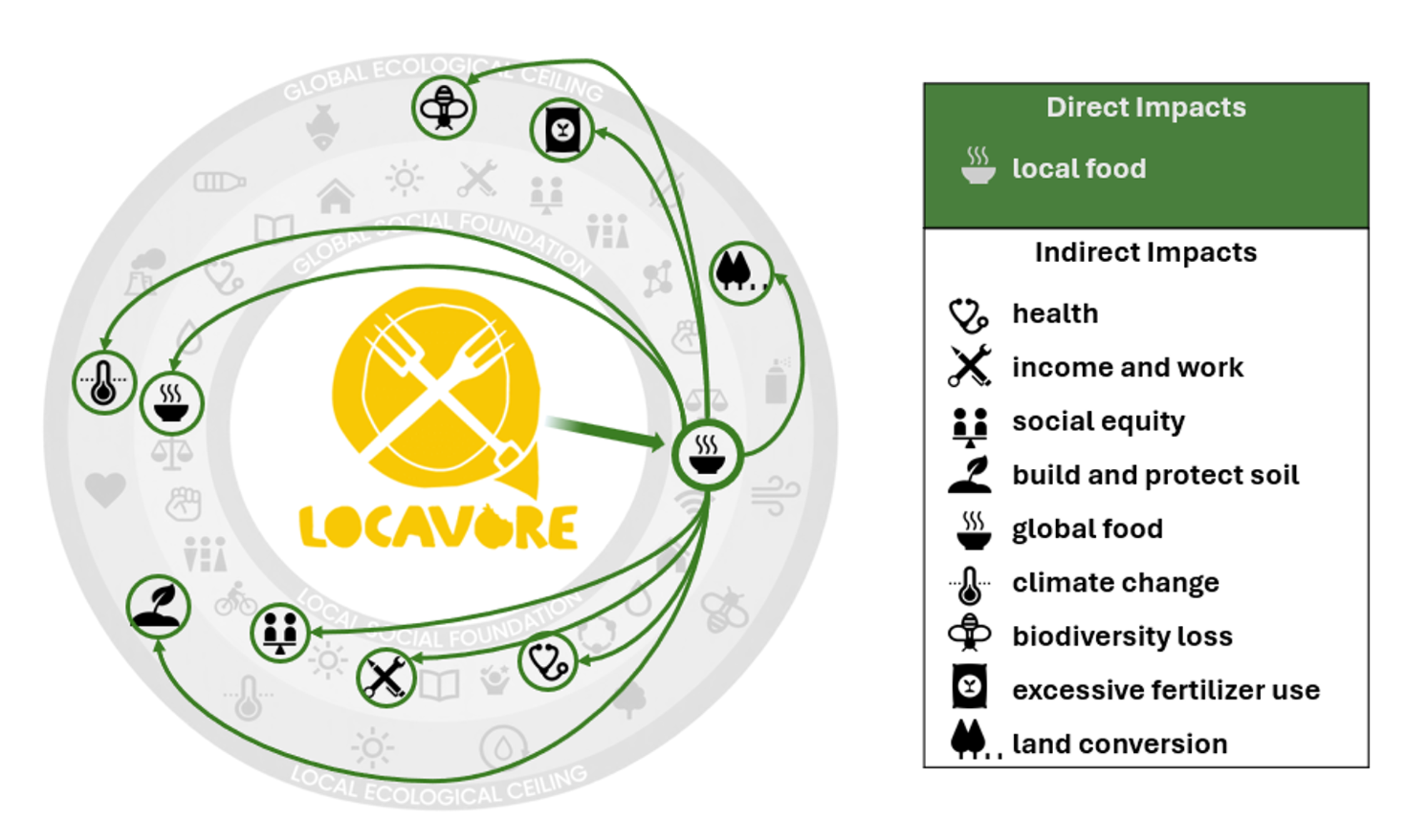
Locavore and the Doughnut: Diagram showing the impact the work of Locavore has on themes within the Doughnut Economics model.
Locavore focusses on local food growing as a means of supporting Glasgow’s transition to sustainability. The organisation’s practices also have indirect effects on improving income and work, improving health and social equity, building and protecting soil, and reducing unsustainable global food consumption, excessive fertilizer use, land conversion, biodiversity loss and climate change.
Growing food
Locavore grows their own products at their facility in Renfrewshire. On around 21.5 acres of former grazing land, for decades untouched by chemicals, Locavore’s farm is a very diverse place. Having moved there very recently, the company is currently developing a garden with polytunnels, creating year-round growing capacity for the vegetables that require warmer, more delicate environment. Their field is split into plots of around 1.25 acres, each home to a different plant family to allow crop rotation to nourish the soil with diverse nutrients, preventing plant disease and the use of artificial chemicals. This allows them to produce a big diversity of root vegetables, squash, alliums, legumes, potatoes and much more.
While the Renfrewshire farm is a new addition to the enterprise, Locavore has grown its own food for much longer in several places, including their previous site at Bellahouston Nursery. Since first being invited by the Council to take over the nursery in 2016 and receiving permission to use the site in 2019, Locavore invested significant time, money, and labour into restoring the site, developing organic food production, community allotments, volunteering programmes, and a logistics hub for its Veg Box Scheme. Following Locavore's administration in early 2024, operations were transferredto its successor organisation. However, the Council lease of the site was not transferred and the organisation was instructed to vacate Bellahouston in a short timeframe. Bellahouston Nursery had become a key asset for Glasgow’s local food system and a living example and encouragement for building and investing in the urban, alternative food system. The loss of this site resulted in down-scaling of much of the organisation’s functions, limiting the previous positive contirbuttion to achieving Glasgow’s own food- growing, climate, and sustainability policies, all of which emphasise support for local food production and community-led land use. Most importantly, it points to a very important aspect of systems transformation – the ability and readiness of local councils and governments to listen, adjust and facilitate stability, especially when this concerns survival of enterprises and projects that have proved essential in carrying out the change.
While growing its own produce is an important part of Locavore's work, the enterprise also sources food from many independent growers across Scotland. Their long-standing partnerships include Chapel Farm in East Lothian, organic meat suppliers such as Peelham Farm and Grierson Farm, and Mossgiel Farm, whose cow-with-calf milk is available both through the Veg Box scheme and in milk-dispensing machines in Locavore’s shops. Another particularly important partnership is with Freedom Bakery, a social enterprise employing people with experience of the criminal justice system, for whom Locavore serves as a key retail outlet. The organisation also trades with Green City Wholefoods Cooperative and works with wholesalers such as Organic North and Organic Pantry to source products that cannot currently be grown in Scotland from producers elsewhere in Britain and Europe. By sourcing products from as close to home as possible while recognising the climatic limitations of Scottish agriculture, Locavore balances its commitment to local food with the practical need to offer customers a diverse range of produce.
Rather than competing with other sustainable businesses, Locavore strengthens the economic resilience of its partners by providing stable demand and reliable routes to the market. In doing so, it demonstrates that the transition to a local food system is not achieved by a single organisation, but through a collaborative network of producers, processors, distributors and retailers that collectively make alternative food systems viable. This network extends beyond suppliers. During periods of financial uncertainty, Locavore's customers deliberately increased their purchases to help sustain the enterprise, illustrating the increased resilience that ethics-driven businesses often have in times of hardship.
Shops and Wholesale
Stability and confidence are, perhaps counterintuitively, among the most important conditions for the transition to a more sustainable urban food system. Local, organic businesses operate through dense networks of long-term relationships rather than anonymous market transactions. Farmers, processors, retailers and customers create mutual dependencies, shaping an ecosystem in which the success of one actor reinforces the resilience of many others. Enterprises such as Locavore therefore act as important connecting actors within this network. As a buyer, Locavore provides a stable market for local farmers and producers, as well as businesses such as local coffee roasteries, bakeries and other artisan food makers, allowing them to generate reliable income and continue operating. As a retailer and wholesaler, it creates routes through which local organic produce reaches households, cafés, restaurants and independent shops that would otherwise struggle to source it.
This impact is most visible in Locavore's two Glasgow shops. Alongside produce grown on Locavore's own farms, the shops stock vegetables, fruit, dairy, bread, coffee, preserves and pantry staples sourced from a network of independent Scottish, British and (although more rarely) international producers, with an emphasis on organic, seasonal food. By making these products available in accessible neighbourhood locations of Govanhill and Partick, Locavore enables residents to participate in a food system that is local, more transparent and environmentally sustainable.
By maintaining deep commercial links with local farmers, Locavore drives the emergence of the local alternative food economy, allowing Scottish organic goods to find their buyer in a much easier way. An important benefit of that is the rising incentive for local producers to rethink their farming practices and include organic options, rather than using the fields exclusively for wholesale production for big supermarkets, where pursuit of profit may encourage them to prioritise timeliness and volumes over quality and sustainability.
Veg Boxes
In the city, Locavore is best known for its Veg Boxes – a subscription service delivering boxes of fresh, seasonal fruit and vegetables to households across Central Scotland. With flexible delivery options and prices that are often comparable to supermarket alternatives, the scheme makes locally grown, organic food substantially more accessible. By connecting consumers directly with regional producers, the Veg Boxes stimulate demand for seasonal and organic produce, creating stable markets for existing growers while encouraging the expansion of organic farming across Scotland's Central Belt. Depending on the time of year, Locavore is able to supply a substantial proportion of the contents from its own farms, with home-grown produce accounting for approximately 25% of the annual financial value of the boxes, and this number increasing. Seasonal fluctuations, however, require the enterprise to remain flexible, supplementing its own harvests with produce sourced from a network of trusted local farmers.
A common criticism of organic food initiatives is their limited accessibility to lower-earning people. A 2024 survey of its Veg Box subscribers found that 28.4% of respondent households had an annual income below £30,000, while only a quarter earned more than £70,000, suggesting that its customer base is considerably more socio-economically diverse than is often assumed. Moreover, the impact of the Veg Box scheme extends well beyond providing access to food. Survey respondents reported eating a greater variety of fruit and vegetables (85%), consuming more fresh produce (61%), and eating more locally grown (95%) and organic food (91%). Many also reported cooking more meals from scratch, reducing their reliance on supermarkets, and becoming more conscious of seasonal eating. In this way, the Veg Boxes actively reshape everyday consumption behaviours, helping households adopt healthier and more sustainable diets while strengthening demand for local food systems.
The Veg Box scheme also underpins Locavore's Good Food Fund, through which customers are invited to add a small voluntary donation when placing an order. These contributions are used to provide fresh fruit and vegetables to community meals, food banks and other organisations supporting people experiencing food poverty across Glasgow. Crucially, this model differs from the donation schemes commonly found in large supermarket chains, where donated products are first purchased at retail price, allowing retailers to profit from charitable giving. In Locavore's case, customer donations are used to purchase produce at cost price, ensuring that every pound donated translates into a greater quantity of fresh food reaching those who need it most. Rather than treating food redistribution as a charitable add-on, Locavore integrates it into its wider mission of making locally grown, organic food accessible to all sections of society, regardless of income.
Institutional Environment and Future Direction
Locavore's experience demonstrates that the success of alternative food systems depends not only on the practices of individual organisations but also on the institutional environment in which they operate. As a Community Interest Company (CIC), Locavore is legally structured to generate social and environmental benefit rather than maximise private profit. The CIC model, with its asset lock and public benefit requirements, enables the organisation to operate commercially while remaining accountable to a clearly defined social mission.
However, Locavore argues that public institutions have not yet fully adapted to organisations that exist between the traditional categories of charities and private businesses. Although policy strategies increasingly recognise social enterprises as important actors in delivering sustainable development, this recognition has not always translated into practice. During periods of financial hardship, and particularly throughout the Bellahouston dispute, Locavore felt that it was treated primarily as a conventional commercial business, expected to absorb risks independently despite the wider public value it generated. Rather than seeking substantial financial subsidies, the organisation often required stability, transparent communication, institutional flexibility and a taxation system better suited to mission-driven enterprises.
This highlights a broader challenge for the transition towards more sustainable food systems. Institutions may endorse innovative social enterprises in principle while continuing to govern through frameworks designed for either profit-maximising firms or charitable organisations. Supporting hybrid enterprises therefore requires a different institutional approach. Drawing on its own experience, Locavore argues that local government should adopt the role of a patient and supportive gardener: nurturing the wider ecosystem by creating conditions in which diverse organisations can thrive, collaborate and strengthen the relationships that enable the system to become resilient and self-sustaining. Such an approach stands in contrast to short-term, narrowly self-interested decision-making and inflexible support structures, which can undermine emerging alternatives before they have the opportunity to mature.
Looking ahead, Locavore sees considerable potential for strengthening connections between public institutions and ecological food producers through trade. For example, procuring locally and organically produced food for schools, hospitals and other public institutions would reduce reliance on increasingly unsustainable global supply chains, while also supporting environmentally and socially sustainable farming practices taking place within the local economy. Beyond supporting existing producers, such partnerships could help build confidence among new entrants to the sector by demonstrating that long-term institutional demand exists for sustainable food production. In this sense, procurement policies represent not only an economic tool but also an important mechanism for cultivating trust, resilience and the continued development of local food systems.
Alongside these broader institutional changes, Locavore intends to continue expanding its own production capacity. Future plans include further development of its farming operations, including the planting of fruit trees and other long-term investments that enhance both environmental sustainability and local food resilience. These ambitions reflect the organisation's belief that meaningful transformation of the food system depends on the combined evolution of individual enterprises and the institutional structures that support them. Locavore's experience therefore illustrates that building sustainable local food systems is not solely a matter of entrepreneurial innovation, but of creating governance arrangements capable of recognising, nurturing and enabling enterprises whose value extends well beyond conventional economic measures.