

Case Study 7 - Greyfriars Biophilic Garden

Greyfriars Biophilic Garden is a community garden in central Glasgow, comprising around 55 raised growing beds, that has developed into a high-profile community-led project. It was established in 2012 on Shuttle Street following local interest in creating a growing space for the surrounding communities, including Drygate, an area experiencing significant socioeconomic disadvantage. The project was supported by Glasgow City Council and SAGE (Sow and Grow Everywhere), which helped the community establish the organisational structures needed to manage the garden. The original garden was designed by ERZ Landscape Architects and built by Glasgow Wood Recycling. Although initially expected to last only three years, Greyfriars remained on Shuttle Street for eleven years, during which it expanded its activities and became increasingly established within Glasgow's community and urban projects.
In 2021, Greyfriars became a Scottish Charitable Incorporated Organisation (SCIO), giving the project a more formal organisational structure. It is governed by seven trustees, five of whom are elected by the members, while a further two can be co-opted. In April 2023, it moved to its current site at 321 High Street, a larger space developed with substantial support from Glasgow City Council. The new garden was designed with input from Greyfriars and the Council's Landscape Design team, drawing on the community's experience of what had and had not worked at Shuttle Street. Its development therefore reflects a combination of community initiative, professional design and long-term public-sector support, allowing Greyfriars to continue its work from a more permanent and prominent location in Glasgow.
Find out more about Greyfriars Biophilic Garden
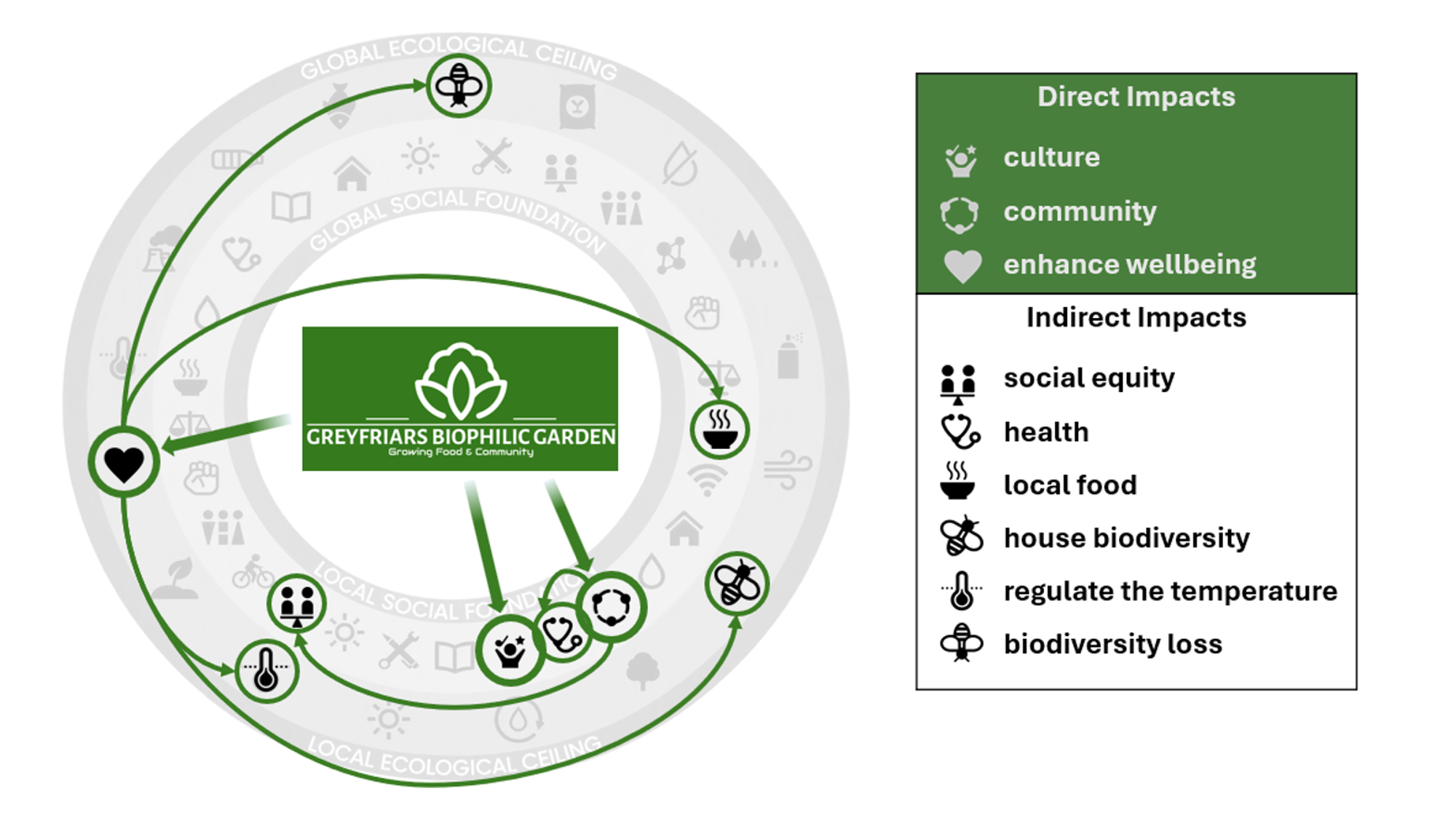
Greyfriars Biophilic Garden and the Doughnut: Diagram showing the impact the work of Greyfriars Biophilic Garden has on themes within the Doughnut Economics model.
Greyfriars Biophilic Garden aims to create a Community and Cultural space, providing a green space within Glasgow City Centre that allows people to connect with nature and Enhance Wellbeing. Through these ambitions the organisation also indirectly impacts a range of other Doughnut dimensions, including social equity, health, biodiversity and regulating the temperature.
Life of the Garden
Greyfriars is primarily a social and cultural space rather than a source of food provision. Gardeners are free to grow whatever they like. Common crops include tomatoes, strawberries, lettuce, herbs, potatoes, leeks, onions, carrots and spinach, while some gardeners experiment with Mediterranean plants, which the gardeners consider increasingly viable in Glasgow's changing climate, particularly with greenhouse techniques. The garden accommodates both individual and collective forms of participation: gardeners can work on their own plots individually while also taking part in the social life of the group. Social gatherings are held every few months, while open days allow members of the wider public to experience the garden. The garden also hosts creative activities such as poetry and drawing nights. One project involved a Haiku workshop with the eco group at St Stephen's Primary School, with poems from pupils and gardeners displayed and incorporated into the garden. Greyfriars has also shared its experience beyond the garden, helping staff at the nearby Royal Infirmary establish a small garden and supporting the development of the Apothecary Garden at the back of the Provost Lordship, where a small group of Greyfriars gardeners now act as its keepers. Its profile has also been strengthened through its involvement in projects beyond the garden itself.
The garden operates through a close relationship with Glasgow City Council. Greyfriars pays a small annual rent for its tenancy of the site and is also supported through grants from the Council. Its community extends beyond those who currently hold a growing space: because the waiting list for plots is years-long, a limited number of people on the waiting list can participate in the garden through the Friends of Greyfriars before receiving their own plot. This helps make the garden more than a collection of individual growing spaces. It is simultaneously a place for personal gardening, social interaction, creative activity and community participation.
Benefits of the Garden
One of the most important benefits of Greyfriars is its ability to bring together people from High Street, Drygate and the Merchant City, areas whose populations differ socio-economically. The garden creates a shared project in which these differences do not disappear but can be placed alongside a common interest in gardening. According to one member, maintaining a high degree of respect between gardeners has allowed the group to overcome some of the social and behavioural challenges that can arise from these differences. The garden can also provide an important social space for older people, particularly men who may become increasingly isolated later in life. In areas with many single-person households, a shared activity such as gardening offers an accessible way to meet others, develop relationships and simply have a reason to leave the house and interact with people. In this sense, community growing can provide an informal but valuable response to loneliness and social isolation.
Greyfriars also demonstrates the potential of community gardens to develop active citizenship. Running the organisation requires members to take responsibility for fundraising, managing finances, organising activities and resolving disagreements. As one participant put it, people need experience to learn how to “run the books, organise and run an organisation”. Initiatives such as Greyfriars therefore give people opportunities to develop practical and interpersonal skills outside their professional lives, while providing a meaningful shared purpose. At the same time, this empowerment depends heavily on voluntary labour. Managing the garden can at times resemble a full-time job, particularly when funding is being sought and subsequently has to be carefully accounted for. Such organisations can therefore become vulnerable when too much responsibility falls on the small number of people with sufficient time and energy to volunteer. Nevertheless, the workload becomes more manageable once an organisation is established: as one participant observed, establishing something takes more time, while maintaining it requires less. Greyfriars illustrates how giving communities access to land, resources, responsibility and organisational experience can help them become capable stewards of their own spaces.
Finally, the garden provides contact with nature in a part of Glasgow where access to greenery can otherwise be limited. Its ecological value is visible in the wildlife it attracts, including a charm of goldfinches living in the garden's trees. Foxes, rats, dragonflies and other animals regularly visit, and the garden has even provided a temporary home for a rabbit. These encounters may be small in scale, but they contribute to making the garden a living ecological space within the dense urban environment of central Glasgow.
Looking Ahead
The future of Greyfriars is closely connected to the future of the surrounding High Street. The gardeners would like to see the street become more pedestrian-friendly, with less motor traffic, allowing its historical and cultural assets to become more prominent. High Street has considerable potential as a destination, with historic churches, cafés, murals and other important sites, and there is an opportunity to build on this heritage through setting up a local committee dedicated to its regeneration. Such an initiative could help reconnect the street with its historical role as one of Glasgow's principal thoroughfares and complement the work already being done by Greyfriars.
The garden itself is also gradually evolving, with an increasing focus on creating structures that can ensure its continuity beyond the involvement of its current members. One priority is developing a mechanism for leadership turnover, so that responsibility is shared and passed over the wider circle of members. Greyfriars is therefore working towards building stronger community institutions and systems of governance that can support smooth decision-making and democratic participation. This builds on the organisational skills and capacity developed through participation in the garden. In this sense, the garden's future is not only about maintaining its physical space, but about developing the organisational capacity needed to ensure that the community can continue to steward it in the long term.