

Case Study 5 - Cyclehoop

Cyclehoop is a British enterprise that creates innovative cycle parking and infrastructure. Through cooperation with local councils, charities and public organisations, the company aims to make urban spaces friendlier and safer for cyclists and their bicycles. By equipping cities with well-designed, secure bike parking and easy-to-use apps to operate them, Cyclehoop helps remove practical barriers to cycling while supporting healthier, more sustainable and more accessible communities. Its work demonstrates how well-designed infrastructure can play a vital role in encouraging active travel and shaping more liveable towns and cities.
The Story
Cyclehoop came to life in 2008 as a result of a bike theft in London. The bicycle had been locked to a street pole, but because there was nothing on the pole to stop it from being lifted off, the thief was able to remove the bike without breaking the lock. Frustrated with the lack of adequate bike security infrastructure, the owner of the bike – Anthony Lau – designed “Cyclehoop”: a circular steel attachment that transforms existing street furniture, such as poles and railings, into secure parking for two bicycles. The design won a competition organised by Blueprint magazine, launching the company and giving it its name. Since then, Cyclehoop has expanded its range of products and its presence across the UK, while remaining committed to a simple goal: removing one of the biggest barriers to cycling by ensuring people always have a safe place to leave their bikes.
Find out more about Cyclehoop
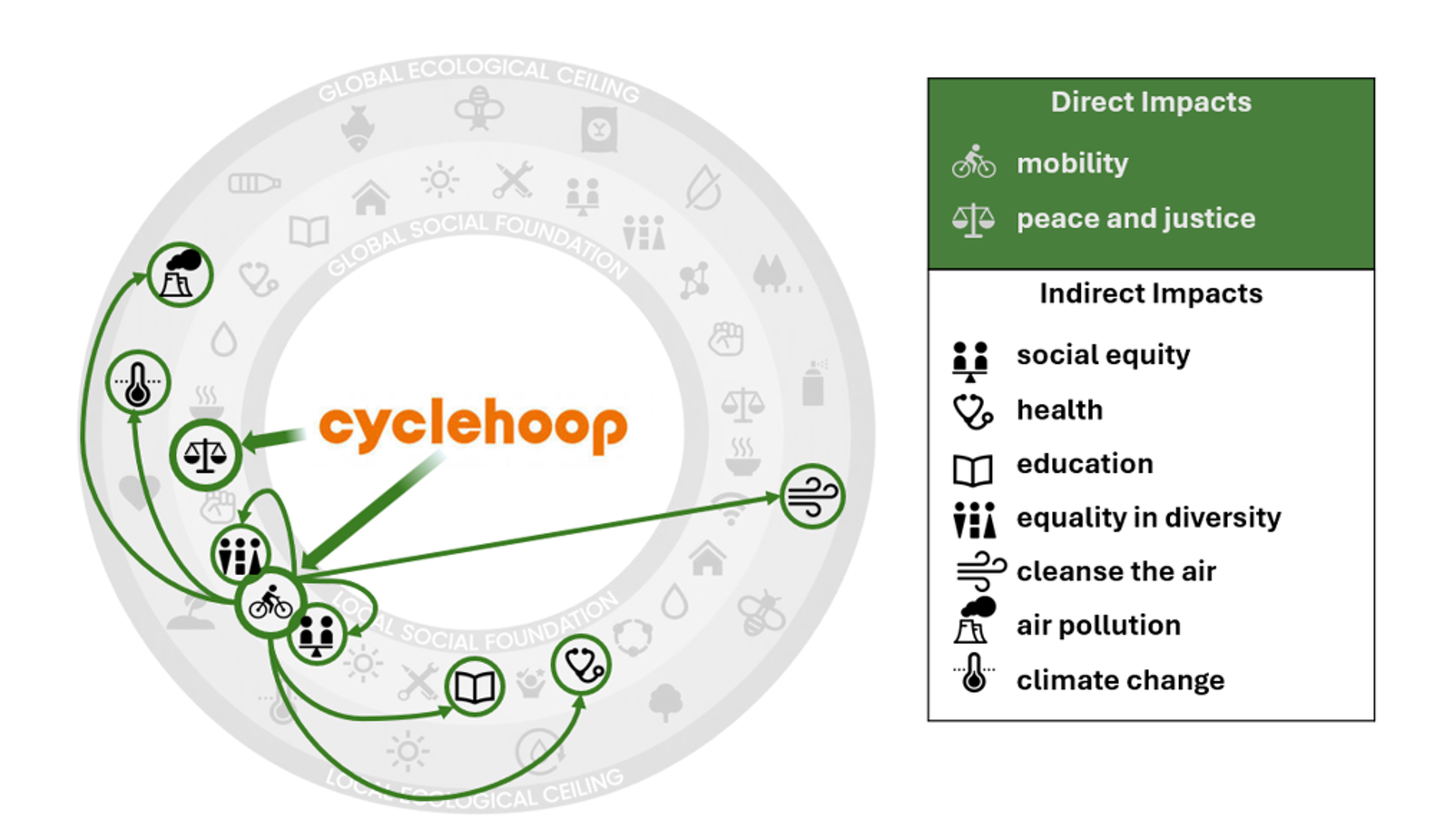
Cyclehoop and the Doughnut: Diagram showing the impact the work of Cyclehoop has on themes within the Doughnut Economics model.
Cyclehoop aims to improve mobility and peace and justice by providing safe cycle parking and infrastructure. Through Cyclehoop’s innovative designs and organisational set-up they also indirectly impact other Doughnut dimensions, including social equity, health, education, equality in diversity, air pollution and climate change.
From Bikehangars® to Better Cities
Headquartered in London, Cyclehoop has a strong presence in Scotland, with its Scottish office based in South Ayrshire. In 2012, in partnership with Lambeth Council, the company developed its flagship product: Bikehangar®. Since then, more than 8,000 Bikehangars have been installed, with around 4,000 currently managed by Cyclehoop, making it the world's largest cycle parking rental network. In Glasgow, Cyclehoop works closely with Glasgow City Council to deliver the Hooplr Home scheme, which currently provides 325 Bikehangars offering residents secure, long-term and affordable cycle parking close to home. New Bikehangar locations are selected through an ongoing public request process, allowing residents to nominate sites in their neighbourhoods. The success of the schemes in Glasgow and Edinburgh was recognised with the 2022 Scottish Transport Award for Excellence in Walking, Public Realm and Cycling.
While the Hooplr Home scheme was generally intended as a way to provide access to cycle commutes to the residents of smaller and less accessible dwellings, Cyclehoop also underlines the impact that their product has on general equality in active traveling. Over 70% of Glaswegians live in apartments, including traditional tenements, which often constitutes a challenge to people with disabilities. In this context, managing one’s bicycle may be a particular obstacle. By providing secure parking hangars tailored to different types and sizes of bicycles, Bikehangars make cycling a more practical and accessible option for a wider range of people.
Secure cycle parking also plays an important role in reducing gender inequalities in active travel. Around 46% of respondents to Cyclehoop's annual user survey identify as female — a higher proportion than is typically seen among cycle commuters. Eliminating the need to carry bikes through narrow corridors or up flights of stairs, while providing parking closer to home, helps remove practical and personal safety barriers, particularly during darker morning and evening journeys.
The same approach has been extended to destinations across the city through Hooplr Trips. Ahead of the 2023 UCI Cycling World Championships, 20 pay-as-you-go Bikehangars were installed throughout Glasgow city centre. Using a dedicated mobile app, cyclists can reserve a space, unlock a Bikehangar, pay for their parking and monitor their booking in real time. By providing secure, weatherproof parking at key destinations, Hooplr Trips encourages more people to cycle into the city centre. Alongside initiatives such as the Avenues programme and Glasgow's expanding cycle network, these facilities contribute to both the city's environmental ambitions and the revitalisation of its public spaces. Importantly, all Bikehangars used in Hooplr Home and Hooplr Trips systems remain in ownership and responsibility of the cities that purchase them, with Cyclehoop playing the role of service manager.
Charitable Action
Alongside developing cycling infrastructure, the company supports organisations working to make cycling more accessible and inclusive. In Glasgow, for example, Cyclehoop has partnered with Bike for Good to fund its Dr Bike maintenance sessions and is currently working with the Sunny Cycles collective to develop secure cycle parking solutions tailored to its needs.
A few years ago, the company recognised that the manufacturing capacity, industry expertise and partnerships it had built over more than a decade could deliver value far beyond financial donations. This led to the creation of the Cyclehoop Education Fund, which provides schools with full or partial funding for secure cycle parking. Following an application and assessment process, each school's needs are carefully evaluated to ensure that the refurbished or newly installed facilities are appropriate for its pupils and community. By making cycling to school easier and more secure, these projects help reduce traffic congestion and air pollution while encouraging healthier, more active lifestyles. They also support young people's independence, confidence and navigation skills, demonstrating how thoughtful cycling infrastructure can generate benefits that extend well beyond transport.
Looking Ahead
The Cyclehoop team believes that the future worth pursuing is the one where systemic thinking is deployed. One where cycling infrastructure is well-designed and intended to assist people on every stage of their commute, where it is standardised and recognisable across the regions of our country, and where it is perceived as normal, essential part of every city, town and village. Where the mental and physical discomfort of exposing oneself and one’s property to danger, associated with commuting through spaces not adjusted to safe cycling, is reduced to the minimum. Achieving this vision, they argue, will require active travel to be viewed not as a political issue, but as a shared public good that benefits communities regardless of political affiliation. Cycling, after all, is an immense source of joy and emancipation, especially when it happens within a system that supports and rewards it.
Importantly, the Cyclehoop team sees itself as an essential contributor to this transition. By expanding its presence across the UK, the company hopes to help create a future in which choosing to cycle is no longer an act of determination, but an ordinary, safe and enjoyable part of everyday life.