

Case Study 10 - Veganwheels

Veganwheels is a food delivery co-operative, delivering exclusively from vegan establishments across Glasgow. Founded on the belief that businesses can be designed around ethical values rather than profit alone, it combines ethical values with a worker-owned model that supports local restaurants, couriers and the wider community. More than a delivery service, it offers a practical example of how business can be organised around shared values, with everyday choices adding up to social and environmental change.
The Story
It all started 13 years ago, when Andy, a huge cycling enthusiast, decided to switch to a vegan diet. For him, veganism meant much more than avoiding animal products. Turning vegan was an ethical choice, which came with the commitment to create change through everyday choices. Andy became increasingly conscious of where his money was going and, looking to order some food home, he could no longer justify supporting large delivery platforms that not only profited from the sale of animal products but also relied on business models that left many couriers in precarious working conditions. Inspired by the writings of twentieth-century dissidents and the idea of living according to one's principles even within imperfect systems, Andy set out to create an alternative that would align economic activity with the values of fairness, sustainability and social responsibility.
It was then that Andy conceived the idea of an independent, vegan delivery co-operative. Before launching it, he carried out informal market research and discovered that restaurants were often paying commission fees of up to 35% on every order placed through major delivery platforms. At a time when there was no comparable service in the region, Andy turned to the local vegan community to gauge interest. The response was overwhelmingly positive, confirming that there was demand for an ethical alternative. Encouraged by this support, Andy brought together a small group of like-minded people and enlisted a friend to help build the company's first website. What began as an idea rooted in personal values was quickly transformed into a working enterprise; Veganwheels were up and spinning.
Find out more about Veganwheels
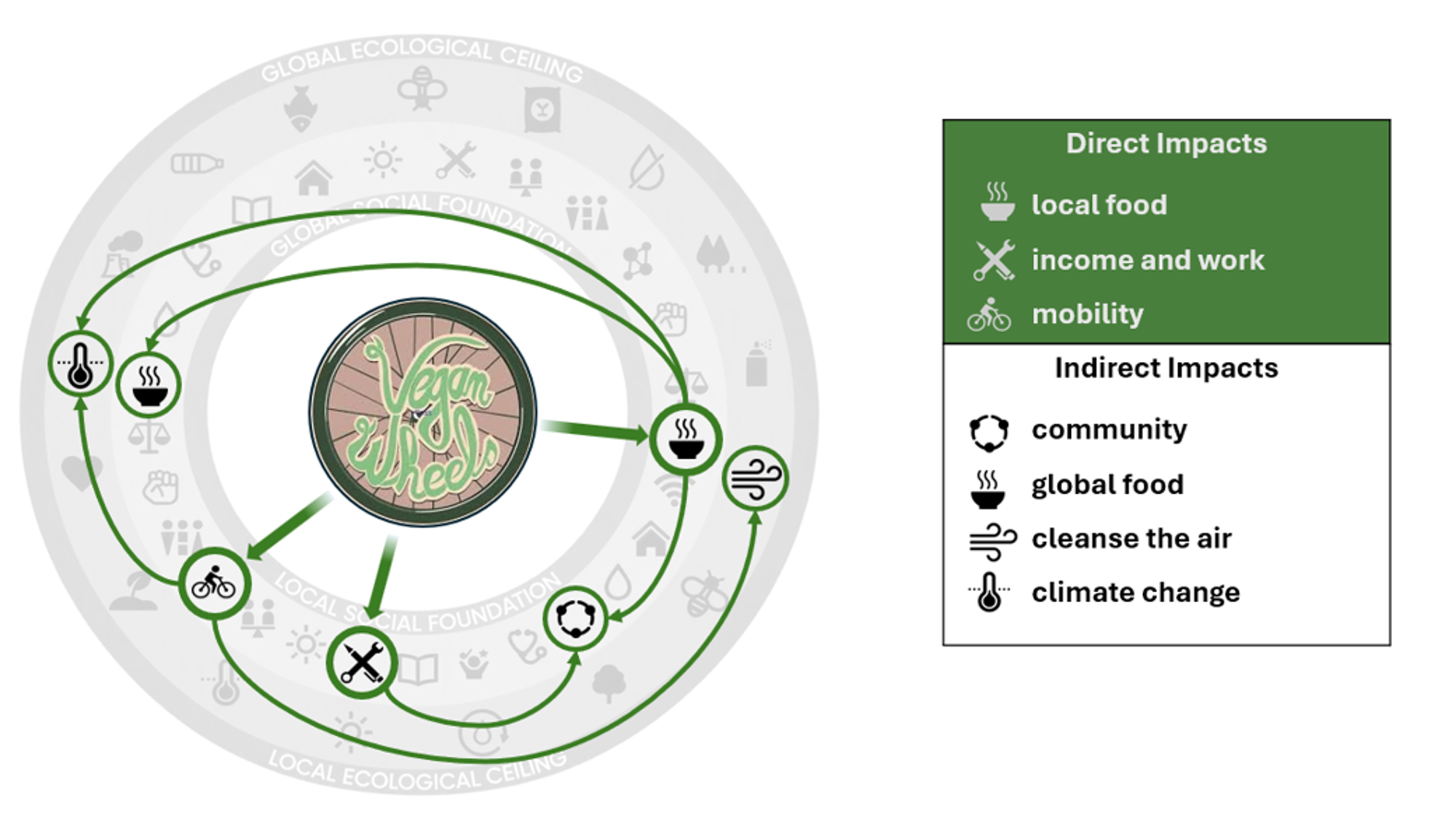
Veganwheels and the Doughnut: Diagram showing the impact the work of Veganwheels has on themes within the Doughnut Economics model.
Veganwheels directly influences local food, mobility and income and work by providing a local cycling delivery service for vegan food establishments. Through these actions, Veganwheels also supports the vegan community, reduces air pollution and movement towards more sustainable food production globally, as well as limiting carbon emissions that contribute to climate change.
Advantages of Their Design
The team began approaching vegan restaurants, offering them a delivery service at 15% of the cost of every order – a fraction of what they would otherwise pay to the bigger services. Aside of a much more competitive service cost, Veganwheels also offered Glaswegian ethics-driven businesses an opportunity to partner with a worker co-operative whose structure prioritised fair working conditions and the wellbeing of its members over shareholder profit. Finally, they projected a very clear ethical stance – a service made by vegans to facilitate veganism without moral compromises.
The employee-owned structure and superior ethical standards allowed them to find and build lasting relationships within Glasgow's vegan food scene. Entering their peak in the short-lived post-Covid business boom, Veganwheels served 13 restaurants across the city. Although many of those businesses have since closed, the number of deliveries carried out by Veganwheels has remained relatively stable. This is the advantage of operating in the field, where ethical considerations play a significant role in consumer choice. As the proportion of vegans in the society keeps rising, and with Glasgow, according to some statistics, being the city with the highest concentration of vegans in the entire country, the demand for their services remained very solid.
Another key factor behind Veganwheels' success is its remarkably low operating costs. Shortly after launching, the co-operative introduced an additional 3% commission to help cover maintenance and future investment. In practice, however, the co-operative soon found that it had little need for the additional income, as there was remarkably little that required significant maintenance or investment. All food is delivered on the members’ personal bicycles, with the team collectively funding repairs and upgrades that any of them may require.
Rather than retaining the surplus, the team chose to redirect the additional 3% into a dedicated fund, which accumulates throughout the year before being donated annually to local animal welfare charities. Because decisions are made collectively by the people who own and run the business, charitable action became a natural expression of the co-operative's values rather than something driven by external tax incentives or costly profit compromises. Even after donating one-sixth of its revenue in this way, Veganwheels remains financially sustainable and pays each of its six members above the Real Living Wage.
Change and The Future
The co-op’s team believes that any deep, lasting change starts from culture, from what we see and what is perceived as normal. Veganwheels challenges the individualist, profit-prioritising ideas that often accompany the discussions around entrepreneurship. They also reject the growingly rentier tendencies of the modern business models, exemplified in the functioning of big delivery services, who aim to extract wealth from local communities through establishing control over markets transnationally. The team offers a local, ethics-driven co-operative model as a viable response to many of the social, economic and environmental challenges. In doing so, it argues that businesses can be designed not only to generate income, but also to strengthen communities, support workers and contribute to a more sustainable future.
Looking ahead, Veganwheels' ambitions remain closely tied to the purpose that inspired its creation: supporting and promoting veganism. The cooperative hopes to become a visible social voice for the vegan movement in the city by helping to make it more approachable, attractive and culturally mainstream. The ambition behind still revolves around helping to bring about the world they envision – the same attitude that led to Veganwheel’s establishment 5 years ago.